跳到主要内容

FP3 · Further Pure Mathematics 3

Edexcel International A-Level 纯数学知识点 7

本主题的视频课程 打开视频页面
23:42

进阶纯数学3

WFM03试卷:时长1小时30分钟,总分75分,纯数学单元部分,默认已掌握P1至P4及FP1内容。本卷涵盖双曲函数及其反函数、椭圆以及……

英文讲解 · 可切换中英文字幕

3.1.1

Further Pure Mathematics 3: hyperbolic functions, conics, vectors and matrices

English

Why it matters. What shape does a chain make when it hangs between two posts? Galileo thought it was a parabola, and for decades nobody could prove otherwise. In May 1690 Jacob Bernoulli challenged the mathematicians of Europe to find the true curve. In June 1691 three solutions appeared together in the Leipzig journal Acta Eruditorum, by Gottfried Leibniz, Christiaan Huygens and Jacob's younger brother Johann. The curve is not a parabola but the catenary, $y = a\cosh\frac{x}{a}$, built from exponentials. Johann was so proud that he boasted, years later, that his brother had failed where he had succeeded in a single night. Today engineers use the catenary for power lines and, turned upside down, for arches such as the Gateway Arch in St Louis.

In this unit you will:

  • use hyperbolic functions and their inverses, and solve equations with them;
  • work with the ellipse and the hyperbola, including their foci and directrices;
  • differentiate and integrate hyperbolic and inverse functions, use reduction formulae, and find arc lengths and surface areas;
  • use vector products to work with lines and planes in three dimensions;
  • find $3 \times 3$ determinants, inverses, eigenvalues and eigenvectors, and diagonalise symmetric matrices.

Edexcel International A Level, Further Pure Mathematics 3 (FP3, paper WFM03/01, 1 hour 30 minutes, 75 marks). Pure Mathematics 1 to 4 and FP1 are assumed.

These results are assumed knowledge:

Topic Results
calculus product, quotient and chain rules; integration by parts and by substitution
trigonometry $\sec^2\theta = 1 + \tan^2\theta$, double angle formulae
vectors $\mathbf a\cdot\mathbf b = a_1b_1 + a_2b_2 + a_3b_3$, $\cos\theta = \dfrac{\mathbf a\cdot\mathbf b}{\lvert\mathbf a\rvert\lvert\mathbf b\rvert}$
matrices $2 \times 2$ inverses, $(\mathbf{AB})^{-1} = \mathbf B^{-1}\mathbf A^{-1}$
exponentials $e^{\ln x} = x$, and the laws of logarithms
3.1.1

双曲函数

English

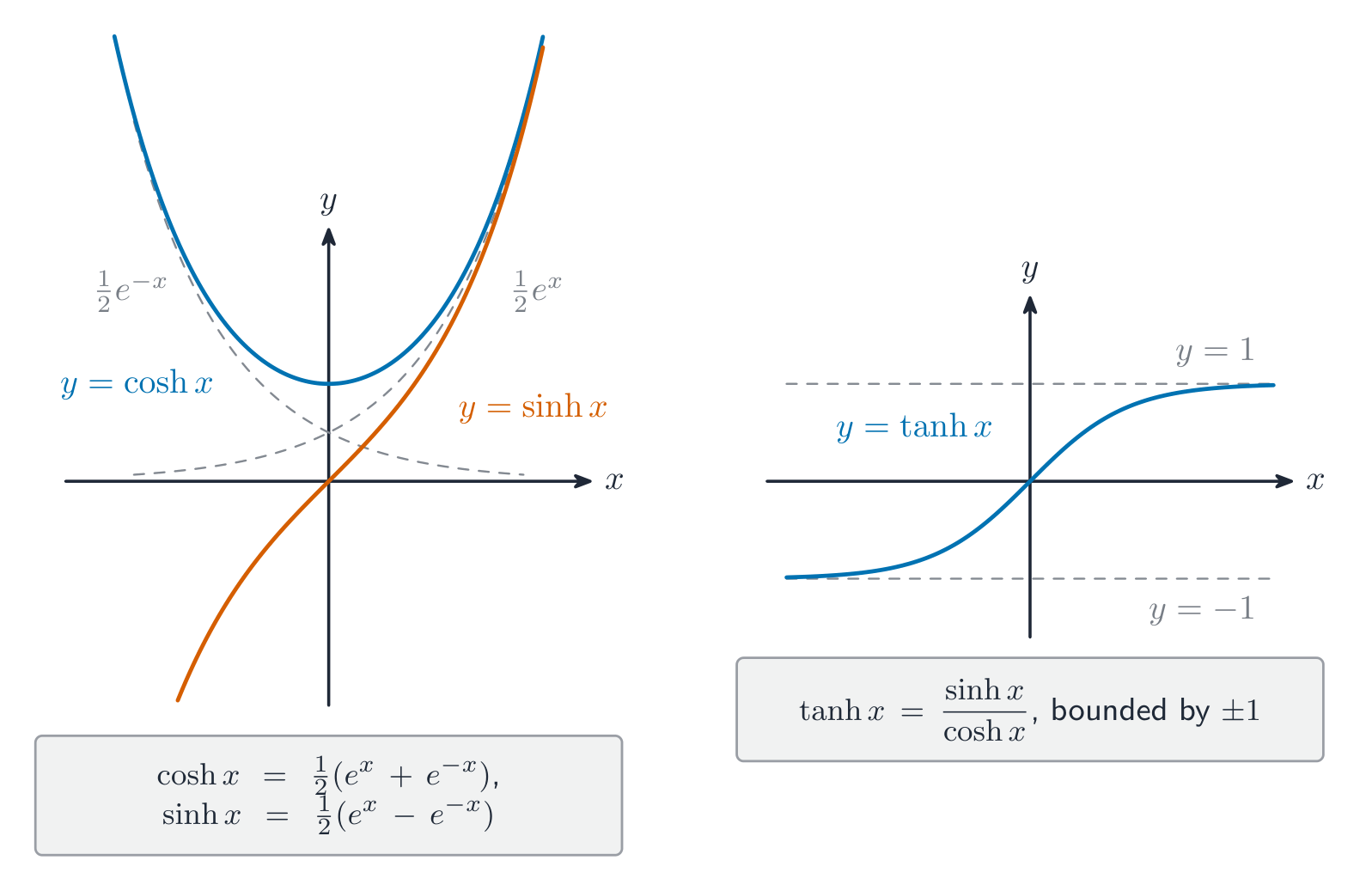
The hyperbolic functions 双曲函数 are defined using exponentials:

$$\cosh x = \tfrac12\left(e^x + e^{-x}\right) \qquad \sinh x = \tfrac12\left(e^x - e^{-x}\right) \qquad \tanh x = \frac{\sinh x}{\cosh x}$$
  • The graph of $y = \cosh x$ is a catenary 悬链线. It is symmetrical about the $y$-axis, with a minimum point at $(0, 1)$.
  • The graph of $y = \sinh x$ passes through the origin and has rotational symmetry about it.
  • The graph of $y = \tanh x$ lies between the asymptote 渐近线 lines $y = 1$ and $y = -1$.
A chain hanging between two bollards, sagging in one smooth curve
A chain hanging between two posts makes a catenary, $y = a\cosh\frac xa$.
The graphs of  and  (left), and  between its asymptotes  (right).
The graphs of $y = \cosh x$ and $y = \sinh x$ (left), and $y = \tanh x$ between its asymptotes $y = \pm1$ (right).

Two identities you should be able to prove from the definitions are

$$\cosh^2 x - \sinh^2 x = 1 \qquad \cosh 2x = \cosh^2 x + \sinh^2 x$$

Worked example 1. Prove that $\cosh 6x + \cosh 4x = 2\cosh 5x\cosh x$, and solve $\cosh 6x + \cosh 4x = 8\cosh x$.

$$2\cosh 5x\cosh x = 2 \times \tfrac12\left(e^{5x} + e^{-5x}\right) \times \tfrac12\left(e^{x} + e^{-x}\right) = \tfrac12\left(e^{6x} + e^{4x} + e^{-4x} + e^{-6x}\right) = \cosh 6x + \cosh 4x$$

The equation becomes $2\cosh 5x\cosh x = 8\cosh x$. Since $\cosh x$ is never zero, $\cosh 5x = 4$, so $5x = \pm\ln\left(4 + \sqrt{15}\right)$ and $x = \pm\tfrac15\ln\left(4 + \sqrt{15}\right)$.

Worked example 2. Solve $2\cosh x + \sinh x = 2$. Using the definitions, $e^x + e^{-x} + \tfrac12e^x - \tfrac12e^{-x} = 2$, so $3e^x + e^{-x} = 4$. Multiply by $e^x$: $3e^{2x} - 4e^x + 1 = 0$, so $(3e^x - 1)(e^x - 1) = 0$. Then $e^x = \tfrac13$ or $e^x = 1$, giving $x = -\ln 3$ or $x = 0$.

探索

双曲函数及其反关系

定义 sinh x=(e^x-e^(-x))/2 和 cosh x=(e^x+e^(-x))/2

对比模型与已解案例,并说明其中一处变化。

词汇 训练
English 中文 拼音
hyperbolic functions/ˌhaɪpəˈbɒlɪk ˈfʌŋkʃnz/ 双曲函数 shuāng qū hán shù
catenary/kəˈtiːnəri/ 悬链线 xuán liàn xiàn
asymptote/ˈæsɪmptəʊt/ 渐近线 jiàn jìn xiàn
3.1.2

Inverse hyperbolic functions

English

$\sinh x$ and $\tanh x$ are one-to-one, so they have inverses. $\cosh x$ is one-to-one only for $x \ge 0$, so its inverse uses that part. The inverse functions can be written as logarithms:

$$\operatorname{arsinh} x = \ln\left(x + \sqrt{x^2 + 1}\right) \qquad \operatorname{arcosh} x = \ln\left(x + \sqrt{x^2 - 1}\right),\ x \ge 1 \qquad \operatorname{artanh} x = \tfrac12\ln\frac{1 + x}{1 - x},\ \lvert x\rvert < 1$$

You must be able to prove these.

Worked example 3. Prove that $\operatorname{arsinh} w = \ln\left(w + \sqrt{w^2 + 1}\right)$. Let $x = \operatorname{arsinh} w$, so $w = \sinh x = \tfrac12\left(e^x - e^{-x}\right)$. Multiply by $2e^x$: $e^{2x} - 2we^x - 1 = 0$. This is a quadratic in $e^x$, so $e^x = w \pm \sqrt{w^2 + 1}$. Since $e^x > 0$, take the positive sign, so $x = \ln\left(w + \sqrt{w^2 + 1}\right)$.

3.2.1 3.2.2

The ellipse and the hyperbola

English
Ellipse Hyperbola
equation $\dfrac{x^2}{a^2} + \dfrac{y^2}{b^2} = 1$ $\dfrac{x^2}{a^2} - \dfrac{y^2}{b^2} = 1$
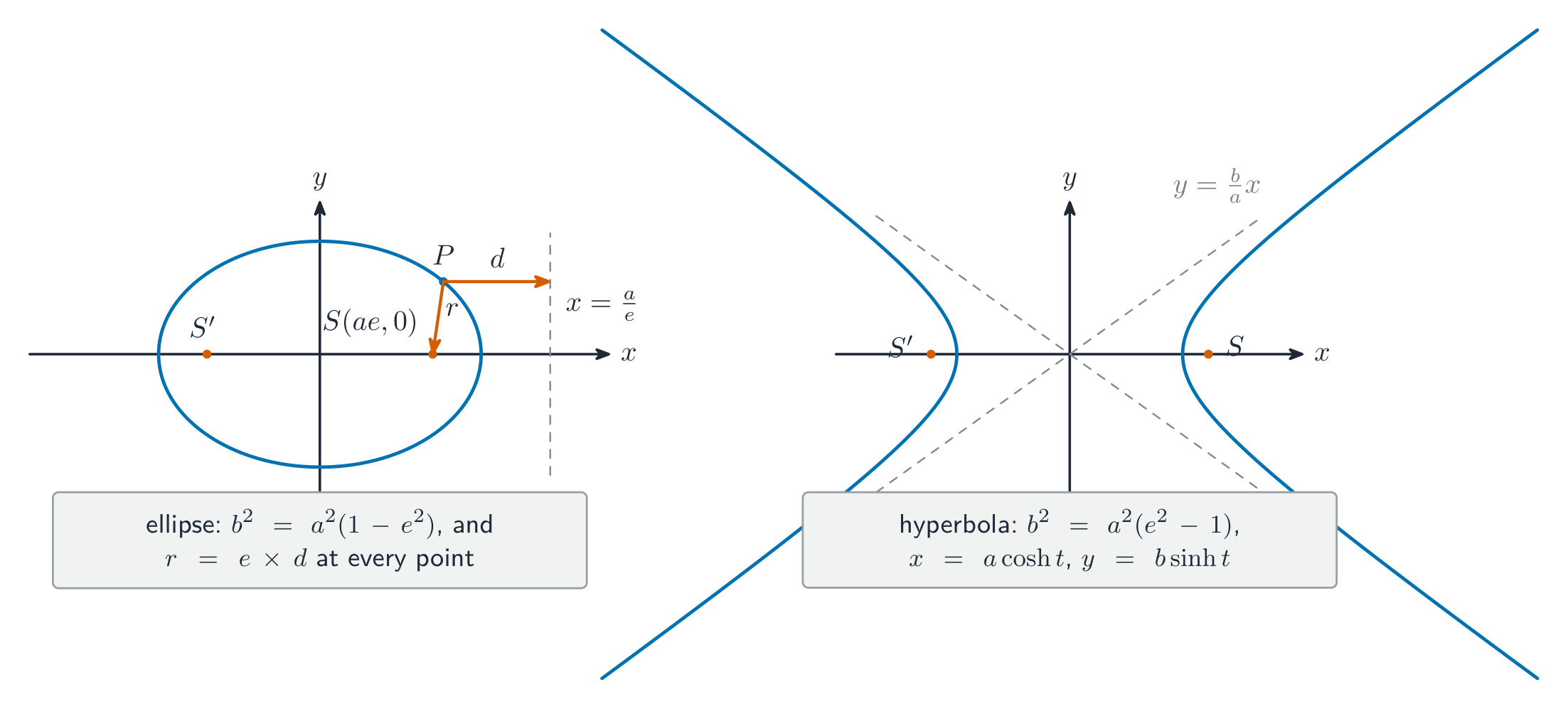
parametric form $x = a\cos t$, $y = b\sin t$ $x = a\sec t$, $y = b\tan t$, or $x = a\cosh t$, $y = b\sinh t$
eccentricity $e$ $b^2 = a^2(1 - e^2)$, with $e < 1$ $b^2 = a^2(e^2 - 1)$, with $e > 1$
foci $(\pm ae, 0)$ $(\pm ae, 0)$
directrices $x = \pm\dfrac ae$ $x = \pm\dfrac ae$
asymptotes none $y = \pm\dfrac ba x$

For a point $P$ on either curve, the distance from $P$ to a focus 焦点 equals $e$ times the distance from $P$ to the corresponding directrix 准线: $PS = e \times PN$. The ellipse 椭圆 is a closed curve; the hyperbola 双曲线 has two branches. The number $e$ is the eccentricity 离心率.

Elliptical orbits: conic sections describe closed paths with two foci — a key parametric model
Planets and satellites move in ellipses, with the attracting body at one focus..
The ellipse, with  (left), and the hyperbola with its asymptotes and foci (right).
The ellipse, with $PS = e \times PN$ (left), and the hyperbola with its asymptotes and foci (right).

Worked example 4. Find the eccentricity and foci of the hyperbola $\dfrac{x^2}{64} - \dfrac{y^2}{49} = 1$. Here $a^2 = 64$ and $b^2 = 49$, so $49 = 64(e^2 - 1)$, $e^2 = \tfrac{113}{64}$ and $e = \tfrac{\sqrt{113}}{8}$. The foci are $(\pm ae, 0) = \left(\pm\sqrt{113}, 0\right)$.

词汇 训练
English 中文 拼音
focus/ˈfəʊkəs/ 焦点 jiāo diǎn
directrix/daɪˈrektrɪks/ 准线 zhǔn xiàn
ellipse/ɪˈlɪps/ 椭圆 tuǒ yuán
hyperbola/haɪˈpɜːbələ/ 双曲线 shuāng qū xiàn
eccentricity/ˌeksənˈtrɪsɪti/ 离心率 lí xīn lǜ
3.2.3 3.2.4

Tangents, normals and loci

English

There are two ways to find a tangent:

  • at a point given by parameters, differentiate: $\dfrac{dy}{dx} = \dfrac{dy/dt}{dx/dt}$;
  • for a line $y = mx + c$, substitute into the equation of the curve and make the discriminant zero. This gives $c^2 = a^2m^2 + b^2$ for the ellipse and $c^2 = a^2m^2 - b^2$ for the hyperbola.

Worked example 5. $P(8\sec\theta, 7\tan\theta)$ lies on $H$: $\dfrac{x^2}{64} - \dfrac{y^2}{49} = 1$.

  • $\dfrac{dy}{dx} = \dfrac{7\sec^2\theta}{8\sec\theta\tan\theta} = \dfrac{7\sec\theta}{8\tan\theta}$, and the tangent simplifies to $\dfrac{x\sec\theta}{8} - \dfrac{y\tan\theta}{7} = \sec^2\theta - \tan^2\theta = 1$.
  • The tangent meets the $y$-axis at $Q(0, -7\cot\theta)$. The normal, $8x\cos\theta + 7y\cot\theta = 113$, meets it at $R\left(0, \tfrac{113}{7}\tan\theta\right)$.
  • A circle with diameter $QR$, where $Q = (0, q)$ and $R = (0, r)$, crosses the $x$-axis where $x^2 = -qr$. Here $qr = -7\cot\theta \times \tfrac{113}{7}\tan\theta = -113$, so $x = \pm\sqrt{113}$ for every value of $\theta$.
  • These are the foci of $H$, so the circle always passes through both foci.
The hyperbola x squared over 64 minus y squared over 49 equals 1 with the tangent and normal at P meeting the y-axis at Q and R; the circle on diameter QR passes through both foci at plus and minus root 113
Whatever the value of $\theta$, the circle on diameter $QR$ passes through both foci.
3.3.1 3.3.2

Differentiating hyperbolic and inverse functions

English
$f(x)$ $f'(x)$
$\sinh x$ $\cosh x$
$\cosh x$ $\sinh x$
$\tanh x$ $\operatorname{sech}^2 x$
$\operatorname{arsinh} x$ $\dfrac{1}{\sqrt{x^2 + 1}}$
$\operatorname{arcosh} x$ $\dfrac{1}{\sqrt{x^2 - 1}}$, for $x > 1$
$\operatorname{artanh} x$ $\dfrac{1}{1 - x^2}$, for $\lvert x\rvert < 1$

You can prove the last three by writing, for example, $y = \operatorname{arsinh} x$ as $x = \sinh y$ and differentiating implicitly.

Worked example 6. Find the stationary point of $y = \operatorname{arsinh} x + \operatorname{arsinh}\dfrac1x$, for $x > 0$.

$$\frac{dy}{dx} = \frac{1}{\sqrt{1 + x^2}} + \frac{-1/x^2}{\sqrt{1 + 1/x^2}} = \frac{1}{\sqrt{1 + x^2}} - \frac{1}{x\sqrt{1 + x^2}} = \frac{x - 1}{x\sqrt{1 + x^2}}$$

(Because $x > 0$, $\sqrt{x^2} = x$.) $\dfrac{dy}{dx} = 0$ when $x = 1$, and then $y = 2\operatorname{arsinh} 1 = 2\ln\left(1 + \sqrt2\right)$.

探索

链式法则、乘积法则、商法则和隐函数求导

对于 y=f(g(x)),y'=f'(g(x))g'(x)

对比模型与已解案例,并说明其中一处变化。

3.4.1 3.4.2

Integrating hyperbolic and inverse functions

English

For a square root of a quadratic in the denominator, complete the square first. To integrate an inverse function, use integration by parts with $u$ = the inverse function and $\dfrac{dv}{dx} = 1$.

Worked example 7. Find $\displaystyle\int\frac{1}{\sqrt{4x^2 + 8x + 9}}\,dx$. Since $4x^2 + 8x + 9 = 4\left((x + 1)^2 + \tfrac54\right)$,

$$\int\frac{dx}{\sqrt{4x^2 + 8x + 9}} = \frac12\int\frac{dx}{\sqrt{(x + 1)^2 + \frac54}} = \frac12\operatorname{arsinh}\frac{2(x + 1)}{\sqrt5} + c$$

Worked example 8. Find $\displaystyle\int\operatorname{arcosh} 3x\,dx$. With $u = \operatorname{arcosh} 3x$ and $v = x$:

$$\int\operatorname{arcosh} 3x\,dx = x\operatorname{arcosh} 3x - \int\frac{3x}{\sqrt{9x^2 - 1}}\,dx = x\operatorname{arcosh} 3x - \tfrac13\sqrt{9x^2 - 1} + c$$
探索

换元法、分部积分法和部分分式法

V/π = ∫(从0到3) x² dx = 9

小工具显示被积函数 y²=x²(对应 y=x);请将精确值 9 与体积校验结果进行比较。

3.4.3 3.4.4 3.4.5 3.4.6

Substitutions, reduction formulae and surfaces of revolution

English

These integrals (for $a > 0$) can be found with substitutions such as $x = a\sinh u$ or $x = a\cosh u$:

$$\int\frac{dx}{\sqrt{x^2 + a^2}} = \operatorname{arsinh}\frac xa + c \qquad \int\frac{dx}{\sqrt{x^2 - a^2}} = \operatorname{arcosh}\frac xa + c\ \ (x > a)$$
$$\int\frac{dx}{x^2 + a^2} = \frac1a\arctan\frac xa + c \qquad \int\frac{dx}{x^2 - a^2} = \frac{1}{2a}\ln\left\lvert\frac{x - a}{x + a}\right\rvert + c$$

Reduction formulae. A reduction formula 递推公式 links an integral $I_n$ to $I_{n-1}$ or $I_{n-2}$. Usually you integrate by parts, then rewrite what is left in terms of $I_n$ and $I_{n-1}$.

Worked example 9. $I_n = \displaystyle\int_1^6 \frac{x^n}{\sqrt{3x - 2}}\,dx$. Show that $(3 + 6n)I_n = 4nI_{n-1} + 8 \times 6^n - 2$, and find $I_3$.

  • With $u = x^n$ and $v = \tfrac23\sqrt{3x - 2}$:
    $$I_n = \left[\tfrac23 x^n\sqrt{3x - 2}\right]_1^6 - \tfrac{2n}{3}\int_1^6 x^{n-1}\sqrt{3x - 2}\,dx$$
  • The bracket is $\dfrac{8 \times 6^n - 2}{3}$. Write $\sqrt{3x - 2} = \dfrac{3x - 2}{\sqrt{3x - 2}}$, so the integral is $3I_n - 2I_{n-1}$.
  • $I_n = \dfrac{8 \times 6^n - 2}{3} - \dfrac{2n}{3}(3I_n - 2I_{n-1})$. Multiply by 3 and collect the $I_n$ terms: $(3 + 6n)I_n = 4nI_{n-1} + 8 \times 6^n - 2$.
  • $I_0 = \left[\tfrac23\sqrt{3x - 2}\right]_1^6 = 2$. Then $9I_1 = 8 + 48 - 2$, so $I_1 = 6$; $15I_2 = 48 + 288 - 2 = 334$; and $21I_3 = 12 \times \tfrac{334}{15} + 1728 - 2$, so $I_3 = \tfrac{3322}{35}$.

Arc length and surface area. The arc length 弧长 of a curve, and the area of the surface of revolution 旋转曲面 made by rotating it through $2\pi$ about the $x$-axis, are

$$s = \int\sqrt{1 + \left(\frac{dy}{dx}\right)^2}\,dx \qquad S = 2\pi\int y\sqrt{1 + \left(\frac{dy}{dx}\right)^2}\,dx$$

For a curve given by parameters, use $\sqrt{\left(\frac{dx}{dt}\right)^2 + \left(\frac{dy}{dt}\right)^2}\,dt$ instead.

A curve rotated about the x-axis with one thin band of radius y and slant width delta s, area about 2 pi y delta s, leading to the surface-area integral
A surface of revolution is made of thin bands, each with area about $2\pi y\,\delta s$.

Worked example 10. The curve $y = \cos 2x$, $0 \le x \le \tfrac\pi4$, is rotated through $2\pi$ about the $x$-axis. Use the substitution $\sinh\theta = 2\sin 2x$ to find the exact surface area.

  • $\dfrac{dy}{dx} = -2\sin 2x$, so $S = 2\pi\displaystyle\int_0^{\pi/4}\cos 2x\sqrt{1 + 4\sin^2 2x}\,dx$.
  • $\cosh\theta\,d\theta = 4\cos 2x\,dx$, and $\sqrt{1 + 4\sin^2 2x} = \cosh\theta$. The limits become 0 and $\operatorname{arsinh} 2$.
  • $S = \dfrac{\pi}{2}\displaystyle\int_0^{\operatorname{arsinh}2}\cosh^2\theta\,d\theta = \dfrac\pi4\Big[\sinh\theta\cosh\theta + \theta\Big]_0^{\operatorname{arsinh}2}$.
  • At the upper limit, $\sinh\theta = 2$ and $\cosh\theta = \sqrt5$, so $S = \dfrac\pi4\left(2\sqrt5 + \ln\left(2 + \sqrt5\right)\right)$.
词汇 训练
English 中文 拼音
reduction formula/rɪˈdʌkʃn ˈfɔːmjʊlə/ 递推公式 dì tuī gōng shì
arc length/ɑːk leŋθ/ 弧长 hú cháng
surface of revolution/ˈsɜːfɪs ɒv ˌrevəˈluːʃn/ 旋转曲面 xuán zhuǎn qū miàn
3.5.1 3.5.2 3.5.3

Vectors: products, lines and planes

English

The vector product 向量积 of $\mathbf a$ and $\mathbf b$ is

$$\mathbf a \times \mathbf b = \begin{vmatrix}\mathbf i & \mathbf j & \mathbf k\\ a_1 & a_2 & a_3\\ b_1 & b_2 & b_3\end{vmatrix}$$

It is perpendicular to both $\mathbf a$ and $\mathbf b$, and $\lvert\mathbf a \times \mathbf b\rvert = \lvert\mathbf a\rvert\lvert\mathbf b\rvert\sin\theta$, which is the area of the parallelogram they form. The scalar triple product 混合积 $\mathbf a \cdot (\mathbf b \times \mathbf c)$ gives the volume of the parallelepiped formed by the three vectors (the volume of a tetrahedron is one sixth of this). If it is zero, the three vectors lie in one plane.

The vector product gives the area of a parallelogram (left); the scalar triple product gives the volume of a parallelepiped (right).
  • A line: $\mathbf r = \mathbf a + t\mathbf b$, or $(\mathbf r - \mathbf a) \times \mathbf b = \mathbf 0$.
  • A plane: $\mathbf r \cdot \mathbf n = p$, or $\mathbf r = \mathbf a + s\mathbf b + t\mathbf c$, where $\mathbf n = \mathbf b \times \mathbf c$ is a normal.
  • The distance from the point with position vector $\mathbf x$ to the plane $\mathbf r\cdot\mathbf n = p$ is $\dfrac{\lvert\mathbf x\cdot\mathbf n - p\rvert}{\lvert\mathbf n\rvert}$.
  • Skew lines 异面直线 are not parallel and do not meet. To find the shortest distance between them, find the common normal $\mathbf n = \mathbf b_1 \times \mathbf b_2$, and project the vector between a point on each line onto it.

Worked example 11. $\Pi_1$: $\mathbf r = (4, 2, -1) + \lambda(7, 5, -6) + \mu(-3, 1, 2)$ and $\Pi_2$: $x - y + z = 7$.

  • Normal to $\Pi_1$: $(7, 5, -6) \times (-3, 1, 2) = (16, 4, 22) = 2(8, 2, 11)$. Using the point $(4, 2, -1)$: $\mathbf r \cdot (8, 2, 11) = 32 + 4 - 11 = 25$.
  • The line of intersection has direction $(8, 2, 11) \times (1, -1, 1) = (13, 3, -10)$, and the point $\left(\tfrac{13}{5}, -\tfrac{17}{5}, 1\right)$ lies on both planes. So its equation is $\left(\mathbf r - \left(\tfrac{13}{5}, -\tfrac{17}{5}, 1\right)\right) \times (13, 3, -10) = \mathbf 0$.
  • The line through $A(2, 1, 3)$ and $B(3, 0, 2)$ has direction $(1, -1, -1)$. The common normal is $(13, 3, -10) \times (1, -1, -1) = (-13, 3, -16)$, with length $\sqrt{434}$.
  • The vector from $\left(\tfrac{13}{5}, -\tfrac{17}{5}, 1\right)$ to $A$ is $\left(-\tfrac35, \tfrac{22}{5}, 2\right)$. Shortest distance $= \dfrac{\lvert\frac{39}{5} + \frac{66}{5} - 32\rvert}{\sqrt{434}} = \dfrac{11}{\sqrt{434}}$.
词汇 训练
English 中文 拼音
vector product/ˈvektə ˈprɒdʌkt/ 向量积 xiàng liàng jī
scalar triple product/ˈskeɪlə ˈtrɪpl ˈprɒdʌkt/ 混合积 hùn hé jī
skew lines/skjuː laɪnz/ 异面直线 yì miàn zhí xiàn
3.6.1 3.6.2 3.6.3 3.6.4 3.6.5 3.6.6 3.6.7 3.6.8

Further matrix algebra

English

Determinant and inverse of a $3 \times 3$ matrix. Expand along any row or column, using the signs $+ - +$. The inverse is

$$\mathbf A^{-1} = \frac{1}{\det\mathbf A}\operatorname{adj}\mathbf A$$

where the adjugate is the transpose of the matrix of cofactors. A singular 奇异 matrix has determinant 0 and no inverse. Also, $(\mathbf{AB})^{\mathrm T} = \mathbf B^{\mathrm T}\mathbf A^{\mathrm T}$.

Eigenvalues and eigenvectors. An eigenvector 特征向量 $\mathbf v$ of $\mathbf A$ is a non-zero vector whose direction does not change: $\mathbf{Av} = \lambda\mathbf v$. The number $\lambda$ is the eigenvalue 特征值. To find eigenvalues, solve $\det(\mathbf A - \lambda\mathbf I) = 0$; then solve $(\mathbf A - \lambda\mathbf I)\mathbf v = \mathbf 0$ for each eigenvector.

An eigenvector with a positive eigenvalue stays on its original line
An eigenvector keeps its direction under the matrix; other vectors are turned.

Diagonalising. For a symmetric matrix, eigenvectors with different eigenvalues are perpendicular. Make each one a unit vector and use them as the columns of an orthogonal matrix $\mathbf P$. Then $\mathbf P^{\mathrm T}\mathbf{AP} = \mathbf D$, a diagonal matrix of the eigenvalues; this is how you diagonalise 对角化 $\mathbf A$.

Worked example 12. $\mathbf M = \begin{pmatrix}1 & -1 & 4\\ 3 & a & b\\ a & 1 & b\end{pmatrix}$ has eigenvector $\mathbf i + 2\mathbf j + \mathbf k$. Find $a$, $b$ and all the eigenvalues and eigenvectors.

  • Row 1 of $\mathbf{Mv}$: $1 - 2 + 4 = 3$, which must be $\lambda \times 1$, so $\lambda = 3$.
  • Row 2: $3 + 2a + b = 3 \times 2 = 6$. Row 3: $a + 2 + b = 3 \times 1 = 3$. So $2a + b = 3$ and $a + b = 1$, giving $a = 2$, $b = -1$.
  • The sum of the eigenvalues equals the trace, $1 + 2 - 1 = 2$, and their product equals $\det\mathbf M = 1(-1) + 1(-1) + 4(-1) = -6$. The other two eigenvalues add to $-1$ and multiply to $-2$, so they are $1$ and $-2$.
  • For $\lambda = 1$, solving $(\mathbf M - \mathbf I)\mathbf v = \mathbf 0$ gives $\mathbf v = (-1, 4, 1)$. For $\lambda = -2$, $(\mathbf M + 2\mathbf I)\mathbf v = \mathbf 0$ gives $\mathbf v = (-1, 1, 1)$.

Worked example 13. $\mathbf A = \begin{pmatrix}1 & k & 2\\ 5 & 3 & -2\\ 6 & -1 & 4\end{pmatrix}$. Find the value of $k$ for which $\mathbf A$ is singular, and $\mathbf A^{-1}$ in terms of $k$.

  • $\det\mathbf A = 1(12 - 2) - k(20 + 12) + 2(-5 - 18) = -36 - 32k$, so $\mathbf A$ is singular when $k = -\tfrac98$.
  • Using the transposed cofactors,
    $$\mathbf A^{-1} = \frac{1}{-36 - 32k}\begin{pmatrix}10 & -4k - 2 & -2k - 6\\ -32 & -8 & 12\\ -23 & 6k + 1 & 3 - 5k\end{pmatrix}$$
  • Check: row 1 of $\mathbf A$ times column 1 of the adjugate is $10 - 32k - 46 = -36 - 32k$, which equals the determinant. ✓
探索

矩阵变换、逆矩阵及特征值

一个 2×2 矩阵 [[a,b],[c,d]] 的行列式为 ad-bc;若行列式非零,其逆矩阵为 [[d,-b],[-c,a]]/(ad-bc)。

对比模型与已解案例,并说明其中一处变化。

词汇 训练
English 中文 拼音
singular/ˈsɪŋɡjʊlə/ 奇异 qí yì
eigenvector/ˈaɪɡənvektə/ 特征向量 tè zhēng xiàng liàng
eigenvalue/ˈaɪɡənvæljuː/ 特征值 tè zhēng zhí
diagonalise/daɪˈæɡənəlaɪz/ 对角化 duì jiǎo huà
3.6.1 3.6.2 3.6.3 3.6.4 3.6.5 3.6.6 3.6.7 3.6.8

本课资料

English
  • Pearson Edexcel, International Advanced Level Mathematics, Further Mathematics and Pure Mathematics specification (2018), unit FP3, and the formula booklet.
  • G. W. Leibniz, C. Huygens and J. Bernoulli, solutions of the catenary problem, Acta Eruditorum (Leipzig, June 1691).
  • Pearson Edexcel, WFM03/01 June 2025, questions 1 to 9 (adapted).
3.6.1 3.6.2 3.6.3 3.6.4 3.6.5 3.6.6 3.6.7 3.6.8

常见错误

English
  • Confusing the hyperbolic identities with the trigonometric ones: $\cosh^2 x - \sinh^2 x = 1$, with a minus sign.
  • Forgetting to reject the negative root when solving a quadratic in $e^x$.
  • Mixing up $b^2 = a^2(1 - e^2)$ for the ellipse and $b^2 = a^2(e^2 - 1)$ for the hyperbola.
  • Forgetting the domain of $\operatorname{arcosh}$ and $\operatorname{artanh}$.
  • Making a sign error in the middle component of a vector product.
  • Using the wrong sign pattern for cofactors, or forgetting to transpose them.
  • Giving an eigenvector as the zero vector.
3.6.1 3.6.2 3.6.3 3.6.4 3.6.5 3.6.6 3.6.7 3.6.8

关键术语

English
  • Hyperbolic functions: $\cosh$, $\sinh$ and $\tanh$, defined using $e^x$ and $e^{-x}$.
  • Eccentricity: the ratio $e$ in $PS = e \times PN$; $e < 1$ for an ellipse and $e > 1$ for a hyperbola.
  • Reduction formula: a formula linking $I_n$ to $I_{n-1}$ or $I_{n-2}$.
  • Vector product: a vector perpendicular to two given vectors, with length equal to the parallelogram area.
  • Scalar triple product: $\mathbf a\cdot(\mathbf b\times\mathbf c)$, the volume of a parallelepiped.
  • Eigenvector: a non-zero vector $\mathbf v$ with $\mathbf{Av} = \lambda\mathbf v$; $\lambda$ is its eigenvalue.
3.6.1 3.6.2 3.6.3 3.6.4 3.6.5 3.6.6 3.6.7 3.6.8

自我检测

English
  1. Solve $\sinh x = 2$, giving your answer as a logarithm.
  2. Prove that $\cosh^2 x - \sinh^2 x = 1$.
  3. Find the eccentricity and the foci of the ellipse $\dfrac{x^2}{25} + \dfrac{y^2}{16} = 1$.
  4. Differentiate $\operatorname{artanh} 2x$.
  5. Find $\displaystyle\int\frac{dx}{\sqrt{x^2 + 9}}$.
  6. Find $(1, 2, 3) \times (2, 0, 1)$.
  7. Find the eigenvalues of $\begin{pmatrix}2 & 1\\ 1 & 2\end{pmatrix}$.

Answers: 1. $x = \ln\left(2 + \sqrt5\right)$. 2. $\cosh^2 x - \sinh^2 x = \tfrac14\left(e^{2x} + 2 + e^{-2x}\right) - \tfrac14\left(e^{2x} - 2 + e^{-2x}\right) = 1$. 3. $16 = 25(1 - e^2)$, so $e = \tfrac35$; foci $(\pm 3, 0)$. 4. $\dfrac{2}{1 - 4x^2}$. 5. $\operatorname{arsinh}\dfrac x3 + c$. 6. $(2, 5, -4)$. 7. $(2 - \lambda)^2 - 1 = 0$, so $\lambda = 1$ or $3$.

这有帮助吗?

该知识点的互动课程

逐步完成,配合即时检查练习。

更多 Edexcel International A-Level 纯数学 知识点

登录或创建账户

IGCSE, A-Level & AP