跳到主要内容

P2 · Pure Mathematics 2

Edexcel International A-Level 纯数学知识点 2

本主题的视频课程 打开视频页面
25:03

纯数学2

试卷 WMA12:1 小时 30 分钟,75 分,而且 P1 也可能被考到。记住对数定律、两个三角恒等式,以及定积分……

英文讲解 · 可切换中英文字幕

2.5.2

Pure Mathematics 2: building on the P1 toolkit

English

Why it matters. In 1614 the Scottish landowner John Napier published Mirifici Logarithmorum Canonis Descriptio (A Description of the Wonderful Table of Logarithms) in Edinburgh. He had spent about twenty years calculating tables that turned multiplication into addition: to multiply two large numbers, you looked up their logarithms, added them, and looked up the answer. The mathematician Henry Briggs was so excited that he travelled from London to Edinburgh to meet him, and together they planned the base-10 logarithms used for the next 350 years. Johannes Kepler used the new tables to calculate the orbits of the planets. Today logarithms measure earthquakes, sound levels and acidity. P2 introduces logarithms, together with proof, sequences and series, circles, trigonometric equations and more calculus.

In this unit you will:

  • prove results by exhaustion and disprove them with a counterexample;
  • use the factor and remainder theorems and algebraic division;
  • find equations of circles and use their geometry;
  • work with arithmetic and geometric series and the binomial expansion;
  • solve exponential, logarithmic and trigonometric equations;
  • find stationary points, areas and trapezium rule estimates.

Edexcel International Advanced Subsidiary, Pure Mathematics 2 (P2, paper WMA12/01, 1 hour 30 minutes, 75 marks). It is compulsory for International AS and A Level Mathematics and Pure Mathematics. Everything in P1 is assumed and may be tested. The calculator rules are the same as for P1. Give answers to 3 significant figures unless the question says otherwise, and show all your working when the question asks for it.

These results are not in the formula booklet, so learn them:

Formula Use
$\log_a x + \log_a y \equiv \log_a (xy)$, $\log_a x - \log_a y \equiv \log_a \dfrac{x}{y}$, $k\log_a x \equiv \log_a (x^k)$ laws of logarithms 对数运算法则
$\tan\theta \equiv \dfrac{\sin\theta}{\cos\theta}$, $\sin^2\theta + \cos^2\theta \equiv 1$ trigonometric identities 三角恒等式
area under a curve $= \displaystyle\int_a^b y\,dx \quad (y \ge 0)$ definite integral as an area
词汇 训练
English 中文 拼音
laws of logarithms/lɔːz ɒv ˈlɒɡərɪθəmz/ 对数运算法则 duì shù yùn suàn fǎ zé
trigonometric identities/ˌtrɪɡənəʊˈmetrɪk aɪˈdentɪtiz/ 三角恒等式 sān jiǎo héng děng shì
2.1.1 2.1.2 2.1.3

证明

English

A proof 证明 proceeds from given assumptions through logical steps to a conclusion. P2 uses three methods:

Three panels: two odd numbers drawn as dot pairs with one spare dot each, the spare dots pairing up to make an even sum; the values n = 0 to 40 with n² + n + 41 prime up to 39 and 1681 = 41² at n = 40; and the chain of steps from supposing √2 = p/q in lowest terms to p and q both even
Deduction proves every case at once; one counterexample (n = 40) disproves an “always” claim; contradiction assumes the opposite and breaks it
  • Proof by exhaustion 穷举法: split the possibilities into cases and check every case.
  • Disproof by counterexample 反例法: one example that breaks the claim disproves it.
  • Algebraic proof: start from what is given, manipulate identities (not equations to solve), and end with the target statement.

Worked example 1: exhaustion (adapted from Edexcel IAL WMA12 June 2025 Q10). Prove that for all positive integers $m$ that are not multiples of 3, the value of $m^2 + 3m + 2$ is always a multiple of 3.

  • Factorise first: $m^2 + 3m + 2 = (m+1)(m+2)$.
  • A positive integer not divisible by 3 is either $m = 3q + 1$ or $m = 3q + 2$ — those are all the cases, so exhausting them proves the claim.
  • Case $m = 3q + 1$: $(m+1)(m+2) = (3q+2)(3q+3) = 3(3q+2)(q+1)$ — a multiple of 3.
  • Case $m = 3q + 2$: $(m+1)(m+2) = (3q+3)(3q+4) = 3(q+1)(3q+4)$ — a multiple of 3.
  • Both cases give a multiple of 3, so $3 \mid m^2+3m+2$ whenever $3 \nmid m$. $\blacksquare$
  • Check: $m = 1$: $6 = 3 \times 2$ ✓; $m = 2$: $12 = 3 \times 4$ ✓; $m = 4$: $30$ ✓; $m = 5$: $42$ ✓.

Worked example 2: counterexample. Disprove: "$n^2 - n + 1$ is prime for all integers $n \ge 2$."

  • One counterexample is enough. Try $n = 5$: $25 - 5 + 1 = 21 = 3 \times 7$, which is not prime.
  • The claim is false. Check $n = 2,3,4$ give the primes $3, 7, 13$ — the pattern holds at first, which is exactly why a counterexample, not more examples, settles the question.
词汇 训练
English 中文 拼音
proof/pruːf/ 证明 zhèng míng
proof by exhaustion/pruːf baɪ eɡˈzɔːstʃn/ 穷举法 qióng jǔ fǎ
disproof by counterexample/dɪˈspruːf baɪ ˈkaʊntəreɡzæmpl/ 反例法 fǎn lì fǎ
2.2.1

Algebra: the factor and remainder theorems

English

For a polynomial $f(x)$:

  • Factor theorem 因式定理: $(x - b)$ is a factor of $f(x)$ exactly when $f(b) = 0$. For divisors of the form $(ax - b)$: if $f\!\left(\tfrac{b}{a}\right) = 0$ then $(ax - b)$ is a factor.
  • Remainder theorem 余项定理: dividing $f(x)$ by $(ax - b)$ leaves remainder $f\!\left(\tfrac{b}{a}\right)$.
  • Algebraic division 代数除法 by $(ax \pm b)$ gives a quotient 商 and a remainder; the degree drops by one: $f(x) = (ax - b) \times (\text{quotient}) + \text{remainder}$.
Graph of f(x) = x³ − 2x² − 5x + 6 = (x − 1)(x + 2)(x − 3) crossing the x-axis at −2, 1 and 3; f(1) = 0 shows (x − 1) is a factor, and the height f(4) = 18 is the remainder on dividing by (x − 4)
Roots are factors; the height at x = b is the remainder on dividing by (x − b)

Worked example 3: both theorems at once (adapted from Edexcel IAL WMA12 June 2025 Q4). $f(x) = ax^3 + bx^2 + 5x - 3$, where $(x+3)$ is a factor of $f(x)$ and dividing $f(x)$ by $(2x - 1)$ leaves remainder 7.

(a) Show that $b = 3a + 2$.

  • Factor theorem: $f(-3) = 0$:
    $$a(-27) + b(9) + 5(-3) - 3 = 0 \implies -27a + 9b - 18 = 0 \implies b = 3a + 2$$

(b) Find $a$ and $b$.

  • Remainder theorem with $(2x-1)$: $f\!\left(\tfrac12\right) = 7$:
    $$\frac{a}{8} + \frac{b}{4} + \frac{5}{2} - 3 = 7 \implies \frac{a}{8} + \frac{b}{4} = 7.5 \implies a + 2b = 60$$
  • Substitute $b = 3a + 2$: $a + 6a + 4 = 60$, so $a = 8$ and $b = 26$.
  • Check: $f(x) = 8x^3 + 26x^2 + 5x - 3$; $f(-3) = -216 + 234 - 15 - 3 = 0$ ✓ and $f(\tfrac12) = 1 + 6.5 + 2.5 - 3 = 7$ ✓.

(c) Quotient and remainder when $f(x)$ is divided by $(x - 2)$.

  • Divide $8x^3 + 26x^2 + 5x - 3$ by $(x-2)$: quotient $8x^2 + 42x + 89$, remainder $175$.
  • Check by rebuilding: $(x-2)(8x^2+42x+89) + 175 = 8x^3 + 42x^2 + 89x - 16x^2 - 84x - 178 + 175 = 8x^3 + 26x^2 + 5x - 3$ ✓. The remainder also equals $f(2) = 64 + 104 + 10 - 3 = 175$ ✓.
探索

二次方程与不等式

y=(x²-10x+21)/4

该图像将纵轴按正数因子 1/4 进行了缩放。请检查为何其根仍为 3 和 7。

词汇 训练
English 中文 拼音
factor theorem/ˈfæktə ˈθɪərəm/ 因式定理 yīn shì dìng lǐ
remainder theorem/rɪˈmeɪndə ˈθɪərəm/ 余项定理 yú xiàng dìng lǐ
algebraic division/ˌældʒɪˈbreɪɪk dɪˈvɪʒn/ 代数除法 dài shù chú fǎ
quotient/ˈkwəʊʃənt/ 商 shāng
2.3.1

Coordinate geometry of the circle

English

A circle centre $(a, b)$ radius $r$ has equation

$$(x - a)^2 + (y - b)^2 = r^2$$

Given the expanded form $x^2 + y^2 + fx + gy + c = 0$, complete the square to recover centre $\left(-\tfrac f2, -\tfrac g2\right)$ and $r^2 = \tfrac{f^2 + g^2}{4} - c$. Three circle properties are examined:

  • the angle in a semicircle is a right angle;
  • the perpendicular from the centre to a chord 弦 bisects the chord;
  • a tangent 切线 is perpendicular to the radius at the point of contact.
A circle with centre, radius, a chord bisected by the perpendicular from the centre, and a tangent perpendicular to a radius at its contact point.
Radius ⊥ tangent; centre-to-chord perpendicular bisects the chord.

Worked example 4: diameter endpoints (adapted from Edexcel IAL WMA12 June 2025 Q2). The line joining $(-2, 5)$ and $(4, 15)$ is a diameter of circle $C$.

(a) Equation of $C$.

  • The centre is the midpoint: $\left(\tfrac{-2+4}{2}, \tfrac{5+15}{2}\right) = (1, 10)$.
  • The diameter squared: $d^2 = (4-(-2))^2 + (15-5)^2 = 36 + 100 = 136$, so $r^2 = 136 \div 4 = 34$.
    $$(x - 1)^2 + (y - 10)^2 = 34$$
  • Check: both endpoints satisfy the equation: $(-3)^2 + (-5)^2 = 34$ ✓ and $3^2 + 5^2 = 34$ ✓.

(b) Exact coordinates of the point on $C$ nearest the $x$-axis.

  • The nearest point lies on the vertical radius: same $x$ as the centre, $r$ below it:
    $$(1,\ 10 - \sqrt{34})$$
  • Check: $(1-1)^2 + (10-\sqrt{34}-10)^2 = 34$ ✓, and no smaller $y$ is possible since the centre sits $10 > \sqrt{34}$ above the axis.
探索

解析几何与切线

经过点(x₁,y₁)且斜率为m的直线方程为y-y₁=m(x-x₁)

对比模型与已解案例,并说明其中一处变化。

词汇 训练
English 中文 拼音
chord/kɔːd/ 弦 xián
tangent/ˈtændʒənt/ 切线 qiē xiàn
2.4.1 2.4.2 2.4.3 2.4.4 2.4.5

数列与级数

English

A sequence 数列 may be given by a formula for the $n$th term or by a relation $x_{n+1} = f(x_n)$. Describe it as increasing 递增, decreasing 递减 or periodic 周期 (from its terms, not its formula).

Romanesco broccoli spirals
Romanesco broccoli: each bud repeats the whole at a smaller scale, a geometric pattern

Arithmetic sequences 等差数列: constant difference $d$.

$$a_n = a + (n-1)d \qquad S_n = \frac{n}{2}\big(2a + (n-1)d\big) \qquad \sum_{r=1}^{n} r = \frac{n(n+1)}{2}$$

The proof of the sum formula (write $S_n$ forwards and backwards, add) should be known, as should $\Sigma$ notation.

Geometric sequences 等比数列: constant ratio $r$.

$$a_n = ar^{n-1} \qquad S_n = \frac{a(1 - r^n)}{1 - r} \qquad S_\infty = \frac{a}{1 - r} \ (|r| < 1)$$

The sum formula's proof (telescoping $S_n - rS_n$) should be known. Use logarithms to solve for $n$ when a term value is given.

Binomial expansion 二项展开式 for a positive integer $n$:

$$(a + bx)^n = a^n + \binom n1 a^{n-1}(bx) + \binom n2 a^{n-2}(bx)^2 + \cdots + (bx)^n, \qquad \binom nr = \frac{n!}{r!\,(n-r)!}$$
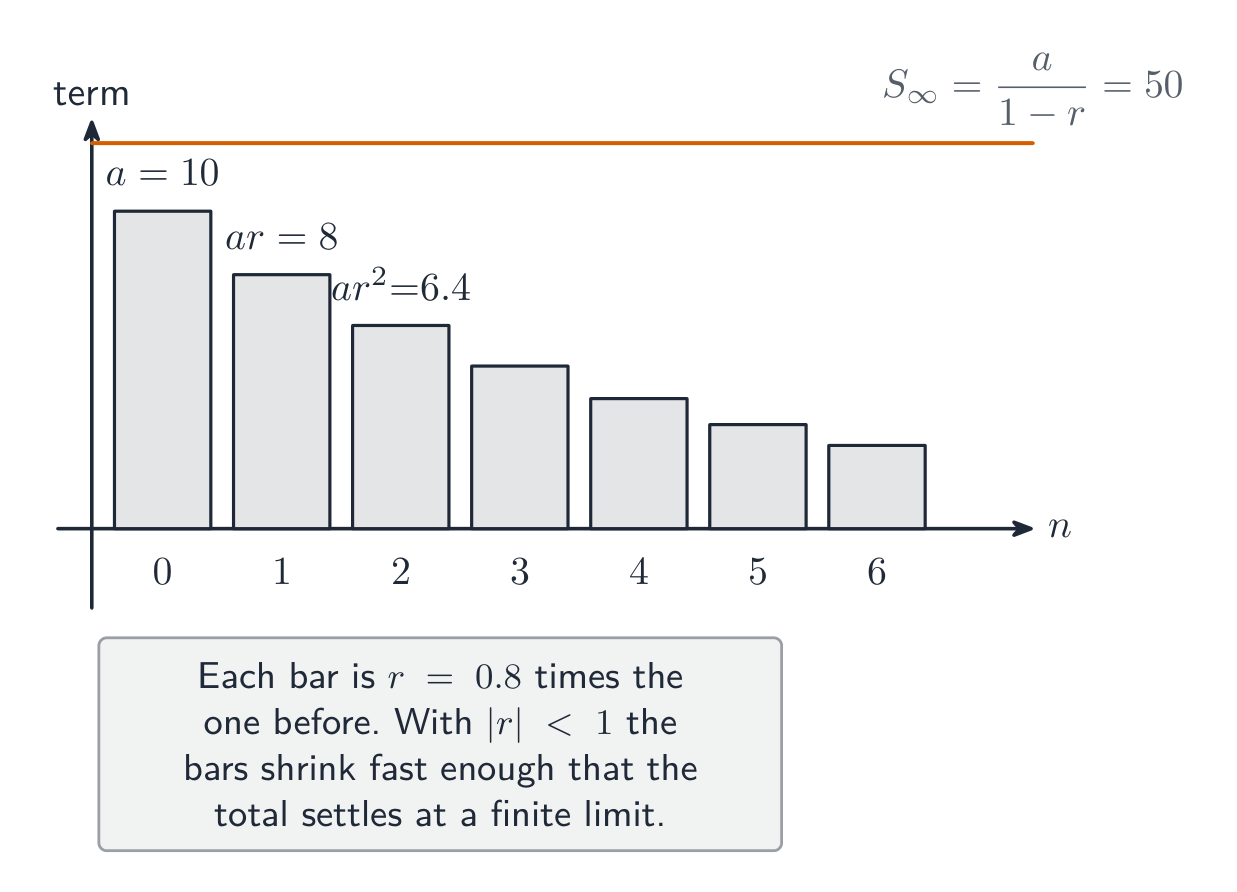
Geometric bars: each bar is 0.8 times the previous one; their total approaches the sum to infinity a/(1−r).
|r| < 1 means the terms shrink; the sum settles at S∞.

Worked example 5: geometric series with logs (adapted from Edexcel IAL WMA12 June 2025 Q7). A geometric series begins $10 + 8 + 6.4 + \cdots$

(a) Sum to infinity.

  • $a = 10$, $r = 8/10 = 0.8$, and $|r| < 1$:
    $$S_\infty = \frac{a}{1-r} = \frac{10}{1 - 0.8} = 50$$

(b) The $k$th term is less than 0.0005 — find the smallest $k$, by algebra.

  • The $k$th term is $10(0.8)^{k-1}$:
    $$10(0.8)^{k-1} < 0.0005 \implies (0.8)^{k-1} < 0.00005$$
  • Take logs (the log of a number below 1 is negative — keep the inequality direction when dividing by it):
    $$(k-1)\log 0.8 < \log 0.00005 \implies k - 1 > \frac{\log 0.00005}{\log 0.8} = 44.38\ldots$$
  • So $k > 45.38$ and the smallest integer is $k = 46$.
  • Check: $10(0.8)^{45} = 0.000436\ldots < 0.0005$ ✓ but $10(0.8)^{44} = 0.000544\ldots > 0.0005$ ✓.

Worked example 6: maximum arithmetic sum (adapted from the same question). An arithmetic series begins $850 + 843 + 836 + \cdots$ ($d = -7$). Its greatest partial sum:

  • Terms stay positive until $u_n = 850 - 7(n-1) > 0$, so $n \le 122.4$; the 122nd term is $850 - 7(121) = 3 > 0$ and the 123rd is $-4 < 0$.
    $$S_{122} = \frac{122}{2}\big(2(850) + 121(-7)\big) = 61(1700 - 847) = 61 \times 853 = 52\,033$$
  • Check: adding a negative 123rd term would reduce the sum, so $S_{122}$ is the maximum ✓.
探索

数列、级数与递推关系

对于等差数列,u_n=a+(n-1)d,且S_n=n(2a+(n-1)d)/2

对比模型与已解案例,并说明其中一处变化。

词汇 训练
English 中文 拼音
sequence/ˈsiːkwəns/ 数列 shù liè
increasing/ɪnˈkriːsɪŋ/ 递增 dì zēng
decreasing/ˈdiːkriːsɪŋ/ 递减 dì jiǎn
periodic/ˌpɪərɪˈɒdɪk/ 周期 zhōu qī
arithmetic sequences/əˈrɪθmətɪk ˈsiːkwənsɪz/ 等差数列 děng chā shù liè
geometric sequences/ˌdʒiːəʊˈmetrɪk ˈsiːkwənsɪz/ 等比数列 děng bǐ shù liè
binomial expansion/baɪˈnəʊmɪəl ekˈspænʃn/ 二项展开式 èr xiàng zhǎn kāi shì
2.5.1 2.5.2 2.5.3

指数函数与对数

English

$y = a^x$ ($a > 0$, $a \ne 1$) passes through $(0, 1)$ and grows without bound for $a > 1$. The logarithm 对数 $\log_a x$ inverts it: $\log_a x = y$ means $a^y = x$. Know:

A seismograph tracing an earthquake
A seismograph: earthquake magnitude is a logarithmic scale, so each step up is ten times the shaking
Left: y = 2ˣ and y = log₂ x reflected in y = x. Right: ln y = ln 80 − 0.2t plotted as a straight line with the half-life point marked
Exponential and log are inverse functions; ln y against t is a straight line, and the half-life is ln 2 / 0.2 ≈ 3.47 hours
$$\log_a x + \log_a y \equiv \log_a(xy) \qquad \log_a x - \log_a y \equiv \log_a \frac{x}{y} \qquad k\log_a x \equiv \log_a(x^k) \qquad \log_a a = 1$$

and $\log_a \tfrac1x = -\log_a x$. Solve $a^x = b$ with $x = \log_a b$ (a change of base may be used). Always check candidates against the domain 定义域: logs need positive arguments.

Worked example 7: a log equation (adapted from Edexcel IAL WMA12 June 2025 Q6). Solve $2\log_2(4 - x) = 3 + \log_2\!\left(\dfrac{x + 11}{2}\right)$.

  • Bring everything to one log per side:
    $$\log_2(4-x)^2 = \log_2 8 + \log_2\!\left(\frac{x+11}{2}\right) = \log_2\big(4(x+11)\big)$$
  • Equal logs give equal arguments:
    $$(4-x)^2 = 4(x+11) \implies x^2 - 8x + 16 = 4x + 44 \implies x^2 - 12x - 28 = 0$$
    $$(x - 14)(x + 2) = 0 \implies x = 14 \ \text{or}\ x = -2$$
  • Domain check: $4 - x > 0$ needs $x < 4$, so $x = 14$ is rejected. $x = -2$.
  • Check: LHS $= 2\log_2 6$; RHS $= 3 + \log_2(4.5) = \log_2(8 \times 4.5) = \log_2 36 = 2\log_2 6$ ✓.

Worked example 8: exact intersection in $\log_3$ form (same question). The curves $y = 3^{2x+1}$ and $y = 6 \times 3^x$ meet at $P$; write $P$ as $(\log_3 a, b)$.

  • Set equal and substitute $u = 3^x$:
    $$3\cdot 3^{2x} = 6 \cdot 3^x \implies 3u^2 = 6u \implies u = 2 \implies 3^x = 2 \implies x = \log_3 2$$
    $$y = 6 \times 3^x = 6 \times 2 = 12$$
  • $P = (\log_3 2,\ 12)$, so $a = 2$, $b = 12$. Check: $3^{2\log_3 2 + 1} = 3 \cdot 3^{2\log_3 2} = 3 \cdot 4 = 12$ ✓.
词汇 训练
English 中文 拼音
logarithm/ˈlɒɡərɪθəm/ 对数 duì shù
domain/dəˈmeɪn/ 定义域 dìng yì yù
2.6.1 2.6.2

Trigonometric identities and equations

English

Two identities convert between sine, cosine and tangent:

The unit circle with the point (cos theta, sin theta), its reflection at pi minus theta with the same height, and its reflection at minus theta with the same x-coordinate; quadrant labels all, sin, tan, cos positive
Reflections in the unit circle give the symmetry rules
$$\tan\theta \equiv \frac{\sin\theta}{\cos\theta} \qquad \sin^2\theta + \cos^2\theta \equiv 1$$

Solve trigonometric equations 三角方程 in a given interval by reducing to one function (often a hidden quadratic), then reading the second solution from the graph's symmetry. State the interval, work in its units (degrees or radians), and reject values outside.

Worked example 9: radians and exact fractions (adapted from Edexcel IAL WMA12 June 2025 Q8). Solve $3\tan\!\left(2x + \dfrac{\pi}{5}\right) = \sqrt3$ for $0 \le x < \pi$.

  • Divide by 3: $\tan\left(2x + \tfrac{\pi}{5}\right) = \dfrac{1}{\sqrt3}$, and $\tan\frac{\pi}{6} = \dfrac{1}{\sqrt3}$:
    $$2x + \frac{\pi}{5} = \frac{\pi}{6} + k\pi \implies 2x = -\frac{\pi}{30} + k\pi \implies x = -\frac{\pi}{60} + \frac{k\pi}{2}$$
  • In $0 \le x < \pi$: $x = \dfrac{29\pi}{60}$ (k = 1) and $x = \dfrac{59\pi}{60}$ (k = 2).
  • Check: at $x = \frac{29\pi}{60}$: $2x + \frac\pi5 = \frac{7\pi}{6}$ and $\tan\frac{7\pi}{6} = \tan\frac{\pi}{6} = \frac{1}{\sqrt3}$ ✓.

Worked example 10: hidden quadratic in cosine (same question). Solve $5\sin\theta\tan\theta = \cos\theta + 4$ for $0 \le \theta < 360°$.

  • Replace $\tan\theta = \sin\theta/\cos\theta$ and multiply through by $\cos\theta$:
    $$\frac{5\sin^2\theta}{\cos\theta} = \cos\theta + 4 \implies 5\sin^2\theta = \cos^2\theta + 4\cos\theta$$
  • Use $\sin^2\theta = 1 - \cos^2\theta$:
    $$5(1 - \cos^2\theta) = \cos^2\theta + 4\cos\theta \implies 6\cos^2\theta + 4\cos\theta - 5 = 0$$
  • Quadratic formula in $\cos\theta$:
    $$\cos\theta = \frac{-4 \pm \sqrt{16 + 120}}{12} = \frac{-2 \pm \sqrt{34}}{6}$$
  • The $-$ root is below $-1$ (reject); $\cos\theta = 0.6385$ gives $\theta = 50.3°$ and, from cosine's symmetry, $\theta = 360° - 50.3° = 309.7°$.
  • Check: $\cos 50.3° = 0.638$ ✓; both angles lie in the interval ✓.
探索

弧度制、恒等式与三角方程

对于以弧度为单位的角θ,弧长s=rθ,扇形面积A=r²θ/2。

对比模型与已解案例,并说明其中一处变化。

词汇 训练
English 中文 拼音
trigonometric equations/ˌtrɪɡənəʊˈmetrɪk ɪˈkweɪʒnz/ 三角方程 sān jiǎo fāng chéng
2.7.1

Differentiation: stationary points

English

Stationary points 驻点 have $\dfrac{dy}{dx} = 0$. Classify with the sign of the derivative:

  • derivative changes $+$ to $-$: maximum 极大值;
  • derivative changes $-$ to $+$: minimum 极小值;
  • the second derivative helps: $f''(x) > 0$ at the point confirms a minimum, $f''(x) < 0$ a maximum.

A function is increasing where $f'(x) > 0$ and decreasing where $f'(x) < 0$. Practical problems — least material, least cost — translate into minimising an expression in one variable.

A curve with a local maximum and a local minimum marked; the derivative's sign is shown on each stretch of the curve.
Stationary means the tangent is horizontal; the sign change classifies it.

Worked example 11: a modelling minimum (adapted from Edexcel IAL WMA12 June 2025 Q9). An open trough has right-triangle ends with legs $3x$ and $2x$ (metres), rectangular sides $3x \times L$ and $2x \times L$, and capacity $12\ \text{m}^3$. The metal area is $S\ \text{m}^2$.

(a) Show $S = 6x^2 + \dfrac{20}{x}$.

  • Volume: cross-section $\times$ length $= \tfrac12(3x)(2x) \times L = 3x^2L = 12$, so $L = \dfrac{4}{x^2}$.
  • Surface: two triangles plus the two rectangles:
    $$S = 2 \times \tfrac12(3x)(2x) + 3xL + 2xL = 6x^2 + 5x \cdot \frac{4}{x^2} = 6x^2 + \frac{20}{x}$$

(b) Minimum $S$ by calculus.

$$\frac{dS}{dx} = 12x - \frac{20}{x^2} = 0 \implies 12x^3 = 20 \implies x^3 = \frac53 \implies x = 1.1856\ldots$$
$$S = 6(1.1856)^2 + \frac{20}{1.1856} = 8.43 + 16.87 = 25.3\ \text{m}^2\ (1\ \text{d.p.})$$

(c) Justify the minimum.

$$\frac{d^2S}{dx^2} = 12 + \frac{40}{x^3} > 0 \quad \text{for all } x > 0$$

  • Positive second derivative everywhere on the domain: the stationary point is a minimum ✓.
  • Check: at $x = 1.1856$, $\frac{d^2S}{dx^2} = 12 + 40/(5/3) = 12 + 24 = 36 > 0$ ✓.
探索

导数与驻点

对于 y=ax^n,dy/dx=anx^(n-1)

对比模型与已解案例,并说明其中一处变化。

词汇 训练
English 中文 拼音
stationary points/ˈsteɪʃənəri pɔɪnts/ 驻点 zhù diǎn
maximum/ˈmæksɪməm/ 极大值 jí dà zhí
minimum/ˈmɪnɪməm/ 极小值 jí xiǎo zhí
2.8.1 2.8.2 2.8.3

Integration: areas and the trapezium rule

English

Evaluate definite integrals 定积分 with the fundamental theorem:

$$\int_a^b y\,dx = F(b) - F(a) \quad \text{where } F'(x) = y$$

The definite integral is the area under the curve 曲线下面积 for $y \ge 0$. For a region bounded by a curve and a line, integrate (upper − lower) between their intersections, splitting wherever their order changes. Check which graph is above the other.

A curve and a line meeting at two points, with the enclosed region shaded; strips under a curve show the trapezium rule's approximation.
Area between uses ∫(upper − lower), splitting at crossings; the trapezium rule joins neighbouring values with straight strips.

Worked example 12: area between curve and line (adapted from Edexcel IAL WMA12 June 2025 Q3). $C$: $y = 3x + \dfrac{16}{x^2} - 8$ ($x > 0$) with $P(1, 11)$ and $Q(4, 5)$ on $C$; find the area between $C$ and the line segment $PQ$.

  • Line $PQ$: gradient $\dfrac{5-11}{4-1} = -2$, so $y - 11 = -2(x - 1) \implies y = -2x + 13$.
  • Check $Q$: $-8 + 13 = 5$ ✓.
  • Area under the line: $\displaystyle\int_1^4 (-2x + 13)\,dx = \left[-x^2 + 13x\right]_1^4 = 36 - 12 = 24$.
  • Area under the curve: $\displaystyle\int_1^4 \left(3x + 16x^{-2} - 8\right)dx = \left[\tfrac32x^2 - \tfrac{16}{x} - 8x\right]_1^4 = (24 - 4 - 32) - (\tfrac32 - 16 - 8) = 10.5$.
  • Region area: $24 - 10.5 = \mathbf{13.5}$ square units.
  • Check: the line is above the curve throughout (at $x = 2$: line $9$, curve $3(2) + 4 - 8 = 2$), so subtracting curve from line is the right way round ✓.

The trapezium rule 梯形法则 approximates an area with $n$ strips of width $h$:

$$\int_a^b y\,dx \approx h\Big[\tfrac12(y_0 + y_n) + y_1 + y_2 + \cdots + y_{n-1}\Big] \quad\text{or}\quad \frac h2\big[y_0 + y_n + 2(y_1 + \cdots + y_{n-1})\big]$$

More strips (or a straighter curve) improve the estimate; a curve that bends upwards (convex, U-shaped like $x^2$) leaves every chord above it, so the rule overestimates, while a curve that bends downwards (concave, like $\sqrt x$ or a circle arc) leaves chords below it, so the rule underestimates.

Worked example 13: trapezium rule with a table. Estimate $\displaystyle\int_1^3 \frac{1}{x}\,dx$ with 4 strips.

  • Four strips over $[1, 3]$ give $h = 0.5$ and five values of $y = \dfrac1x$: at $x = 1,\ 1.5,\ 2,\ 2.5,\ 3$ the values are $1,\ 0.6667,\ 0.5,\ 0.4,\ 0.3333$.
    $$\int_1^3 \frac1x\,dx \approx \frac{0.5}{2}\big[1 + 0.3333 + 2(0.6667 + 0.5 + 0.4)\big] = 0.25 \times 4.4667 = 1.12$$
  • The true value is $\ln 3 = 1.099$ (3 s.f.). The estimate is an overestimate: $y = 1/x$ is convex (it bends upwards), so every straight strip sits above the curve ✓.
探索

积分、面积与累积量

当 n≠-1 时,ax^n 的积分为 ax^(n+1)/(n+1)+C。

对比模型与已解案例,并说明其中一处变化。

词汇 训练
English 中文 拼音
definite integral/ˈdefɪnət ˈɪntɪɡrəl/ 定积分 dìng jī fēn
area under the curve/ˈeərɪə ˈʌndə ðə kɜːv/ 曲线下面积 qū xiàn xià miàn jī
trapezium rule/trəˈpiːzɪəm ruːl/ 梯形法则 tī xíng fǎ zé
2.8.1 2.8.2 2.8.3

本课资料

English
  • Pearson Edexcel, International Advanced Level Mathematics, Further Mathematics and Pure Mathematics specification (Issue 3, 2019), unit P2.
  • J. Napier, Mirifici Logarithmorum Canonis Descriptio (Edinburgh, 1614).
  • Pearson Edexcel, WMA12/01 June 2025, questions 2 to 10 (adapted).
2.8.1 2.8.2 2.8.3

常见错误

English
  • Trying to prove a general statement by checking a few examples.
  • Using $f(b)$ instead of $f\!\left(\frac ba\right)$ for the divisor $(ax - b)$.
  • Getting the sign of the centre wrong: $(x - 3)^2 + (y + 2)^2 = 25$ has centre $(3, -2)$.
  • Using the sum to infinity when $\lvert r\rvert \ge 1$.
  • Forgetting to reverse an inequality when dividing by the logarithm of a number less than 1, which is negative.
  • Writing $\log(a + b) = \log a + \log b$.
  • Giving only one solution of a trigonometric equation when the interval contains more.
  • Finding a stationary point without showing whether it is a maximum or a minimum.
2.8.1 2.8.2 2.8.3

关键术语

English
  • Proof by exhaustion: proving a statement by checking every possible case.
  • Factor theorem: $(x - b)$ is a factor of $f(x)$ if and only if $f(b) = 0$.
  • Geometric sequence: a sequence in which each term is the previous term multiplied by a constant ratio $r$.
  • Logarithm: $\log_a x = y$ means $a^y = x$.
  • Stationary point: a point on a curve where the gradient is zero.
  • Trapezium rule: a method of estimating an area under a curve using strips shaped like trapezia.
2.8.1 2.8.2 2.8.3

自我检测

English
  1. Show that $(x - 2)$ is a factor of $x^3 - 3x^2 + 4$.
  2. Find the centre and radius of the circle $x^2 + y^2 - 6x + 4y - 12 = 0$.
  3. An arithmetic series has first term 5 and common difference 3. Find the sum of the first 20 terms.
  4. Find the coefficient of $x^2$ in the expansion of $(1 + 2x)^6$.
  5. Solve $3^x = 20$, giving your answer to 3 significant figures.
  6. Solve $\sin\theta = 0.5$ for $0 \le \theta < 360°$.
  7. Find the coordinates of the stationary point of $y = x^2 - 8x + 3$, and say whether it is a maximum or a minimum.

Answers: 1. $f(2) = 8 - 12 + 4 = 0$. 2. $(x - 3)^2 + (y + 2)^2 = 25$: centre $(3, -2)$, radius 5. 3. $\frac{20}{2}(10 + 19 \times 3) = 670$. 4. $\binom62 \times 2^2 = 60$. 5. $x = \frac{\ln 20}{\ln 3} = 2.73$. 6. $30°$ and $150°$. 7. $\frac{dy}{dx} = 2x - 8 = 0$ at $x = 4$: $(4, -13)$, a minimum since $\frac{d^2y}{dx^2} = 2 > 0$.

该知识点的互动课程

逐步完成,配合即时检查练习。

更多 Edexcel International A-Level 纯数学 知识点

登录或创建账户

IGCSE, A-Level & AP