跳到主要内容

FP1 · Further Pure Mathematics 1

Edexcel International A-Level 纯数学 · 知识点 5

本主题的视频课程 打开视频页面
23:50

进阶纯数学1

试卷 WFM01:1 小时 30 分钟,75 分,假定已学 P1 和 P2。有五组公式不在手册里:根的和与积、r 的和……

英文讲解 · 可切换中英文字幕

1.4.1

Further Pure Mathematics 1: complex numbers, matrices and proof

English

Why it matters. In 1545 the Italian doctor and mathematician Gerolamo Cardano published Ars Magna (The Great Art), with the first printed method for solving cubic equations. One of his problems was to split 10 into two parts whose product is 40. The answer, $5 + \sqrt{-15}$ and $5 - \sqrt{-15}$, seemed meaningless, and Cardano called it "as subtle as it is useless". In 1572 Rafael Bombelli went further. For the cubic $x^3 = 15x + 4$, Cardano's formula needs the square root of $-121$, yet the equation has the ordinary answer $x = 4$. Bombelli showed that if you calculate with $\sqrt{-1}$ as if it were a number, the impossible parts cancel and 4 appears. Today these complex numbers describe alternating current, signal processing and quantum physics.

In this unit you will:

  • calculate with complex numbers, and find the complex roots of polynomials with real coefficients;
  • use the sum and product of the roots of a quadratic, and solve equations numerically;
  • work with the parabola and the rectangular hyperbola;
  • use matrices to represent and combine transformations;
  • sum series and prove results by mathematical induction.

Edexcel International A Level, Further Pure Mathematics 1 (FP1, paper WFM01/01, 1 hour 30 minutes, 75 marks). FP1 is compulsory for International AS and A Level Further Mathematics and for Pure Mathematics. Pure Mathematics 1 and 2 are assumed, including locating roots by a change of sign, and dividing a cubic or quartic by a quadratic.

These results are not in the formula booklet, so learn them:

Topic Results to learn
roots of a quadratic for $ax^2 + bx + c = 0$ with roots $\alpha, \beta$: $\alpha + \beta = -\dfrac ba$, $\alpha\beta = \dfrac ca$
series $\displaystyle\sum_{r=1}^n r = \tfrac12 n(n+1)$
complex numbers $z = a + bi$, $\lvert z\rvert = \sqrt{a^2 + b^2}$, $z^* = a - bi$, $\lvert z_1z_2\rvert = \lvert z_1\rvert\lvert z_2\rvert$
conics parabola $y^2 = 4ax$, with $x = at^2$, $y = 2at$; rectangular hyperbola $xy = c^2$, with $x = ct$, $y = \tfrac ct$
matrices $\det\begin{pmatrix}a&b\\c&d\end{pmatrix} = ad - bc$, $\mathbf M^{-1} = \dfrac1{ad-bc}\begin{pmatrix}d&-b\\-c&a\end{pmatrix}$, $(\mathbf{AB})^{-1} = \mathbf B^{-1}\mathbf A^{-1}$
1.1.1 1.1.2 1.1.3 1.1.4

复数

English

A complex number 复数 has the form $z = a + bi$, where $i^2 = -1$. The number $a$ is the real part 实部 and $b$ is the imaginary part 虚部. Two complex numbers are equal only if their real parts are equal and their imaginary parts are equal.

The conjugate 共轭复数 of $z = a + bi$ is $z^* = a - bi$. Multiplying a number by its conjugate gives a real number: $z z^* = a^2 + b^2$. This is how you divide: multiply the top and bottom by the conjugate of the bottom.

$$\frac{z_1}{z_2} = \frac{z_1 z_2^*}{z_2 z_2^*}$$

Worked example 1. Find $\dfrac{3 + 4i}{1 - 2i}$. Multiply top and bottom by $1 + 2i$: the top is $(3 + 4i)(1 + 2i) = 3 + 6i + 4i + 8i^2 = -5 + 10i$, and the bottom is $1 + 4 = 5$. So the answer is $-1 + 2i$.

An Argand diagram 阿甘特图 shows $z = a + bi$ as the point $(a, b)$. Adding complex numbers is like adding vectors, and the conjugate is the reflection of $z$ in the real axis.

Adding complex numbers on an Argand diagram, with conjugates reflected in the real axis (left); modulus and argument (right).

Modulus and argument. The modulus 模 $\lvert z\rvert = r$ is the distance of $z$ from the origin. The argument 辐角 $\arg z = \theta$ is the angle from the positive real axis, usually taken with $-\pi < \theta \le \pi$; it is defined only when $z \ne 0$. Then $z = r(\cos\theta + i\sin\theta)$. When you multiply complex numbers, you multiply their moduli: $\lvert z_1 z_2\rvert = \lvert z_1\rvert\lvert z_2\rvert$.

Worked example 2. $z_1 = r\left(\cos\tfrac{7\pi}{6} + i\sin\tfrac{7\pi}{6}\right)$ with $r > 0$, $\lvert z_2\rvert = 5$ and $\lvert z_1 z_2\rvert = 15$. Also, $z_1 + z_2$ is real. Find $z_1$ and the possible values of $z_2$.

  • $5r = 15$, so $r = 3$ and $z_1 = 3\left(-\tfrac{\sqrt3}{2} - \tfrac12 i\right) = -\tfrac{3\sqrt3}{2} - \tfrac32 i$.
  • For $z_1 + z_2$ to be real, the imaginary parts must cancel, so $z_2 = a + \tfrac32 i$.
  • $a^2 + \tfrac94 = 25$, so $a = \pm\tfrac{\sqrt{91}}{2}$, and $z_2 = \pm\tfrac{\sqrt{91}}{2} + \tfrac32 i$.
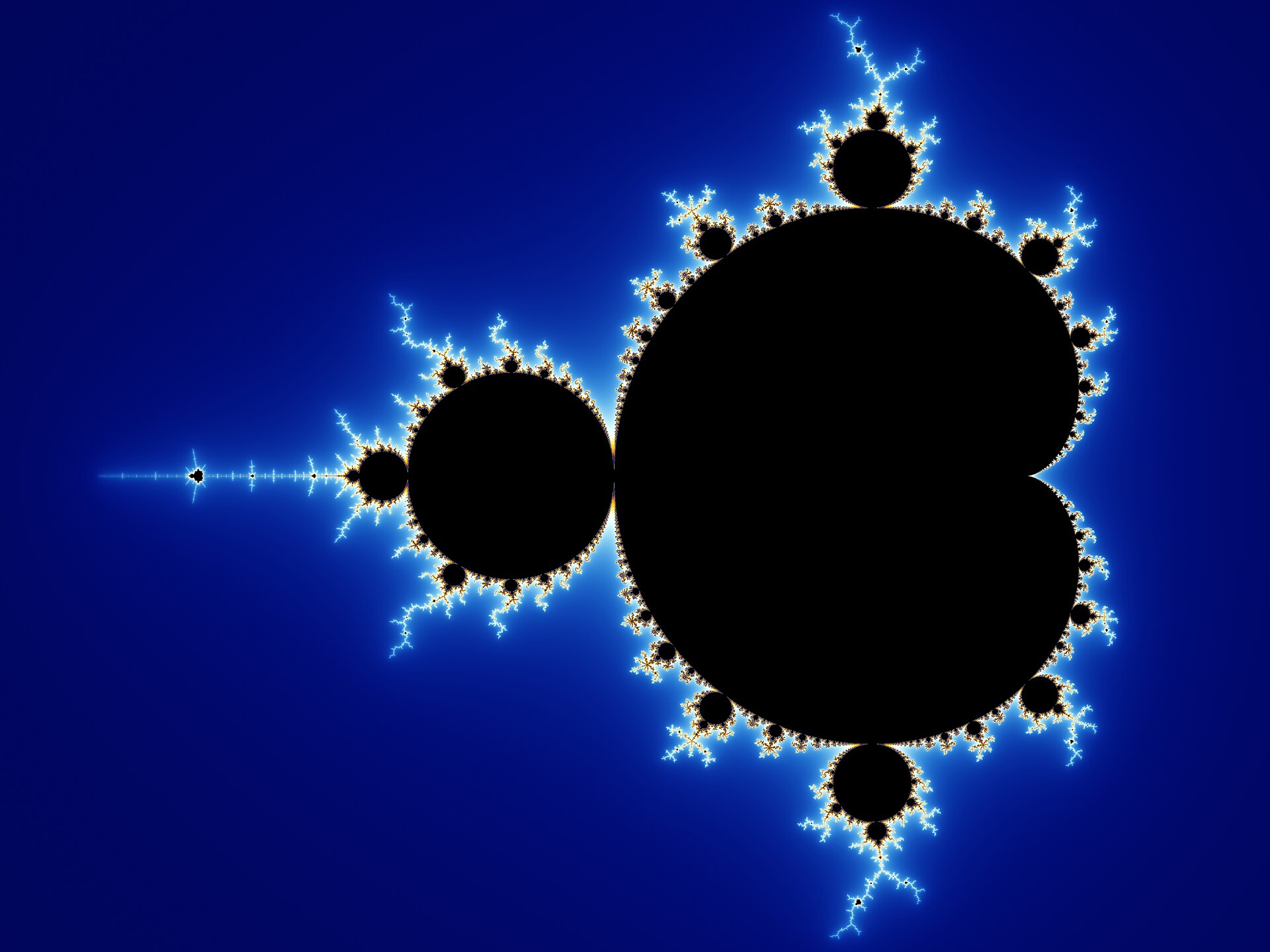
The Mandelbrot set, a black heart-shaped region ringed by smaller discs and fine blue filaments
The Mandelbrot set: the complex numbers c for which repeating z → z² + c, starting from z = 0, stays bounded
探索

复杂的算术运算和二次方程根

将 z=a+bi 写成 i²=-1 的形式

对比模型与已解案例,并说明其中一处变化。

词汇 训练
English 中文 拼音
complex number/ˈkɒmpleks ˈnʌmbə/ 复数 fù shù
real part/rɪəl pɑːt/ 实部 shí bù
imaginary part/ɪˈmædʒɪnəri pɑːt/ 虚部 xū bù
conjugate/ˈkɒndʒuːɡeɪt/ 共轭复数 gòng è fù shù
Argand diagram/ˈɑːɡænd ˈdaɪəɡræm/ 阿甘特图 ā gān tè tú
modulus/ˈmɒdjʊləs/ 模 mó
argument/ˈɑːɡjuːmənt/ 辐角 fú jiǎo
1.1.5 1.1.6

Complex roots of polynomials

English

If a quadratic with real coefficients has a negative discriminant, its roots are complex. For example, $x^2 - 6x + 13 = (x - 3)^2 + 4 = 0$ gives $x = 3 \pm 2i$. The two roots are a conjugate pair.

This is true for any polynomial with real coefficients: if $z_1$ is a root, so is $z_1^*$. So a cubic with real coefficients has either three real roots, or one real root and a conjugate pair. The two conjugate roots give a real quadratic factor:

$$(z - z_1)(z - z_1^*) = z^2 - (\text{sum})z + \text{product} = z^2 - 2\operatorname{Re}(z_1)\,z + \lvert z_1\rvert^2$$
A positive real graph still has complex polynomial roots
The graph of $y = x^4 + 4$ never meets the $x$-axis, but the equation has four complex roots, $\pm1 \pm i$.

Worked example 3. $f(z) = Pz^4 - 36z^3 + Qz^2 + 192z + 68$ has a root $3 + 5i$. Find $P$, $Q$ and the other roots.

  • $3 - 5i$ is also a root. The sum of the pair is 6 and the product is $9 + 25 = 34$, so $z^2 - 6z + 34$ is a factor.
  • Write $f(z) = (z^2 - 6z + 34)(Pz^2 + bz + c)$ and compare coefficients:
    • constant: $34c = 68$, so $c = 2$;
    • $z$: $34b - 6c = 192$, so $b = 6$;
    • $z^3$: $b - 6P = -36$, so $P = 7$;
    • $z^2$: $Q = c - 6b + 34P = 2 - 36 + 238 = 204$.
  • The other roots solve $7z^2 + 6z + 2 = 0$: $z = \dfrac{-6 \pm \sqrt{36 - 56}}{14} = \dfrac{-3 \pm i\sqrt5}{7}$.
1.2.1 1.2.2 1.2.3

Roots of quadratic equations

English

If $\alpha$ and $\beta$ are the roots of $ax^2 + bx + c = 0$, then

$$\alpha + \beta = -\frac ba \qquad \alpha\beta = \frac ca$$

Many expressions can be written using only $\alpha + \beta$ and $\alpha\beta$, so you do not need the roots themselves:

  • $\alpha^2 + \beta^2 = (\alpha + \beta)^2 - 2\alpha\beta$
  • $\alpha^3 + \beta^3 = (\alpha + \beta)^3 - 3\alpha\beta(\alpha + \beta)$
  • $\dfrac1\alpha + \dfrac1\beta = \dfrac{\alpha + \beta}{\alpha\beta}$

To find an equation with new roots, work out the new sum and the new product. The equation is then $x^2 - (\text{sum})x + (\text{product}) = 0$.

From the original sum and product of roots, express the new sum and product symmetrically, then write x squared minus sum x plus product equals 0
Forming an equation with new roots from the sum and product of the old ones.

Worked example 4. $\alpha$ and $\beta$ are the roots of $x^2 - 5x + 3 = 0$. Find a quadratic with roots $\alpha^2$ and $\beta^2$. Here $\alpha + \beta = 5$ and $\alpha\beta = 3$. New sum: $\alpha^2 + \beta^2 = 25 - 6 = 19$. New product: $(\alpha\beta)^2 = 9$. The equation is $x^2 - 19x + 9 = 0$.

Worked example 5. $3x^2 + kx - 5 = 0$ has roots $\alpha$ and $\beta$, with $\alpha + \beta = 9\alpha\beta$. Find $k$, then a quadratic with integer coefficients whose roots are $\alpha^2 + \beta$ and $\alpha + \beta^2$.

  • $\alpha\beta = -\tfrac53$, so $\alpha + \beta = -15$. Since $\alpha + \beta = -\tfrac k3$, $k = 45$.
  • Sum $= (\alpha^2 + \beta^2) + (\alpha + \beta) = \left(225 + \tfrac{10}{3}\right) - 15 = \tfrac{640}{3}$.
  • Product $= \alpha^3 + \beta^3 + \alpha\beta + (\alpha\beta)^2$. Here $\alpha^3 + \beta^3 = (-15)^3 - 3\left(-\tfrac53\right)(-15) = -3375 - 75 = -3450$, so the product is $-3450 - \tfrac53 + \tfrac{25}{9} = -\tfrac{31\,040}{9}$.
  • Multiply $x^2 - \tfrac{640}{3}x - \tfrac{31\,040}{9} = 0$ by 9: $9x^2 - 1920x - 31\,040 = 0$.
1.3.1

方程的数值解

English

If $f$ is continuous on $[a, b]$ and $f(a)$ and $f(b)$ have opposite signs, there is a root between $a$ and $b$.

A curve passing from below the x-axis at a to above it at b
A change of sign of a continuous function on $[a, b]$ shows that a root lies between $a$ and $b$.
  • Interval bisection 区间二分法: find the sign of $f$ at the midpoint of the interval, and keep the half that still has a change of sign.
  • Linear interpolation 线性插值: join $(a, f(a))$ and $(b, f(b))$ with a straight line and use the point where it crosses the $x$-axis:
    $$x \approx a + \frac{(b - a)\,\lvert f(a)\rvert}{\lvert f(a)\rvert + \lvert f(b)\rvert}$$
  • The Newton–Raphson method 牛顿-拉夫逊法 (in the formula booklet) uses the tangent: $x_{n+1} = x_n - \dfrac{f(x_n)}{f'(x_n)}$. It fails if $f'(x_n) = 0$, and it may not converge from a poor starting value.

Always write down every value of $f$ that you calculate; an answer from a calculator's equation solver scores nothing.

Worked example 6. $f(x) = x^2 + 5 - 8^{5x}$ has one root $\alpha$ in $[0, 1]$. Use bisection twice. $f(0) = 4 > 0$ and $f(0.5) = 5.25 - 8^{2.5} = -175.77 < 0$, so $\alpha \in [0, 0.5]$. $f(0.25) = 5.0625 - 8^{1.25} = -8.39 < 0$, so $\alpha \in [0, 0.25]$.

Worked example 7. $g(x) = 3^{\sin x} - 3\cos x$, in radians. $g(4) = 2.396$ and $g(5) = -0.502$, so a root $\beta$ lies in $[4, 5]$. One step of linear interpolation gives $\beta \approx 4 + \dfrac{2.396}{2.396 + 0.502} = 4.827$ (4 s.f.).

Worked example 8. Use Newton–Raphson on $f(x) = x^3 - 2x - 5$ with $x_0 = 2$. $f'(x) = 3x^2 - 2$. $x_1 = 2 - \dfrac{-1}{10} = 2.1$. Then $f(2.1) = 0.061$ and $f'(2.1) = 11.23$, so $x_2 = 2.1 - \dfrac{0.061}{11.23} = 2.0946$.

探索

二分法与牛顿迭代法求根

对于存在符号变化的连续函数,对根所在区间进行二分,并保留端点符号相反的半个区间。

对比模型与已解案例,并说明其中一处变化。

词汇 训练
English 中文 拼音
interval bisection/ˈɪntəvl baɪˈsekʃn/ 区间二分法 qū jiān èr fēn fǎ
linear interpolation/ˈlɪnɪə ɪnˌtɜːpəˈleɪʃn/ 线性插值 xiàn xìng chā zhí
Newton–Raphson method/ˈnjuːtn ˈræfsn ˈmeθəd/ 牛顿-拉夫逊法 niú dùn - lā fū xùn fǎ
1.4.1 1.4.2 1.4.3 1.4.4

Parabola and rectangular hyperbola

English

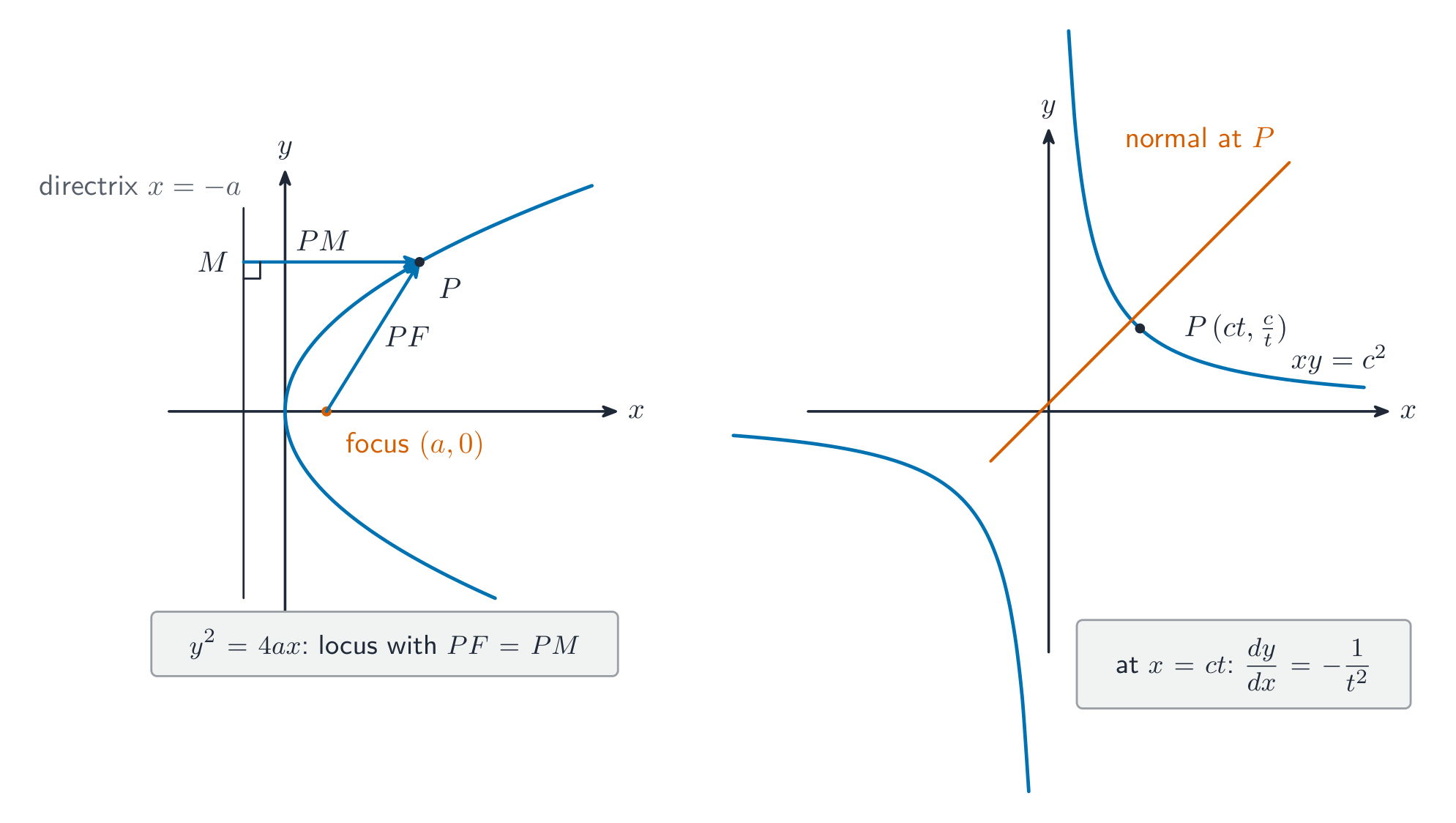
The parabola 抛物线 $y^2 = 4ax$ can be written as $x = at^2$, $y = 2at$. It is the set of points that are the same distance from the focus 焦点 $(a, 0)$ as from the directrix 准线 $x = -a$.

The rectangular hyperbola 直角双曲线 $xy = c^2$ can be written as $x = ct$, $y = \dfrac ct$.

The Golden Gate suspension bridge
The main cable of a suspension bridge hangs in a shape close to a parabola.

To find tangents and normals, differentiate the Cartesian equation:

  • $y^2 = 4ax$ gives $2y\dfrac{dy}{dx} = 4a$, so $\dfrac{dy}{dx} = \dfrac{2a}{y} = \dfrac1t$ at the point with parameter $t$;
  • $xy = c^2$ gives $y = \dfrac{c^2}{x}$, so $\dfrac{dy}{dx} = -\dfrac{c^2}{x^2} = -\dfrac{1}{t^2}$ at $(ct, \tfrac ct)$.

The normal is perpendicular to the tangent, so its gradient is $-\dfrac{1}{\text{tangent gradient}}$.

The parabola , where PF = PM (left), and the rectangular hyperbola  with a normal at  (right).
The parabola $y^2 = 4ax$, where PF = PM (left), and the rectangular hyperbola $xy = c^2$ with a normal at $(ct, \tfrac ct)$ (right).

Worked example 9. $P\left(9t, \tfrac9t\right)$ lies on $xy = 81$. The tangent gradient is $-\dfrac1{t^2}$, so the normal has gradient $t^2$:

$$y - \frac9t = t^2(x - 9t) \quad\Longrightarrow\quad ty = t^3x + 9(1 - t^4)$$

The normal meets the $y$-axis at $A\left(0, \tfrac{9(1 - t^4)}{t}\right)$. When $t = \tfrac13$, $P = (3, 27)$ and $A = \left(0, \tfrac{80}{3}\right)$, so the area of triangle $OPA$ is $\tfrac12 \times \tfrac{80}{3} \times 3 = 40$.

Worked example 10. A point $P$ on a parabola is 5 units from the focus. Points $Q$ and $R$ on the directrix are each 10 units from $P$. Find $QR$. $P$ is also 5 units from the directrix, so if $M$ is the foot of the perpendicular from $P$ to the directrix, $PM = 5$. In the right-angled triangle $PQM$, $QM = \sqrt{10^2 - 5^2} = 5\sqrt3$. $M$ is the midpoint of $QR$, so $QR = 10\sqrt3$.

词汇 训练
English 中文 拼音
parabola/pəˈræbələ/ 抛物线 pāo wù xiàn
focus/ˈfəʊkəs/ 焦点 jiāo diǎn
directrix/daɪˈrektrɪks/ 准线 zhǔn xiàn
rectangular hyperbola/rekˈtæŋɡjʊlə haɪˈpɜːbələ/ 直角双曲线 zhí jiǎo shuāng qū xiàn
1.5.1 1.5.2 1.5.3 1.5.4 1.5.5

Matrix algebra

English

Matrices of the same size are added entry by entry. To multiply, combine rows of the first matrix with columns of the second. In general $\mathbf{AB} \ne \mathbf{BA}$.

For a $2 \times 2$ matrix, $\det\mathbf M = ad - bc$. If $\det\mathbf M = 0$, the matrix is singular 奇异 and has no inverse. Otherwise

$$\mathbf M^{-1} = \frac{1}{ad - bc}\begin{pmatrix}d & -b\\ -c & a\end{pmatrix}, \qquad \mathbf M\mathbf M^{-1} = \mathbf I$$

The inverse of a product reverses the order: $(\mathbf{AB})^{-1} = \mathbf B^{-1}\mathbf A^{-1}$.

Worked example 11. $\mathbf M = \begin{pmatrix}1 & a\\ 3 & -5\end{pmatrix}$, and $\mathbf M^{-1} = 2\mathbf M + 8\mathbf I$. Find $a$.

$$\mathbf M^{-1} = \frac{1}{-5 - 3a}\begin{pmatrix}-5 & -a\\ -3 & 1\end{pmatrix}, \qquad 2\mathbf M + 8\mathbf I = \begin{pmatrix}10 & 2a\\ 6 & -2\end{pmatrix}$$

Comparing the bottom-left entries, $\dfrac{-3}{-(5 + 3a)} = 6$, so $5 + 3a = \tfrac12$ and $a = -\tfrac32$. Check the top-left entry: $\dfrac{-5}{-\frac12} = 10$. ✓

词汇 训练
English 中文 拼音
singular/ˈsɪŋɡjʊlə/ 奇异 qí yì
1.6.1 1.6.2 1.6.3 1.6.4

Transformations using matrices

English

A $2 \times 2$ matrix $\mathbf M$ maps a point with position vector $\mathbf x$ to $\mathbf{Mx}$. The columns of $\mathbf M$ are the images of $\begin{pmatrix}1\\0\end{pmatrix}$ and $\begin{pmatrix}0\\1\end{pmatrix}$, so you can read the transformation from the matrix.

Transformation Matrix
reflection in the $x$-axis $\begin{pmatrix}1&0\\0&-1\end{pmatrix}$
reflection in the $y$-axis $\begin{pmatrix}-1&0\\0&1\end{pmatrix}$
reflection in $y = x$ / in $y = -x$ $\begin{pmatrix}0&1\\1&0\end{pmatrix}$ / $\begin{pmatrix}0&-1\\-1&0\end{pmatrix}$
rotation through $\theta$ anticlockwise about $O$ $\begin{pmatrix}\cos\theta&-\sin\theta\\\sin\theta&\cos\theta\end{pmatrix}$
stretch, scale factor $k$, parallel to the $x$-axis $\begin{pmatrix}k&0\\0&1\end{pmatrix}$
enlargement, scale factor $k$, centre $O$ $\begin{pmatrix}k&0\\0&k\end{pmatrix}$
  • $\mathbf{AB}$ means: apply $\mathbf B$ first, then $\mathbf A$.
  • $\lvert\det\mathbf M\rvert$ is the area scale factor 面积比例因子. A negative determinant means the transformation includes a reflection.
The columns of the matrix are the images of the unit vectors; the determinant is the area scale factor.

Worked example 12. $\mathbf P = \begin{pmatrix}0 & 1\\ -1 & 0\end{pmatrix}$ and $\mathbf Q = \begin{pmatrix}5 & 0\\ 0 & 5\end{pmatrix}$.

  • $\mathbf P$ maps $\begin{pmatrix}1\\0\end{pmatrix}$ to $\begin{pmatrix}0\\-1\end{pmatrix}$: a rotation of $90°$ clockwise about $O$. $\mathbf Q$ is an enlargement with scale factor 5, centre $O$.
  • Reflecting $(4, 3)$ in $y = -x$ gives $A(-3, -4)$.
  • $\mathbf P$ followed by $\mathbf Q$ maps $B$ to $A$. Then $B = \mathbf P^{-1}\mathbf Q^{-1}A$. $\mathbf Q^{-1}A = (-0.6, -0.8)$, and $\mathbf P^{-1} = \begin{pmatrix}0 & -1\\ 1 & 0\end{pmatrix}$, so $B = (0.8, -0.6)$.
探索

矩阵运算、逆矩阵与平面变换

一个 2×2 矩阵 [[a,b],[c,d]] 的行列式为 ad-bc;若行列式非零,其逆矩阵为 [[d,-b],[-c,a]]/(ad-bc)。

对比模型与已解案例,并说明其中一处变化。

词汇 训练
English 中文 拼音
area scale factor/ˈeərɪə skeɪl ˈfæktə/ 面积比例因子 miàn jī bǐ lì yīn zi
1.7.1

串联

English

You can find the sum of any polynomial series using the standard results $\sum_{r=1}^n r = \tfrac12 n(n+1)$ and, from the formula booklet, $\sum_{r=1}^n r^2 = \tfrac16 n(n+1)(2n+1)$ and $\sum_{r=1}^n r^3 = \tfrac14 n^2(n+1)^2$. For a sum to $2n$, replace $n$ by $2n$ in the formulae.

Worked example 13. Show that $\displaystyle\sum_{r=1}^{2n}(2r^2 - 1) = \tfrac43 n(n+1)(4n - 1)$.

$$2\sum_{r=1}^{2n} r^2 - 2n = 2 \cdot \frac{2n(2n+1)(4n+1)}{6} - 2n = \frac{2n(8n^2 + 6n + 1) - 6n}{3} = \frac{4n(4n^2 + 3n - 1)}{3}$$

and $4n^2 + 3n - 1 = (n + 1)(4n - 1)$, which gives the result. Check with $n = 1$: $1 + 7 = 8$ and $\tfrac43 \times 1 \times 2 \times 3 = 8$. ✓

探索

有限求和与数学归纳法

对于k=1到n,∑k=n(n+1)/2,∑k²=n(n+1)(2n+1)/6,∑k³=[n(n+1)/2]²

对比模型与已解案例,并说明其中一处变化。

1.8.1

Proof by mathematical induction

English

Induction 数学归纳法 proves that a statement is true for every positive integer $n$:

  1. Show that it is true for $n = 1$.
  2. Assume that it is true for $n = k$.
  3. Use this to show that it is true for $n = k + 1$.
  4. Conclude: "It is true for $n = 1$, and if it is true for $n = k$ then it is true for $n = k + 1$. So, by mathematical induction, it is true for all positive integers $n$."

The conclusion earns a mark, so always write it. FP1 uses induction for sums of series, divisibility, recurrence relations and powers of matrices.

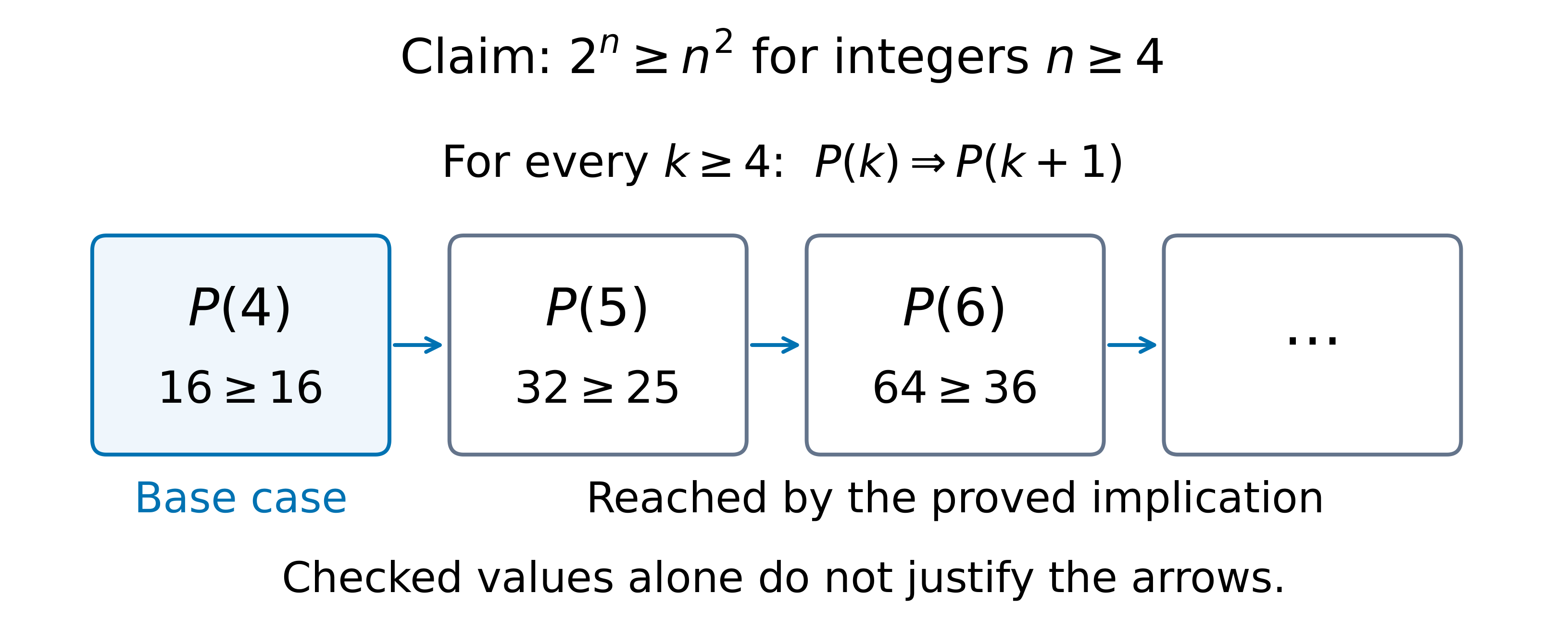
Falling dominoes: prove the first case, prove each case knocks over the next, and every case follows by induction
Induction is like dominoes: if the first falls, and each one knocks over the next, they all fall.
An induction proof can start at any first value, here ; the general step then links each case to the next.
An induction proof can start at any first value, here = 4$; the general step then links each case to the next.

Worked example 14. Prove that $\displaystyle\sum_{r=1}^n r(3r - 2)^2 = \tfrac14 n^2(n + 1)(9n - 7)$.

  • $n = 1$: the left side is $1 \times 1^2 = 1$ and the right side is $\tfrac14 \times 1 \times 2 \times 2 = 1$. True.
  • Assume it is true for $n = k$. Add the $(k + 1)$th term, $(k + 1)(3k + 1)^2$:
    $$\tfrac14 k^2(k + 1)(9k - 7) + (k + 1)(3k + 1)^2 = \tfrac14(k + 1)\left[9k^3 + 29k^2 + 24k + 4\right]$$
  • The result for $n = k + 1$ is $\tfrac14(k + 1)^2(k + 2)(9k + 2) = \tfrac14(k + 1)\left[(k + 1)(k + 2)(9k + 2)\right]$, and $(k + 1)(k + 2)(9k + 2) = 9k^3 + 29k^2 + 24k + 4$. The two are equal.
  • So it is true for $n = k + 1$, and by induction for all positive integers $n$.

Worked example 15. Prove that $n^3 + 2n$ is divisible by 3 for all positive integers $n$. For $n = 1$, $1 + 2 = 3$. Assume $k^3 + 2k = 3m$. Then

$$(k + 1)^3 + 2(k + 1) = (k^3 + 2k) + 3k^2 + 3k + 3 = 3(m + k^2 + k + 1)$$

which is divisible by 3. So the result is true for all positive integers $n$.

Worked example 16. Prove that $\begin{pmatrix}1 & 1\\ 0 & 1\end{pmatrix}^n = \begin{pmatrix}1 & n\\ 0 & 1\end{pmatrix}$. It is true for $n = 1$. If it is true for $n = k$, then

$$\begin{pmatrix}1 & 1\\ 0 & 1\end{pmatrix}^{k+1} = \begin{pmatrix}1 & k\\ 0 & 1\end{pmatrix}\begin{pmatrix}1 & 1\\ 0 & 1\end{pmatrix} = \begin{pmatrix}1 & k + 1\\ 0 & 1\end{pmatrix}$$

so it is true for $n = k + 1$, and by induction for all positive integers $n$.

词汇 训练
English 中文 拼音
Induction/ɪnˈdʌkʃn/ 数学归纳法 shù xué guī nà fǎ
1.8.1

本课资料

English
  • Pearson Edexcel, International Advanced Level Mathematics, Further Mathematics and Pure Mathematics specification (2018), unit FP1, and the formula booklet.
  • G. Cardano, Ars Magna (Nuremberg, 1545), chapter 37; R. Bombelli, L'Algebra (Bologna, 1572).
  • Pearson Edexcel, WFM01/01 June 2025, questions 1 to 4 and 6 to 9 (adapted).
1.8.1

常见错误

English
  • Writing $i^2 = 1$, or forgetting to multiply the denominator by its conjugate as well.
  • Giving the argument in the wrong quadrant; draw the Argand diagram first.
  • Forgetting the conjugate root of a polynomial with real coefficients.
  • Using $\alpha + \beta = \dfrac ba$ instead of $-\dfrac ba$.
  • Giving a root from a calculator's solver without showing the values of $f$.
  • Multiplying matrices in the wrong order: $\mathbf{AB}$ means $\mathbf B$ first.
  • Leaving out the concluding sentence of an induction proof.
1.8.1

关键术语

English
  • Complex conjugate: $z^* = a - bi$ for $z = a + bi$.
  • Modulus: the distance of $z$ from the origin on an Argand diagram.
  • Argument: the angle of $z$ measured from the positive real axis.
  • Singular matrix: a matrix with determinant 0, which has no inverse.
  • Area scale factor: $\lvert\det\mathbf M\rvert$, the factor by which a transformation multiplies areas.
  • Mathematical induction: a proof that a statement for $n = 1$, and the step from $n = k$ to $n = k + 1$, together prove it for all positive integers.
1.8.1

自我检测

English
  1. Find $(2 + 3i)(4 - i)$ and $\dfrac{5}{2 + i}$.
  2. Find the modulus and argument of $-1 + i$.
  3. $2 - i$ is a root of $z^3 - 3z^2 + z + 5 = 0$. Find the other roots.
  4. The roots of $2x^2 - 3x + 4 = 0$ are $\alpha$ and $\beta$. Find $\alpha^2 + \beta^2$.
  5. Find the inverse of $\begin{pmatrix}2 & 1\\ 5 & 3\end{pmatrix}$.
  6. Describe the transformation given by $\begin{pmatrix}0 & -1\\ 1 & 0\end{pmatrix}$.
  7. Find $\displaystyle\sum_{r=1}^{n}(2r + 1)$ in terms of $n$.

Answers: 1. $11 + 10i$; $\dfrac{5(2 - i)}{5} = 2 - i$. 2. $\sqrt2$, $\dfrac{3\pi}{4}$. 3. $2 + i$ is a root, so $z^2 - 4z + 5$ is a factor; $z^3 - 3z^2 + z + 5 = (z^2 - 4z + 5)(z + 1)$, so the roots are $2 + i$, $2 - i$ and $-1$. 4. $\alpha + \beta = \tfrac32$, $\alpha\beta = 2$, so $\tfrac94 - 4 = -\tfrac74$. 5. $\begin{pmatrix}3 & -1\\ -5 & 2\end{pmatrix}$ (the determinant is 1). 6. A rotation of $90°$ anticlockwise about the origin. 7. $n(n + 1) + n = n^2 + 2n$.

该知识点的互动课程

逐步完成,配合即时检查练习。

更多 Edexcel International A-Level 纯数学 知识点

登录或创建账户

IGCSE, A-Level & AP