跳到主要内容

FP2 · Further Pure Mathematics 2

Edexcel International A-Level 纯数学 · 知识点 6

本主题的视频课程 打开视频页面
25:26

进阶纯数学2

试卷 WFM02:1 小时 30 分钟,75 分,建立在 P1 到 P4 以及 FP1 之上。它的工具:模不等式、差分法、欧拉与棣莫弗、轨迹……

英文讲解 · 可切换中英文字幕

2.1.1

进阶纯数学2:不等式、高阶复数与微分方程

English

Why it matters. In 1748 the Swiss mathematician Leonhard Euler, then working at the Berlin Academy, published Introductio in analysin infinitorum, a textbook on infinite series. In chapter 8 he showed that the series for $e^x$, $\cos x$ and $\sin x$ fit together in a surprising way when $x$ is imaginary: $e^{ix} = \cos x + i\sin x$. Put $x = \pi$ and you get $e^{i\pi} + 1 = 0$, which links the five most important numbers in mathematics. Euler's formula turns difficult trigonometry into simple algebra with powers. Engineers use it every day to analyse vibrating bridges, electrical circuits and radio signals, and the differential equations in this unit describe the same vibrations.

In this unit you will:

  • solve inequalities involving the modulus sign, and sum series by the method of differences;
  • use Euler's relation and de Moivre's theorem, and find the $n$th roots of complex numbers;
  • sketch loci in the Argand diagram, and find images under transformations $w = \frac{az + b}{cz + d}$;
  • solve first and second order differential equations;
  • find Maclaurin and Taylor series, and work with curves in polar coordinates.

Edexcel International A Level, Further Pure Mathematics 2 (FP2, paper WFM02/01, 1 hour 30 minutes, 75 marks). Pure Mathematics 1 to 4 and FP1 are assumed, especially partial fractions, integration by parts and substitution, separation of variables, and complex numbers.

These results are assumed knowledge:

Topic Results
modulus $\lvert x\rvert = x$ if $x \ge 0$ and $-x$ if $x < 0$; $\lvert z_1z_2\rvert = \lvert z_1\rvert\lvert z_2\rvert$, $\arg(z_1z_2) = \arg z_1 + \arg z_2$
sums $\sum r = \tfrac12 n(n + 1)$; $\sum r^2$ and $\sum r^3$ are in the formula booklet
partial fractions for example $\dfrac{1}{r(r + 1)} = \dfrac1r - \dfrac{1}{r + 1}$
calculus product, quotient and chain rules; integration by substitution, by parts and with partial fractions
2.1.1

Inequalities involving the modulus sign

English

There are two safe methods:

  • split into cases using the definition of the modulus, and keep only the solutions that lie in each case's own range;
  • if both sides are moduli (so both are positive or zero), square both sides: $\lvert A\rvert > \lvert B\rvert$ means $A^2 > B^2$.

Never multiply both sides by an expression unless you know its sign; if you do not, split into cases.

Worked example 1. Solve $\lvert x^2 - 1\rvert > 2(x + 1)$.

  • Case $x^2 \ge 1$ (that is, $x \le -1$ or $x \ge 1$): $x^2 - 1 > 2x + 2$, so $x^2 - 2x - 3 > 0$, $(x - 3)(x + 1) > 0$, giving $x < -1$ or $x > 3$. Both parts lie in this case's range.
  • Case $-1 < x < 1$: $1 - x^2 > 2x + 2$, so $x^2 + 2x + 1 < 0$, that is $(x + 1)^2 < 0$, which is impossible.
  • Solution: $x < -1$ or $x > 3$.

Worked example 2. The curve $C$ is $y = \dfrac{15x}{\lvert x\rvert + 4}$ and the line $l$ is $y = x - 2$.

(a) Solve $x - 2 > \dfrac{15x}{\lvert x\rvert + 4}$. The denominator is always positive, so multiply by it.

  • For $x \ge 0$: $(x - 2)(x + 4) > 15x$ gives $x^2 - 13x - 8 > 0$, so $x > \dfrac{13 + \sqrt{201}}{2}$ (the other root is negative).
  • For $x < 0$: $(x - 2)(4 - x) > 15x$ gives $x^2 + 9x + 8 < 0$, so $-8 < x < -1$.

(b) Solve $\lvert x - 2\rvert > \left\lvert \dfrac{15x}{\lvert x\rvert + 4}\right\rvert$. Square and multiply by $(\lvert x\rvert + 4)^2$. This gives $PQ > 0$, where $P = (x - 2)(\lvert x\rvert + 4) - 15x$ is the expression from part (a) and $Q = (x - 2)(\lvert x\rvert + 4) + 15x$. So $P$ and $Q$ must have the same sign.

  • For $x \ge 0$: $P = x^2 - 13x - 8$ and $Q = x^2 + 17x - 8$. Both are positive for $x > \dfrac{13 + \sqrt{201}}{2}$, and both are negative for $0 \le x < \dfrac{\sqrt{321} - 17}{2}$.
  • For $x < 0$: $Q = -x^2 + 21x - 8$ is always negative, so we need $P < 0$, which gives $x < -8$ or $-1 < x < 0$.
  • Solution: $x < -8$, or $-1 < x < \dfrac{\sqrt{321} - 17}{2}$, or $x > \dfrac{13 + \sqrt{201}}{2}$.

Check $x = -5$: $\lvert x - 2\rvert = 7$ but $\left\lvert\frac{-75}{9}\right\rvert = 8.3$, so $-5$ is correctly not included.

Top: the curve y = 15x/(|x| + 4) and the line y = x − 2, with the intervals where the line is above the curve shaded; bottom: the moduli of both sides and the three solution intervals
Top: the curve and the line, with the intervals where the line is above the curve shaded. Bottom: the moduli of both sides, which cross at $x = -8$, $-1$, $\tfrac{\sqrt{321} - 17}{2}$ and $\tfrac{13 + \sqrt{201}}{2}$.
探索

二次方程与不等式

y=(x²-10x+21)/4

该图像将纵轴按正数因子 1/4 进行了缩放。请检查为何其根仍为 3 和 7。

2.2.1

The method of differences

English

The method of differences 差分法 sums a series by writing each term as a difference, usually using partial fractions 部分分式, so that most of the terms cancel. Write out the terms for $r = 1$, $r = 2$, …, $r = n - 1$ and $r = n$ to show clearly what cancels; this earns marks.

Rows r = 1 to n of 1/(r+1) − 1/(r+2): each negative term is struck out against the positive term on the next line, leaving the boxed 1/2 and −1/(n+2), so the sum is n/(2(n+2))
Write out the first and last rows: the middle terms cancel.

Worked example 3. Show that $\displaystyle\sum_{r=1}^{n} \frac{1}{(r + 1)(r + 2)} = \frac{n}{2(n + 2)}$.

$$\frac{1}{(r + 1)(r + 2)} = \frac{1}{r + 1} - \frac{1}{r + 2}$$
$$\sum = \left(\tfrac12 - \tfrac13\right) + \left(\tfrac13 - \tfrac14\right) + \dots + \left(\tfrac{1}{n + 1} - \tfrac{1}{n + 2}\right) = \frac12 - \frac{1}{n + 2} = \frac{n}{2(n + 2)}$$

Check with $n = 1$: both sides are $\tfrac16$. To find the smallest $n$ for which the sum is more than 0.49, solve $\dfrac{n}{2(n + 2)} > 0.49$: $n > 0.98n + 1.96$, so $n > 98$ and the smallest value is $n = 99$.

词汇 训练
English 中文 拼音
method of differences/ˈmeθəd ɒv ˈdɪfrənsɪz/ 差分法 chā fēn fǎ
partial fractions/ˈpɑːʃl ˈfrækʃnz/ 部分分式 bù fèn fēn shì
2.3.1 2.3.2

Euler's relation and de Moivre's theorem

English

Euler's relation 欧拉关系式 is

$$e^{i\theta} = \cos\theta + i\sin\theta$$

So a complex number with modulus $r$ and argument $\theta$ can be written $z = re^{i\theta}$, and then $z^n = r^n e^{in\theta}$. It also gives $\cos\theta = \tfrac12\left(e^{i\theta} + e^{-i\theta}\right)$ and $\sin\theta = \dfrac{1}{2i}\left(e^{i\theta} - e^{-i\theta}\right)$.

De Moivre's theorem 棣莫弗定理 states that

$$(\cos\theta + i\sin\theta)^n = \cos n\theta + i\sin n\theta$$

You can prove it for positive integers by induction: it is true for $n = 1$, and multiplying $(\cos k\theta + i\sin k\theta)(\cos\theta + i\sin\theta)$ and using the addition formulae gives $\cos(k + 1)\theta + i\sin(k + 1)\theta$.

Multiple angles. Expand $(\cos\theta + i\sin\theta)^n$ with the binomial theorem, and compare real or imaginary parts with $\cos n\theta + i\sin n\theta$.

Worked example 4. Show that $\sin 5\theta = 16\sin^5\theta - 20\sin^3\theta + 5\sin\theta$, and hence find $\sin\frac{\pi}{5}$ exactly. Write $c = \cos\theta$ and $s = \sin\theta$. The imaginary part of $(c + is)^5$ is $5c^4s - 10c^2s^3 + s^5$. Substituting $c^2 = 1 - s^2$:

$$5s(1 - s^2)^2 - 10s^3(1 - s^2) + s^5 = 16s^5 - 20s^3 + 5s$$

When $5\theta = \pi$, $\sin 5\theta = 0$, so $16s^4 - 20s^2 + 5 = 0$ and $s^2 = \dfrac{5 \pm \sqrt5}{8}$. $\sin\frac{\pi}{5}$ is the smaller positive root (the larger is $\sin\frac{3\pi}{5}$), so $\sin\dfrac{\pi}{5} = \sqrt{\dfrac{5 - \sqrt5}{8}}$.

$n$th roots. The equation $z^n = re^{i\theta}$ has $n$ roots,

$$z = r^{1/n} e^{i(\theta + 2k\pi)/n}, \qquad k = 0, 1, \dots, n - 1$$

They lie equally spaced around a circle of radius $r^{1/n}$.

The three cube roots of 8 on a circle of radius 2, spaced 2 pi / 3 apart, forming an equilateral triangle
The three cube roots of 8 are equally spaced round a circle of radius 2.

Worked example 5. Solve $z^5 = -2\sqrt2 - 2\sqrt6\,i$. The modulus is $\sqrt{8 + 24} = \sqrt{32} = 4\sqrt2$. The point is in the third quadrant with $\tan\alpha = \sqrt3$, so the argument is $-\dfrac{2\pi}{3}$. Since $(4\sqrt2)^{1/5} = \left(2^{5/2}\right)^{1/5} = \sqrt2$,

$$z = \sqrt2\, e^{i\left(-\frac{2\pi}{15} + \frac{2k\pi}{5}\right)}, \qquad k = 0, 1, 2, 3, 4$$

Give exact arguments, not decimals.

探索

复数与根

将 z=a+bi 写成 i²=-1 的形式

对比模型与已解案例,并说明其中一处变化。

词汇 训练
English 中文 拼音
Euler's relation/ˈɔɪləz rɪˈleɪʃn/ 欧拉关系式 ōu lā guān xì shì
de Moivre's theorem/də ˈmɔɪvəz ˈθɪərəm/ 棣莫弗定理 dì mò fú dìng lǐ
2.3.3 2.3.4

Loci, regions and z→w transformations

English

A locus 轨迹 is the set of points that satisfy a condition. In the Argand diagram:

  • $\lvert z - a\rvert = b$ is a circle with centre $a$ and radius $b$;
  • $\lvert z - a\rvert = \lvert z - b\rvert$ is the perpendicular bisector 垂直平分线 of the line joining $a$ and $b$;
  • $\lvert z - a\rvert = k\lvert z - b\rvert$ with $k \ne 1$ is a circle: write $z = x + iy$, square both sides and complete the square;
  • $\arg(z - a) = \beta$ is a half-line starting at $a$.

For a region, replace $=$ with $<$ or $>$, and test one point to decide which side to shade.

Transformations. A Möbius transformation 莫比乌斯变换 has the form $w = \dfrac{az + b}{cz + d}$. To find the image of a locus, make $z$ the subject, then substitute into the condition on $z$. A circle or line in the $z$-plane maps to a circle or line in the $w$-plane.

Worked example 6. Find the image of $\lvert z\rvert = 1$ under $w = \dfrac{9i - iz}{1 + z}$.

  • Make $z$ the subject: $w + wz = 9i - iz$, so $z(w + i) = 9i - w$ and $z = \dfrac{9i - w}{w + i}$.
  • $\lvert z\rvert = 1$ gives $\lvert 9i - w\rvert = \lvert w + i\rvert$: the perpendicular bisector of $9i$ and $-i$.
  • With $w = u + iv$: $u^2 + (v - 9)^2 = u^2 + (v + 1)^2$, so $81 - 18v = 2v + 1$ and $v = 4$.

Check: $z = i$ maps to $\dfrac{1 + 9i}{1 + i} = 5 + 4i$, which lies on $v = 4$.

The unit circle |z| = 1 in the z-plane and its image, the line v = 4, in the w-plane
The unit circle in the $z$-plane maps to the line $v = 4$ in the $w$-plane.
词汇 训练
English 中文 拼音
locus/ˈləʊkəs/ 轨迹 guǐ jì
perpendicular bisector/ˌpɜːpənˈdɪkjʊlə baɪˈsektə/ 垂直平分线 chuí zhí píng fēn xiàn
Möbius transformation/ˈmɜːbɪəs trænsfɔːˈmeɪʃn/ 莫比乌斯变换 mò bǐ wū sī biàn huàn
2.4.1 2.4.2 2.4.3

First order differential equations

English

A first order linear differential equation has the form

$$\frac{dy}{dx} + Py = Q$$

where $P$ and $Q$ are functions of $x$. Multiply every term by the integrating factor 积分因子 $e^{\int P\,dx}$. The left side then becomes the derivative of a product, $\dfrac{d}{dx}\left(y\,e^{\int P\,dx}\right)$, so you can integrate both sides.

A cooling cup of coffee: Newton's law of cooling is a differential equation.

Worked example 7. Solve $\dfrac{dy}{dx} + 2y = e^{-x}$. The integrating factor is $e^{2x}$, so $\dfrac{d}{dx}\left(ye^{2x}\right) = e^{x}$. Integrating, $ye^{2x} = e^{x} + C$, so $y = e^{-x} + Ce^{-2x}$.

Substitutions. If the question gives a substitution, such as $z = \dfrac{1}{y^2}$, use the chain rule to write $\dfrac{dy}{dx}$ in terms of $\dfrac{dz}{dx}$, rewrite the equation in $z$ and $x$, solve it, and then substitute back.

Worked example 8. $2\dfrac{dy}{dx} + y\cot x + y^3\tan x\sec x = 0$, for $0 < x < \tfrac\pi2$.

(a) With $z = y^{-2}$, $\dfrac{dz}{dx} = -2y^{-3}\dfrac{dy}{dx}$, so $2\dfrac{dy}{dx} = -y^3\dfrac{dz}{dx}$. Substitute and divide by $-y^3$:

$$\frac{dz}{dx} - z\cot x = \tan x\sec x$$

(b) The integrating factor is $e^{-\int \cot x\,dx} = e^{-\ln\sin x} = \operatorname{cosec} x$. Then $\dfrac{d}{dx}(z\operatorname{cosec} x) = \dfrac{\tan x\sec x}{\sin x} = \sec^2 x$, so $z\operatorname{cosec} x = \tan x + C$ and

$$y^2 = \frac{1}{\sin x\tan x + C\sin x}$$

(c) Given $y^2 = \tfrac{4\sqrt3}{3}$ when $x = \tfrac\pi6$, we have $z = \tfrac{\sqrt3}{4} = \tfrac{1}{2\sqrt3} + \tfrac C2$, so $C = \tfrac{1}{2\sqrt3}$. When $x = \tfrac\pi3$, $z = \tfrac32 + \tfrac14 = \tfrac74$, so $y^2 = \tfrac47$ and $y = \pm\tfrac{2}{\sqrt7}$. Both signs are possible, because only $y^2$ was known.

探索

微分方程与数值解法

对于 dy/dx=ky,分离变量得 dy/y=k dx,解为 y=Ae^(kx)

对比模型与已解案例,并说明其中一处变化。

词汇 训练
English 中文 拼音
integrating factor/ˈɪntɪɡreɪtɪŋ ˈfæktə/ 积分因子 jī fēn yīn zi
2.5.1 2.5.2

Second order differential equations

English

For $a\dfrac{d^2y}{dx^2} + b\dfrac{dy}{dx} + cy = f(x)$, the general solution is the complementary function plus a particular integral.

  • The complementary function 余函数 (CF) solves the equation with $f(x) = 0$. Find it from the roots of the auxiliary equation 辅助方程 $am^2 + bm + c = 0$.
  • A particular integral 特积分 (PI) is any one solution of the full equation. Try a function of the same form as $f(x)$.
A pendulum clock
The small swings of a pendulum obey a second order differential equation.
Roots of the auxiliary equation Complementary function
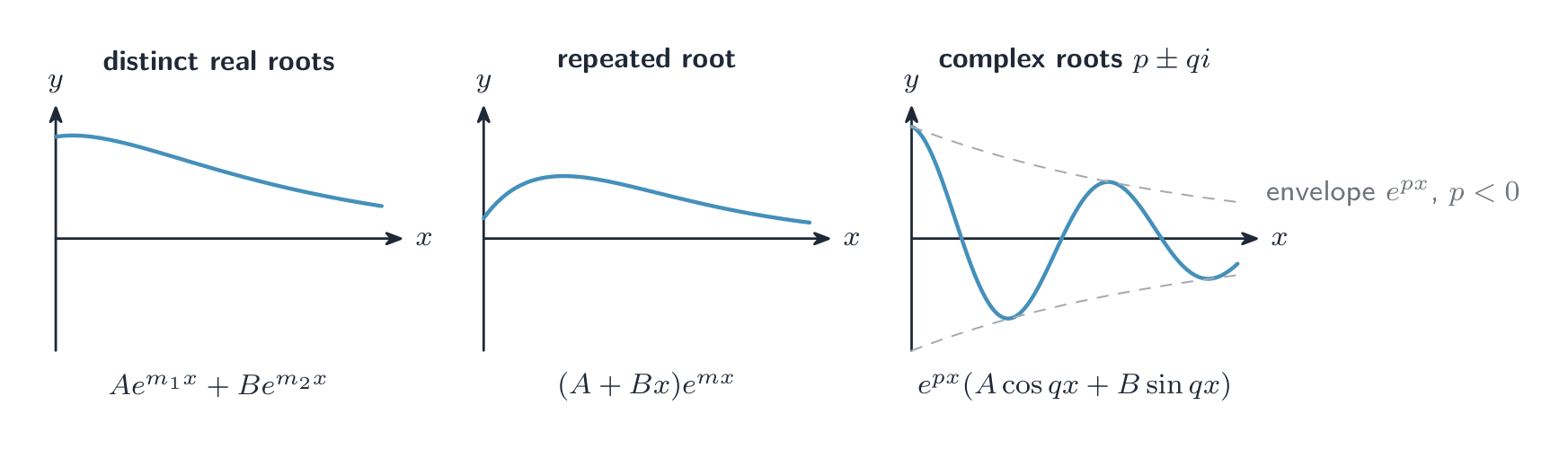
two different real roots $m_1$, $m_2$ $y = Ae^{m_1x} + Be^{m_2x}$
one repeated root $m$ $y = (A + Bx)e^{mx}$
complex roots $p \pm qi$ $y = e^{px}(A\cos qx + B\sin qx)$
$f(x)$ Try as particular integral
$ke^{px}$ $\lambda e^{px}$; if $p$ is a root of the auxiliary equation, $\lambda xe^{px}$
a polynomial such as $a + bx$ a polynomial of the same degree, $\lambda + \mu x$
$m\cos\omega x + n\sin\omega x$ $\lambda\cos\omega x + \mu\sin\omega x$
Three sketches of complementary functions: distinct real roots give a sum of two exponentials, a repeated root gives (A + Bx)e^{mx}, and complex roots p ± qi give an oscillation inside an exponential envelope
The roots of the auxiliary equation set the shape of the complementary function; here every root has a negative real part.

Use any initial conditions last, with the complete general solution.

Worked example 9. $y = \lambda xe^{3x}$ is a particular integral of $4\dfrac{d^2y}{dx^2} - 11\dfrac{dy}{dx} - 3y = 78e^{3x}$.

(a) $y' = \lambda e^{3x}(1 + 3x)$ and $y'' = \lambda e^{3x}(6 + 9x)$. The left side is $\lambda e^{3x}(24 + 36x - 11 - 33x - 3x) = 13\lambda e^{3x}$, so $13\lambda = 78$ and $\lambda = 6$. (The trial $\lambda e^{3x}$ would give 0, because 3 is a root of the auxiliary equation.)

(b) $4m^2 - 11m - 3 = (4m + 1)(m - 3) = 0$, so $m = -\tfrac14$ or 3, and $y = Ae^{-x/4} + Be^{3x} + 6xe^{3x}$.

(c) When $x = 0$, $y = \tfrac92$ and $\dfrac{dy}{dx} = 0$. Then $A + B = \tfrac92$ and $-\tfrac A4 + 3B + 6 = 0$, giving $A = 6$ and $B = -\tfrac32$:

$$y = 6e^{-x/4} - \tfrac32 e^{3x} + 6xe^{3x}$$
词汇 训练
English 中文 拼音
complementary function/ˌkɒmplɪˈmentəri ˈfʌŋkʃn/ 余函数 yú hán shù
auxiliary equation/ɔːkˈsɪlɪəri ɪˈkweɪʒn/ 辅助方程 fǔ zhù fāng chéng
particular integral/pəˈtɪkjʊlə ˈɪntɪɡrəl/ 特积分 tè jī fēn
2.6.1 2.6.2 2.6.3 2.6.4

麦克劳林级数与泰勒级数

English

The Maclaurin series 麦克劳林级数 of $f(x)$ is

$$f(x) = f(0) + f'(0)x + \frac{f''(0)}{2!}x^2 + \frac{f'''(0)}{3!}x^3 + \dots$$

The Taylor series 泰勒级数 about $x = a$ is

$$f(x) = f(a) + f'(a)(x - a) + \frac{f''(a)}{2!}(x - a)^2 + \frac{f'''(a)}{3!}(x - a)^3 + \dots$$
Sine curve compared with first-, third- and fifth-order Maclaurin polynomials
The curves compare $\sin x$ with $T_1=x$, $T_3=x-x^3/6$ and $T_5=x-x^3/6+x^5/120$.

For a differential equation, use the equation to find $y''(a)$ from $y(a)$ and $y'(a)$. Then differentiate the whole equation to find $y'''(a)$.

Worked example 10. $\dfrac{d^2y}{dx^2} - 4\dfrac{dy}{dx} - 5y = e^{2x/9}$, with $y = 2$ and $\dfrac{dy}{dx} = -1$ when $x = 3$. Find the series solution up to the term in $(x - 3)^3$.

  • At $x = 3$: $y'' = 4y' + 5y + e^{2/3} = -4 + 10 + e^{2/3} = 6 + e^{2/3}$.
  • Differentiate the equation: $y''' = 4y'' + 5y' + \tfrac29 e^{2x/9}$. At $x = 3$: $y''' = 24 + 4e^{2/3} - 5 + \tfrac29e^{2/3} = 19 + \tfrac{38}{9}e^{2/3}$.
  • So
    $$y = 2 - (x - 3) + \left(3 + \tfrac12 e^{2/3}\right)(x - 3)^2 + \left(\tfrac{19}{6} + \tfrac{19}{27}e^{2/3}\right)(x - 3)^3 + \dots$$
探索

级数、有限差分与泰勒展开

关于 x=a,f(x)=f(a)+f'(a)(x-a)+f''(a)(x-a)²/2!+

对比模型与已解案例,并说明其中一处变化。

词汇 训练
English 中文 拼音
Maclaurin series/məˈklɔːrɪn ˈsɪəriːz/ 麦克劳林级数 mài kè láo lín jí shù
Taylor series/ˈteɪlə ˈsɪəriːz/ 泰勒级数 tài lēi jí shù
2.7.1 2.7.1#occurrence2

Polar coordinates and areas

English

In polar coordinates 极坐标, a point is described by $(r, \theta)$: its distance $r$ from the pole (the origin), and the angle $\theta$ measured anticlockwise from the initial line 初始线 (the positive $x$-axis). To convert, use $x = r\cos\theta$, $y = r\sin\theta$ and $r^2 = x^2 + y^2$.

Worked example 11. Convert $r = 4\cos\theta$ to Cartesian form. Multiply by $r$: $r^2 = 4r\cos\theta$, so $x^2 + y^2 = 4x$, which is the circle $(x - 2)^2 + y^2 = 4$.

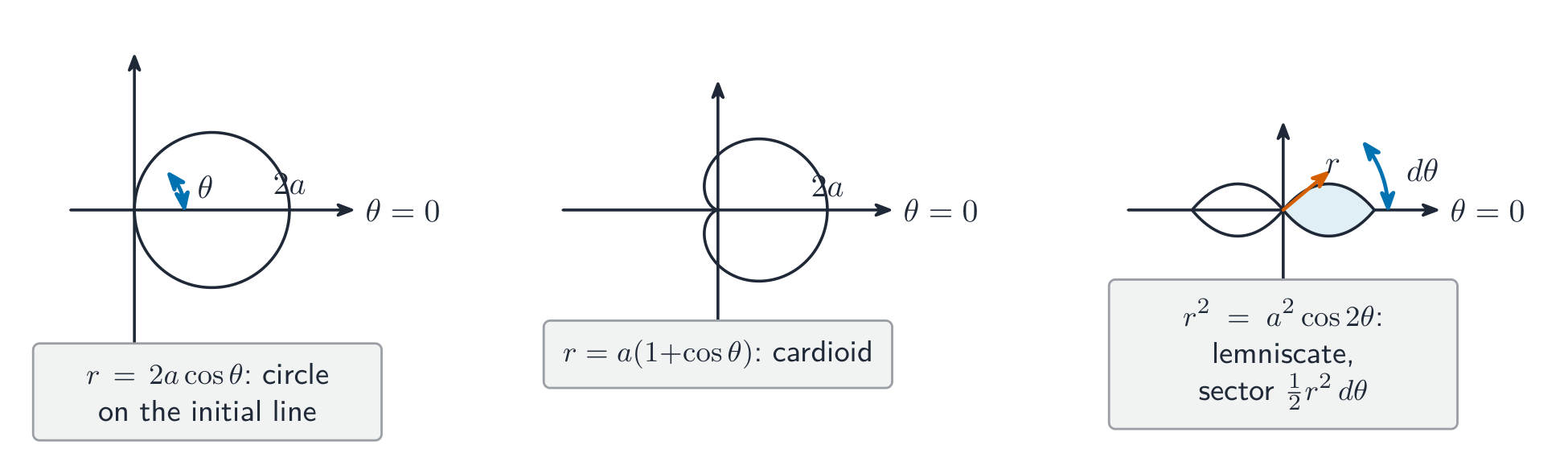
Curves to know: $r = 2a\cos\theta$ (a circle through the pole), $r = k\theta$ (a spiral), $r = a(1 + \cos\theta)$ (a cardioid 心形线), and $r^2 = a^2\cos 2\theta$ (a lemniscate 双纽线, which exists only where $\cos 2\theta \ge 0$).

A spiral staircase: spirals are described naturally in polar coordinates (r, theta)
A spiral staircase: spirals are described most simply in polar coordinates..

The area bounded by a curve and the half-lines $\theta = \alpha$ and $\theta = \beta$ is

$$A = \frac12\int_\alpha^\beta r^2\,d\theta$$

A tangent is parallel to the initial line where $\dfrac{dy}{d\theta} = 0$, and perpendicular to it where $\dfrac{dx}{d\theta} = 0$, using $y = r\sin\theta$ and $x = r\cos\theta$.

Polar grids showing a circle through the pole, a cardioid and a lemniscate with one loop shaded
A circle through the pole, a cardioid and a lemniscate, with the area element $\tfrac12 r^2\,d\theta$.

Worked example 12. Find the area enclosed by the lemniscate $r^2 = 8\cos 2\theta$. One loop lies between $\theta = -\tfrac\pi4$ and $\tfrac\pi4$:

$$\frac12\int_{-\pi/4}^{\pi/4} 8\cos 2\theta\,d\theta = 4\left[\tfrac12\sin 2\theta\right]_{-\pi/4}^{\pi/4} = 4$$

So the two loops enclose a total area of 8.

Worked example 13. Find the area enclosed by the cardioid $r = 2(1 + \cos\theta)$.

$$\frac12\int_{-\pi}^{\pi} 4(1 + \cos\theta)^2\,d\theta = 2\int_{-\pi}^{\pi}\left(1 + 2\cos\theta + \cos^2\theta\right)d\theta = 2(2\pi + 0 + \pi) = 6\pi$$

using $\cos^2\theta = \tfrac12(1 + \cos 2\theta)$, so that $\int_{-\pi}^{\pi}\cos^2\theta\,d\theta = \pi$.

探索

极坐标曲线与面积

使用 x=r cosθ 和 y=r sinθ

对比模型与已解案例,并说明其中一处变化。

词汇 训练
English 中文 拼音
polar coordinates/ˈpəʊlə kəʊˈɔːdɪnəts/ 极坐标 jí zuò biāo
initial line/ɪˈnɪʃl laɪn/ 初始线 chū shǐ xiàn
cardioid/ˈkɑːdiɔɪd/ 心形线 xīn xíng xiàn
lemniscate/ˈlemnɪskeɪt/ 双纽线 shuāng niǔ xiàn
2.7.1 2.7.1#occurrence2

本课资料

English
  • Pearson Edexcel, International Advanced Level Mathematics, Further Mathematics and Pure Mathematics specification (2018), unit FP2, and the formula booklet.
  • L. Euler, Introductio in analysin infinitorum, volume 1 (Lausanne, 1748), chapter 8.
  • Pearson Edexcel, WFM02/01 June 2025, questions 1 to 6, 8 and 9 (adapted).
2.7.1 2.7.1#occurrence2

常见错误

English
  • Multiplying an inequality by an expression whose sign is unknown.
  • Squaring an inequality when one side could be negative.
  • Not writing out enough terms in the method of differences to show which terms are left.
  • Giving only one $n$th root, or decimal arguments instead of exact ones.
  • Forgetting to multiply $Q$ by the integrating factor as well.
  • Using $\lambda e^{px}$ as the particular integral when $p$ is already a root of the auxiliary equation.
  • Finding the constants from the complementary function alone instead of the complete solution.
  • Using the wrong limits for one loop of a polar curve.
2.7.1 2.7.1#occurrence2

关键术语

English
  • Method of differences: summing a series by writing each term as a difference so that most terms cancel.
  • Euler's relation: $e^{i\theta} = \cos\theta + i\sin\theta$.
  • De Moivre's theorem: $(\cos\theta + i\sin\theta)^n = \cos n\theta + i\sin n\theta$.
  • Integrating factor: $e^{\int P\,dx}$, which turns the left side of $y' + Py = Q$ into the derivative of a product.
  • Complementary function: the general solution of the equation with the right side set to zero.
  • Particular integral: one solution of the complete differential equation.
  • Polar coordinates: a distance from the pole and an angle from the initial line.
2.7.1 2.7.1#occurrence2

自我检测

English
  1. Solve $\lvert 2x - 1\rvert < \lvert x + 4\rvert$.
  2. Use the method of differences to find $\displaystyle\sum_{r=1}^{n}\frac{1}{r(r + 1)}$.
  3. Write $\left(\sqrt3 + i\right)^6$ in the form $a + bi$.
  4. Solve $\dfrac{dy}{dx} - \dfrac{y}{x} = x$ for $x > 0$.
  5. Find the general solution of $\dfrac{d^2y}{dx^2} + 4y = 0$.
  6. Find the Maclaurin series of $e^{2x}$ up to the term in $x^3$.
  7. Find the area enclosed by the circle $r = 2\cos\theta$, using polar integration.

Answers: 1. Square: $4x^2 - 4x + 1 < x^2 + 8x + 16$, so $3x^2 - 12x - 15 < 0$, $(x - 5)(x + 1) < 0$, giving $-1 < x < 5$. 2. $\dfrac1r - \dfrac{1}{r + 1}$, so the sum is $1 - \dfrac{1}{n + 1} = \dfrac{n}{n + 1}$. 3. $\sqrt3 + i = 2e^{i\pi/6}$, so the answer is $64e^{i\pi} = -64$. 4. The integrating factor is $\dfrac1x$, so $\dfrac{y}{x} = x + C$ and $y = x^2 + Cx$. 5. $m = \pm 2i$, so $y = A\cos 2x + B\sin 2x$. 6. $1 + 2x + 2x^2 + \tfrac43 x^3$. 7. $\tfrac12\displaystyle\int_{-\pi/2}^{\pi/2} 4\cos^2\theta\,d\theta = \pi$.

该知识点的互动课程

逐步完成,配合即时检查练习。

更多 Edexcel International A-Level 纯数学 知识点

登录或创建账户

IGCSE, A-Level & AP