| Learning Objective | Essential Knowledge |
|---|---|
3.1.A |
|
3.1.B |
|
三角函数与极坐标函数
AP 微积分预备 · 第 3 主题
 8:08
8:08
Trigonometric & Polar Functions
Watch a point travel around a circle at a steady rate. Its height rises, falls, and rises again, over and over. Trace that height against time, and you get a…
英文讲解 · 内嵌中英文字幕
3.1
周期现象
大纲
来源:美国大学理事会 AP 课程与考试说明
一个关系是周期性(periodic)的,若它的输出模式在规则的输入步重复。周期(period)是使所有 $x$ 满足 $f(x+k)=f(x)$ 的最小正 $k$。你能通过复制一个单一的周期段(cycle)构建整个图象,并通过找到模式重复的间隔多远来估计周期。在每个周期段内一个周期函数仍有递增/递减和极大值/极小值的区间。
词汇表
训练
| 英文 | 中文 | 拼音 |
|---|---|---|
| periodic/ˌpɪərɪˈɒdɪk/ | 周期性 | zhōu qī xìng |
| period/ˈpɪərɪəd/ | 周期 | zhōu qī |
| cycle/ˈsaɪkl/ | 周期段 | zhōu qī duàn |
3.2
正弦、余弦与正切
大纲
| Learning Objective | Essential Knowledge |
|---|---|
3.2.A |
|
来源:美国大学理事会 AP 课程与考试说明
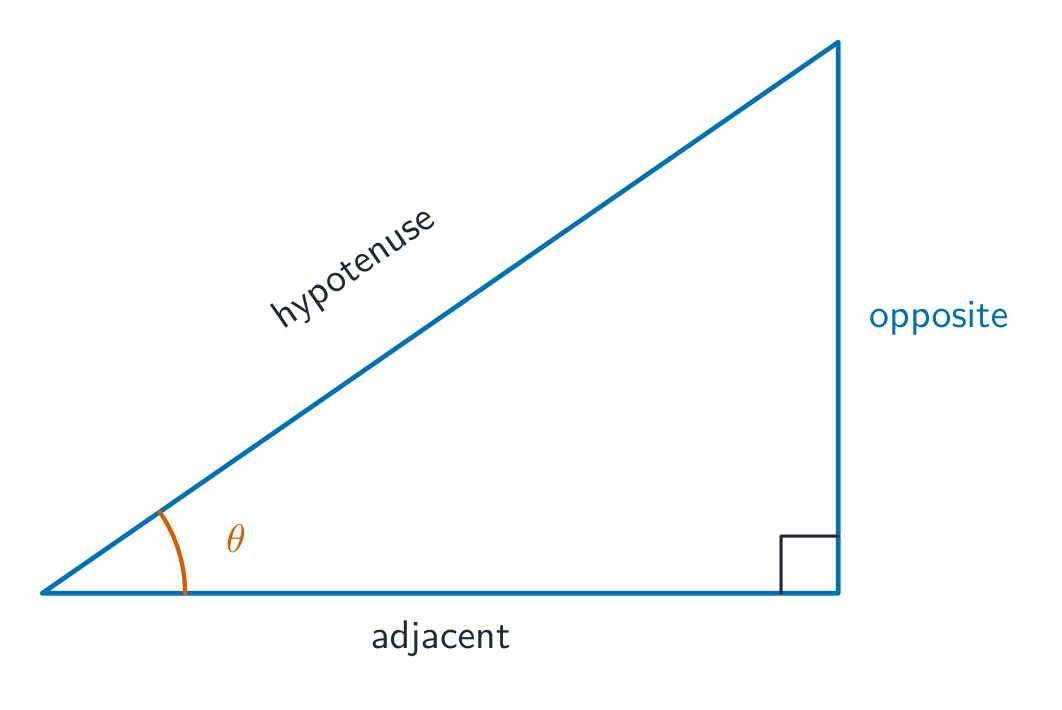
一个角处于标准位置(standard position),当它的顶点在原点而它的始边位于正 $x$ 轴上时。它的弧度(radian)度量是一个单位圆上的弧长。对于终边遇到一个半径 $r$ 的圆的点 $P$:
$$\cos\theta = \frac{x}{r},\qquad \sin\theta = \frac{y}{r},\qquad \tan\theta = \frac{y}{x}\ (\text{the slope of the terminal ray}).$$
探索
Read sine and cosine off the unit circle
On the unit circle a point at angle $\theta$ has coordinates $(\cos\theta,\ \sin\theta)$. Spin the angle to watch sine and cosine trace out as the height and width.
词汇表
训练
| 英文 | 中文 | 拼音 |
|---|---|---|
| standard position/ˈstændəd pəˈzɪʃn/ | 标准位置 | biāo zhǔn wèi zhì |
| radian/ˈreɪdɪən/ | 弧度 | hú dù |
3.3
正弦与余弦函数值
大纲
| Learning Objective | Essential Knowledge |
|---|---|
3.3.A |
|
来源:美国大学理事会 AP 课程与考试说明
在一个半径 $r$ 的圆上,$x=r\cos\theta$ 而 $y=r\sin\theta$。特殊角处($0,\tfrac{\pi}{6},\tfrac{\pi}{4},\tfrac{\pi}{3},\tfrac{\pi}{2},\dots$)的精确值来自等腰直角和等边三角形(equilateral triangle)几何,符号由角的象限(quadrant)设定。
词汇表
训练
| 英文 | 中文 | 拼音 |
|---|---|---|
| equilateral triangle/ˌiːkwɪˈlætərəl ˈtraɪæŋɡl/ | 等边三角形 | děng biān sān jiǎo xíng |
| quadrant/ˈkwɒdrənt/ | 象限 | xiàng xiàn |
3.4
正弦与余弦函数图像
大纲
| Learning Objective | Essential Knowledge |
|---|---|
3.4.A |
|
来源:美国大学理事会 AP 课程与考试说明
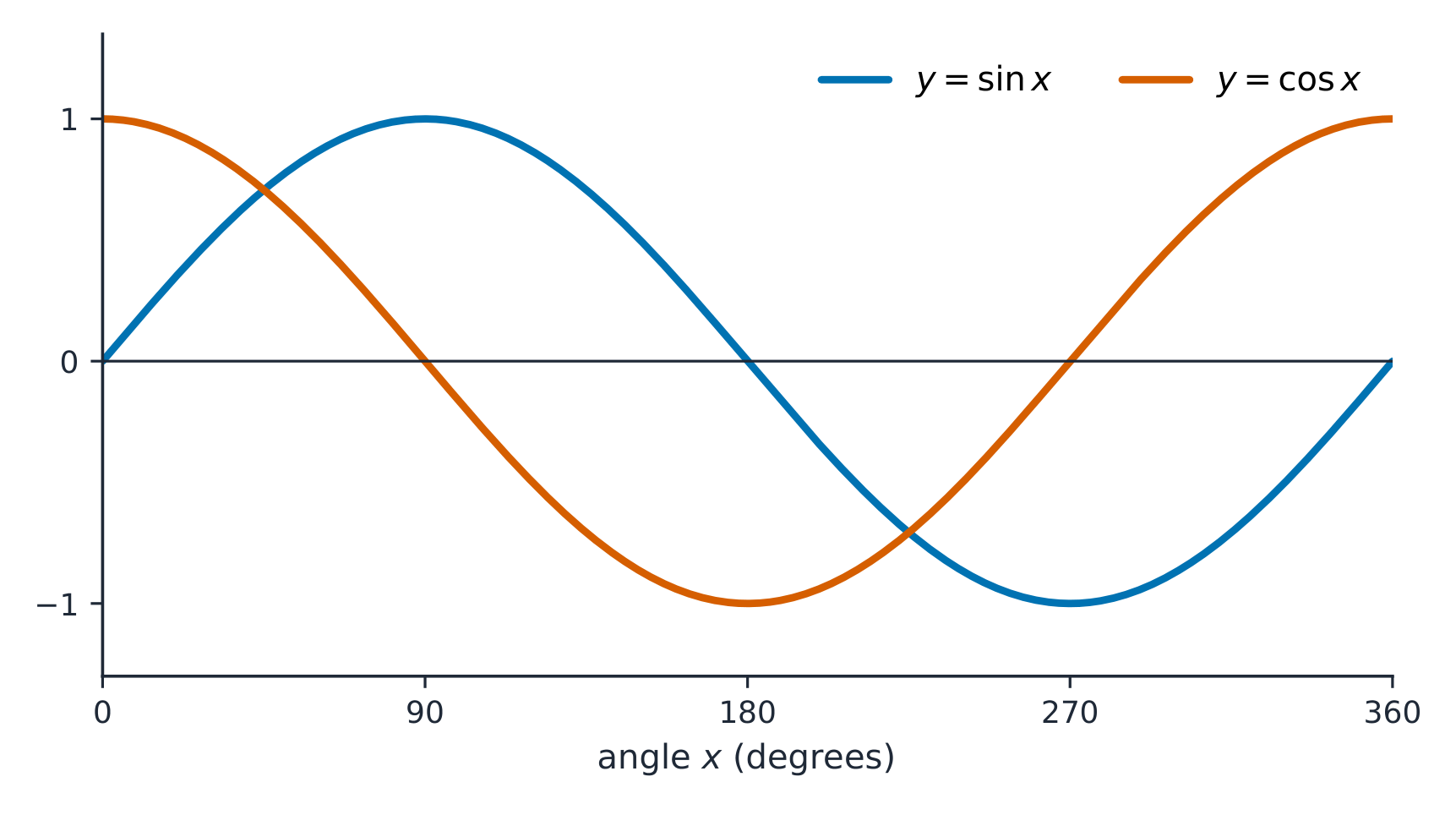
在单位圆(unit circle)($r=1$)上,$\sin\theta$ 是 $y$ 坐标而 $\cos\theta$ 是 $x$ 坐标。随着 $\theta$ 增加,两者以周期 $2\pi$ 在 $-1$ 和 $1$ 之间平滑地振荡(oscillate)。正弦从 $0$ 开始(上升);余弦从 $1$ 开始。它们是移动了 $\tfrac{\pi}{2}$ 的同一个波。
探索
Graph a sine wave
Unrolling the circle gives the wave $y=\sin x$: it repeats every $2\pi$ (its period) and swings between $-1$ and $1$ (its amplitude).
词汇表
训练
| 英文 | 中文 | 拼音 |
|---|---|---|
| unit circle/ˈjuːnɪt ˈsɜːkl/ | 单位圆 | dān wèi yuán |
| oscillate/ˈɒsɪleɪt/ | 振荡 | zhèn dàng |
3.5
正弦型函数
大纲
| Learning Objective | Essential Knowledge |
|---|---|
3.5.A |
|
来源:美国大学理事会 AP 课程与考试说明
一个正弦型函数(sinusoidal function)是正弦(或余弦)的任何变换。它的关键特征:
- 周期和频率(frequency)互为倒数;$\sin\theta$ 有周期 $2\pi$。
- 振幅(amplitude)= 最大和最小输出之间距离的一半。
- 中线(midline)$y=d$ = 最大和最小的平均(水平的中心线)。
图象每半个周期段交替上凹和下凹。
Worked example. 对于 $f(\theta)=3\sin(2\theta)+1$:振幅是 $3$、周期是 $\dfrac{2\pi}{2}=\pi$,而中线是 $y=1$。所以最大输出是 $1+3=4$ 而最小是 $1-3=-2$。
词汇表
训练
| 英文 | 中文 | 拼音 |
|---|---|---|
| sinusoidal function/ˌsaɪnəˈsɔɪdl ˈfʌŋkʃn/ | 正弦型函数 | zhèng xián xíng hán shù |
| frequency/ˈfriːkwənsi/ | 频率 | pín lǜ |
| Amplitude/ˈæmplɪtjuːd/ | 振幅 | zhèn fú |
| Midline/ˈmɪdlaɪn/ | 中线 | zhōng xiàn |
3.6
正弦型函数的变换
大纲
| Learning Objective | Essential Knowledge |
|---|---|
3.6.A |
|
来源:美国大学理事会 AP 课程与考试说明
一般的正弦型函数是
$$f(\theta)=a\sin\big(b(\theta+c)\big)+d \quad\text{or}\quad a\cos\big(b(\theta+c)\big)+d,$$
其中 $|a|$ 是振幅、$\dfrac{2\pi}{|b|}$ 是周期、$-c$ 是水平相移(phase shift)(括号里的 $+c$ 把图像向左移 $c$),而 $d$ 是竖直移动(vertical shift)(中线)。一个负的 $a$ 反射这个波。
探索
Stretch and shift a sinusoid
In $y=a\sin(bx+c)+d$: $a$ sets the amplitude, $b$ the period, $c$ a horizontal phase shift, and $d$ a vertical shift. Change each and watch the wave respond.
词汇表
训练
| 英文 | 中文 | 拼音 |
|---|---|---|
| phase shift/feɪz ʃɪft/ | 相移 | xiāng yí |
3.7
正弦型函数的情境与数据建模
大纲
| Learning Objective | Essential Knowledge |
|---|---|
3.7.A |
|
来源:美国大学理事会 AP 课程与考试说明
要为周期数据(潮汐、日照、温度)建模:从模式重复的地方读周期、从最大和最小得到振幅和中线,并设定相移使一个峰落在正确的输入处。技术拟合一个正弦回归。这样一个模型只在它的上下文定义域上可信。
3.8
正切函数
大纲
| Learning Objective | Essential Knowledge |
|---|---|
3.8.A |
|
3.8.B |
|
来源:美国大学理事会 AP 课程与考试说明
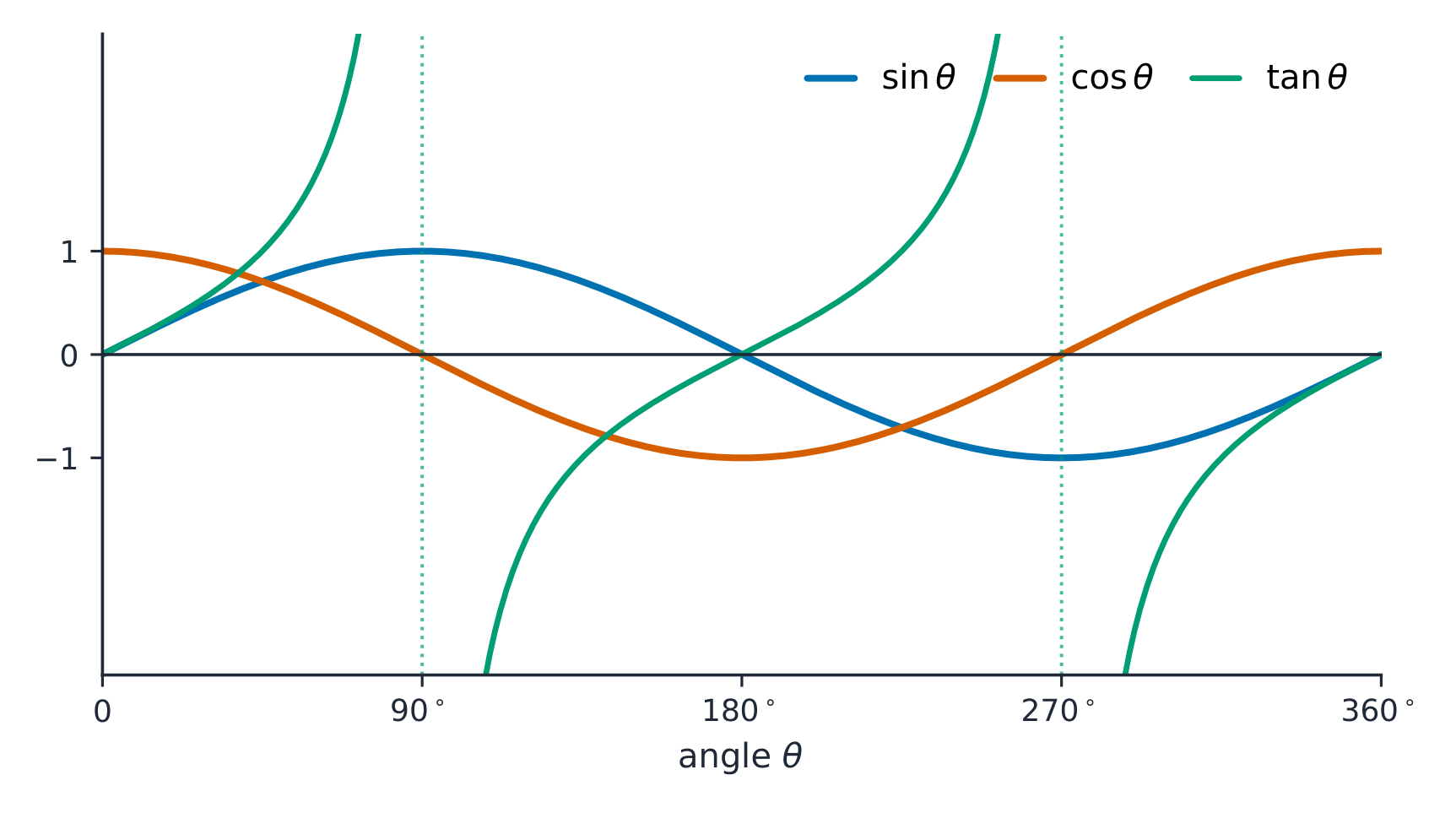
$\tan\theta=\dfrac{\sin\theta}{\cos\theta}$ 是终边的斜率。它的斜率值每半圈重复,所以它的周期是 $\pi$。它在 $\cos\theta=0$ 的地方(在 $\theta=\tfrac{\pi}{2}+k\pi$)有垂直渐近线,而它在连续的渐近线之间总是递增,在每个零点切换凹凸性。
3.9
反三角函数
大纲
| Learning Objective | Essential Knowledge |
|---|---|
3.9.A |
|
来源:美国大学理事会 AP 课程与考试说明
反三角函数(inverse trigonometric functions)——反正弦(arcsine)、反余弦(arccosine)、反正切(arctangent)——反转三角函数,所以它们取一个比并返回一个角。因为正弦、余弦和正切重复,它们的定义域在一个反函数能存在之前必须被限制(e.g. 正弦到 $[-\tfrac{\pi}{2},\tfrac{\pi}{2}]$)。
词汇表
训练
| 英文 | 中文 | 拼音 |
|---|---|---|
| inverse trigonometric functions/ɪnˈvɜːs ˌtrɪɡənəʊˈmetrɪk ˈfʌŋkʃnz/ | 反三角函数 | fǎn sān jiǎo hán shù |
| arcsine/ˈɑːksaɪn/ | 反正弦 | fǎn zhèng xián |
3.10
三角方程与不等式
大纲
| Learning Objective | Essential Knowledge |
|---|---|
3.10.A |
|
来源:美国大学理事会 AP 课程与考试说明
用反三角函数来解三角方程。因为这些函数是周期性的,通常有无穷多个解——通过加周期的倍数写通解,然后保留在要求的(常常是上下文的)定义域里的那些。
Worked example. 在 $[0,2\pi)$ 上解 $2\sin\theta=1$。那么 $\sin\theta=\tfrac12$,而在单位圆上正弦在第一和第二象限为正,所以 $\theta=\dfrac{\pi}{6}$ 或 $\dfrac{5\pi}{6}$。在所有实数上你会给每个加 $2\pi k$。
3.11
正割、余割与余切函数
大纲
| Learning Objective | Essential Knowledge |
|---|---|
3.11.A |
|
来源:美国大学理事会 AP 课程与考试说明
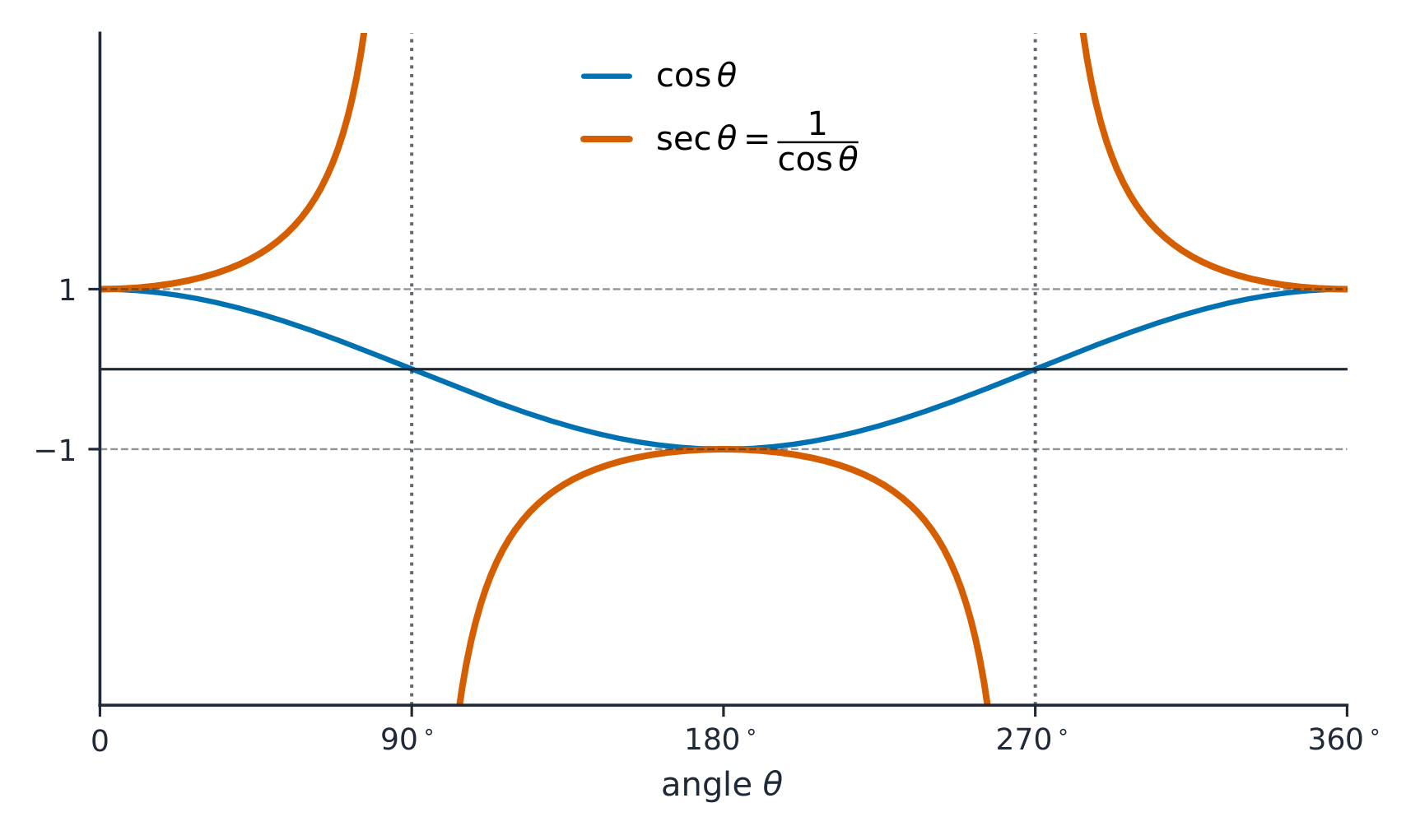
这些是主要三个的倒数(reciprocals):
$$\sec\theta=\frac{1}{\cos\theta},\qquad \csc\theta=\frac{1}{\sin\theta},\qquad \cot\theta=\frac{1}{\tan\theta}.$$
正割和余割在余弦和正弦为零的地方有垂直渐近线;余切在正切为零的地方(正弦为零的地方)有它们。
词汇表
训练
| 英文 | 中文 | 拼音 |
|---|---|---|
| reciprocals/rɪˈsɪprəklz/ | 倒数 | dào shǔ |
3.12
三角函数的等价表示
大纲
| Learning Objective | Essential Knowledge |
|---|---|
3.12.A |
|
3.12.B |
|
3.12.C |
|
来源:美国大学理事会 AP 课程与考试说明
毕达哥拉斯恒等式(Pythagorean identity)来自单位圆上的 $x^2+y^2=1$:
$$\sin^2\theta+\cos^2\theta=1,$$
它重新排列成带 $\sec$ 和 $\tan$ 的形式。和角公式(sum identities):
$$\sin(\alpha+\beta)=\sin\alpha\cos\beta+\cos\alpha\sin\beta,\qquad \cos(\alpha+\beta)=\cos\alpha\cos\beta-\sin\alpha\sin\beta,$$
也给出差角和二倍角(double-angle)恒等式(设 $\beta=\alpha$)。
词汇表
训练
| 英文 | 中文 | 拼音 |
|---|---|---|
| Pythagorean identity/ˈpaɪθəɡɔːrɪən aɪˈdentɪti/ | 毕达哥拉斯恒等式 | bì dá gē lā sī héng děng shì |
| sum identities/sʌm aɪˈdentɪtiz/ | 和角公式 | hé jiǎo gōng shì |
| double-angle/ˈdʌbl ˈæŋɡl/ | 二倍角 | èr bèi jiǎo |
3.13
三角学与极坐标
大纲
| Learning Objective | Essential Knowledge |
|---|---|
3.13.A |
|
来源:美国大学理事会 AP 课程与考试说明
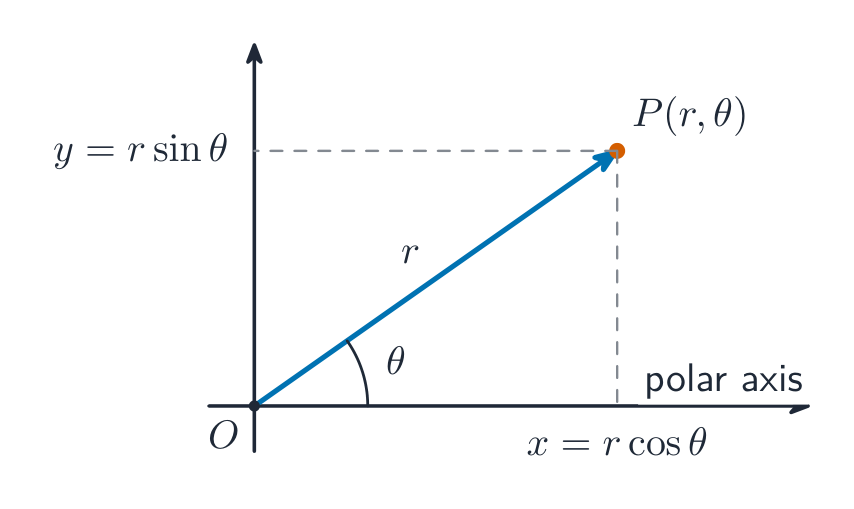
极坐标(polar coordinates)由 $(r,\theta)$ 定位一个点——在角 $\theta$ 距原点的距离 $r$。用以下转换
$$x=r\cos\theta,\quad y=r\sin\theta,\qquad r=\sqrt{x^2+y^2},\quad \tan\theta=\frac{y}{x}.$$
一个复数(complex number)是点 $(x,y)=x+yi$,同样能用 $r$ 和 $\theta$ 写。
词汇表
训练
| 英文 | 中文 | 拼音 |
|---|---|---|
| Polar coordinates/ˈpəʊlə kəʊˈɔːdɪnəts/ | 极坐标 | jí zuò biāo |
| complex number/ˈkɒmpleks ˈnʌmbə/ | 复数 | fù shù |
3.14
极坐标函数图像
大纲
| Learning Objective | Essential Knowledge |
|---|---|
3.14.A |
|
来源:美国大学理事会 AP 课程与考试说明
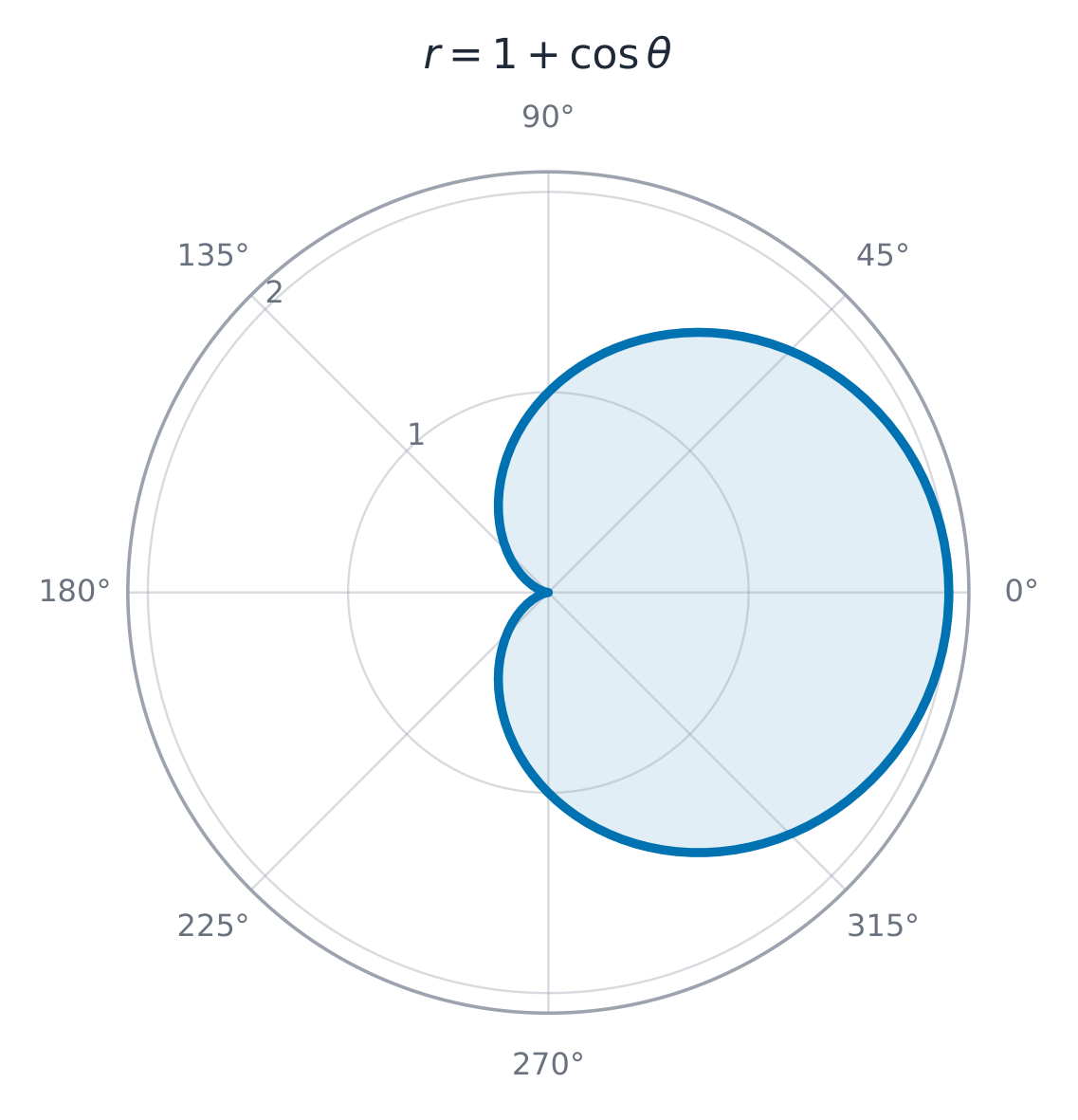
$r=f(\theta)$ 的图象是随着 $\theta$ 扫过所有的点 $(r,\theta)$。限制 $\theta$ 的定义域只画曲线的一部分。随着 $\theta$ 增加,$r$ 增长或缩小,描出螺线、圆、玫瑰线和蚶线。
探索
Plot a curve in polar coordinates
In polar form a point is a distance $r$ at angle $\theta$. Letting $r$ depend on $\theta$ traces shapes a rule in $x,y$ can't — like this cardioid.
3.15
极坐标函数的变化率
大纲
| Learning Objective | Essential Knowledge |
|---|---|
3.15.A |
|
来源:美国大学理事会 AP 课程与考试说明
随着 $\theta$ 增加,离原点的距离 $r$ 变化:
- $r$ 为正且增加(或为负且减少)$\Rightarrow$ 远离原点移动;
- $r$ 为正且减少(或为负且增加)$\Rightarrow$ 朝向原点移动。
$r$ 在递增和递减之间切换的地方,距离达到一个相对极值。$r$ 相对于 $\theta$ 的平均变化率,$\dfrac{\Delta r}{\Delta \theta}$,估计曲线在一个区间上向内或向外移动多快。
3.15
考试技巧
- 用弧度和单位圆:$\cos\theta$ 和 $\sin\theta$ 是坐标,总是在 $-1$ 和 $1$ 之间。
- 对于一个正弦型函数 $a\sin(b(\theta+c))+d$:$|a|$ 是振幅、$\tfrac{2\pi}{|b|}$ 是周期、$d$ 是中线、相移是 $-c$($+c$ 向左移)。
- 通过从最大和最小读周期、振幅和中线为周期数据建模。
- 反三角函数需要一个限制的定义域并返回一个角;三角方程有无穷多个解(加周期)。
- 用 $x=r\cos\theta$、$y=r\sin\theta$ 转换极↔直角。
本主题的互动课程
逐步学习,并即时检测练习。