Forces and equilibrium
Đã giới thiệu| English | Ý nghĩa |
|---|---|
| force/fɔːs/ | lực |
| equilibrium/ˌiːkwɪˈlɪbrɪəm/ | cân bằng |
| component/kəmˈpəʊnənt/ | thành phần |
| friction/ˈfrɪkʃn/ | lực ma sát |
| normal reaction/ˈnɔːml rɪˈækʃn/ | phản lực pháp tuyến |
| limiting friction/ˈlɪmɪtɪŋ ˈfrɪkʃn/ | giới hạn ma sát |
| coefficient of friction/ˌkəʊɪˈfɪʃənt ɒv ˈfrɪkʃn/ | hệ số ma sát |
| pulley/ˈpʊli/ | ròng rọc |
| acceleration/əkˌseləˈreɪʃn/ | gia tốc |
| tension/ˈtenʃn/ | lực căng |
Why bridges don't fall down
- Every bridge, every building, every shelf stays put because the forces 力 on it balance.
- Engineers call this equilibrium 平衡 — the vector sum of all forces is zero. Master this and you can analyse any static structure.
Adding forces
resultant = a + b
Forces add tip-to-tail. They are in equilibrium when the resultant is zero.
Forces and components 分量
- A force is a vector (size + direction). Split it into components: horizontal $F\cos\theta$, vertical $F\sin\theta$.
- A particle is in equilibrium when the forces balance — the vector sum is zero (components add to zero in every direction).
Worked example. A 10 N force acts at $30^{\circ}$ to the horizontal. Horizontal component $= 10\cos 30^{\circ} = 8.66$ N. Vertical component $= 10\sin 30^{\circ} = 5$ N.
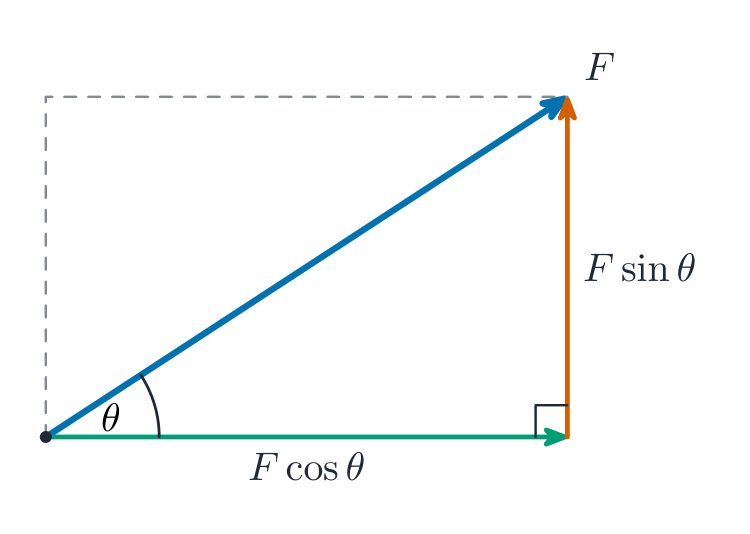
A force splits into F cos theta across and F sin theta up
A particle is in equilibrium when the forces on it:
Độ khó 1/5 · 100 xu + một phần thưởng nhỏ cho lần hoàn thành đầu tiên trong ngày
Equilibrium means the forces balance — their vector sum is zero.
The horizontal component of a force F at angle θ to the horizontal is:
Độ khó 1/5 · 100 xu + một phần thưởng nhỏ cho lần hoàn thành đầu tiên trong ngày
Horizontal component = F cos θ; vertical component = F sin θ.
Friction 摩擦力
- The contact force has the normal reaction 法向反作用力 $R$ (perpendicular) and friction $F$ (along the surface, opposing sliding).
- Friction grows only up to a maximum (limiting friction 最大静摩擦力):
- where $\mu$ is the coefficient of friction 摩擦系数.
Friction opposes motion (or tendency to move). If a block is about to slide down a slope, friction acts up the slope. The direction is always opposite to the (attempted) motion.

The contact force: normal reaction R up and friction F along the surface, with F at most mu R
The coefficient of friction is 0.4 and the normal reaction is 100 N. What is the maximum (limiting) friction force, in N?
Độ khó 2/5 · 140 xu + một phần thưởng nhỏ cho lần hoàn thành đầu tiên trong ngày
Maximum friction = μR = 0.4 × 100 = 40 N.
Friction always acts in the direction of motion.
Độ khó 1/5 · 100 xu + một phần thưởng nhỏ cho lần hoàn thành đầu tiên trong ngày
Friction opposes motion (or the tendency to move). It acts in the opposite direction to the (attempted) motion.
Worked example — equilibrium on a slope
- A 5 kg block rests on a rough slope at $20^{\circ}$ to the horizontal. Find the friction force.
- Resolve parallel to slope: $F = mg\sin 20^{\circ} = 5 \times 10 \times 0.342 = 17.1$ N.
- Resolve perpendicular: $R = mg\cos 20^{\circ} = 5 \times 10 \times 0.940 = 47.0$ N.
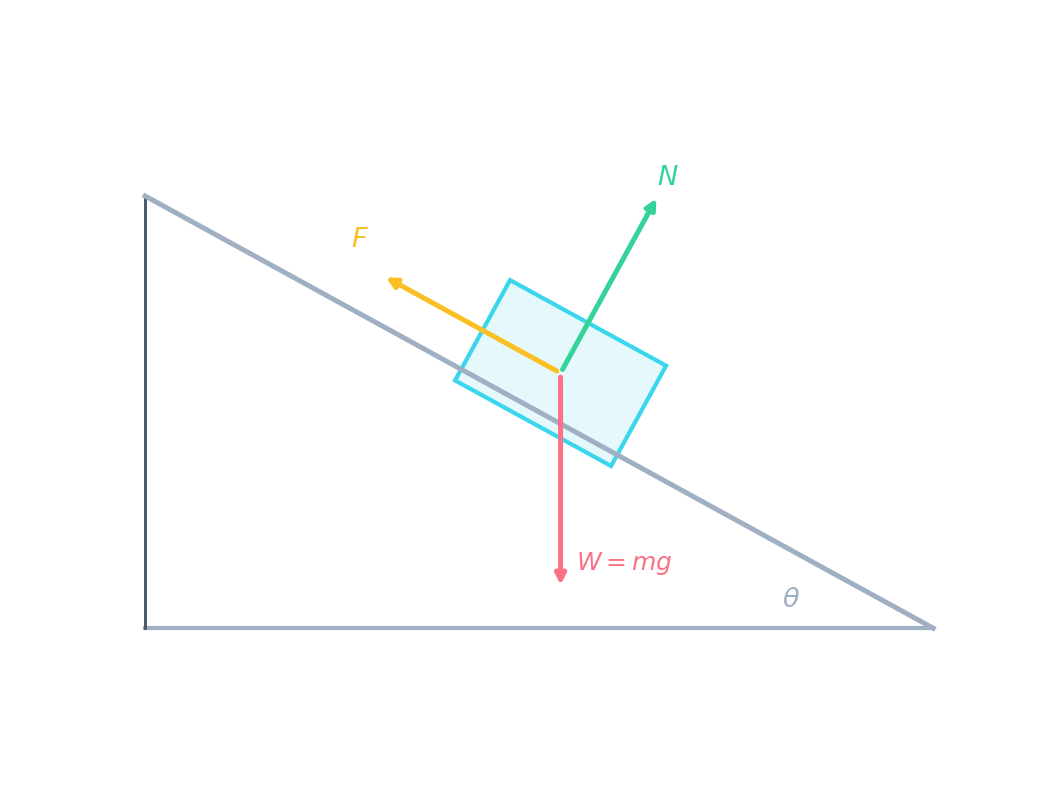
On a slope, resolve the weight into components parallel (mg sin θ) and perpendicular (mg cos θ) to the surface.
A 5 kg block on a 30° slope. The component of weight parallel to the slope is mg sin 30°. Find it (g = 10).
Độ khó 2/5 · 140 xu + một phần thưởng nhỏ cho lần hoàn thành đầu tiên trong ngày
5 × 10 × sin 30° = 50 × 0.5 = 25 N.
A 5 kg block on a 30° slope. The normal reaction is mg cos 30°. Find it (g = 10, 1 dp).
Độ khó 2/5 · 140 xu + một phần thưởng nhỏ cho lần hoàn thành đầu tiên trong ngày
5 × 10 × cos 30° = 50 × 0.866 = 43.3 N.
Connected particles
- When two particles are connected by a light string over a smooth pulley 滑轮, they have the same acceleration 加速度 and the same tension 张力.
- Write $F = ma$ for each particle, then solve the two equations simultaneously.

Forces on a block on a rough slope: weight, normal reaction, tension and friction
- Friction reaches its maximum in limiting equilibrium, when the body is about to slip.
You've got it
- a force splits into $F\cos\theta$ (horizontal) and $F\sin\theta$ (vertical)
- equilibrium = forces balance (vector sum zero)
- friction $F \leq \mu R$, reaching $\mu R$ when about to slip
Write from a resultant of 50 N
- A 40 N force and a 30 N force act at right angles.
- Find the resultant.
Forces of 40 N and 30 N act at right angles. What is the size of their resultant, and what resultant means equilibrium?
1600 plus 900 is 2500, which is 50 squared.
What is the resultant?
Độ khó 1/5 · 100 xu + một phần thưởng nhỏ cho lần hoàn thành đầu tiên trong ngày
40 squared plus 30 squared is 50 squared.