Phổ khối lượng
Đã giới thiệu| English | Ý nghĩa |
|---|---|
| mass spectrometry/mæs spekˈtrɒmətri/ | mass spectrometry: phổ khối |
| mass-to-charge ratio/mæs tə tʃɑːdʒ ˈreɪʃɪəʊ/ | tỷ lệ khối lượng trên điện tích |
| abundance/əˈbʌndəns/ | độ phong phú |
| molecular ion/məˈlekjʊlə ˈaɪɒn/ | ion phân tử |
| fragmentation/ˌfræɡmənˈteɪʃn/ | sự phân mảnh |
Weighing a single molecule
- In mass spectrometry 质谱, a molecule is ionised and sorted by mass-to-charge ratio 质荷比 ($m/e$).
- The spectrum is a set of peaks.
- From it we get relative masses and structural clues.
Tuyến phổ khối lượng
Theo dõi một phân tử qua quá trình ion hóa, tách biệt và phát hiện.
Trong phổ khối, đỉnh tại m/z cao nhất (ion phân tử) cho biết khối lượng phân tử tương đối ______.
Độ khó 1/5 · 100 xu + một phần thưởng nhỏ cho lần hoàn thành đầu tiên trong ngày
Đỉnh M⁺ bằng với Mr.
Relative atomic mass from isotopes
- An element's isotopes give several peaks. From their abundances 丰度, the relative atomic mass is a weighted average:
- Chlorine (75% $^{35}\text{Cl}$, 25% $^{37}\text{Cl}$): $A_r = \dfrac{35 \times 75 + 37 \times 25}{100} = 35.5$.
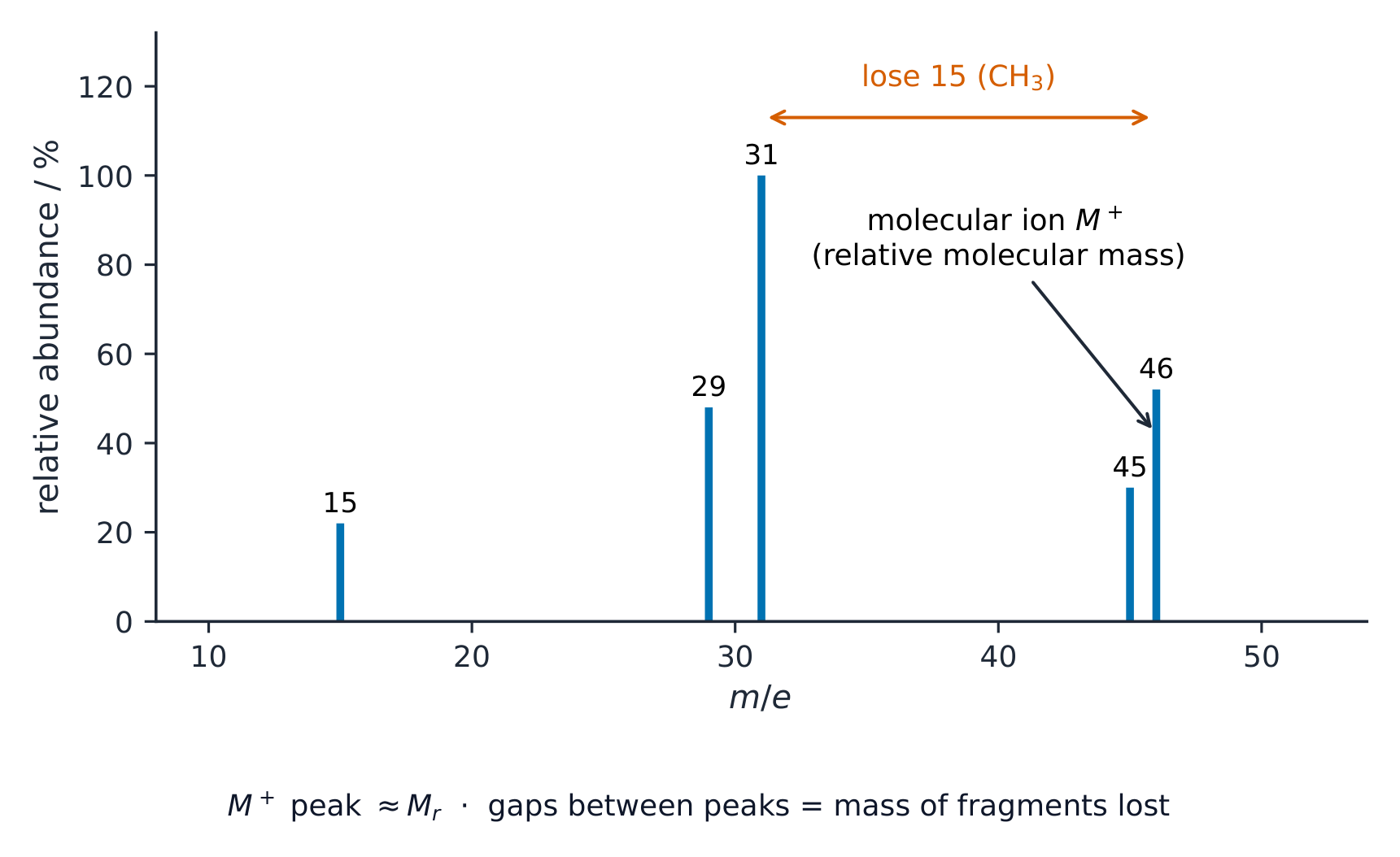
A mass spectrum: the molecular ion 分子离子 gives the Mr, fragments show what was lost
Chlorine có 75% ³⁵Cl và 25% ³⁷Cl. Khối lượng nguyên tử tương đối của nó là bao nhiêu? (sử dụng công thức (35×75 + 37×25)/100)
Độ khó 2/5 · 140 xu + một phần thưởng nhỏ cho lần hoàn thành đầu tiên trong ngày
Ar = (35×75 + 37×25)/100 = (2625 + 925)/100 = 35.5.
Molecular ion and fragmentation 碎裂
- The highest $m/e$ peak is the molecular ion ($M^{+}$) — it gives the relative molecular mass.
- The molecule also breaks into pieces (fragmentation). The gap between peaks = the mass lost: a loss of 15 = a $\text{CH}_3$ group; a loss of 29 = $\text{CHO}$ or $\text{C}_2\text{H}_5$.

A modern mass spectrometer in a laboratory; the sample is loaded at the front and the machine sorts its ions by mass-to-charge ratio
Đỉnh ion phân tử (đỉnh m/e cao nhất) cho biết:
Độ khó 1/5 · 100 xu + một phần thưởng nhỏ cho lần hoàn thành đầu tiên trong ngày
Đỉnh m/e cao nhất (M⁺) đại diện cho toàn bộ phân tử, do đó cung cấp Mr.
Khoảng cách 15 giữa hai đỉnh có nghĩa là phân tử đã mất:
Độ khó 1/5 · 100 xu + một phần thưởng nhỏ cho lần hoàn thành đầu tiên trong ngày
Sự mất đi 15 đơn vị khối lượng tương ứng với mảnh CH₃; sự mất đi 29 là CHO hoặc C₂H₅.
The [M+1] and [M+2] peaks
- a small [M+1] peak (from $^{13}\text{C}$) tells you the number of carbons.
- an [M+2] peak (two units up) shows a halogen: chlorine gives a 3:1 ratio, bromine a 1:1 ratio.
Một đỉnh [M+2] có độ cao xấp xỉ bằng M⁺ (tỷ lệ 1:1) cho thấy phân tử chứa:
Độ khó 1/5 · 100 xu + một phần thưởng nhỏ cho lần hoàn thành đầu tiên trong ngày
Một nguyên tử brom tạo tỷ lệ 1:1 [M+2]:M⁺; một nguyên tử clo tạo khoảng 3:1.
Worked examples
1. A magnesium mass spectrum shows peaks at $m/z$ 24 ($79\%$), 25 ($10\%$) and 26 ($11\%$). $A_r = \dfrac{24 \times 79 + 25 \times 10 + 26 \times 11}{100} = 24.3$.
2. For an organic compound, the molecular ion peak with the highest $m/z$ (ignoring the small $M+1$ peak) gives the $M_r$.
You've got it
- mass spec sorts ions by $m/e$; $A_r = \dfrac{\sum(\text{mass} \times \text{abundance})}{\sum \text{abundance}}$ (Cl = 35.5)
- the molecular ion ($M^{+}$, highest $m/e$) = the $M_r$; fragmentation gaps give lost pieces (loss 15 = $\text{CH}_3$)
- [M+1] ($^{13}\text{C}$) → number of carbons; [M+2] → halogen (Cl 3:1, Br 1:1)