Sales forecasting and time-series
Đã giới thiệu| English | Ý nghĩa |
|---|---|
| sales forecasting/seɪlz ˈfɔːkæstɪŋ/ | Dự báo doanh số |
| time series/taɪm ˈsɪəriːz/ | Chuỗi thời gian |
| trend/trend/ | Xu hướng |
| seasonal/ˈsiːzənl/ | Tính mùa vụ |
| moving average/ˈmuːvɪŋ ˈævrɪdʒ/ | Trung bình động |
| extrapolation/ekˈstræpəleɪʃn/ | Ngoại suy |
Predicting next quarter's sales
- How many units should the factory make next quarter? Order too much and stock piles up; too little and you lose sales.
- Sales forecasting 销售预测 uses past data to predict the future.
Sales forecast lab
sales = trend + seasonal effect
Move along a sales trend and see how forecast and actual can separate.
A time series is data that is:
Độ khó 1/5 · 100 xu + một phần thưởng nhỏ cho lần hoàn thành đầu tiên trong ngày
A time series records a variable over regular periods.
The long-run underlying direction of a time series is its ______.
Độ khó 1/5 · 100 xu + một phần thưởng nhỏ cho lần hoàn thành đầu tiên trong ngày
The trend is what moving averages reveal.
Time-series 时间序列 analysis
- A time series is data recorded over regular intervals (e.g. quarterly sales).
- It splits into a long-run trend 趋势, seasonal 季节性 variation, and random noise.
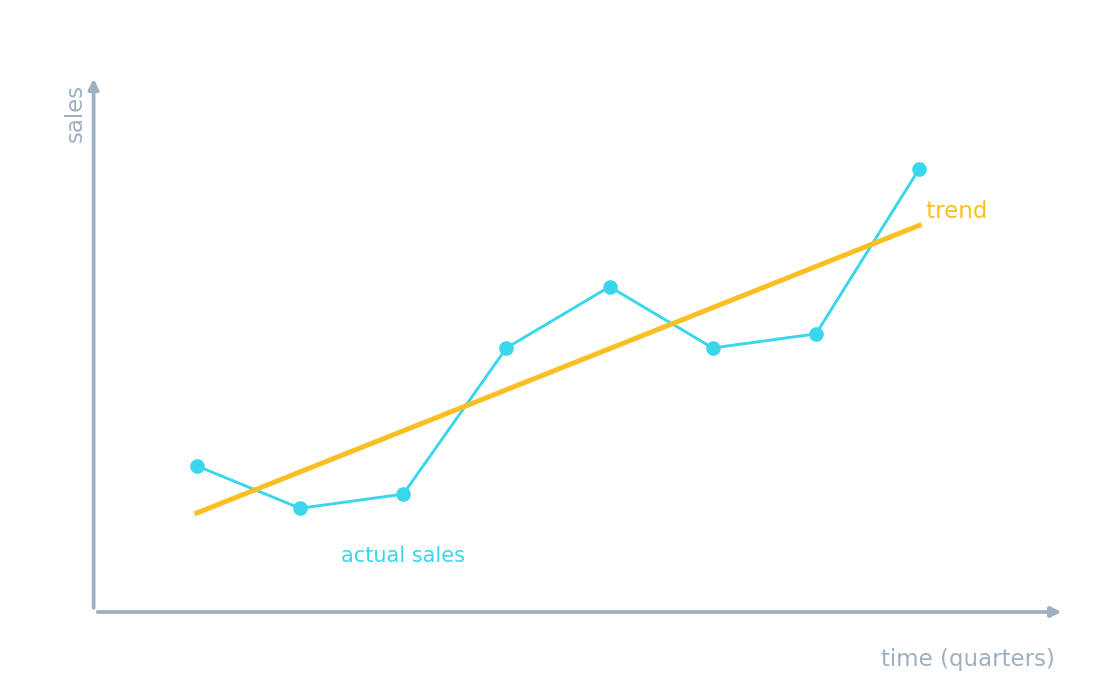
Sales wobble seasonally around an underlying upward trend.
Sales over four quarters are 30, 34, 28, 32. What is the 4-quarter moving average?
Độ khó 2/5 · 140 xu + một phần thưởng nhỏ cho lần hoàn thành đầu tiên trong ngày
(30 + 34 + 28 + 32) ÷ 4 = 124 ÷ 4 = 31.
The main purpose of a moving average is to:
Độ khó 1/5 · 100 xu + một phần thưởng nhỏ cho lần hoàn thành đầu tiên trong ngày
It smooths the data so the trend stands out.
Moving averages 移动平均
- A moving average smooths out short-term ups and downs to reveal the trend.
- A 4-quarter moving average averages each set of four consecutive quarters.
Worked example. Sales of 20, 24, 18, 26 over four quarters average to (20+24+18+26) ÷ 4 = 22 — the smoothed trend value, with the seasonal swings averaged out.

Sales wobble seasonally around a smooth underlying trend
Extrapolation gives reliable forecasts even when market conditions change sharply.
Độ khó 1/5 · 100 xu + một phần thưởng nhỏ cho lần hoàn thành đầu tiên trong ngày
False. Extrapolation assumes the future will follow the past trend. That assumption fails when conditions change, for example after a new competitor or a recession.
Extrapolation 外推 and its limits
- Extrapolation extends the past trend into the future to forecast.
- It assumes the future behaves like the past — risky if conditions change (a new rival, a recession).
Forecasts are not facts. Extrapolation only works while the trend holds. A sudden shock — new competitor, technology, downturn — can make a confident forecast badly wrong.
You've got it
- a time series splits into trend, seasonal variation and noise
- a moving average smooths data to reveal the underlying trend
- extrapolation projects the trend forward — risky if conditions change
Write from a moving average of 23
- Sales over four quarters are 20, 24, 22 and 26.
- Find the 4-quarter moving average.
Sales over four quarters are 20, 24, 22 and 26. What is the 4-quarter moving average?
92 divided by 4 is 23.
What is the 4-quarter moving average?
Độ khó 1/5 · 100 xu + một phần thưởng nhỏ cho lần hoàn thành đầu tiên trong ngày
The four quarters sum to 92, and 92 divided by 4 is 23. Other options — 31 (the lesson average); 26 (the last quarter used as the average).