The external environment
แนะนำใหม่| English | ความหมาย |
|---|---|
| external environment/ekˈstɜːnl enˈvaɪrənmənt/ | สภาพแวดล้อมภายนอก |
The energy bill nobody chose
- Nimbus's energy bill rises by 30% in one year. Nobody at the bakery decided this, yet it squeezes every loaf. In the same year a new café opens on the high street.
- Forces outside the firm shape its choices all the time. This lesson shows how to scan them, sort them and back every claim about them with evidence.
Two rings round the firm
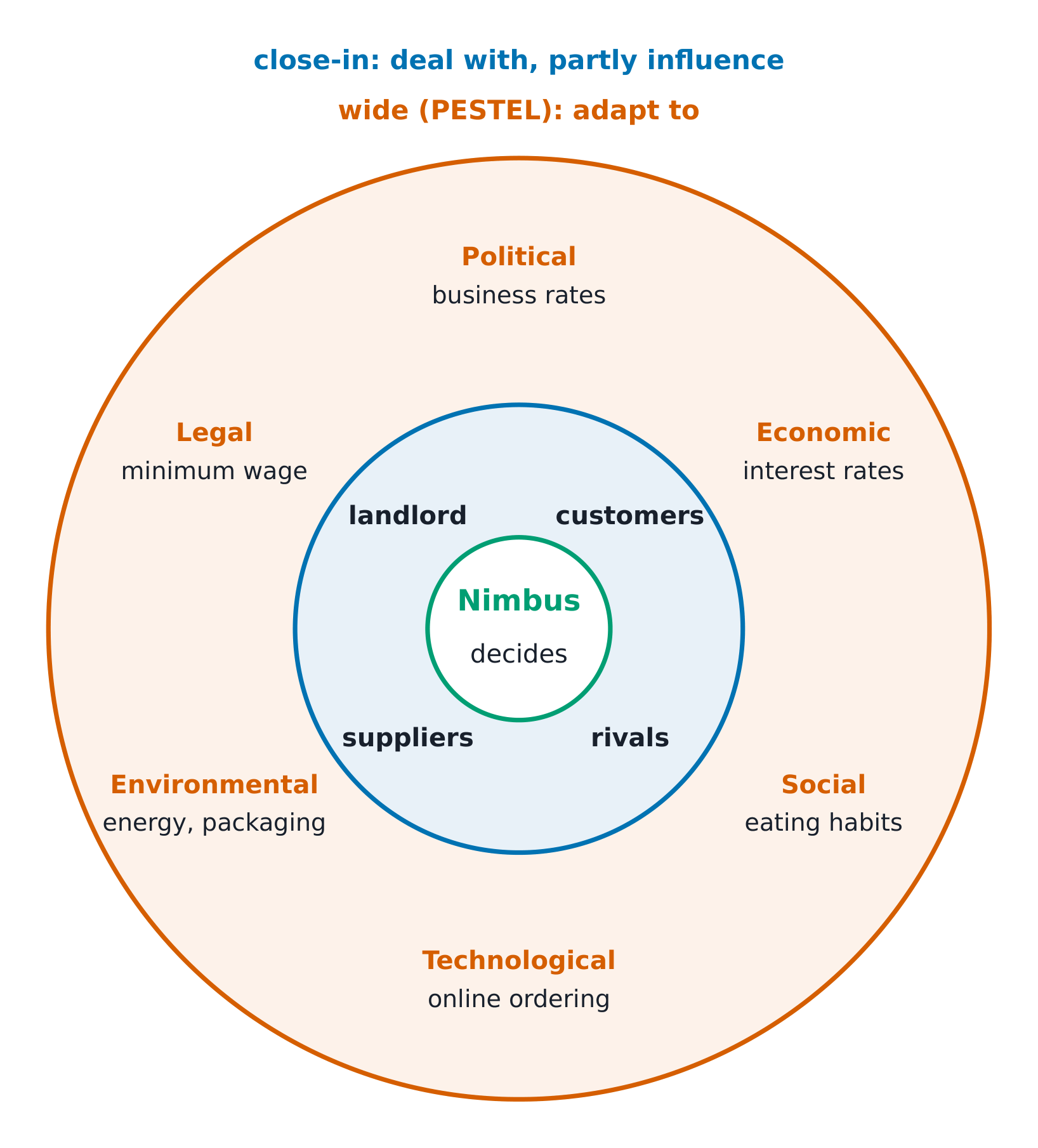
- The external environment 外部环境 is everything outside the firm that affects it. The close-in ring holds the players Nimbus deals with directly: customers, rivals, suppliers and the landlord.
- The wide ring holds big forces that affect every firm at once, such as interest rates, laws and changing habits.
Which of these belongs to Nimbus's close-in environment rather than the wide one?
ความยาก 1/5 · 100 เหรียญ + บอนัสน้อยๆ เมื่อทำสำเร็จครั้งแรกในวันนี้
Nimbus deals with the mill directly and can negotiate or switch. The other three affect every bakery at once and can only be adapted to.
PESTEL: six headings for the wide ring
- PESTEL sorts the wide ring into Political, Economic, Social, Technological, Environmental and Legal factors, so that no area is forgotten.
- For Nimbus: business rates (P), interest rates (E), eating habits (S), online ordering (T), energy and packaging rules (E), the minimum wage (L).
Match each factor to its PESTEL heading.
ความยาก 2/5 · 140 เหรียญ + บอนัสน้อยๆ เมื่อทำสำเร็จครั้งแรกในวันนี้
The heading matters less than not forgetting an area. Some factors fit two headings, and that is fine.
Influence or adapt?
- Nimbus decides its own prices, recipes and opening hours; these are choices, not environment. It can partly influence the close-in ring, for example by negotiating with a supplier.
- It can only adapt to the wide ring: no bakery moves interest rates or the minimum wage. The costly mistake is treating something you must adapt to as if you could control it.
Decide, influence or adapt?
Sort each item by how much control Nimbus has over it. Choices it makes are not environment; close-in players can be partly influenced; wide forces can only be adapted to.
Nimbus's choice of prices belongs in its PESTEL analysis under Economic.
ความยาก 1/5 · 100 เหรียญ + บอนัสน้อยๆ เมื่อทำสำเร็จครั้งแรกในวันนี้
Prices are a decision Nimbus makes, not a force outside it. PESTEL holds only factors the firm cannot control.
Every claim needs a period, a source and a definition
- "Bread sales are falling" is not yet evidence. Ask when (which dates?), who measured it, and how (the source), and what exactly was counted (value or volume? which shops?).
- "Volumes in supermarket in-store bakeries fell 4.2% from 2021 to 2024 (industry survey)" can be checked, and its definition shows it may say nothing about small artisan bakeries.
Which claims give a period, a source and a definition, so they are ready to use as evidence? Select all that apply.
ความยาก 2/5 · 140 เหรียญ + บอนัสน้อยๆ เมื่อทำสำเร็จครั้งแรกในวันนี้
The first two say when, who measured and what was counted. The last two give none of the three, so they are guesses until checked.
Use evidence that fits the decision
- National figures describe the whole market. A decision about one shop on one street needs local evidence: counted footfall, the till data of a similar shop, a trial week.
- Then turn each factor into "so what?": how much does it change costs or sales, and what will Nimbus do about it?
- How much does the 30% energy rise cost per item?
- Energy was £2,400 a month; 30% more is £2,400 × 0.30 = £720 a month.
- Nimbus sells about 12,000 items a month, so the rise costs £720 ÷ 12,000 = £0.06, or 6p, per item.
- Now the factor is a decision: raise prices by about 6p, cut energy use, or accept lower profit.
Energy costs £2,400 a month and rises by 30%. Nimbus sells 12,000 items a month. How much does the rise add to each item, in pence?
ความยาก 2/5 · 140 เหรียญ + บอนัสน้อยๆ เมื่อทำสำเร็จครั้งแรกในวันนี้
$2400 \times 0.30 = 720$ pounds a month, and $720 \div 12\,000 = 0.06$ pounds, which is 6p per item.
A checklist, not a theory
- PESTEL only makes sure nothing is missed. A finished list cannot tell you what will happen or what to do.
- Two firms facing the same environment can succeed or fail on their own choices. The analysis earns its keep only when it changes a decision.
A student hands in a full PESTEL list for Nimbus with no numbers and no actions. What is the biggest weakness?
ความยาก 1/5 · 100 เหรียญ + บอนัสน้อยๆ เมื่อทำสำเร็จครั้งแรกในวันนี้
A checklist only stops you missing an area. The value comes from sizing each effect and turning it into a decision.
Marks that slip away
- Long lists with no "so what?". Give the size of the effect and the response.
- Putting the firm's own choices in PESTEL. Prices and recipes are decisions, not environment.
- Claims without a period, a source or a definition. Treat them as guesses until they have all three.
- National data for a local decision. Check that the evidence covers the same market as the choice.
You've got it
- The external environment has a close-in ring (customers, rivals, suppliers) that the firm can partly influence and a wide ring that it must adapt to.
- PESTEL: Political, Economic, Social, Technological, Environmental, Legal. It is a checklist, not a prediction.
- Back every claim with a period, a source and a definition, use evidence that fits the decision, and turn each factor into a cost, a sales effect and a response.