Magnetism and Moving Charges
แนะนำใหม่ 12:44
สนามแม่เหล็กและแม่เหล็กไฟฟ้า
หากมองไปทางทิศเหนือในคืนฤดูหนาวที่ฟ้าใส และอยู่พอไกลทางทิศเหนือพอ สky จะเรืองแสงสีเขียว แสงเหล่านั้นเกิดจากสนามแม่เหล็ก ทดปัดอนุภาคที่มีประจุไฟฟ้าออกมา…
บรรยายภาษาอังกฤษ · สลับคำบรรยายภาษาอังกฤษและภาษาจีนได้
In this lesson
| English | ความหมาย |
|---|---|
| right-hand rule/raɪt hænd ruːl/ | กฎมือขวา |
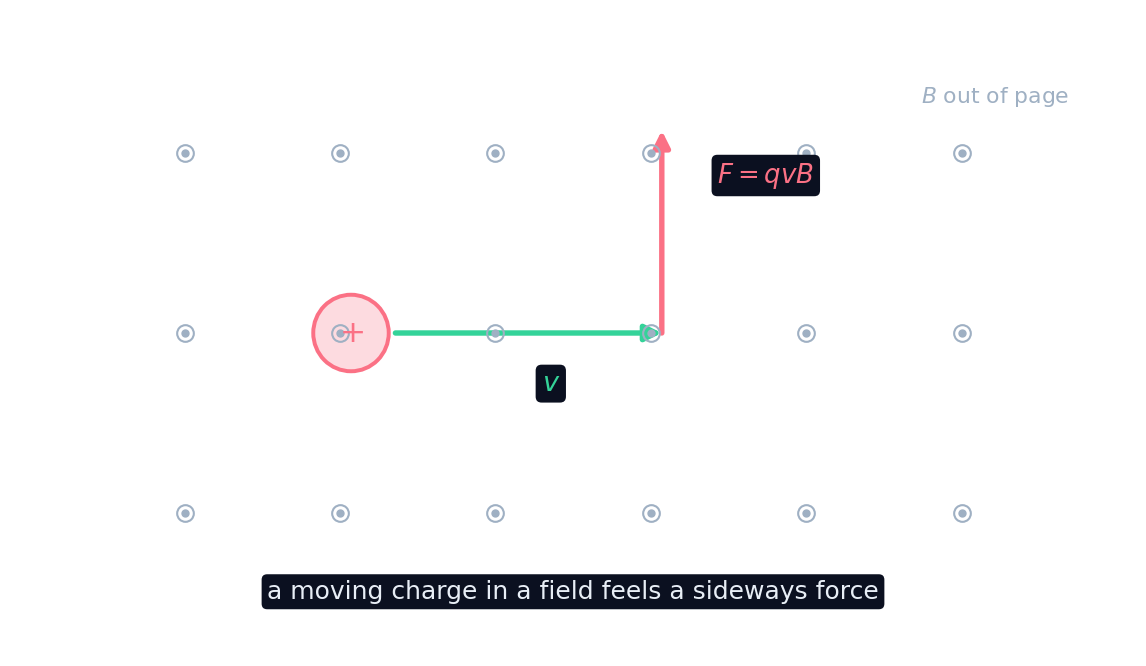
A magnet ignores a still charge but shoves a moving one sideways
- Place a charge at rest near a magnet — nothing happens.
- Send it flying across the field — it swerves to the side.
- The magnetic force acts only on a moving charge.
- And it pushes at right angles to the motion, not along it.
A magnetic field exerts a force on a charge only when the charge is:
ความยาก 1/5 · 100 เหรียญ + บอนัสน้อยๆ เมื่อทำสำเร็จครั้งแรกในวันนี้
The magnetic force $F = qvB$ needs a nonzero velocity.
The force law: F = qvB
- The magnetic force is $F = |q|vB\sin\theta$, where $\theta$ is the angle between $\vec v$ and $\vec B$.
- It is maximum when the charge moves across the field ($\theta = 90^\circ$).
- It is zero when the charge moves along the field ($\theta = 0$).
- A faster charge or a stronger field gives a bigger push.
Force on a current
Set the field and current directions and use the right-hand rule to predict the force.
A $3\ \text{C}$ charge moves at $4\ \text{m/s}$ across a $2\ \text{T}$ field ($\theta = 90^\circ$). Find $F$ (in N).
ความยาก 2/5 · 140 เหรียญ + บอนัสน้อยๆ เมื่อทำสำเร็จครั้งแรกในวันนี้
$F = qvB = 3 \times 4 \times 2 = 24\ \text{N}$.
A charge moving exactly along the magnetic field feels the maximum magnetic force.
ความยาก 1/5 · 100 เหรียญ + บอนัสน้อยๆ เมื่อทำสำเร็จครั้งแรกในวันนี้
False. $F = qvB\sin\theta$ และ $\sin 0 = 0$, so a charge moving along the field feels no magnetic force. The force is largest when it moves perpendicular to B.
The right-hand rule sets the direction
- The force is perpendicular to both the velocity and the field.
- Point your fingers along $\vec v$, curl them toward $\vec B$: the thumb gives the force (right-hand rule 右手定则).
- For a negative charge, the force is the opposite way.
- That is why the two are always at right angles to the motion.
The direction of the magnetic force is found with the ____-hand rule.
ความยาก 1/5 · 100 เหรียญ + บอนัสน้อยๆ เมื่อทำสำเร็จครั้งแรกในวันนี้
The right-hand rule gives the force on a positive charge.
A sideways force makes a circle
- A force always perpendicular to $\vec v$ can only turn the charge, not speed it up.
- With only a uniform magnetic field and $\vec v\perp\vec B$, a charge moves in a circle. A parallel velocity component gives a helix; purely parallel motion stays straight.
- The radius is $r = \dfrac{mv}{|q|B}$ for nonrelativistic motion with $\vec v\perp\vec B$ — faster or heavier means a wider circle.
- This is how mass spectrometers and particle accelerators bend beams.
Select ทั้งหมด true statements about the magnetic force on a charge.
ความยาก 2/5 · 140 เหรียญ + บอนัสน้อยๆ เมื่อทำสำเร็จครั้งแรกในวันนี้
Needs motion, perpendicular, no work. It never speeds the charge up.
The magnetic force does no work
- Because $\vec F \perp \vec v$, the force never adds to the speed.
- It changes only the direction of motion, not the kinetic energy.
- So a magnetic field can steer a charge but never make it faster.
- Speeding up needs an electric field, not a magnetic one.
The magnetic force on a moving charge:
ความยาก 1/5 · 100 เหรียญ + บอนัสน้อยๆ เมื่อทำสำเร็จครั้งแรกในวันนี้
Since $F \perp v$, it does no work — only the direction changes.
A charge of $2\ \text{C}$ moves at $3\ \text{m/s}$ across a $0.5\ \text{T}$ field ($\theta = 90^\circ$).
- $F = qvB = 2 \times 3 \times 0.5 = 3\ \text{N}$.
- The force is perpendicular to the velocity, so the charge curves.
Worked example: a velocity selector and a mass spectrometer
- Velocity selector: crossed $\vec E$ and $\vec B$ push a charge opposite ways. It goes straight only when $qE=qvB$, so $v=\dfrac EB$, whatever its charge or mass.
- Period of the circle: $T=\dfrac{2\pi r}{v}=\dfrac{2\pi m}{|q|B}$. The speed cancels, so faster charges take wider circles in the same time.
Protons ($m=1.67\times10^{-27}$ kg, $q=1.6\times10^{-19}$ C) pass a selector with $E=2.0\times10^4$ V/m and $B=0.10$ T, then enter a region with $B'=0.20$ T.
- The speed through the selector is $v=\dfrac{2.0\times10^4}{0.10}=2.0\times10^5$ m/s.
- The radius in $B'$ is $r=\dfrac{mv}{qB'}=\dfrac{(1.67\times10^{-27})(2.0\times10^5)}{(1.6\times10^{-19})(0.20)}=1.0\times10^{-2}$ m.
- A heavier ion with the same charge and speed makes a wider circle, which is how the spectrometer separates masses.
A velocity selector uses E = 3000 V/m and B = 0.015 T. Find the speed of charges that pass straight through, in units of 10⁵ m/s.
ความยาก 2/5 · 140 เหรียญ + บอนัสน้อยๆ เมื่อทำสำเร็จครั้งแรกในวันนี้
v = E/B = 3000/0.015 = 2.0 × 10⁵ m/s, for any charge or mass.
A proton circles in a uniform magnetic field. Its speed is doubled. What happens to the time for one orbit?
ความยาก 1/5 · 100 เหรียญ + บอนัสน้อยๆ เมื่อทำสำเร็จครั้งแรกในวันนี้
T = 2πm/(|q|B) has no v in it. Double the speed and the radius doubles, so the time per orbit is unchanged.
The magnetic force does no work — it only bends the path, never changes the speed. So "the magnetic field speeds up the charge" is always wrong. And a charge moving along the field ($\theta = 0$) feels no force at all.
A magnetic field pushes only a moving charge: $F = |q|vB\sin\theta$, perpendicular to both $\vec v$ and $\vec B$ (right-hand rule). The force does no work, so it changes direction without changing speed. In a uniform field with perpendicular nonrelativistic motion, the path is a circle of radius $r = mv/(|q|B)$; a parallel component gives a helix.
Write from the data: find the magnetic force
- A charge of 4 coulomb moves at 5 metres per second across a 0.30 tesla field, at 90 degrees.
- Find the force. Say the force when the velocity is parallel to the field.
A charge of 4 coulomb moves at 5 metres per second perpendicular to a 0.30 tesla field. What is the force, and what is it when the velocity is parallel to the field?
4 times 5 times 0.30 is 6 newtons. Sin of 0 degrees is 0, and the force is perpendicular to the velocity.
A +4 coulomb charge moves at 5 metres per second perpendicular to a 0.30 tesla field. What is the force magnitude, and what would it be for motion parallel to the field?
ความยาก 1/5 · 100 เหรียญ + บอนัสน้อยๆ เมื่อทำสำเร็จครั้งแรกในวันนี้
q v B is 6 newtons at 90 degrees, and the parallel force is 0.