Electric Potential Energy
แนะนำใหม่| English | ความหมาย |
|---|---|
| work/wɜːk/ | งาน |
| electric potential energy/ɪˈlektrɪk pəˈtenʃl ˈenədʒi/ | ศักย์พลังงานไฟฟ้า |
Squeeze two like charges together and you bottle up energy
- Push two like charges closer and the field fights you every step.
- The work 功 you do doesn't vanish — it is stored.
- Release the charges and that stored energy pushes them apart, gaining speed.
- Stored energy that depends only on position is potential energy.
Energy to assemble charges
- Electric potential energy 电势能 $U$ is the external work to assemble the charges slowly from infinity, with no change in kinetic energy.
- For two point charges: $U = \dfrac{k\,q_1 q_2}{r}$.
- Note it is $1/r$, not $1/r^2$ — energy, not force.
- $U$ is a scalar (just a number with a sign), so it is easier than force.
The potential energy of two point charges is proportional to:
ความยาก 1/5 · 100 เหรียญ + บอนัสน้อยๆ เมื่อทำสำเร็จครั้งแรกในวันนี้
$U = kq_1q_2/r$ — energy goes as $1/r$ (force goes as $1/r^2$).
ค้นหา $U$ (in J) for a $+1\ \text{nC}$ และ $+1\ \text{nC}$ ประจุไฟฟ้า $1\ \text{m}$ apart. Use $k = 9\times10^9$.
ความยาก 2/5 · 140 เหรียญ + บอนัสน้อยๆ เมื่อทำสำเร็จครั้งแรกในวันนี้
$U = \dfrac{(9\times10^9)(10^{-9})(10^{-9})}{1} = 9\times10^{-9}\ \text{J}$.
The sign tells the story
- Like charges: $U > 0$ — you had to push them together, energy is stored.
- Opposite charges: $U < 0$ — energy is released as they come together slowly from infinity.
- A pair is bound only if its total mechanical energy $K+U$ is negative; $U<0$ alone is insufficient.
- We choose $U = 0$ when the charges are infinitely far apart.
Two opposite charges have a potential energy that is:
ความยาก 1/5 · 100 เหรียญ + บอนัสน้อยๆ เมื่อทำสำเร็จครั้งแรกในวันนี้
With U = 0 at infinite separation, opposite charges have U = k q1 q2/r < 0. Binding also depends on kinetic energy: the total K + U must be negative.
We usually set the potential energy to zero when the charges are infinitely ____.
ความยาก 1/5 · 100 เหรียญ + บอนัสน้อยๆ เมื่อทำสำเร็จครั้งแรกในวันนี้
The reference $U = 0$ is taken at infinite separation.
Work and force from energy
- The work done by the field equals the drop in energy: $W_{\text{field}} = -\Delta U$.
- So moving to lower $U$ releases energy as motion.
- In calculus form the force is the slope of $U$: $F = -\dfrac{dU}{dr}$.
- Energy and force are two views of the same interaction.
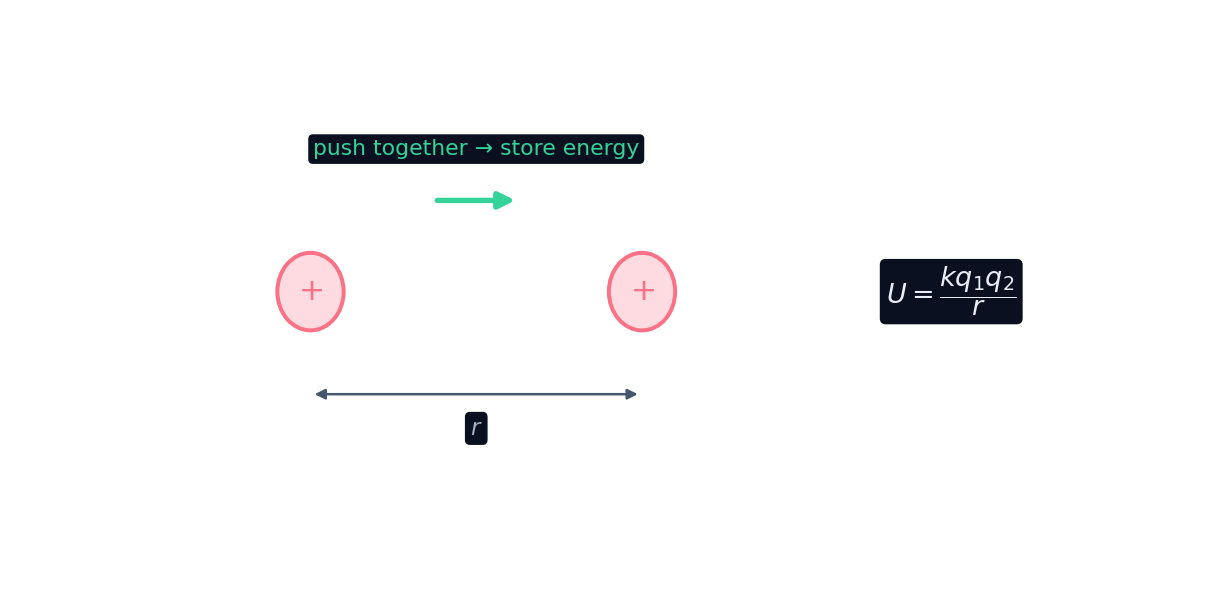
Electric potential energy
The potential energy of two charges falls off as one over the distance between them.
The work done by the electric field equals the decrease in potential energy, $W = -\Delta U$.
ความยาก 1/5 · 100 เหรียญ + บอนัสน้อยๆ เมื่อทำสำเร็จครั้งแรกในวันนี้
A drop in $U$ releases energy as work: $W = -\Delta U$.
Many charges add up
- For several charges, add the energy of every pair.
- Because $U$ is a scalar, you just add numbers — no vectors.
- $U_{\text{total}} = \sum_{\text{pairs}} \dfrac{k\,q_i q_j}{r_{ij}}$.
- Keep the signs: a mix of $+$ and $-$ can give a net negative energy.
Select ทั้งหมด true statements about electric potential energy.
ความยาก 2/5 · 140 เหรียญ + บอนัสน้อยๆ เมื่อทำสำเร็จครั้งแรกในวันนี้
$U$ is a signed scalar, summed over pairs; like charges give $U>0$. It is never a vector.
How much external work is needed to bring slowly from infinity a $+2\ \text{nC}$ charge to $3\ \text{cm}$ from a $+3\ \text{nC}$ charge?
- $U = \dfrac{k\,q_1 q_2}{r} = \dfrac{(9\times10^9)(2\times10^{-9})(3\times10^{-9})}{0.03}$.
- $U \approx 1.8\times10^{-6}\ \text{J}$ — positive, since both are positive.
Worked examples: three charges, then closest approach
1. Assemble a triangle. Three charges $+q$ sit at the corners of an equilateral triangle with side $a$.
- Three pairs, each at distance $a$, so $U=3\cdot\dfrac{kq^2}{a}$.
- That is the work needed to bring them in from infinity one by one (the first charge costs nothing, the second $kq^2/a$, the third $2kq^2/a$).
2. Closest approach. An alpha particle ($+2e$) with $5.0$ MeV of kinetic energy heads straight at a gold nucleus ($+79e$). How close does it get?
- It stops when all its kinetic energy has become potential energy, so $K=\dfrac{k(2e)(79e)}{r_{\min}}$.
- $r_{\min}=\dfrac{(9.0\times10^9)(158)(1.6\times10^{-19})^2}{5.0\times10^6\times1.6\times10^{-19}\ \text{J}}=4.5\times10^{-14}$ m, far smaller than the atom.
Three charges of +2.0 μC sit at the corners of an equilateral triangle with sides 0.30 m. Find the total electric potential energy. Use k = 9.0 × 10⁹ N·m²/C².
ความยาก 2/5 · 140 เหรียญ + บอนัสน้อยๆ เมื่อทำสำเร็จครั้งแรกในวันนี้
Three pairs: U = 3kq²/a = 3 × (9.0 × 10⁹)(2.0 × 10⁻⁶)²/0.30 = 3 × 0.12 = 0.36 J.
A proton is fired straight at a fixed positive charge. If its initial kinetic energy is doubled, the distance of closest approach…
ความยาก 1/5 · 100 เหรียญ + บอนัสน้อยๆ เมื่อทำสำเร็จครั้งแรกในวันนี้
At closest approach K = kq₁q₂/r, so r is proportional to 1/K. Double K, half r.
$U$ is a scalar with a sign, not a force and not a vector. A negative $U$ means energy must be supplied to separate the pair slowly from rest to infinity. A moving pair is bound only if its total mechanical energy $K+U$ is negative.
Electric potential energy is the work to assemble charges: $U = k q_1 q_2 / r$ (a signed scalar, $1/r$). Like charges store $U>0$; opposite charges give $U<0$. Binding depends on total energy $K+U$. The field's work is $W = -\Delta U$, and $F = -dU/dr$.
Write from the data: find the potential energy
- Charges of +20 microcoulomb and +10 microcoulomb are 0.30 m apart. Use k = 9 times 10 to the 9.
- Find the potential energy and its sign.
Find the electric potential energy of a +20 microcoulomb charge and a +10 microcoulomb charge separated by 0.30 m. Use k = 9 times 10 to the 9.
9 times 10 to the 9 times 20 times 10 times 10 to the minus 12, divided by 0.30, is 6 joules.
Two point charges, +20 microcoulomb and +10 microcoulomb, are 0.30 m apart. With zero energy at infinity and k = 9 times 10 to the 9, what is their potential energy?
ความยาก 1/5 · 100 เหรียญ + บอนัสน้อยๆ เมื่อทำสำเร็จครั้งแรกในวันนี้
1.8 divided by 0.30 is 6 joules, and like charges store positive energy.