Electric Fields of Charge Distributions
แนะนำใหม่ 9:52
ประจุไฟฟ้า สนาม และกฎของเกาส์
ฟ้าผ่าลงรถ คนภายในรู้สึกไม่ได้อะเลย ทำไม? เปลือกโลหะรอบตัว他们是ตัวนำ ประจุวิ่งไปตามพื้นผิวด้านนอก...
บรรยายภาษาอังกฤษ · สลับคำบรรยายภาษาอังกฤษและภาษาจีนได้
In this lesson
| English | ความหมาย |
|---|---|
| integral/ˈɪntɪɡrəl/ | อินทิกรัล |
| symmetry/ˈsɪmətri/ | ความสมมาตร |
What if the charge is smeared along a rod, not a dot?
- Real objects hold charge spread over a line, a surface, or a volume.
- A single $E = kQ/r^2$ won't do — there is no single distance $r$.
- The calculus trick: chop the charge into tiny pieces and add up their fields.
- This is the heart of AP Physics C: turning a sum into an integral 积分.
Charge densities
- Spread along a line: linear density $\lambda = \dfrac{dq}{d\ell}$ (C/m).
- Spread over a surface: surface density $\sigma = \dfrac{dq}{dA}$ (C/m²).
- Filling a volume: volume density $\rho = \dfrac{dq}{dV}$ (C/m³).
- Each lets you write a small charge as $dq = \lambda\,d\ell$, $\sigma\,dA$, or $\rho\,dV$.
Linear charge density $\lambda$ has units of:
ความยาก 1/5 · 100 เหรียญ + บอนัสน้อยๆ เมื่อทำสำเร็จครั้งแรกในวันนี้
$\lambda = dq/d\ell$ is charge per length, C/m.
Chop into elements dq
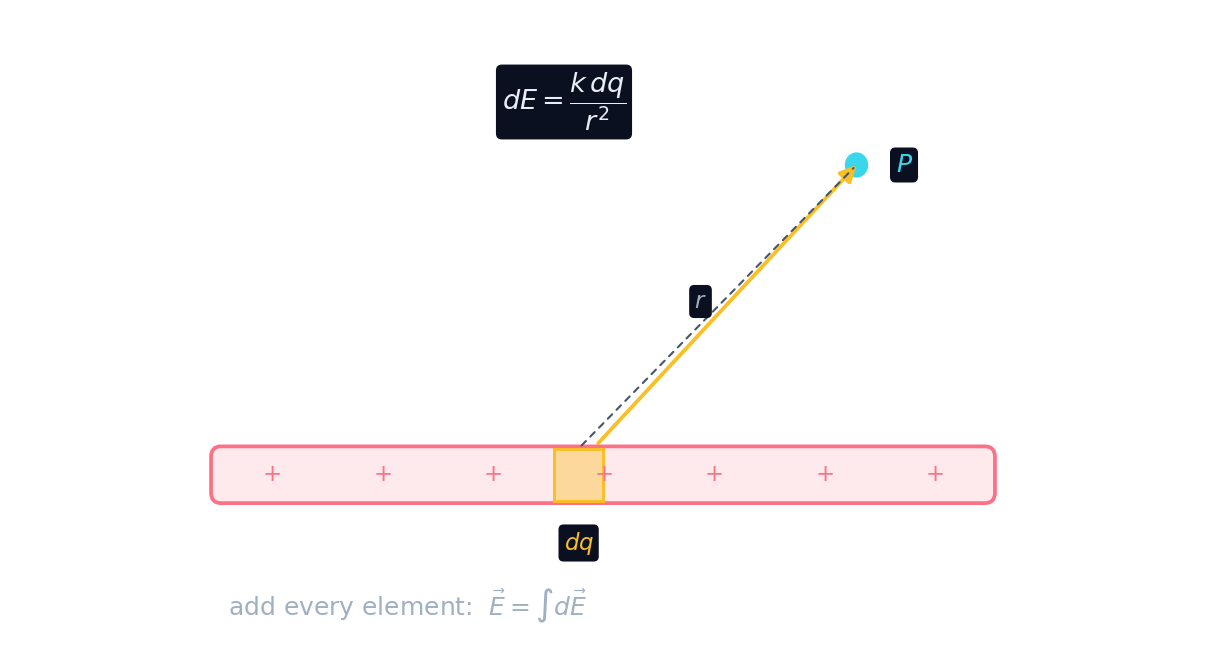
- Pick a tiny element $dq$ at distance $r$ from your point $P$.
- Its field is $d\vec E = \dfrac{k\,dq}{r^2}\hat r$, where $\hat r$ points from the element to $P$; negative $dq$ reverses the field.
- Every element points a slightly different way — $d\vec E$ is a vector.
- Sum them: $\vec E = \displaystyle\int d\vec E$.
Build up a field
See how a larger, denser charge builds a stronger field from many contributions.
The field from a small element $dq$ at distance $r$ เป็น $dE = k\,dq/$ ____.
ความยาก 1/5 · 100 เหรียญ + บอนัสน้อยๆ เมื่อทำสำเร็จครั้งแรกในวันนี้
Each element is a point charge: $dE = k\,dq/r^2$.
Select ทั้งหมด correct steps for the field of a charge distribution.
ความยาก 2/5 · 140 เหรียญ + บอนัสน้อยๆ เมื่อทำสำเร็จครั้งแรกในวันนี้
Density → dE → integrate. A single kQ/r² fails because r differs for each element.
Use symmetry to kill components
- Adding vectors is hard, so let symmetry 对称性 do the work.
- For a symmetric shape, sideways components cancel in pairs.
- Only the component along the symmetry axis survives.
- Integrate just that surviving component — far less algebra.
For a symmetric charge, sideways field components often cancel in pairs.
ความยาก 1/5 · 100 เหรียญ + บอนัสน้อยๆ เมื่อทำสำเร็จครั้งแรกในวันนี้
Symmetry cancels perpendicular components, leaving only the axial part.
A worked shape: the infinite line
- For an infinite uniformly charged line, the integral gives $E = \dfrac{2k\lambda}{r}$.
- Notice: it falls off as $1/r$, not $1/r^2$ — the extra charge farther along helps.
- An infinite uniformly charged plane gives an even flatter field, $E = \dfrac{\sigma}{2\varepsilon_0}$ (constant).
- The shape of the object sets how fast the field fades.
The field of an infinite line of charge falls off as:
ความยาก 1/5 · 100 เหรียญ + บอนัสน้อยๆ เมื่อทำสำเร็จครั้งแรกในวันนี้
An infinite line gives $E = 2k\lambda/r$ — a $1/r$ falloff.
A charged plane gives $E = \sigma/(2\varepsilon_0)$. If $\sigma$ doubles, $E$ becomes how many times bigger?
ความยาก 2/5 · 140 เหรียญ + บอนัสน้อยๆ เมื่อทำสำเร็จครั้งแรกในวันนี้
$E \propto \sigma$, so doubling $\sigma$ doubles $E$.
A ring of radius $a$ carries uniformly distributed charge $Q$. Find $E$ on its axis, distance $x$ from the centre.
- Symmetry cancels transverse components. Every element is $r = \sqrt{x^2+a^2}$ away, and its axial factor is $\cos\theta = x/r$.
- Thus $dE_x = (k\,dq/r^2)(x/r)$, so $E_x = \dfrac{kx}{(x^2+a^2)^{3/2}}\int dq = \dfrac{kQx}{(x^2+a^2)^{3/2}}$. Its sign sets the direction along the axis.
Worked example: a finite rod, point on its axis
A rod of length $L$ carries uniform charge $Q$ ($\lambda=Q/L$) along the $x$-axis from $x=0$ to $x=L$. Find $E$ at point $P$ at $x=L+d$.
- Element: $dq=\lambda\,dx$ at position $x$, a distance $L+d-x$ from $P$. Every $d\vec E$ points along $+x$, so no components cancel and no angles are needed.
- Integrate: $E=\displaystyle\int_0^L\frac{k\lambda\,dx}{(L+d-x)^2}=k\lambda\left[\frac{1}{L+d-x}\right]_0^L$.
- Simplify with $\lambda=Q/L$: $E=k\lambda\left(\dfrac1d-\dfrac1{L+d}\right)=\dfrac{kQ}{d(L+d)}$
- Check: far away ($d\gg L$) this becomes $\dfrac{kQ}{d^2}$, a point charge ✓
- Method: write $dq$, write the distance to $P$ in terms of the variable, decide which components survive, set limits, integrate, then check a limit.
A 0.30 m rod carries 2.0 μC spread uniformly. Find E on its axis 0.10 m beyond one end, in units of 10⁵ N/C. Use k = 9.0 × 10⁹ N·m²/C².
ความยาก 2/5 · 140 เหรียญ + บอนัสน้อยๆ เมื่อทำสำเร็จครั้งแรกในวันนี้
E = kQ/(d(L + d)) = (9.0 × 10⁹ × 2.0 × 10⁻⁶)/(0.10 × 0.40) = 18000/0.04 = 4.5 × 10⁵ N/C.
Why is checking the limit d ≫ L useful for the rod result E = kQ/(d(L + d))?
ความยาก 1/5 · 100 เหรียญ + บอนัสน้อยๆ เมื่อทำสำเร็จครั้งแรกในวันนี้
A limiting case you already know tests the answer: when d ≫ L, d(L + d) ≈ d², giving the point-charge field.
You must add the little fields as vectors, not just their sizes. Skipping symmetry and summing magnitudes gives a wrong (too big) answer — always cancel the components that symmetry kills first.
For spread-out charge, write $dq$ with a density ($\lambda,\sigma,\rho$), find each element's $dE = k\,dq/r^2$, and integrate $\vec E = \int d\vec E$. Use symmetry to cancel components. An infinite line gives $E = 2k\lambda/r$; a plane gives a constant $E = \sigma/2\varepsilon_0$.
Write from the data: find the line field
- An infinite line has lambda = 4 microcoulomb per metre. The point is 0.20 m from the line. Use k = 9 times 10 to the 9.
- Find the field and say how it falls with distance.
An infinite line has linear charge density 4 microcoulomb per metre. Find the field 0.20 m away, using k = 9 times 10 to the 9, and say how a line field depends on distance.
2 times 9 times 10 to the 9 times 4 times 10 to the minus 6, divided by 0.20, is 360000.
An infinite uniformly charged line has density +4 microcoulomb per metre. What is the field 0.20 m away? Use k = 9 times 10 to the 9.
ความยาก 1/5 · 100 เหรียญ + บอนัสน้อยๆ เมื่อทำสำเร็จครั้งแรกในวันนี้
2 k lambda over r is 72000 divided by 0.20, which is 360000 newtons per coulomb.