สนามแม่เหล็กจากกระแสไฟฟ้า
| English | ไทย |
|---|---|
| iron core/ˈaɪən kɔː/ | แกนเหล็ก |
| right-hand grip rule/raɪt hænd ɡrɪp ruːl/ | กฎกำปั้นมือขวา |
| bar magnet/bɑː ˈmæɡnɪt/ | แม่เหล็กแท่ง |
| solenoid/ˈsəʊlənɔɪd/ | โซเลนอยด์ |
A magnet with an off switch
- A scrapyard crane picks up a tonne of steel, swings it across the yard, and drops it by flicking a switch.
- No permanent magnet can do that. What the crane carries is a coil of wire around an iron core, and its magnetism exists only while the current flows.
- Every field in this lesson comes from a current, which means every one of them can be switched, reversed or made stronger at will.
- This lesson is the field patterns that currents produce, and the forces between two currents.
The field around a straight wire
- The field forms concentric circles around the wire, in the plane perpendicular to it.
- Their spacing widens with distance, because the field weakens as you move away.
- The direction comes from the right-hand grip rule 右手定则: grip the wire with your right hand, thumb along the current, and your fingers curl the way the field points.
- For a current into the page, that gives a clockwise field.
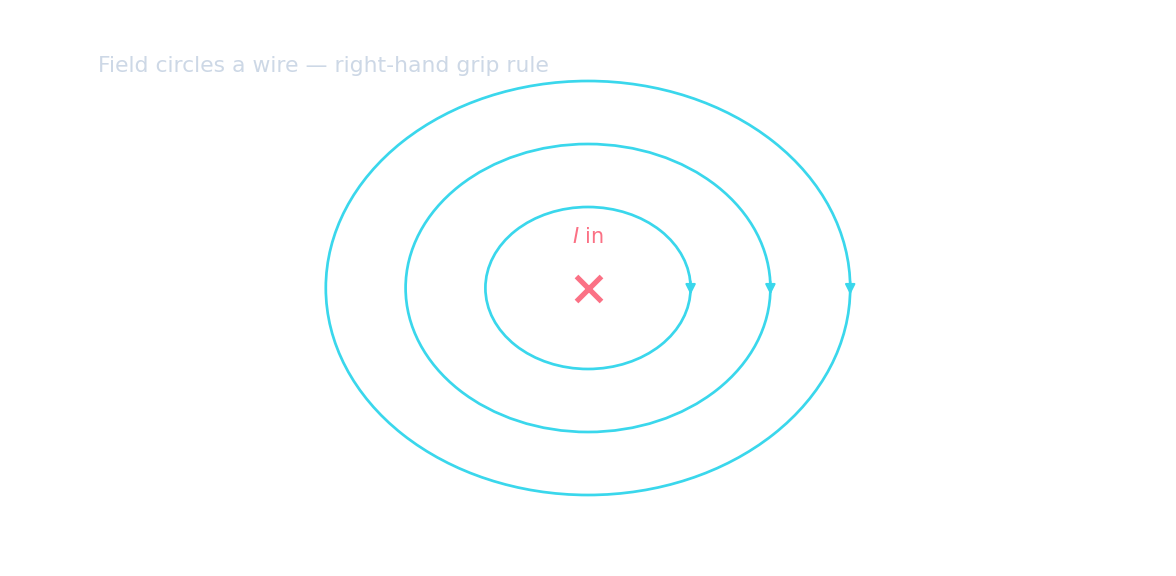
Circles, widening, each with an arrow
การทดลองกฎสนามกระแส
เชื่อมต่ทิศทางกระแสกับสนามแม่เหล็กวงกลมรอบสายไฟ
สนามแม่เหล็กรอบสายไฟตรงยาวจะสร้างรูปทรง:
วงกลมซ้อนกัน โดยทิศทางกำหนดโดยกฎกำปั้นมือขวา
กฎกำปั้นมือขวาใช้บอกทิศทางของสนามรอบสายไฟที่มีกระแสไหลผ่าน
นิ้วโป้งชี้ตามกระแส นิ้วที่งอแสดงทิศทางการชี้ของสนามวงกลม
The flat circular coil
- Bend the wire into a loop and the circular fields around each side reinforce through the centre.
- So the field at the centre is at right angles to the plane of the coil, and strongest there.
- Seen from one face the coil behaves as a north pole, since the field leaves it there; from the other face, a south pole. A single loop is already a small bar magnet 条形磁铁.
ทิศทางของสนามแม่เหล็กที่จุดกึ่งกลางของคอยล์วงกลมแบนคืออะไร?
สนามวงกลมรอบสองด้านเสริมกันผ่านจุดกึ่งกลาง ทำให้คอยล์ทำหน้าที่เหมือนแท่งแม่เหล็กขนาดเล็ก มีขั้วเหนือจากหน้าหนึ่งและขั้วใต้จากอีกหน้าหนึ่ง
The solenoid
- A solenoid 螺线管 is many such loops in a row. Their fields add along the axis, so inside the field is nearly uniform and parallel to the axis, exactly like a stretched bar magnet.
- Outside it spreads out and falls off fast, and the ends behave as N and S poles.
- Three things strengthen it: more turns per unit length, a larger current, and an iron core 铁芯.

Uniform down the axis, and poles at the ends
ภายในโซเลนอยด์ยาว สนามแม่เหล็กจะเป็นแบบ ____ เกือบทั้งหมด
คล้ายกับแท่งแม่เหล็กที่ถูกยืดออก — สนามภายในมีขนาดสม่ำเสมอและขนานกับแกน
การใส่แกนเหล็กจะเพิ่มสนามแม่เหล็กของโซเลนอยด์อย่างมาก
แม่เหล็กอะตอมของเหล็กเรียงตัวและรวมเข้ากับสนาม — ใช้ในแม่เหล็กไฟฟ้าและหม้อแปลง
การเปลี่ยนแปลงใด会增加 inside a solenoid magnetic field? เลือก ทุก ข้อที่ใช้ได้
จำนวนรอบต่อหน่วยความยาว กระแส และแกนโลหะแม่เหล็ก ลวดที่หนากว่าลดความต้านทานแต่ไม่ได้เปลี่ยนสนามโดยตรงสำหรับกระแสที่กำหนด
Worked example: why the core helps
- Explain why inserting an iron core greatly increases the magnetic field of a solenoid.
- The core is a ferrous material, so the solenoid's field magnetises it: its atomic magnets line up with the field.
- The magnetised core then produces its own magnetic field, which adds to the field of the current.
- The two together are far stronger than the current's field alone. Both steps, magnetised and adds its own field, are needed for the marks. "It concentrates the field lines" is not the marked answer.
เรียงลำดับคำอธิบายว่าทำไมแกนเหล็กจึงเสริมสนามโซเลนอยด์
ขั้นตอนกลางทั้งสองจำเป็นเพื่อรับคะแนน: เป็นแม่เหล็ก และสร้างสนามของตัวเอง คำว่า "มันรวมสนาม" ไม่เป็นคำตอบที่รับคะแนน
Two parallel currents
- Each wire sits in the field of the other, so each experiences a motor-effect force $F = BIL$.
- Apply the left-hand rule to each wire in turn, using the field the other one makes. The result is symmetric, as Newton's third law requires.
- Currents in the same direction attract. Currents in opposite directions repel.
- This force is the basis of the historical definition of the ampere.
สายคู่ขนานที่มีกระแสไหลในทิศทาง เดียวกัน :
กระแสทิศทางเดียวกันดึงดูด; กระแสทิศทางตรงข้าม排斥กัน นี่คือพื้นฐานของแอมแปร์
จับคู่แต่ละงานกับกฎที่คุณใช้
คำถามเกี่ยวกับสายขนานต้องใช้ทั้งสอง: มือกขวาสำหรับสนามที่สายหนึ่งสร้าง แล้วมือนิ้วสำหรับแรงที่กระทำต่ออีกสายหนึ่ง
Worked example: predicting the direction
- Two long parallel wires carry currents in the same direction. Show that they attract.
- Use the right-hand grip rule on the left wire: in the region of the right wire, its field points into the page, say.
- Now use the left-hand rule on the right wire: field into the page, current up the page, so the force on it is towards the left wire.
- Repeat for the other wire and the force is towards the first. They attract. Note that like currents attract, which is the opposite of what like charges do.
Marks that slip away
- Right hand for the field a current makes; left hand for the force on a current in a field. Both appear in a parallel-wires question and they are not interchangeable.
- The field around a wire is circles, not lines along the wire, and their spacing widens.
- The iron core is magnetised and adds its own field. Say both parts.
- Currents in the same direction attract, unlike charges of the same sign.
You've got it
- a straight wire's field is concentric circles with widening spacing, direction from the right-hand grip rule
- a flat coil gives a field at right angles through its centre and acts as a small bar magnet; a solenoid is nearly uniform inside and has poles at its ends
- more turns per unit length, a larger current and an iron core all strengthen a solenoid, the core because it is magnetised and adds its own field
- parallel currents attract when in the same direction and repel when opposite, found by using the right-hand rule for the field and the left-hand rule for the force