โมเมนตัม
แนะนำใหม่| English | ความหมาย |
|---|---|
| momentum/məʊˈmentəm/ | โมเมนตัม |
| conservation of momentum/ˌkɒnsəˈveɪʃn ɒv məʊˈmentəm/ | กฎการอนุรักษ์โมเมนตัม |
| collision/kəˈlɪʒn/ | การชน |
| explosion/ekˈspləʊʒn/ | การระเบิด |
| conserved/kənˈsɜːvd/ | ถูกอนุรักษ์ |
| elastic/ɪˈlæstɪk/ | ยืดหยุ่น |
| kinetic energy/kɪˈnetɪk ˈenədʒi/ | พลังงานจลน์ |
| inelastic/ɪnɪˈlæstɪk/ | ไม่ยืดหยุ่น |
The crash that proves physics works
- When two cars collide, the total momentum 动量 before equals the total momentum after — even though the cars are crumpled and stopped.
- Conservation of momentum 动量守恒 is one of the most powerful laws in physics. It works for billiard balls, rockets, and subatomic particles.
What is momentum?
- Momentum = mass × velocity (a vector): $\mathbf{p} = m\mathbf{v}$.
- Units: $\text{kg m s}^{-1}$ (or equivalently, N s).
- Because it's a vector, direction matters: a 2 kg ball going right at 3 m/s has momentum $+6$; going left, $-6$.
Worked example. A 0.5 kg tennis ball hits a wall at $20\text{ m s}^{-1}$ and bounces back at $15\text{ m s}^{-1}$. Change in momentum $= 0.5(15) - 0.5(-20) = 7.5 + 10 = 17.5\text{ kg m s}^{-1}$.
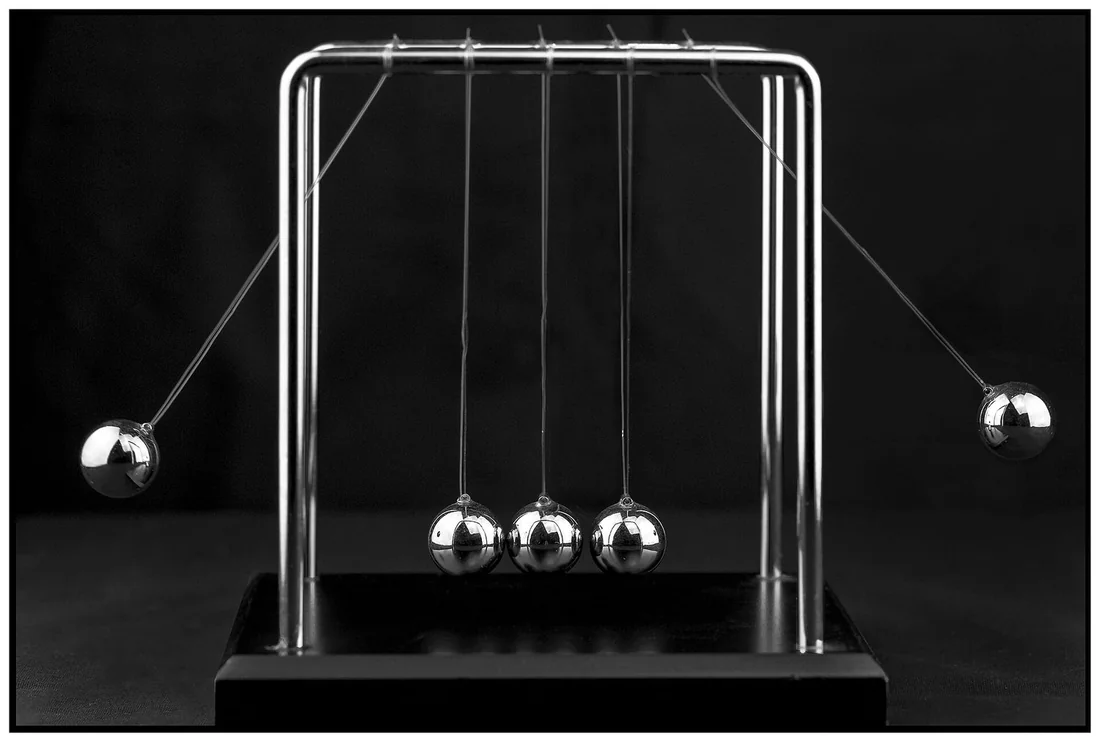
A Newton's cradle demonstrates conservation of momentum
การอนุรักษ์โมเมนตัม
m₁u₁ + m₂u₂ = (m₁+m₂)v
รถเข็นสองคันชนกันและติดกัน — โมเมนตัมรวมก่อนเท่ากับโมเมนตัมรวมหลัง
นิยามของโมเมนตัมคือ:
ความยาก 1/5 · 100 เหรียญ + บอนัสน้อยๆ เมื่อทำสำเร็จครั้งแรกในวันนี้
โมเมนตัม = มวล × ความเร็ว, เป็นปริมาณเวกเตอร์
ลูกบอลที่มีมวล 0.5 kg ชนกำแพงด้วยความเร็ว 20 m/s และเด้งกลับด้วยความเร็ว 15 m/s. การเปลี่ยนแปลงโมเมนตัม (kg m/s) คือเท่าใด?
ความยาก 2/5 · 140 เหรียญ + บอนัสน้อยๆ เมื่อทำสำเร็จครั้งแรกในวันนี้
การเปลี่ยนแปลง = 0.5(15) − 0.5(−20) = 7.5 + 10 = 17.5 kg m/s.
Conservation of momentum
- In a collision 碰撞 (or explosion 爆炸), total momentum is conserved 守恒:
Watch the signs. Momentum is a vector. If one object moves left and another right, one velocity is positive and the other negative. Getting the signs wrong is the most common error.
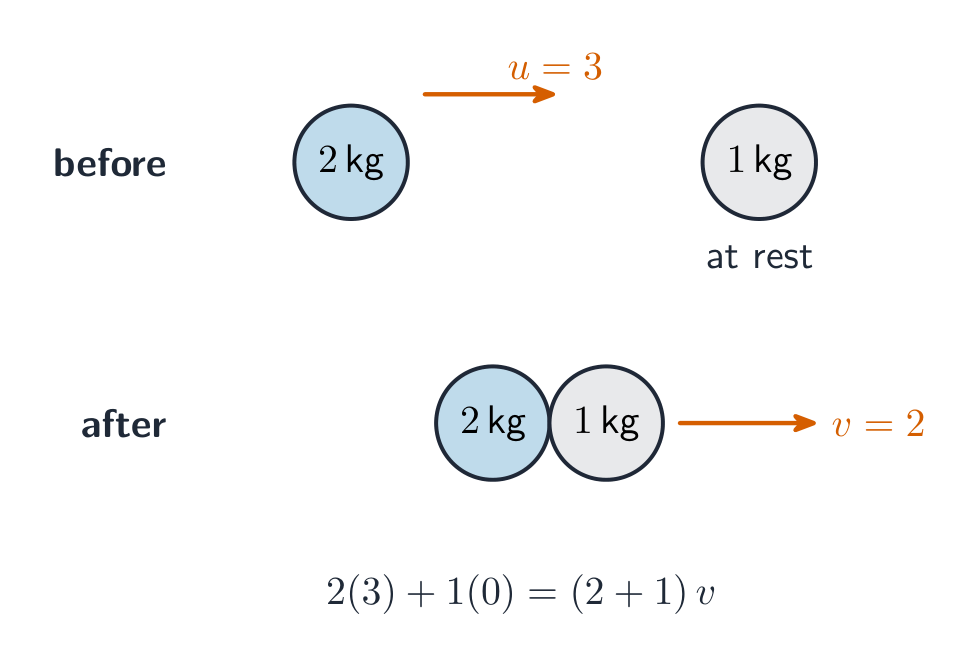
Total momentum before equals total momentum after a collision
ในการชนกัน โมเมนตัมรวมของวัตถุทั้งสองมีค่าคงที่
ความยาก 1/5 · 100 เหรียญ + บอนัสน้อยๆ เมื่อทำสำเร็จครั้งแรกในวันนี้
โมเมนตัมรวมก่อนเท่ากับโมเมนตัมรวมหลังการชน
เมื่อวัตถุสองชิ้นเคลื่อนที่ในทิศทางตรงกันข้าม โมเมนตัมของพวกมันจะมีเครื่องหมายตรงกันข้าม
ความยาก 1/5 · 100 เหรียญ + บอนัสน้อยๆ เมื่อทำสำเร็จครั้งแรกในวันนี้
โมเมนตัมเป็นเวกเตอร์ — ทิศทางตรงกันข้ามหมายถึงเครื่องหมายตรงกันข้าม
Worked example — collision
- A 2 kg body at $3\text{ m s}^{-1}$ hits a stationary 1 kg body and they stick together.

Total momentum before equals total momentum after: 2(3) + 1(0) = (2+1)v.
- Before: $2(3) + 1(0) = 6\text{ kg m s}^{-1}$.
- After: $(2+1)v = 3v$.
- Conservation: $3v = 6 \Rightarrow v = 2\text{ m s}^{-1}$.
วัตถุที่มีมวล 2 kg เคลื่อนที่ด้วยความเร็ว 3 m/s ชนวัตถุนิ่งที่มีมวล 1 kg และติดกัน จะมีความเร็วร่วมเท่าใด (m/s)?
ความยาก 2/5 · 140 เหรียญ + บอนัสน้อยๆ เมื่อทำสำเร็จครั้งแรกในวันนี้
2(3) + 1(0) = (2+1)v, ดังนั้น 6 = 3v, ได้ v = 2 m/s.
Types of collision
- Perfectly elastic 弹性: kinetic energy 动能 is conserved (rare in practice).
- Inelastic 非弹性: kinetic energy is lost (most real collisions).
- Perfectly inelastic: the bodies stick together (maximum energy loss).
- Momentum is conserved in all types — only kinetic energy may change.
- In a collision the total linear momentum is unchanged — the conservation of linear momentum.
ในการชนแบบยืดหยุ่นสมบูรณ์ ปริมาณใดมีค่าคงที่ (นอกเหนือจากโมเมนตัม)?
ความยาก 1/5 · 100 เหรียญ + บอนัสน้อยๆ เมื่อทำสำเร็จครั้งแรกในวันนี้
ในการชนแบบยืดหยุ่นสมบูรณ์ ทั้งโมเมนตัมและพลังงานจลน์มีค่าคงที่
You've got it
- momentum = mass × velocity (a vector)
- conservation: $m_1 u_1 + m_2 u_2 = m_1 v_1 + m_2 v_2$
- total momentum is the same before and after a collision
- momentum is conserved in all collisions; kinetic energy only in elastic ones
Write from the data: find the common speed
- A 2 kg body at 6 metres per second sticks to a stationary 1 kg body.
- Find the common speed.
วัตถุที่มีมวล 2 กิโลกรัม เคลื่อนที่ด้วยความเร็ว 6 เมตรต่อวินาที ติดกับวัตถุที่มีมวล 1 กิโลกรัมซึ่งหยุดนิ่ง ความเร็วร่วมของทั้งสองคือเท่าใด?
2 คูณด้วย 6 ได้ 12 และ 12 หารด้วย 3 ได้ 4
ความเร็วร่วมของทั้งสองคือเท่าใด?
ความยาก 1/5 · 100 เหรียญ + บอนัสน้อยๆ เมื่อทำสำเร็จครั้งแรกในวันนี้
12 หารด้วย 3 ได้ 4 เมตรต่อวินาที ตัวเลือกอื่น — 17.5 (การเปลี่ยนแปลงโมเมนตัมจากการดีดในบทเรียน); 6 เมตรต่อวินาที (ความเร็วเริ่มต้น)