Partition coefficients
แนะนำใหม่ 7:55
สมดุล (A2)
เลือดของคุณถูกรักษาไว้ที่ pH เจ็ดจุดสี่ เลื่อนไปทางใดทางหนึ่งเพียงไม่กี่สิบส่วนแล้วคุณจะเข้าโรงพยาบาล แต่ตลอดทั้งวัน กรดไหลเข้ามา — จากอาหารของคุณ และจาก…
บรรยายภาษาอังกฤษ · สลับคำบรรยายภาษาอังกฤษและภาษาจีนได้
In this lesson
| English | ความหมาย |
|---|---|
| solvent/ˈsɒlvənt/ | ตัวทำละลาย |
| solute/ˈsɒljuːt/ | ตัวละลาย |
| partition coefficient/pɑːˈtɪʃn ˌkəʊɪˈfɪʃənt/ | สัมประสิทธิ์การกระจาย |
| non-polar/nɒn ˈpəʊlə/ | ไม่มีขั้ว |
| polar/ˈpəʊlə/ | ขั้ว |
Splitting between two solvents 溶剂
- Coffee is decaffeinated by shaking it with a solvent that caffeine prefers to water. Shake a solute 溶质 with two solvents 溶剂 that don't mix, and it spreads between them in a fixed ratio.
- That ratio of concentrations is the partition coefficient 分配系数. Polarity decides which solvent the solute prefers.
Partition coefficient lab
Kpc = concentration organic / concentration aqueous
Change organic-layer concentration and see the partition ratio.
A partition coefficient describes how a solute distributes between two immiscible solvents.
ความยาก 1/5 · 100 เหรียญ + บอนัสน้อยๆ เมื่อทำสำเร็จครั้งแรกในวันนี้
It is the ratio of concentrations at equilibrium.
The partition coefficient
- It is constant at a fixed temperature, and has no units (the concentration units cancel). Always say which solvent is on top of the fraction.
- It only applies when the solute is in the same form in both solvents (not ionised or paired up in one of them).
The partition coefficient is:
ความยาก 1/5 · 100 เหรียญ + บอนัสน้อยๆ เมื่อทำสำเร็จครั้งแรกในวันนี้
Kpc = [solute in solvent 1] / [solute in solvent 2], constant at a fixed temperature.
The partition coefficient applies only when the solute is:
ความยาก 1/5 · 100 เหรียญ + บอนัสน้อยๆ เมื่อทำสำเร็จครั้งแรกในวันนี้
Kpc is valid when the solute exists in the same physical state in each solvent.
Match each partition idea.
ความยาก 2/5 · 140 เหรียญ + บอนัสน้อยๆ เมื่อทำสำเร็จครั้งแรกในวันนี้
Each item links the term to its correct meaning.
Polarity decides
- The value depends on the polarity of the solute and each solvent.
- A non-polar 非极性 solute dissolves more in the non-polar solvent; a polar 极性 solute prefers the polar solvent.
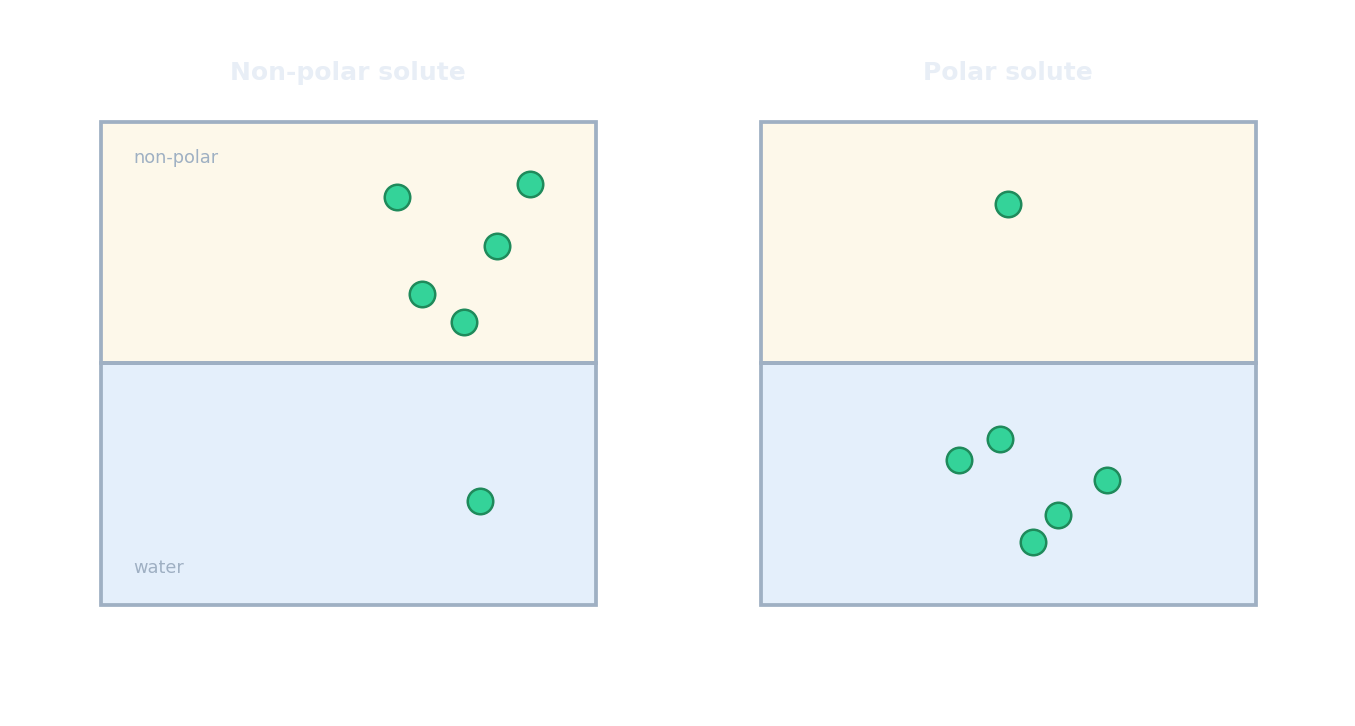
A non-polar solute will dissolve more in:
ความยาก 1/5 · 100 เหรียญ + บอนัสน้อยๆ เมื่อทำสำเร็จครั้งแรกในวันนี้
"Like dissolves like": a non-polar solute prefers the non-polar solvent; a polar solute the polar one.
The value of the partition coefficient depends on the polarity of the solute and solvents.
ความยาก 1/5 · 100 เหรียญ + บอนัสน้อยๆ เมื่อทำสำเร็จครั้งแรกในวันนี้
Polarity governs how the solute distributes, so it sets the partition coefficient.
Calculating $K_{\text{pc}}$ from titrations. Ammonia is shaken with water and trichloromethane (CHCl₃) until equilibrium. A 25.0 cm³ sample of the water layer needs 22.5 cm³ of 0.500 mol dm⁻³ HCl; a 25.0 cm³ sample of the CHCl₃ layer needs 11.5 cm³ of 0.0500 mol dm⁻³ HCl.
- Water layer: $\dfrac{0.0225\times0.500}{0.0250}=0.450$ mol dm⁻³. CHCl₃ layer: $\dfrac{0.0115\times0.0500}{0.0250}=0.0230$ mol dm⁻³.
- $K_{\text{pc}}=\dfrac{[\text{NH}_3\text{ in water}]}{[\text{NH}_3\text{ in CHCl}_3]}=\dfrac{0.450}{0.0230}=19.6$. Polar ammonia prefers water.
At equilibrium, iodine has concentration 0.0850 mol dm⁻³ in hexane and 0.00100 mol dm⁻³ in water. Calculate $K_{\text{pc}}$ (hexane/water).
ความยาก 2/5 · 140 เหรียญ + บอนัสน้อยๆ เมื่อทำสำเร็จครั้งแรกในวันนี้
$\dfrac{0.0850}{0.00100}=85$. Non-polar iodine strongly prefers hexane.
Worked example: one portion or two?
For Y, $K_{\text{pc}} = \dfrac{[\text{Y in hexane}]}{[\text{Y in water}]} = 5.0$. A sample of $50\ \text{cm}^3$ of water holds 1.20 g of Y. Let $x$ be the mass that moves into the hexane.
- One $50\ \text{cm}^3$ portion: $\dfrac{x/50}{(1.20 - x)/50} = 5.0$, so $x = 6.0 - 5.0x$ and $x = 1.00\ \text{g}$.
- Two $25\ \text{cm}^3$ portions: the first takes $0.857\ \text{g}$ (from $\dfrac{x/25}{(1.20-x)/50} = 5.0$), the second $0.245\ \text{g}$ of the $0.343\ \text{g}$ left, $1.10\ \text{g}$ in all. The same volume used in smaller portions extracts more.
$K_{\text{pc}} = \dfrac{[\text{X in hexane}]}{[\text{X in water}]} = 4.0$. $100\ \text{cm}^3$ of water containing 2.00 g of X is shaken with $100\ \text{cm}^3$ of hexane. What mass of X, in g, moves into the hexane?
ความยาก 2/5 · 140 เหรียญ + บอนัสน้อยๆ เมื่อทำสำเร็จครั้งแรกในวันนี้
The volumes are equal, so $\dfrac{x}{2.00 - x} = 4.0$, giving $x = 8.0 - 4.0x$ และ $x = 1.60\ \text{g}$.
A chemist has $50\ \text{cm}^3$ of organic solvent to extract a product from water. Which method extracts the most?
ความยาก 1/5 · 100 เหรียญ + บอนัสน้อยๆ เมื่อทำสำเร็จครั้งแรกในวันนี้
Each extraction sets up a new equilibrium with fresh solvent, so several small portions remove more solute than one large portion.
- Use concentrations, not masses or moles. If the two volumes differ, divide each amount by its own volume.
- $K_{\text{pc}}$ for (hexane/water) is the reciprocal of (water/hexane). Check which way the question writes it.
- Several small extractions remove more than one large one with the same total volume, but some solute is always left behind.
0.30 g of X is in 20 cm³ of ether and 0.10 g is in 100 cm³ of water at equilibrium. Calculate $K_{\text{pc}}$ (ether/water).
ความยาก 2/5 · 140 เหรียญ + บอนัสน้อยๆ เมื่อทำสำเร็จครั้งแรกในวันนี้
Use concentrations: $\dfrac{0.30/20}{0.10/100}=\dfrac{0.015}{0.0010}=15$.
You've got it
- $K_{\text{pc}} = \dfrac{[\text{solute in solvent 1}]}{[\text{solute in solvent 2}]}$ (constant at fixed temperature)
- it applies when the solute is in the same physical state in both solvents
- non-polar solute → non-polar solvent; polar solute → polar solvent