Polymerisation and the addition mechanism
แนะนำใหม่ 9:53
ไฮโดรคาร์บอน
ของเหลวใสสองชนิด เป็นเพียงคาร์บอนและไฮโดรเจนเท่านั้น และมีน้ำบโรมีนสีส้มสองหลอด เขย่าของเหลวแรกลงในหลอดหนึ่ง ของเหลวที่สองลงใน…
บรรยายภาษาอังกฤษ · สลับคำบรรยายภาษาอังกฤษและภาษาจีนได้
In this lesson
| English | ความหมาย |
|---|---|
| polymer/ˈpɒlɪmə/ | โพลิเมอร์ |
| carbocation/ˌkɑːbəˈkeɪʃn/ | คาร์โบแคทไอออน |
| Markovnikov's rule/ˈmɑːkəvnɪkɒvz ruːl/ | กฎของมาร์คอฟนิคอฟ |
| addition polymerisation/əˈdɪʃn ˌpɒlɪməraɪˈzeɪʃn/ | การเกิดโพลิเมอร์ด้วยการเติม |
| inductive effect/ɪnˈdʌktɪv ɪˈfekt/ | ผลเชิงเหนี่ยวนำ |
Tiny units, giant chains
- A plastic bag is made of chains of tens of thousands of ethene units. Alkenes join like this because of their reactive double bond.
- This lesson: making a polymer 聚合物, and the mechanism of electrophilic addition.
Addition polymerisation 加成聚合
- Many monomer molecules (alkenes) open their double bonds and join into one long chain. There is no other product.
- Ethene → poly(ethene): $n\,\text{CH}_2{=}\text{CH}_2\rightarrow{-}[\text{CH}_2{-}\text{CH}_2]_n{-}$.
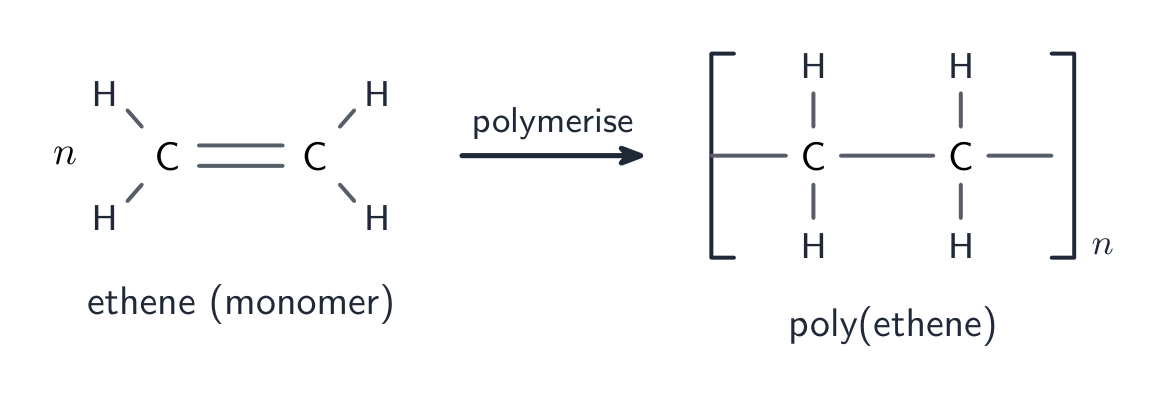
Many ethene molecules join into poly(ethene)
การพอลิเมอไรเซชันแบบเติม
Many alkene monomers open their double bonds and join into one long chain.
In addition polymerisation:
ความยาก 1/5 · 100 เหรียญ + บอนัสน้อยๆ เมื่อทำสำเร็จครั้งแรกในวันนี้
Alkenes open their double bonds and join into a polymer such as poly(ethene); nothing else is formed.
Many ethene molecules join to form the polymer poly(______).
ความยาก 1/5 · 100 เหรียญ + บอนัสน้อยๆ เมื่อทำสำเร็จครั้งแรกในวันนี้
Addition polymerisation of the alkene.
Repeat units and uses
| Monomer | Repeat unit | Polymer | Use |
|---|---|---|---|
| ethene | –CH₂–CH₂– | poly(ethene) | bags, bottles |
| propene | –CH₂–CH(CH₃)– | poly(propene) | ropes, crates |
| chloroethene | –CH₂–CHCl– | PVC, poly(chloroethene) | pipes, window frames |
| tetrafluoroethene | –CF₂–CF₂– | PTFE | non-stick pans |
- To draw a repeat unit, take the two C=C carbons, make the double bond single, and add bonds sticking out of both sides.
A polymer has the repeat unit –CH₂–CH(CN)–. What is its monomer?
ความยาก 1/5 · 100 เหรียญ + บอนัสน้อยๆ เมื่อทำสำเร็จครั้งแรกในวันนี้
Put the double bond back between the two main-chain carbons: CH₂=CHCN (propenenitrile).
A poly(ethene) chain has Mᵣ = 28 000. Ethene has Mᵣ = 28. How many monomer units are in the chain?
ความยาก 2/5 · 140 เหรียญ + บอนัสน้อยๆ เมื่อทำสำเร็จครั้งแรกในวันนี้
Addition polymerisation loses no atoms, so n = 28 000 ÷ 28 = 1000.
Disposing of polymers
- Poly(alkenes) are non-biodegradable: the strong, non-polar C–C and C–H bonds are unreactive, so they stay in landfill for centuries.
- Burning releases energy but can give toxic gases: PVC gives HCl. Recycling sorts and remelts them.
The electrophilic addition mechanism
- The π electrons repel the electrons in Br–Br, so Br₂ becomes polarised ($\text{Br}^{\delta+}{-}\text{Br}^{\delta-}$). A curly arrow goes from the C=C to $\text{Br}^{\delta+}$, and the Br–Br bond breaks to give Br⁻.
- This leaves a positive carbocation 碳正离子. Br⁻ then attacks it with a lone pair: one Br adds to each carbon.

Electrophilic addition of bromine to ethene via a carbocation
During electrophilic addition, the positive intermediate formed is called a:
ความยาก 1/5 · 100 เหรียญ + บอนัสน้อยๆ เมื่อทำสำเร็จครั้งแรกในวันนี้
The C=C attacks the electrophile, forming a positively charged carbocation, which the negative ion then attacks.
Carbocation stability and Markovnikov
- Alkyl groups push electrons towards the positive carbon (inductive effect 诱导效应). Stability: tertiary > secondary > primary.
- With HBr and an unsymmetrical alkene, the more stable carbocation forms, so H adds to the carbon that already has more H atoms. This is Markovnikov's rule 马氏规则.

Alkyl groups stabilise the positive carbon, so tertiary > secondary > primary — the basis of Markovnikov's rule
Carbocation stability increases in the order:
ความยาก 1/5 · 100 เหรียญ + บอนัสน้อยๆ เมื่อทำสำเร็จครั้งแรกในวันนี้
More alkyl groups push electrons towards the positive carbon (inductive effect), so tertiary is most stable.
Markovnikov's rule predicts that when HBr adds to propene:
ความยาก 1/5 · 100 เหรียญ + บอนัสน้อยๆ เมื่อทำสำเร็จครั้งแรกในวันนี้
The more stable carbocation forms, so the major product follows Markovnikov's rule.
Match each addition idea.
ความยาก 2/5 · 140 เหรียญ + บอนัสน้อยๆ เมื่อทำสำเร็จครั้งแรกในวันนี้
Each item links the term to its correct meaning.
Predict the major product when HBr adds to 2-methylpropene, $(\text{CH}_3)_2\text{C}{=}\text{CH}_2$, and explain.
- $\text{H}^{+}$ can add to either alkene carbon. On the $\text{CH}_2$ end it leaves a tertiary carbocation, $(\text{CH}_3)_3\text{C}^{+}$, held up by three alkyl groups. On the other end it leaves a primary carbocation, $(\text{CH}_3)_2\text{CHCH}_2^{+}$, with only one.
- The tertiary carbocation is far more stable, so it forms almost every time; $\text{Br}^-$ then attacks it. The major product is 2-bromo-2-methylpropane, $(\text{CH}_3)_3\text{CBr}$; 1-bromo-2-methylpropane is the minor product.
HBr adds to but-1-ene, $\text{CH}_2{=}\text{CHCH}_2\text{CH}_3$. What is the major product?
ความยาก 1/5 · 100 เหรียญ + บอนัสน้อยๆ เมื่อทำสำเร็จครั้งแรกในวันนี้
H adds to the CH₂ end, leaving the positive charge on C2, which carries two alkyl groups (secondary, more stable).
HBr adding to but-2-ene, $\text{CH}_3\text{CH}{=}\text{CHCH}_3$, gives only one product.
ความยาก 1/5 · 100 เหรียญ + บอนัสน้อยๆ เมื่อทำสำเร็จครั้งแรกในวันนี้
The alkene is symmetrical: whichever carbon H adds to, both routes give a secondary carbocation and 2-bromobutane.
- A curly arrow starts at a pair of electrons (a bond or a lone pair) and points to where they go.
- The repeat unit has single bonds and open ends; the monomer has the C=C.
- Primary, secondary and tertiary describe the positive carbon: how many carbons it is bonded to.
You've got it
- Addition polymerisation: n alkene monomers → one polymer, no by-product; draw the repeat unit with open bonds.
- Poly(alkenes) are non-biodegradable; burning PVC gives HCl.
- Electrophilic addition: C=C attacks the electrophile → carbocation → anion attacks; tertiary > secondary > primary → Markovnikov.