หลักสูตรนี้คืออะไร และการใช้หลักสูตรนี้
นี่คือหลักสูตรที่สิบหนึ่งใน Medicine level University: เภสัชวิทยา — ร่างกายทำกับยาอย่างไร (พลวัต) และยาทำให้ร่างกายเกิดอะไรขึ้น (จลนศาสตร์) MED02 จัดเตรียมเคมีของรีเซปเตอร์, MED05 คือสรีรวิทยา, MED08 เป็นเป้าหมายต้านจุลชีพ
ขอบเขตจำกัด, ระบุครั้งเดียว: หลักสูตรการศึกษา ไม่ใช่ปริญญาตรีสาขาแพทย์; ทุกเคสเป็นเรื่องสมมติ, ทุกตัวเลขเป็นค่าการสอนเพื่ออธิบายภายในคำคำนวณที่มีฉลาก, ชื่อยาเป็นชื่อสากลที่ไม่ใช่เครื่องหมายการค้า (INN), และสิ่งเหล่านี้ไม่ใช่คำแนะนำในการสั่งยาหรือแผนการรักษา
- หน่วย 11.1–11.2 คือหัวใจ: เภสัชจลนศาสตร์และเภสัชพลศาสตร์
- หน่วย 11.3–11.6 คือระบบ: ระบบประสาทอัตโนมัติ, หัวใจและหลอดเลือด/ไต, ต้านจุลชีพ/?p?cancer, ระบบประสาทส่วนกลาง และการบรรเทาอาการปวด
- หน่วย 11.7 คือความปลอดภัย: ปฏิกิริยาร้ายแรง, การโต้ตอบ, การป้องกันความผิดพลาด
นิสัยทางเภสัชวิทยา: กลไกทำนายผล, คณิตศาสตร์ทำนายปริมาณ — กราฟทุกเส้นด้านล่างอ่านได้ทั้งสองทิศทาง, และครึ่งชีวิตทุกตัวคือสิ่งที่ต้องคำนวณใหม่
เภสัชจลนศาสตร์
ความสำคัญ. จลนศาสตร์แปลงขนาดยาเป็นความเข้มข้น — และสิ่งที่ยับยั้งคือความเข้มข้น ไม่ใช่ขนาดยา 半衰期, clearance และ volume เป็นสามตัวแปรหลัก
แนวคิด พร้อมภาพประกอบ. Volume of distribution $V_d$ (ปริมาตรที่ยา "อาศัยอยู่" แบบปรากฏ), clearance $CL$ (ปริมาตรที่กำจัดต่อหน่วยเวลา), เชื่อมโยงโดย $t_{1/2} = 0.693 \cdot V_d / CL$ ✓; การดูดซึมพร้อม bioavailability $F$ (สัดส่วนที่เข้าสู่กระแสเลือด); first-pass metabolism ลดปริมาณยาเมื่อทาน oral $F$ ✓.

การพิสูจน์ (ทำไม 4–5 ครึ่งชีวิตจึงถึงสถานะคงตัว) การให้ยาซ้ำเติมยาเข้าไปในแต่ละช่วง ในขณะที่การขับออกกำจัดสัดส่วนคงที่: ช่องว่างจะหดลงแบบเอ็กซ์โพเนนเชียลเข้าหา สถานะคงตัว — หลัง 3.3 ครึ่งชีวิต ~90 % ของสถานะคงตัว, หลัง 5 ครึ่งชีวิต ~97 % ✓. ปริมาณเริ่มต้น เติมถังพร้อมกัน: $D_L = C_{target} \cdot V_d / F$ (คำนวณเพื่อสอน: เป้าหมาย 10 mg/L, $V_d$ 40 L, $F$ 1.0 → 400 mg — ค่าการสอน, ไม่ใช่การสั่งยา) ✓
ตัวอย่างฝึกปฏิบัติ 1 — ตัวควบคุมสามอย่าง (ค่าสำหรับสอน) $V_d$ 40 L, $CL$ 5 L/h: $t_{1/2} = 0.693 \times 40 / 5 = 5.5$ h ✓. ลดการขับออกลงครึ่งหนึ่ง (โรคตับ): $t_{1/2}$ สองเท่าเป็น 11.1 h — ปริมาณเดียวกันนี้จะสะสม; สถานะคงตัวช้ากว่าและสูงกว่า ✓
ตัวอย่างคำนวณ 2 — เชื่อมโยงทางคลินิก: ค่าเสียจาก first-pass. (ค่าสมมติ) ยาที่มี oral $F$ = 0.6: จากขนาด oral ที่ระบุไว้ 100 mg, มีเพียง 60 mg ที่เข้าสู่กระแสเลือด — ตับดึงออก 40 % ในรอบแรก ✓. Portal failure หรือ bypass ทำให้ $F$ เพิ่มขึ้น และเม็ดยาเดียวกันก็เหมือนมีขนาดใหญ่ขึ้น: จลนศาสตร์ ไม่ใช่เภสัชวิทยา เปลี่ยนแปลงผลลัพธ์
ข้อผิดพลาดทั่วไป. สมมติว่า半衰期 กับระยะเวลาของผล药理 action เหมือนกัน (ผล药理 action ขึ้นกับความเข้มข้นเทียบกับช่วงเป้าหมายของยา) อ่าน $V_d$ ว่าเป็นปริมาตรจริง (มันคือค่าคงที่ความแปรผัน — ประมาณ 3 L หมายความว่ายาอยู่ใน plasma, 500 L หมายความว่ามีการจับกับเนื้อเยื่อ) ลืมว่าการให้ยาบำรุงรักษา (maintenance dosing) มุ่งไปที่ $CL \cdot C_{ss}$
สรุป. $t_{1/2} = 0.693\,V_d/CL$; สภาวะคงที่ ≈ 90 % ที่ 3.3 $t_{1/2}$, 97 % ที่ 5; loading $C_{target}V_d/F$; oral $F$ = สัดส่วนผ่าน first-pass; clearance กำหนด maintenance, volume กำหนด load
เภสัชพลศาสตร์
ความสำคัญ. พลศาสตร์คือไวยากรณ์ของกราฟยาทุกชนิด: receptor ทำอย่างไรกับโมเลกุล — potency, efficacy, และ antagonists ที่ลบทั้งสองอย่าง
แนวคิด พร้อมภาพประกอบ. Dose–response curve (log dose): ตำแหน่งบนแกน x = potency (EC₅₀); Ceiling = efficacy ($E_{max}$) ✓. Agonists ถึง $E_{max}$; partial agonists ถึง ceiling ต่ำกว่า (และแทนที่ full agonists); Competitive antagonists ขยับcurveไปทางขวาแบบขนาน; Non-competitive ลด $E_{max}$ ✓.
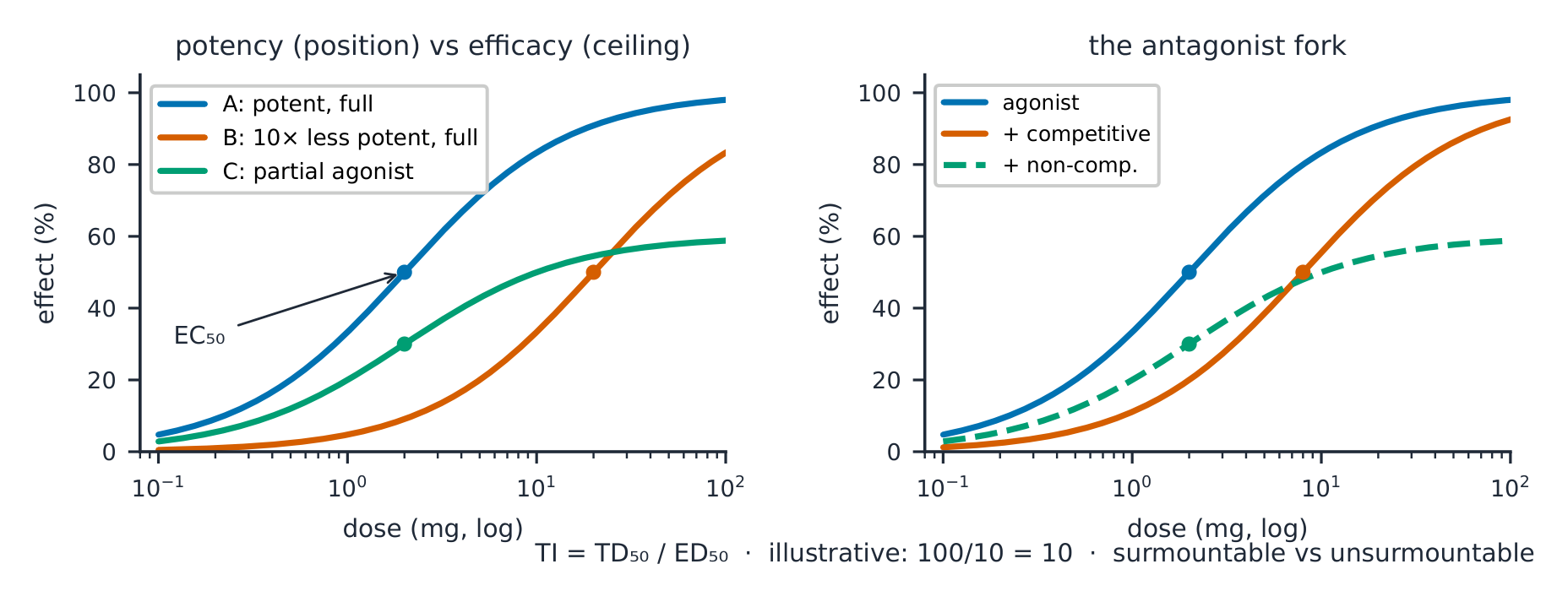 *Potency คือตำแหน่ง, efficacy คือ ceiling — antagonists ขยับไปทางขวาหรือลด ceiling
การพิสูจน์ (ทำไมดัชนีรักษาเป็นอัตราส่วน) ดัชนีรักษา $TI = TD_{50}/ED_{50}$ — ปริมาณที่ทำให้พิษต่อปริมาณที่ใช้รักษา, อ่านจากกราฟสะสมของแต่ละตัว (ตัวอย่าง: $TD_{50}$ 100 mg, $ED_{50}$ 10 mg → TI 10) ✓. ยาที่มี TI 2 ต้องใช้ด้วยความระวัง; TI 100 ยอมความผิดพลาดได้ง่าย. ยาที่มีTIแคบ (ตัวที่ต้องการตรวจระดับยา) คือยาwhose กราฟพิษและกราฟรักษาทับซ้อนกัน
ตัวอย่างคำนวณ 1 — อ่านคู่ curve. (curve สมมติ) Drug A: EC₅₀ 2 mg, $E_{max}$ 100 %; Drug B: EC₅₀ 20 mg, $E_{max}$ 100 % — B มี 10× potency น้อยแต่ efficacy เท่ากัน; Drug C: EC₅₀ 2 mg, $E_{max}$ 60 % — partial agonist, potent แต่ถูกจำกัด ceiling ✓. สามข้ออ้าง, สามคุณลักษณะของ curve
ตัวอย่างคำนวณ 2 — เชื่อมโยงทางคลินิก: The antagonist fork. (สมมติ) Competitive antagonist ใช้ร่วม: curve ขยับไปทางขวา — ผล药理 action ของ agonist สามารถเอาชนะได้ด้วยความเข้มข้น (surmountable). Non-competitive antagonist ลด $E_{max}$ — ความเข้มข้นเท่าไรก็ชนะไม่ได้ ✓. Logic ของ overdose ตามนี้: อย่างแรกคือการดึงเชือก, อย่างที่สองคือการตัดเชือกออก
ข้อผิดพลาดทั่วไป การเรียกยาที่มีฤทธิ์แรงว่าเป็นยาที่มีประสิทธิภาพสูง ( potency คือตำแหน่งของปริมาณยา; efficacy คือเพดานสูงสุด) การคาดหวังว่า partial agonist จะทำงานเหมือน full agonist ที่อ่อนแรงเมื่อใช้ร่วมกัน (มัน แข่งขัน — ลดเพดานของผสมนั้น) การอ่าน TI จากกราฟเดียว (ต้องใช้สอง: ผลและการเกิดพิษ)
สรุป. Potency = EC₅₀ ตำแหน่ง; Efficacy = $E_{max}$; Partial agonist = ceiling ต่ำกว่าที่แทนที่; Competitive → ขยับไปทางขวาแบบขนาน (surmountable); Non-competitive → ลด ceiling; $TI = TD_{50}/ED_{50}$ (ตัวอย่าง 100/10 = 10)
เภสัชวิทยาของระบบประสาทอัตโนมัติ
Why it matters. The autonomic receptor map (MED09 §5) is the most-prescribed territory in medicine — every agonist and blocker is a prediction exercise, and the toxidromes are its emergencies.
แนวคิด พร้อมภาพประกอบ รหัส: α1 ทำให้หลอดเลือดหดและม่านตาขยาย; β1 กระตุ้นหัวใจ; β2 เปิดทางเดินหายใจ; M3 กระตุ้นการหลั่ง ม่านตาหด และเร่งการทำงานของลำไส้ ในขณะที่ M2 ชะลอหัวใจ ✓ Agonists ดันตัวรับ ส่วน Blockers ลดการกระตุ้นของตัวรับนั้นลง

The derivation (why toxidromes are the map upside down). Cholinergic excess = everything M stands for: salivation, lacrimation, miosis, bronchorrhoea, bradycardia, gut cramps and diarrhoea ✓. Anticholinergic = M blocked: dry mouth, dilated fixed pupils, tachycardia, urinary retention, hot dry skin ✓. Adrenergic excess = α+β on: tachycardia, hypertension, mydriasis, sweating. The syndrome is the arithmetic of the map.
Worked example 1 — predict four drugs. (Fictional INN teaching set) a β1 blocker lowers heart rate and contractility (cardio-selective logic); an α1 blocker lowers blood pressure and can cause postural drop; a β2 agonist opens airways with little cardiac effect; an M blocker dries secretions and blurs vision ✓ — four predictions straight off the table.
ตัวอย่างวิธีทำ 2 — เชื่อมโยงทางคลินิก: ภาวะ overdose สองกรณี, แผนที่ยี่สอง (สมมติ) ผู้ป่วย A: ม่านตาจุดเล็ก, มีเหงื่อ, ปวดท้องและท้องเสีย — cholinergic; ผู้ป่วย B: ผิวแห้ง, ม่านตาขยาย, เต้นเร็ว — anticholinergic ✓. อาการแต่ละอย่างคือแถวตัวรับหนึ่งบรรทัด; การรวมกันเหล่านี้บอกชื่อกลุ่มก่อนผลการตรวจจะออกมา
Common mistakes. Expecting β-blockade to lower blood pressure instantly (output falls first; the full antihypertensive effect takes weeks of remodelling). Forgetting muscarinic versus nicotinic (M effects dominate toxidromes; N is ganglia and the NMJ). Treating sweating as an adrenergic sign only (sweat glands are sympathetic but cholinergic, at muscarinic receptors — the MED09 exception, which is why the anticholinergic patient is hot and dry).
สรุป α1 หด/ขยายม่านตา · β1 หัวใจ · β2 ทางเดินหายใจ · M3 หลั่ง/หดม่านตา/เร่งลำไส้, M2 ชะลอหัวใจ; agonist = ดัน, blocker = ปิดเสียง; cholinergic = เปียกและช้า; anticholinergic = แห้ง, บอกลา, เร็ว; adrenergic = เร็วและตึง; การทำนายมาจากแผนที่ ไม่ใช่ความจำ
ยา cardiovasculary และ renal drugs
เหตุผลที่สำคัญ ความดันโลหิตสูง, ภาวะหัวใจล้มเหลว และ thrombosis มีกลไกซับซ้อน: ยากลุ่มแต่ละกลุ่มคือการปรับลดขั้นตอนควบคุมความดันหรือการแข็งตัวของเลือดที่มีชื่อเรียกไว้ และ nephron คือแผนที่ diuretic
แนวคิด พร้อมภาพประกอบ ยาต้านความดันโลหิตตามกลไก: diuretics (ปริมาณ), ACE inhibitors ACE (บล็อกการสร้าง angiotensin II; ไอจ้ำ bradykinin), angiotensin receptor blockers, calcium-channel blockers (vasodilation), β1 blockers (output และ renin) ✓ Diuretics ตามตำแหน่ง nephron: loop (Na⁺-K⁺-2Cl⁻, thick ascending, ~25 % ของ Na⁺), thiazide (Na⁺-Cl⁻, distal tubule), potassium-sparing (collecting duct) ✓.

The derivation (why anticoagulants monitor differently). Unfractionated heparin acts immediately and is monitored with the aPTT; warfarin blocks vitamin-K clotting-factor synthesis — existing factors must decay first, so onset lags days and the INR measures the effect, not the dose ✓; direct oral anticoagulants target one factor (Xa or thrombin) with predictable kinetics, mostly unmonitored. The monitoring test is a property of the mechanism.
Worked example 1 — site to electrolyte. (Fictional) loop diuretic at the thick ascending limb: powerful Na⁺ loss, K⁺ loss (downstream flow), and Ca²⁺ loss; a potassium-sparing agent at the collecting duct: mild, K⁺-retaining ✓. Each site's chemistry predicts its electrolyte fingerprint.
ตัวอย่างวิธีทำ 2 — เชื่อมโยงทางคลินิก: ไอที่ไม่ใช่ติดเชื้อ (สมมติ) ใช้ ACE inhibitor, ไอแห้งเรื้อรัง: bradykinin ไม่ถูกย่อยสลายใน pathway นั้นอีกต่อไป ✓ — กลไกบอกชื่อ side effect, และการเปลี่ยนกลุ่ม (ไป ARB) มาจากกลไก ไม่ใช่การลองผิดลองถูก
Common mistakes. Placing thiazides in the loop (they act distally — weaker, slower, Ca²⁺-retaining). Expecting warfarin to act on factors already made (it blocks CARBOXYLATION of new ones). Confusing anticoagulants (clots) with antiplatelets (platelet plugs — different pipeline, different monitoring).
สรุป Volume/ACE/ARB/CCB/β1 = กลไกต้านความดันโลหิต; loop 25 %, thiazide distal, K-sparing collecting duct; heparin→aPTT ตอนนี้; warfarin→INR หลัง factor สลาย; DOACs target one factor, คาดเดาได้; กลไกบอก side effect
ยา antimicrobial และ anticancer drugs
Why it matters. The two attack maps share one logic — selective toxicity against cells that differ from ours — and the plan defers to MED08 §6 for the antibacterial targets.
The idea, with a picture. Antibacterial targets (MED08): wall (β-lactams), ribosome, nucleic-acid enzymes, folate ✓. Anticancer: cell-cycle-specific agents hit cycling cells — S-phase (antimetabolites: methotrexate, fluorouracil), M-phase (vinca alkaloids, taxanes) — while alkylators damage DNA regardless of cycle ✓.
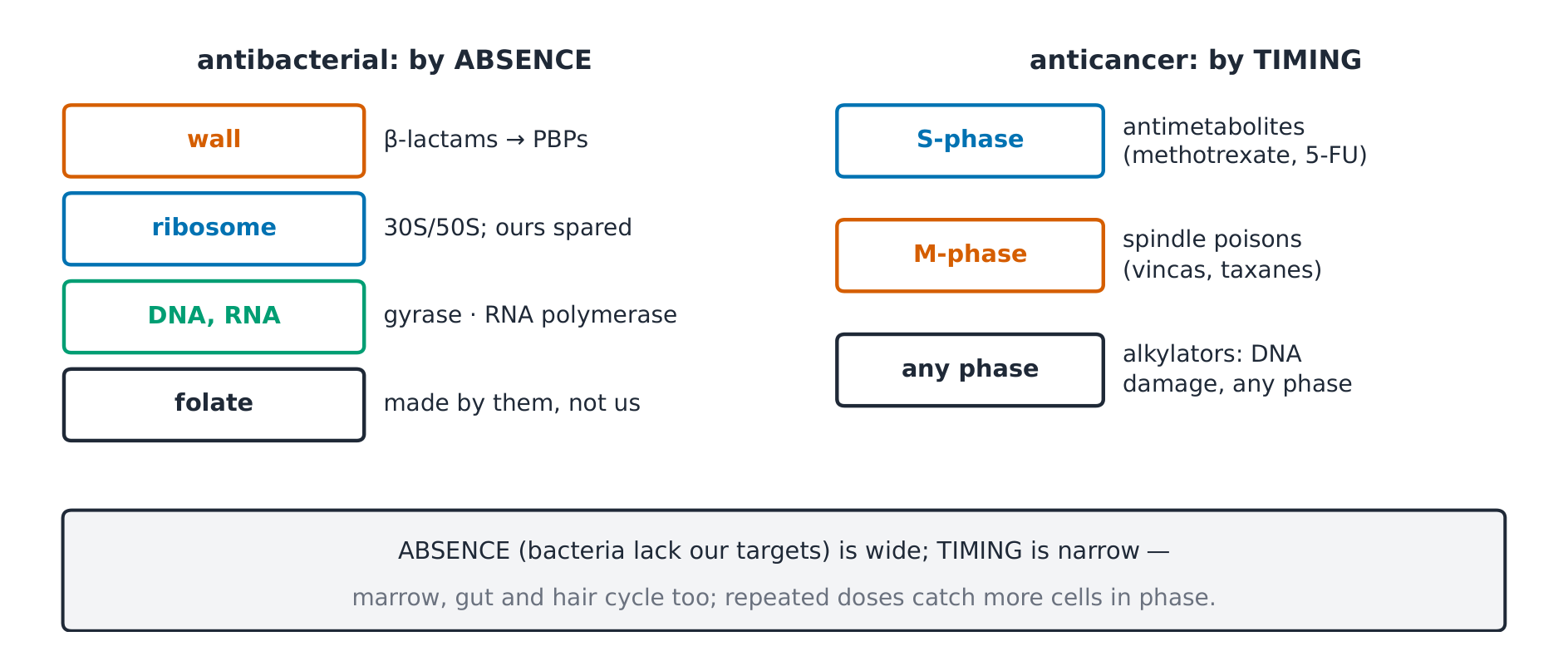
การพิสูจน์ (ทำไมความจำเพาะจึงแตกต่างกันระหว่างสาขา). ความจำเพาะต่อแบคทีเรียขึ้นอยู่กับโครงสร้างที่เซลล์มนุษย์ไม่มี (ผนังเซลล์, ไรโบโซมชนิดต่าง) — มีช่วงกว้าง ความจำเพาะต่อมะเร็งขึ้นอยู่กับเวลา (เซลล์ที่แบ่งตัวจะได้รับผลกระทบ) — ช่วงแคบ เพราะไขกระดูก, ไตและเส้นผมก็แบ่งตัวด้วย ✓ ช่วงนี้ทำนายลักษณะผลข้างเคียงได้ก่อนต้องท่องรายการ
Worked example 1 — the arithmetic of resistance (from MED08). β-lactamase cleaves the ring (enzyme); altered PBP2a is target reshaping; the $10^{-7}$–$10^{-9}$ per-cell mutation supply explains why combinations outlast single agents ✓ — the pharmacology of failure is arithmetic.
Worked example 2 — clinical link: schedule is mechanism. (Fictional teaching schedule) an S-phase antimetabolite given as a short bolus misses cells not in S at that moment — the same total dose fractionated over time meets more cells in their vulnerable phase; an M-phase vinca depends on cells arriving at mitosis ✓. Cycle specificity dictates scheduling logic.
ข้อผิดพลาดทั่วไป. คาดหวังว่า "ความจำเพาะ" ของยารักษาโรคมะเร็งจะไม่ทำลายเนื้อเยื่อแบ่งตัวปกติ (ไขกระดูกและเยื่อบุช่องปากแบ่งตัว — ผลพิษที่คาดเดาได้); มองความต้านทานว่าเป็นแค่ความล้มเหลวของยา (มันคือการวิวัฒนาการในจานทดลอง: แรงกดดันเลือกเอา); เรียกยาต้านเมตาบอลิซึมว่าไม่จำเพาะ (มันจำเพาะต่อระยะ Sphase จริงๆ)
Summary. Antibacterial: wall/ribosome/DNA/folate (MED08). Anticancer: S-phase antimetabolites, M-phase vinca/taxanes, alkylators cycle-independent; selectivity by ABSENCE (bacteria) vs TIMING (cancer); schedule follows the cycle.
CNS drugs and analgesia
Why it matters. CNS pharmacology is receptor physiology named: opioids, sedatives and antidepressants each sit at a known synapse — and tolerance and dependence are the learning the synapse does.
The idea, with a picture. Opioids act at μ receptors: analgesia with respiratory depression, constipation, miosis; tolerance and dependence develop ✓. NSAIDs block cyclo-oxygenase (COX-1 housekeeping/COX-2 inflammatory): less prostaglandin → less pain and inflammation, but gastric and renal cost ✓. Benzodiazepines are positive allosteric modulators at GABA-A; SSRIs block serotonin reuptake (weeks to full effect — receptor adaptation, not the synapse alone).

The derivation (why tolerance is physiology, not weakness). Chronic receptor activation down-regulates and desensitises: the same concentration does less — larger doses restore effect (tolerance), and abrupt withdrawal unmasks the adapted state (dependence) ✓. This is why benzodiazepines are short-course and why opioids' effective dose climbs; the WHO analgesic ladder (1986, revised 1996) is the classic framework naming pain severity to drug class.
Worked example 1 — three pains, three sites. (Fictional) prostaglandin-mediated inflammation — a NSAID at the peripheral COX site; severe post-operative pain — an opioid at μ receptors (with the respiratory price); neuropathic burning — neither class alone; agents acting on neuronal excitability ✓ — matching the site to the drug, not the severity alone.
Worked example 2 — clinical link: the paracetamol lesson. (Fictional teaching case) an overdose of paracetamol saturates the safe conjugation pathways and uses up glutathione, so the toxic metabolite (NAPQI) binds liver proteins — the MED10 necrosis rulebook applies ✓. Mechanism names both the antidote logic (acetylcysteine restores glutathione) and the organ at risk.
Common mistakes. Equating analgesic classes by strength (they act at different SITES — combinations are additive by mechanism). Expecting SSRIs to work in days (reuptake blockade is immediate; clinical effect needs weeks of adaptation). Forgetting constipation is the opioid effect that barely tolerises.
Summary. Opioid μ: analgesia + respiratory depression + constipation, tolerance/dependence; NSAID COX-1/2: periphery, gastric/renal cost; benzodiazepine GABA-A PAM; SSRI reuptake, weeks; tolerance = down-regulation; paracetamol = glutathione and liver.
ผลข้างเคียง ปฏิกิริยาต่อยา และหลักการใช้ยาอย่างปลอดภัย
Why it matters. Every drug chart is an experiment with adverse drug reactions, interactions and human error — the last unit is where the course's mechanisms become safety habits.
The idea, with a picture. Type A reactions: DOSE-RELATED, predictable from pharmacology (β-blocker bradycardia); type B: idiosyncratic, not dose-related (allergy, rare toxicity) ✓. Interactions: enzyme induction (rifampicin, phenytoin → a co-medication's levels fall) versus enzyme inhibition (clarithromycin, grapefruit at CYP3A4 → levels rise) ✓.

The derivation (why induction and inhibition move levels for days). Induction builds new enzyme — days to build, days to unwind; inhibition occupies existing enzyme — begins with the first co-dose ✓. So a new inhibitor raises a substrate's level within doses (warfarin effect climbs with it), while an inducer's effect arrives late and outlasts its stop date. Timing is the mechanism made visible.
ตัวอย่างการคำนวณ 1 — การมีปฏิสัมพันธ์หนึ่งครั้ง, สี่คำถาม. (เรื่องสมมติ) วาร์ฟาริน + ยับยั้ง CYP ใหม่: INR เพิ่มขึ้น (ผลของวาร์ฟารินมากขึ้น); วาร์ฟาริน + ไรแฟมพิซิน: INR ลดลง (การเหนี่ยวนำช่วยขจัดยา); การเปลี่ยนแปลงทั้งสองชนิดสามารถตรวจจับได้ผ่านรูปแบบของ INR นี่คือเหตุผลที่ช่วงเวลาการตรวจติดตามจะขึ้นอยู่กับความเสี่ยงของการมีปฏิสัมพันธ์ ✓
ตัวอย่างการคำนวณ 2 — เชื่อมโยงทางคลินิก: หลักห้าข้อ และการรายงาน (ในหอผู้ป่วยสมมติ) เหตุการณ์ใกล้ล้มเหลวที่ถูกจับได้หน้าเตียง: หลักห้าข้อ — ผู้ป่วยถูกต้อง ยาถูกต้อง ขนาดถูกต้อง วิธีให้ถูกต้อง เวลาถูกต้อง — เป็นแนวป้องกันด้านพฤติกรรมสำหรับกลไกทั้งหมดข้างต้น; ระบบรายงานระดับชาติ (แผนก Yellow Card ของ MHRA ในสหราชอาณาจักร; MedWatch ของ FDA ในสหรัฐอเมริกา) มีขึ้นเพราะปฏิกิริยาประเภท B ถูกพบผ่านการรายงานจากประชากรเพียงอย่างเดียว ✓ — ข้อความจำกัดเขตตามวันที่ ตามที่แผนงานกำหนดไว้
Common mistakes. Blaming type B reactions on dose (they are idiosyncratic — dose neither predicts nor prevents them). Forgetting the inducer's tail (its effect on enzyme outlasts the course). Treating interactions as pharmacological trivia — most are kinetic, and the INR/aPTT/level is where they surface.
Summary. Type A = dose-related, type B = idiosyncratic; induction → levels fall (slow on, slow off), inhibition → levels rise (fast on); five rights as the behavioural backstop; Yellow Card (UK) / MedWatch (US) for population detection of type B.