Skip to content · ⁨ข้ามไปยังเนื้อหา⁩

The allocation of resources · ⁨การจัดสรรทรัพยากร⁩

IGCSE Economics · ⁨Economics IGCSE⁩ · Topic 2 · ⁨หัวข้อ 2⁩

Video lesson for this topic · ⁨บทเรียนวิดีโอสำหรับหัวข้อนี้⁩ Open the video page · ⁨เปิดหน้าวิดีโอ⁩
21:51

การจัดสรรทรัพยากร

ไม่มีใครในโลกเป็นผู้กำหนดว่าจะปลูกถั่วกาแฟกี่เมล็ด ไม่มีคณะกรรมการประชุม ไม่มีแผนถูกเขียนขึ้น และppure, ทุกเช้ายังมีกาแฟ…

English narration · English + 中文 subtitles burned in · ⁨การบรรยายภาษาอังกฤษ · คำบรรยายภาษาอังกฤษ + 中文 ลอยตัวบนภาพ⁩

2.1

Markets and the price mechanism · ⁨ตลาดและกลไกราคา⁩

Syllabus · ⁨หลักสูตร⁩
English
  1. define microeconomics and macroeconomics
  2. explain how the market (price mechanism) allocates resources through the signalling, incentive and rationing functions of price
ไทย
  1. นิยามจุลเศรษฐศาสตร์และมหภาคเศรษฐศาสตร์
  2. อธิบายว่าตลาด (กลไกราคา)分配ทรัพยากรผ่านหน้าที่การส่งสัญญาณ, แรงจูงใจ และการจัดสรรของราคาอย่างไร

Source: Cambridge International syllabus · ⁨แหล่งที่มา: หลักสูตร Cambridge International⁩

English

Economics is split into two parts:

  • microeconomics 微观经济学 — the study of single parts of the economy, such as one industry or one product.
  • macroeconomics 宏观经济学 — the study of the whole economy, like total jobs, prices, and growth.

A market 市场 is any place or system where buyers and sellers meet to trade. It does not need a building — it can be online or over the phone.

When a market is free, no one is in charge of deciding what to make. Instead, the price mechanism 价格机制 (the free movement of prices) allocates 配置 resources 资源 — it decides what is made, how, and for whom. Price does three jobs:

  • the signalling 信号 function — a price change tells buyers and sellers what is happening. A rising price signals "make more"; a falling price signals "make less".
  • the incentive 激励 function — a higher price gives firms 企业 a reason to produce more, because they can earn more.
  • the rationing 配给 function — when a product is scarce, its price rises. The high price shares out the limited amount to those willing to pay.
ไทย

เศรษฐศาสตร์แบ่งออกเป็นสองส่วน:

  • จุลเศรษฐศาสตร์ — การศึกษาส่วนย่อยของเศรษฐกิจ เช่น อุตสาหกรรมหนึ่งหรือผลิตภัณฑ์หนึ่ง
  • มหภาคเศรษฐศาสตร์ — การศึกษาเศรษฐกิจทั้งระบบ เช่น อัตราการจ้างงานรวม ราคา และการเติบโต

ตลาด คือสถานที่หรือระบบใดๆ ที่ผู้ซื้อและผู้ขายมาพบกันเพื่อ进行交易 ไม่ต้องมีอาคาร — สามารถเป็นออนไลน์หรือทางโทรศัพท์ก็ได้

นักเทรดทำงานบนพื้นตลาดที่แน่นแฟ้นของตลาดหลักทรัพย์นิวยอร์ก ล้อมรอบด้วยหน้าจอ
ตลาดหลักทรัพย์เป็นตลาด: เมื่อผู้ซื้อและผู้ขาย进行交易 ข้อเสนอ将他们กำหนดราคาหุ้นแต่ละตัว

เมื่อตลาดเป็นอิสระ ไม่มีใคร来控制การตัดสินใจว่าจะผลิตอะไร ในทางกลับกัน กลไกราคา (การเคลื่อนไหวของราคาอย่างอิสระ) จัดสรร ทรัพยากร — ตัดสินใจว่าจะผลิตอะไร ผลิตอย่างไร และ为谁ผลิต ราคาทำหน้าที่สามอย่าง:

  • หน้าที่ ส่งสัญญาณ — การเปลี่ยนแปลงของราคาบอกผู้ซื้อและผู้ขายว่าเกิดอะไรขึ้น ราคาที่เพิ่มขึ้นส่งสัญญาณ "ผลิตเพิ่ม"; ราคาที่ลดลงส่งสัญญาณ "ผลิตลด"
  • หน้าที่ จูงใจ — ราคาที่สูงขึ้นให้ บริษัท เหตุผลที่จะผลิตมากขึ้น เพราะพวกเขาสามารถหาเงินได้มากขึ้น
  • หน้าที่ จัดสรร — เมื่อสินค้าขาดแคลน ราคาจะเพิ่มขึ้น ราคาสูงช่วยแบ่งปันปริมาณจำกัดให้กับผู้ที่ยินดีจ่าย
Explore · ⁨สำรวจ⁩

How markets allocate resources · ⁨ตลาดจัดสรรทรัพยากรอย่างไร⁩

Price moves to where demand meets supply. That equilibrium price signals firms what to produce and rations goods to buyers. · ⁨ราคาปรับตัวไปที่จุดที่อุปสงค์และอุปทาน bertemu ราคาสมดุลนี้ส่งสัญญาณให้บริษัทผลิตอะไร และจัดสรรสินค้าให้ผู้ซื้อ⁩

2.2

Demand · ⁨ความต้องการ⁩

Syllabus · ⁨หลักสูตร⁩
English
  1. define demand and explain the law of demand (inverse relationship with price), ceteris paribus
  2. draw demand curves and distinguish a movement along (change in price) from a shift (change in conditions of demand)
  3. list the conditions of demand (income, tastes, price of substitutes and complements, population, advertising)
ไทย
  1. นิยาม demand อธิบายกฎแห่ง demand (ความสัมพันธ์ผกผันกับราคา), ceteris paribus
  2. วาดเส้น demand และแยกแยะการเคลื่อนที่ตามเส้น (การเปลี่ยนแปลงราคา) จากการเลื่อน (การเปลี่ยนแปลงเงื่อนไขของ demand)
  3. รายการเงื่อนไขของ demand (รายได้, รสนิยม, ราคาของสินค้าทดแทนและสินค้าเสริม, ประชากร, การโฆษณา)

Source: Cambridge International syllabus · ⁨แหล่งที่มา: หลักสูตร Cambridge International⁩

English

Demand 需求 is the amount of a good 物品 that consumers 消费者 (buyers) are willing and able to buy at each price, in a period of time.

The law of demand 需求定律 says: when the price of a good rises, the quantity demanded falls; when the price falls, the quantity demanded rises. Price and quantity move in opposite directions — an inverse relationship 反向关系. This is true ceteris paribus 其他条件不变 (a Latin phrase meaning "all other things stay the same").

Movements and shifts

It helps to separate two ideas:

  • quantity demanded 需求量 — the amount bought at one price.
  • demand — the whole pattern of buying at every price.

On a demand diagram, price is on the up axis and quantity on the across axis. The demand curve 需求曲线 slopes downward from left to right: high price, low quantity; low price, high quantity.

  • A change in the good's own price causes a movement along the demand curve. You slide to a new point on the same line.
  • A change in any other condition causes a shift 移动 of the whole curve. A rightward shift means more is demanded at every price; a leftward shift means less.

Conditions of demand

These are the things (other than the good's own price) that shift the demand curve:

  • income 收入 — more income usually means more demand.
  • tastes 偏好 — if a good becomes popular, demand rises.
  • price of substitutes 替代品 — goods used instead of each other (tea and coffee). If coffee gets dearer, demand for tea rises.
  • price of complements 互补品 — goods used together (cars and fuel). If cars get dearer, demand for fuel falls.
  • population 人口 — more people means more demand.
  • advertising 广告 — good adverts raise demand.
ไทย

ความต้องการ คือปริมาณของ สินค้า ที่ ผู้บริโภค (ผู้ซื้อ) ยินดีและสามารถซื้อได้ในแต่ละราคา ในช่วงเวลาหนึ่ง

กฎแห่งการต้องการ ระบุว่า: เมื่อราคาของสินค้าเพิ่มขึ้น ปริมาณที่ต้องการจะลดลง; เมื่อราคาลดลง ปริมาณที่ต้องการจะเพิ่มขึ้น ราคาและปริมาณเคลื่อนไหวในทิศทางตรงกันข้าม — เป็น ความสัมพันธ์แบบผกผัน ข้อนี้เป็นจริงภายใต้เงื่อนไข ceteris paribus (คำภาษาละตินหมายถึง "ปัจจัยอื่นๆ คงที่")

การเคลื่อนที่และการเลื่อน

ควรแยกแนวคิดสองอย่างออก:

  • ปริมาณที่ต้องการ — จำนวนที่ซื้อได้ ที่ราคาหนึ่ง เท่านั้น
  • ความต้องการ — รูปแบบการซื้อทั้งหมดที่ระดับราคาต่างๆ

ในแผนภูมิความต้องการ ราคาอยู่บนแกนตั้ง และปริมาณอยู่บนแกนนอน เส้นความต้องการ มีแนวโน้มลาดลงจากซ้ายไปขวา: ราคาสูง ปริมาณต่ำ; ราคาต่ำ ปริมาณสูง

  • การเปลี่ยนแปลงใน ราคาของสินค้านั้นๆ ทำให้เกิด การเคลื่อนที่ตามเส้น ความต้องการ คุณจะเลื่อนไปยังจุดใหม่บน เส้นเดิม
  • การเปลี่ยนแปลงในเงื่อนไขอื่นใดจะทำให้เกิด การเลื่อน ของเส้นทั้งเส้น การเลื่อนไปทางขวาหมายความว่ามีความต้องการมากขึ้นในทุกๆ ระดับราคา; การเลื่อนไปทางซ้ายหมายความว่ามีความต้องการน้อยลง

ปัจจัย决定ความต้องการ

นี่คือสิ่งที่ (นอกจากราคาของสินค้านั้นๆ) ทำให้เส้นความต้องการเลื่อน:

  • รายได้ — รายได้เพิ่มขึ้นโดยทั่วไปทำให้ความต้องการเพิ่มขึ้น
  • รสนิยม — หากสินค้านั้นได้รับความนิยม ความต้องการจะเพิ่มขึ้น
  • ราคาของ สินค้าทดแทน — สินค้าที่ใช้ แทน กัน (ชาและกาแฟ) หากกาแฟแพงขึ้น ความต้องการชาจะเพิ่มขึ้น
  • ราคาของ สินค้าประกอบ — สินค้าที่ใช้ ร่วมกัน (รถยนต์และน้ำมัน) หากรถแพงขึ้น ความต้องการน้ำมันจะลดลง
  • ประชากร — คนมากขึ้นทำให้ความต้องการเพิ่มขึ้น
  • โฆษณา — โฆษณาที่ดีช่วยเพิ่มความต้องการ
เส้นความต้องการที่ลาดลงพร้อมกับการเลื่อนไปทางขวาและทางซ้าย
เส้นความต้องการลาดลง การเปลี่ยนแปลงในรายได้อารมณ์ รสนิยม ประชากร หรือราคาที่เกี่ยวข้อง จะทำให้เส้นทั้งเส้นเลื่อน; ส่วนการเปลี่ยนแปลงในราคานั้นๆ เองเป็นการเคลื่อนที่ตามเส้น
Explore · ⁨สำรวจ⁩

Demand & supply · ⁨อุปสงค์ & อุปทาน (Demand & supply)⁩

Demand slopes down — cheaper means more wanted. · ⁨ความต้องการ มีแนวโน้มลดลง — ราคา越低意味着越受欢迎。⁩

Vocabulary · ⁨คำศัพท์⁩ Train · ⁨ฝึกฝน⁩
English ไทย
microeconomics/ˌmaɪkrəʊˌiːkəˈnɒmɪks/ จุลเศรษฐศาสตร์
macroeconomics/ˌmækrəˌriːkəˈnɒmɪks/ macroeconomics
market/ˈmɑːkɪt/ ตลาด
price mechanism/praɪs ˈmekənɪzəm/ กลไกราคา
allocate/ˈæləkeɪt/ จัดสรร
resources/rɪˈzɔːsɪz/ ทรัพยากร
signalling/ˈsɪɡnəlɪŋ/ สัญญาณ
incentive/ɪnˈsentɪv/ แรงจูงใจ
firms/fɜːmz/ บริษัท
rationing/ˈræʃənɪŋ/ การจัดสรร (rationing)
demand/dɪˈmænd/ ความต้องการ
ceteris paribus/ˈsetərɪs ˈpærɪbəs/ ceteris paribus assumption
quantity demanded/ˈkwɒntɪti dɪˈmændɪd/ ปริมาณที่ต้องการ
demand curve/dɪˈmænd kɜːv/ เส้นความต้องการ
shift/ʃɪft/ 平移
income/ˈɪŋkʌm/ รายได้
tastes/teɪsts/ รสนิยม
substitutes/ˈsʌbstɪtjuːts/ สินค้าทดแทน
complements/ˈkɒmplɪmənts/ สินค้าเสริมกัน
population/ˌpɒpjʊˈleɪʃn/ ประชากร
advertising/ˈædvətaɪzɪŋ/ การโฆษณา
2.3

Supply · ⁨Offer⁩

Syllabus · ⁨หลักสูตร⁩
English
  1. define supply and explain the law of supply (direct relationship with price)
  2. draw supply curves and distinguish a movement along from a shift
  3. list the conditions of supply (costs of production, technology, taxes/subsidies, weather, number of firms)
ไทย
  1. นิยาม supply อธิบายกฎแห่ง supply (ความสัมพันธ์เชิงบวกกับราคา)
  2. วาดเส้น supply และแยกแยะการเคลื่อนที่ตามเส้นกับการเลื่อน
  3. รายการเงื่อนไขของ supply (ต้นทุนการผลิต, เทคโนโลยี, ภาษี/เงินอุดหนุน, สภาพอากาศ, จำนวนบริษัท)

Source: Cambridge International syllabus · ⁨แหล่งที่มา: หลักสูตร Cambridge International⁩

English
Supply shifts right: P falls, Q rises

Supply 供给 is the amount of a good that firms are willing and able to sell at each price, in a period of time.

The law of supply 供给定律 says: when the price rises, the quantity supplied rises too. Price and quantity move the same way — a direct relationship 正向关系. Firms supply more at a high price because they can earn more.

Movements and shifts

  • quantity supplied 供给量 — the amount offered at one price.
  • The supply curve 供给曲线 slopes upward from left to right.
  • A change in the good's own price → a movement along the curve.
  • A change in any other condition → a shift of the whole curve.

Conditions of supply

  • costs of production 生产成本 — if costs rise, firms supply less (curve shifts left).
  • technology 技术 — better technology lowers costs, so supply rises.
  • taxes and subsidies — a tax 税收 on a good raises firms' costs (supply falls); a subsidy 补贴 (money from the government) lowers costs (supply rises).
  • weather — important for farm goods.
  • number of firms — more firms means more supply.
ไทย
อุปทานเลื่อนไปทางขวา: P ลดลง, Q เพิ่มขึ้น

อุปทาน คือจำนวนของสินค้าที่กิจการยินดีและสามารถขายได้ในแต่ละระดับราคา ในช่วงเวลาหนึ่ง

กฎของอุปทานระบุว่า: เมื่อราคาสูงขึ้น ปริมาณอุปทานก็เพิ่มขึ้นด้วย ราคาและปริมาณเคลื่อนที่ไปในทิศทางเดียวกัน — เป็น ความสัมพันธ์แบบตรง ผู้ผลิตจะเสนอขายมากขึ้นเมื่อราคาสูงเพราะสามารถสร้างรายได้ได้มากขึ้น

การเคลื่อนที่และการเลื่อน

  • ปริมาณอุปทาน — จำนวนที่เสนอขาย ที่ระดับราคาหนึ่ง
  • เส้นอุปทานมีความชันขึ้นจากซ้ายไปขวา
  • การเปลี่ยนแปลงราคาของสินค้านั้นเอง → การเคลื่อนที่ตามเส้นโค้ง
  • การเปลี่ยนแปลงเงื่อนไขอื่นๆ → การเลื่อนของเส้นโค้งทั้งเส้น

เงื่อนไขของอุปทาน

  • ต้นทุนการผลิต — หากต้นทุนเพิ่มขึ้น ผู้ผลิตจะเสนอขายน้อยลง (เส้นโค้งเลื่อนไปทางซ้าย)
  • เทคโนโลยี — เทคโนโลยีที่ดีขึ้นลดต้นทุน ทำให้ปริมาณอุปทานเพิ่มขึ้น
  • ภาษี และเงินอุดหนุน — ภาษี ที่ใช้กับสินค้าทำให้ต้นทุนผู้ผลิตเพิ่มขึ้น (อุปทานลดลง); เงินอุดหนุน (เงินจากรัฐบาล) ลดต้นทุน (อุปทานเพิ่มขึ้น)
  • สภาพอากาศ — สำคัญสำหรับสินค้าทางการเกษตร
  • จำนวนบริษัท — มีบริษัทมากขึ้น berartiมีปริมาณอุปทานมากขึ้น
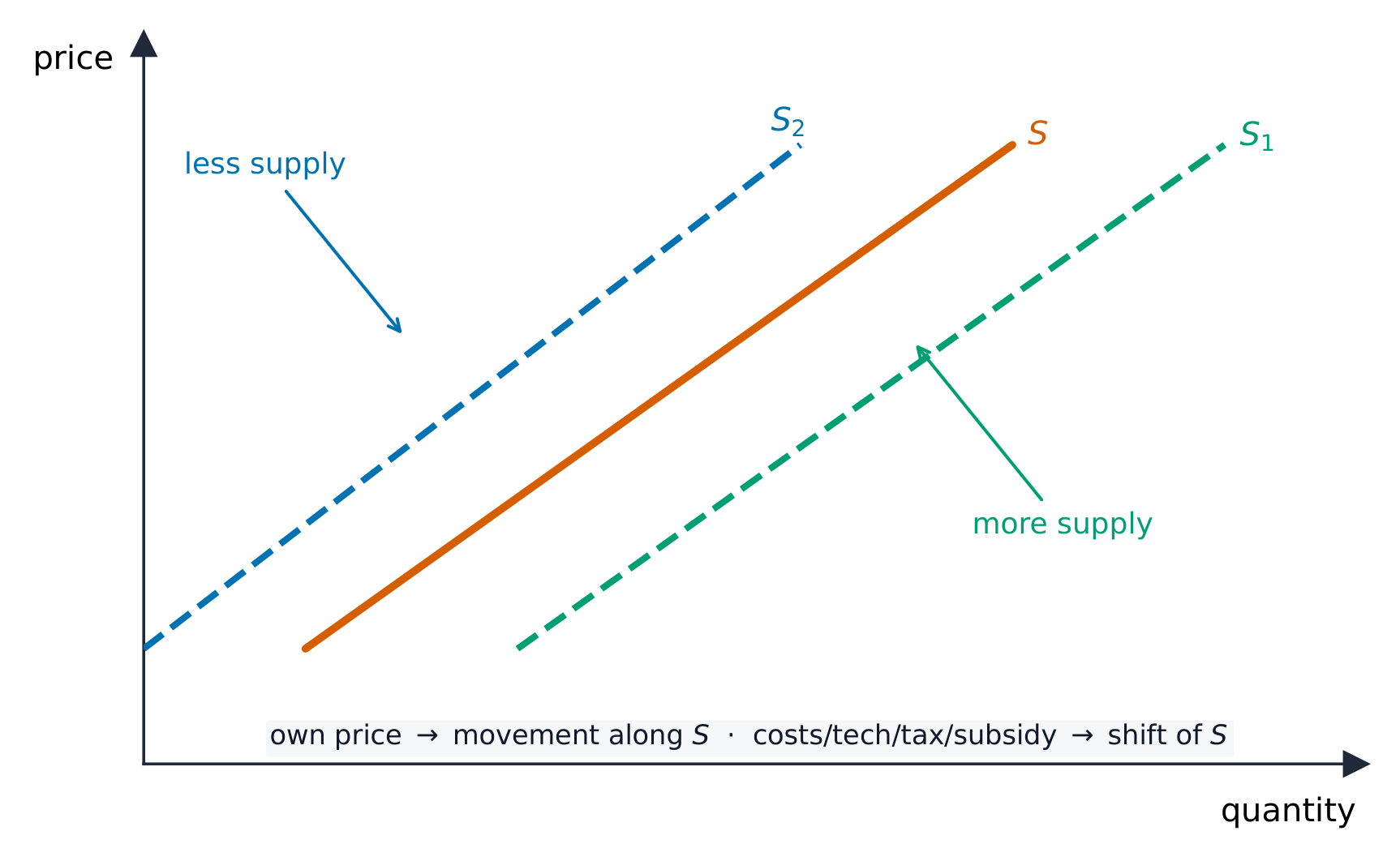
เส้นอุปทานที่มีความชันขึ้นพร้อมการเลื่อนไปทางขวาและซ้าย
เส้นอุปทานมีความชันขึ้น ต้นทุนที่ต่ำลง เทคโนโลยีที่ดีขึ้นหรือเงินอุดหนุนจะทำให้เส้นเลื่อนไปทางขวา; ต้นทุนที่สูงขึ้นหรือภาษีจะทำให้เส้นเลื่อนไปทางซ้าย
Explore · ⁨สำรวจ⁩

Demand & supply · ⁨อุปสงค์ & อุปทาน (Demand & supply)⁩

Supply slopes up — dearer means more made. · ⁨供给 向上倾斜——价格越高意味着生产越多。⁩

Vocabulary · ⁨คำศัพท์⁩ Train · ⁨ฝึกฝน⁩
English ไทย
supply/səˈplaɪ/ อุปทาน
law of supply/lɔː ɒv səˈplaɪ/ กฎแห่งการเสนอขาย
direct relationship/daɪˈrekt rɪˈleɪʃənʃɪp/ ความสัมพันธ์เชิงบวก
quantity supplied/ˈkwɒntɪti səˈplaɪd/ ปริมาณเสนอขาย
supply curve/səˈplaɪ kɜːv/ เส้น_supply curve
costs of production/kɒsts ɒv prəˈdʌkʃn/ ต้นทุนการผลิต
technology/tekˈnɒlədʒi/ เทคโนโลยี
tax/tæks/ tax
subsidy/ˈsʌbsɪdi/ เงินอุดหนุน
Watch lesson · ⁨ดูบทเรียน⁩
2.4

Price determination · ⁨การกำหนดราคา⁩

Syllabus · ⁨หลักสูตร⁩
English
  1. explain market equilibrium: equilibrium price and quantity where demand equals supply
  2. draw and interpret demand and supply diagrams to find equilibrium
ไทย
  1. อธิบาย equilibrium ของตลาด: ราคาและปริมาณสมดุลเมื่อ demand เท่ากับ supply
  2. วาดและตีความกราฟ demand และ supply เพื่อหาจุดสมดุล

Source: Cambridge International syllabus · ⁨แหล่งที่มา: หลักสูตร Cambridge International⁩

English
Demand shifts right: P and Q rise

The price of a good is set where demand and supply meet. Draw both curves on one diagram. They cross at a single point. This point gives:

  • the equilibrium 均衡 price — the price where the amount buyers want to buy exactly equals the amount firms want to sell.
  • the equilibrium quantity — the amount traded at that price.

At equilibrium, quantity demanded equals quantity supplied. There is no good left over and no buyer left waiting.

ไทย
อุปสงค์ shifted ขวา: ราคา (P) และปริมาณ (Q) เพิ่มขึ้น

ราคาสินค้าถูกกำหนดที่จุดที่อุปสงค์และอุปทานบรรจบกัน วาดเส้นโค้งทั้งสองลงในแผนภาพเดียว They ตัดกันที่จุดเดียว จุดนี้ให้:

  • ราคาสมดุล — ราคาที่ปริมาณที่ผู้ซื้อต้องการซื้อพอดีกับปริมาณที่ผู้ผลิตต้องการขาย
  • ปริมาณสมดุล — ปริมาณที่ซื้อขายกันได้ที่ราคานี้

ที่จุดสมดุล ปริมาณอุปสงค์เท่ากับปริมาณอุปทาน ไม่มีสินค้าเหลือเกินและไม่มีการรอซื้อ

需求和供给在均衡价格和数量处相交
ราคาจะคงอยู่ที่จุดที่เส้นอุปสงค์และอุปทานตัดกัน — ราคาสมดุล $P_e$ และปริมาณ $Q_e$
Explore · ⁨สำรวจ⁩

Demand & supply · ⁨อุปสงค์ & อุปทาน (Demand & supply)⁩

Equilibrium is where demand meets supply. · ⁨均衡 是需求与供给相交之处。⁩

Vocabulary · ⁨คำศัพท์⁩ Train · ⁨ฝึกฝน⁩
English ไทย
equilibrium/ˌiːkwɪˈlɪbrɪəm/ จุดดุลยภาพ
Watch lesson · ⁨ดูบทเรียน⁩
2.5

Price changes · ⁨การเปลี่ยนแปลงราคา⁩

Syllabus · ⁨หลักสูตร⁩
English
  1. explain how shifts in demand and supply cause changes in equilibrium price and quantity
  2. explain the consequences of disequilibrium (excess demand/shortage, excess supply/surplus)
ไทย
  1. อธิบายว่าการเลื่อนของ demand และ supply ทำให้เกิดการเปลี่ยนแปลงในราคาและปริมาณสมดุลได้อย่างไร
  2. อธิบายผลของการไม่สมดุล (demand สูงเกิน/ขาดแคลน, supply สูงเกิน/ส่วนเกิน)

Source: Cambridge International syllabus · ⁨แหล่งที่มา: หลักสูตร Cambridge International⁩

English

When a curve shifts, the crossing point moves, so price and quantity change:

  • Demand rises (shifts right): price rises and quantity rises.
  • Demand falls (shifts left): price falls and quantity falls.
  • Supply rises (shifts right): price falls and quantity rises.
  • Supply falls (shifts left): price rises and quantity falls.

Disequilibrium

If the price is not at equilibrium, the market is in disequilibrium 非均衡:

  • If price is below equilibrium, buyers want more than firms supply. This is excess demand 超额需求, also called a shortage 短缺. Buyers compete, so the price is pushed up until equilibrium returns.
  • If price is above equilibrium, firms supply more than buyers want. This is excess supply 超额供给, also called a surplus 过剩. Sellers cut the price until equilibrium returns.
ไทย

เมื่อเส้นโค้งมีการเปลี่ยนแปลง จุดตัดจะเคลื่อนที่ ทำให้ราคาและปริมาณเปลี่ยนแปลงตาม:

  • ความต้องการเพิ่มขึ้น ( SHIFT ไปทางขวา): ราคาสูงขึ้น และปริมาณเพิ่มขึ้น
  • ความต้องการลดลง ( SHIFT ไปทางซ้าย): ราคาลดลง และปริมาณลดลง
  • การเสนอขายเพิ่มขึ้น ( SHIFT ไปทางขวา): ราคาลดลง และปริมาณเพิ่มขึ้น
  • การเสนอขายลดลง ( SHIFT ไปทางซ้าย): ราคาสูงขึ้น และปริมาณลดลง

عدمสมดุล

หากไม่ได้อยู่ที่ระดับราคาสมดุล ตลาดจะอยู่ในสภาวะ ขาดสมดุล:

  • หากราคาราคาต่ำกว่าจุดสมดุล ผู้ซื้อต้องการซื้อมากกว่าที่ผู้ผลิตจัดจำหน่าย นี่คือ ความต้องการเกิน หรือที่เรียกว่า ของขาดแคลน ผู้ซื้อแข่งขันกันซื้อ ทำให้ราคาถูกดันสูงขึ้นจนกลับสู่จุดสมดุลอีกครั้ง
  • หากราคาราคาสูงกว่าจุดสมดุล ผู้ผลิตจัดจำหน่ายมากกว่าที่ผู้ซื้อต้องการซื้อ นี่คือ การเสนอขายเกิน หรือที่เรียกว่า ของเหลือล้น ผู้ขายลดราคาลงจนกลับสู่จุดสมดุลอีกครั้ง
การเสนอขายเกินเหนือจุดสมดุลและความต้องการเกินใต้จุดสมดุล
เหนือจุดสมดุลมีการเสนอขายเกิน; ใต้จุดสมดุลมีความต้องการเกิน (ขาดแคลน) ในทุกกรณีราคาจะถูกดันกลับสู่จุดสมดุล
Explore · ⁨สำรวจ⁩

Demand & supply · ⁨อุปสงค์ & อุปทาน (Demand & supply)⁩

A shift in demand or supply moves the equilibrium. · ⁨需求或供给的______移动会导致均衡点的改变。⁩

Vocabulary · ⁨คำศัพท์⁩ Train · ⁨ฝึกฝน⁩
English ไทย
disequilibrium/ˌdɪˌsiːkwɪˈlɪbrɪəm/ disequilibrium
excess demand/ekˈses dɪˈmænd/ ความต้องการเกิน
shortage/ˈʃɔːtɪdʒ/ ขาดแคลน
excess supply/ekˈses səˈplaɪ/ อุปทานเกิน
surplus/ˈsɜːpləs/ ส่วนเกิน
price elasticity of demand/praɪs ɪlæˈstɪsɪti ɒv dɪˈmænd/ ความยืดหยุ่นของราคาต่อความต้องการ
determinants/dɪˈtɜːmɪnənts/ ปัจจัยกำหนด
Watch lesson · ⁨ดูบทเรียน⁩
2.6

Price elasticity of demand (PED) · ⁨ความยืดหยุ่นต่อราคาของความ.example (PED)⁩

Syllabus · ⁨หลักสูตร⁩
English
  1. define and calculate PED (% change in quantity demanded ÷ % change in price)
  2. interpret values (elastic, inelastic, unit) and the determinants of PED
  3. explain the relationship between PED and total revenue and the usefulness of PED to firms and government
ไทย
  1. นิยามและคำนวณ PED (% การเปลี่ยนแปลงของ quantity demanded ÷ % การเปลี่ยนแปลงของราคา)
  2. ตีความค่า (elastic, inelastic, unit) และตัวกำหนดของ PED
  3. อธิบายความสัมพันธ์ระหว่าง PED กับ total revenue และความสำคัญของ PED ต่อบริษัทและรัฐบาล

Source: Cambridge International syllabus · ⁨แหล่งที่มา: หลักสูตร Cambridge International⁩

English
Elastic vs inelastic demand

Price elasticity of demand 需求价格弹性 measures how much the quantity demanded changes when the price changes.

PED = (% change in quantity demanded) ÷ (% change in price)

(We usually ignore the minus sign and read the size of the number.) The determinants 决定因素 (the things that decide PED) include whether the good has close substitutes, whether it is a need or a luxury, and what share of income it takes.

Worked example. When the price of a good rises by 20%, the quantity demanded falls by 10%. Find the PED.

PED = (% change in quantity demanded) ÷ (% change in price) = 10 ÷ 20 = 0.5.

Because 0.5 is less than 1, demand is inelastic — the quantity changed by a smaller percentage than the price.

Reading the value

  • PED greater than 1: demand is elastic 富有弹性. Quantity changes by a large %. (Goods with many substitutes, like one brand of crisps.)
  • PED less than 1: demand is inelastic 缺乏弹性. Quantity changes by a small %. (Needs with few substitutes, like petrol or salt.)
  • PED equal to 1: unit elastic 单位弹性. Quantity changes by the same % as price.

PED and total revenue

Total revenue 总收益 is the money a firm gets from sales: price × quantity sold. (To the buyer, the same money is total expenditure 总支出.) PED tells a firm what happens to revenue if it changes its price:

  • If demand is inelastic, raising the price raises total revenue (quantity falls only a little).
  • If demand is elastic, raising the price lowers total revenue (quantity falls a lot).

This is useful. A firm sets prices knowing how buyers will react. A government taxes inelastic goods (like cigarettes) because people keep buying them, so the tax raises a lot of money.

Worked example. A bus company sells 1,000 tickets a day at £2 each. It raises the price by 10% to £2.20, and daily sales fall by 5% to 950. Find the PED and what happens to total revenue.

  • PED = 5 ÷ 10 = 0.5, so demand is inelastic (less than 1).
  • old revenue = £2 × 1,000 = £2,000.
  • new revenue = £2.20 × 950 = £2,090.

Total revenue rose by £90. Because demand is inelastic, the price rose by a bigger percentage than the quantity fell, so raising the price raised revenue.

ไทย
ความยืดหยุ่นของอุปสงค์ vs ความไม่ยืดหยุ่นของอุปสงค์

ความยืดหยุ่นต่อราคาของความ.example วัดว่าปริมาณความต้องการเปลี่ยนแปลงมากน้อยเพียงใดเมื่อราคาเปลี่ยนแปลง

PED = (% การเปลี่ยนแปลงของปริมาณความต้องการ) ÷ (% การเปลี่ยนแปลงของราคา)

(โดยทั่วไปเราจะละเว้นเครื่องหมายลบและอ่านค่าตัวเลข) ปัจจัยกำหนด (สิ่งที่กำหนด PED) ได้แก่ สินค้ามีทางเลือกใกล้เคียงหรือไม่ เป็นสินค้าจำเป็นหรือฟุ่มเฟือย และมีสัดส่วนรายได้เท่าไร

ตัวอย่างวิธีทำ. เมื่อราคาสินค้าเพิ่มขึ้น 20% ปริมาณความต้องการลดลง 10% จงหา PED

PED = (% การเปลี่ยนแปลงปริมาณที่ต้องการซื้อ) ÷ (% การเปลี่ยนแปลงราคา) = 10 ÷ 20 = 0.5.

เนื่องจาก 0.5 น้อยกว่า 1 ความต้องการจึงมีความไม่ยืดหยุ่น — ปริมาณเปลี่ยนแปลงในเปอร์เซ็นต์น้อยกว่าราคา

การอ่านค่า

  • PED มากกว่า 1: ความต้องการเป็นแบบ ยืดหยุ่น. ปริมาณเปลี่ยนแปลงด้วยเปอร์เซ็นต์สูง. (สินค้าที่มีทางเลือกหลายชนิด เช่น มันฝรั่งทอดยี่ห้อหนึ่ง)
  • PED น้อยกว่า 1: ความต้องการเป็นแบบ ไม่ยืดหยุ่น. ปริมาณเปลี่ยนแปลงด้วยเปอร์เซ็นต์ต่ำ. (สินค้าจำเป็นที่มีทางเลือกน้อย เช่น น้ำมันเบนซินหรือเกลือ)
  • PED เท่ากับ 1: ยืดหยุ่นหน่วยเดียว. ปริมาณเปลี่ยนแปลงด้วยเปอร์เซ็นต์เท่ากับราคา
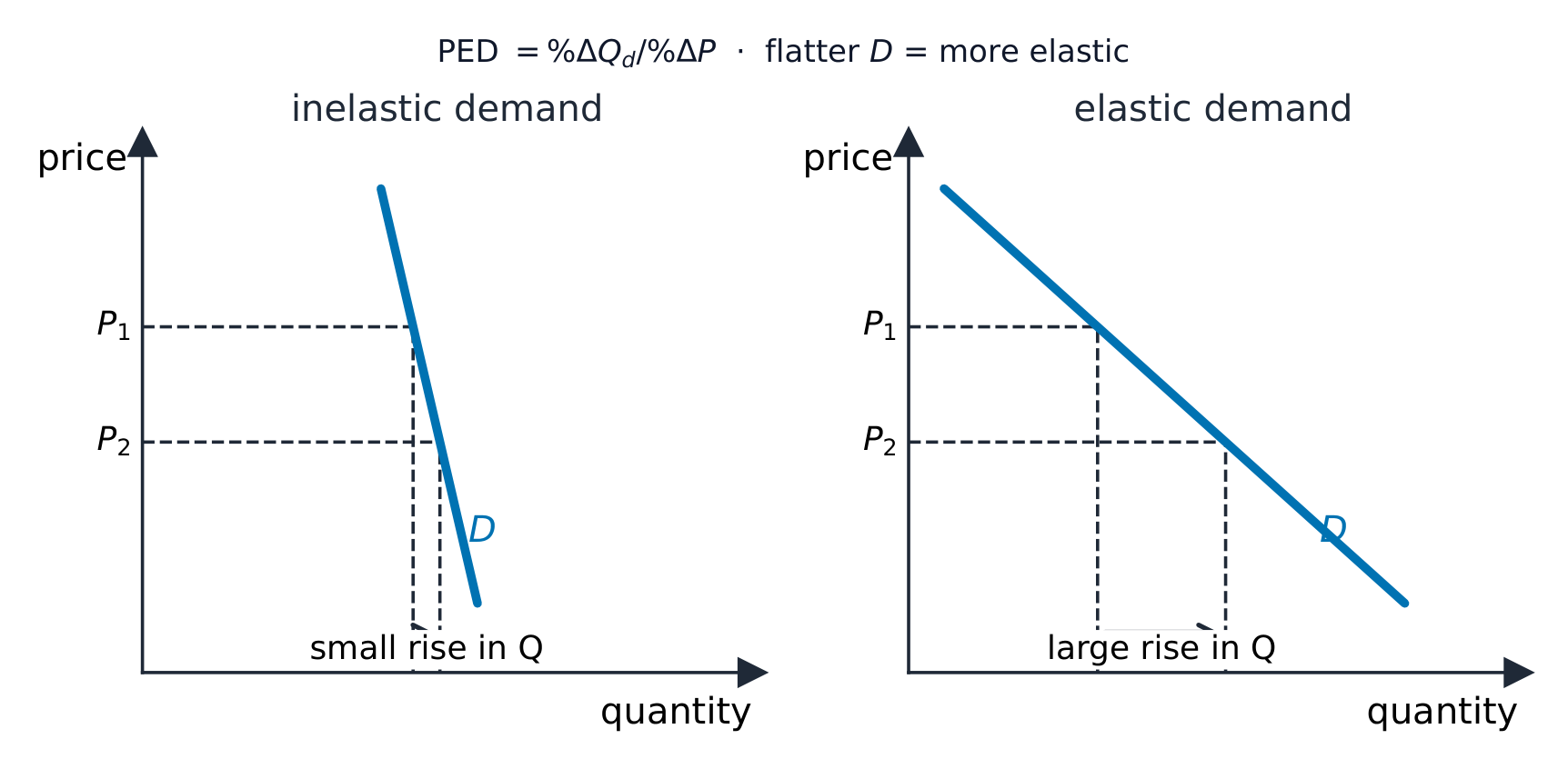
เส้นความต้องการที่ไม่ยืดหยุ่นชันอยู่ข้างเส้นที่ต้องการที่ยืดหยุ่นแบน
เมื่ออุปสงค์ไม่ยืดหยุ่น (ชัน) การเปลี่ยนแปลงราคาจะส่งผลต่อปริมาณน้อยมาก; เมื่ออุปสงค์ยืดหยุ่น (ลาดเอียง) การเปลี่ยนแปลงเดียวกันจะทำให้ปริมาณเปลี่ยนแปลงมาก

ความยืดหยุ่นของราคาต่อปริมาณต้องการ (PED) และรายได้รวม

รายได้รวม คือเงินที่กิจการได้รับจากการขาย: ราคา × ปริมาณที่ขาย (สำหรับผู้ซื้อ เงินจำนวนนี้เรียกว่า ค่าใช้จ่ายรวม) ค่าความยืดหยุ่นของอุปสงค์ต่อราคา (PED) บอกให้กิจการทราบถึงผลกระทบต่อยอดรายได้หากมีการเปลี่ยนราคา:

  • หากอุปสงค์ไม่ยืดหยุ่น การขึ้นราคาจะ เพิ่ม รายได้รวม (ปริมาณลดลงเพียงเล็กน้อย)
  • หากอุปสงค์ยืดหยุ่น การขึ้นราคาจะ ลด รายได้รวม (ปริมาณลดลงมาก)

สิ่งนี้มีประโยชน์ กิจการกำหนดราคาโดยพิจารณาจากปฏิกิริยาของผู้บริโภค รัฐบาลเก็บภาษีสินค้าที่ไม่ยืดหยุ่น (เช่นบุหรี่) เพราะผู้คนยังซื้อต่อไป ทำให้รัฐสามารถเก็บเงินภาษีได้มาก

ตัวอย่างคำนวณ. บริษัทรถบัสขายบัตรโดยสารวันละ 1,000 ใบ ในราคาใบละ £2 แล้วปรับราคาเพิ่มขึ้น 10% เป็น £2.20 ทำให้ยอดขายรายวันลดลง 5% เหลือ 950 ใบ จงหาค่า PED และผลกระทบต่อยอดรายได้รวม

  • PED = 5 ÷ 10 = 0.5 ดังนั้นอุปสงค์ไม่ยืดหยุ่น (ค่าน้อยกว่า 1)
  • รายได้เดิม = £2 × 1,000 = £2,000
  • รายได้ใหม่ = £2.20 × 950 = £2,090

รายได้รวมเพิ่มขึ้น £90 เนื่องจากอุปสงค์ไม่ยืดลุน ราคาจึงเพิ่มขึ้นในอัตราส่วนมากกว่าปริมาณที่ลดลง การขึ้นราคาจึงทำให้รายได้เพิ่มขึ้น

แผนภาพอุปสงค์สองแบบพร้อมรูปสี่เหลี่ยมผืนผ้าแสดงรายได้ (ราคาคูณปริมาณ): เมื่อราคาขึ้น รูปสี่เหลี่ยมจะขยายใหญ่ขึ้นเมื่ออุปสงค์ไม่ยืดหยุ่นและเล็กลงเมื่ออุปสงค์ยืดหยุ่น
การขึ้นราคาเท่ากันจะเพิ่มรายได้เมื่ออุปสงค์ไม่ยืดหยุ่น แต่จะลดรายได้เมื่ออุปสงค์ยืดหยุ่น
Explore · ⁨สำรวจ⁩

Elasticity & total revenue · ⁨弹性与总收益⁩

PED is the % change in quantity over the % change in price; whether it is above or below 1 decides how total revenue moves. · ⁨PED是需求量百分比变化除以价格百分比变化;其数值大于或小于1决定了总收益如何变动。⁩

Explore · ⁨สำรวจ⁩

Demand & supply · ⁨อุปสงค์ & อุปทาน (Demand & supply)⁩

Elasticity of demand is the steepness of the curve. · ⁨需求的______反映了曲线的陡峭程度。⁩

Vocabulary · ⁨คำศัพท์⁩ Train · ⁨ฝึกฝน⁩
English ไทย
elastic/ɪˈlæstɪk/ ยืดหยุ่น
inelastic/ɪnɪˈlæstɪk/ ไม่ยืดหยุ่น (inelastic)
unit elastic/ˈjuːnɪt ɪˈlæstɪk/ ความยืดหยุ่นเท่าหน่วย
total revenue/ˈtəʊtl ˈrevənjuː/ รายได้รวม
total expenditure/ˈtəʊtl ekˈspendɪtʃə/ รายจ่ายรวม
price elasticity of supply/praɪs ɪlæˈstɪsɪti ɒv səˈplaɪ/ ความยืดหยุ่นของราคาต่อปริมาณเสนอขาย
spare capacity/speə kəˈpæsɪti/ กำลังการผลิตสำรอง
stocks/stɒks/ สินค้าคงคลัง
market economy/ˈmɑːkɪt ɪˈkɒnəmi/ ระบบเศรษฐกิจตลาด
planned economy/plænd ɪˈkɒnəmi/ เศรษฐกิจวางแผน
market failure/ˈmɑːkɪt ˈfeɪlɪə/ ความล้มเหลวของตลาด
inefficient/ɪnɪˈfɪʃənt/ ไม่มีประสิทธิภาพ
private cost/ˈpraɪvət kɒst/ ต้นทุนส่วนตัว
external cost/ekˈstɜːnl kɒst/ ต้นทุนภายนอก
social cost/ˈsəʊʃl kɒst/ ต้นทุนทางสังคม
private benefit/ˈpraɪvət ˈbenɪfɪt/ ประโยชน์ส่วนตัว
external benefit/ekˈstɜːnl ˈbenɪfɪt/ ประโยชน์ภายนอก
social benefit/ˈsəʊʃl ˈbenɪfɪt/ ประโยชน์ทางสังคม
merit goods/ˈmerɪt ɡʊdz/ สินค้าเชิงคุณธรรม
demerit goods/ˈdemərɪt ɡʊdz/ สินค้าเชิงโทษ
public goods/ˈpʌblɪk ɡʊdz/ สินค้าสาธารณะ
monopoly/məˈnɒpəli/ มอนوپولی
mixed economy/mɪkst ɪˈkɒnəmi/ ระบบเศรษฐกิจผสม
private sector/ˈpraɪvət ˈsektə/ ภาคเอกชน
public sector/ˈpʌblɪk ˈsektə/ ภาคสาธารณะ
intervention/ˌɪntəˈvenʃn/ การแทรกแซง
maximum price/ˈmæksɪməm praɪs/ ราคาสูงสุด
minimum price/ˈmɪnɪməm praɪs/ ราคาต่ำสุด
indirect tax/ɪndaɪˈrekt tæks/ ภาษีทางอ้อม
regulation/ˌreɡjʊˈleɪʃn/ การกำกับดูแล
direct provision/daɪˈrekt prəˈvɪʒn/ การจัดจำหน่ายโดยตรง
Watch lesson · ⁨ดูบทเรียน⁩
2.7

Price elasticity of supply (PES) · ⁨ความยืดหยุ่นของอุปทานต่อราคา (PES)⁩

Syllabus · ⁨หลักสูตร⁩
English
  1. define and calculate PES (% change in quantity supplied ÷ % change in price)
  2. interpret values and explain the determinants of PES (time, spare capacity, stocks, ease of factor switching)
ไทย
  1. นิยามและคำนวณ PES (% การเปลี่ยนแปลงของ quantity supplied ÷ % การเปลี่ยนแปลงของราคา)
  2. ตีความค่าและอธิบายตัวกำหนดของ PES (เวลา, ความจุสำรอง, สต็อก, ความง่ายในการเปลี่ยนปัจจัย)

Source: Cambridge International syllabus · ⁨แหล่งที่มา: หลักสูตร Cambridge International⁩

English

Price elasticity of supply 供给价格弹性 measures how much the quantity supplied changes when the price changes.

PES = (% change in quantity supplied) ÷ (% change in price)

Supply is elastic if PES is greater than 1, and inelastic if PES is less than 1.

Worked example. When the price of a good rises by 10%, the quantity supplied rises by 30%. Find the PES.

PES = (% change in quantity supplied) ÷ (% change in price) = 30 ÷ 10 = 3.

Because 3 is greater than 1, supply is elastic.

The determinants of PES are:

  • time — supply is more elastic over a long time, because firms can change how much they make.
  • spare capacity 闲置产能 — if a firm has unused machines and workers, it can raise output quickly, so supply is elastic.
  • stocks 库存 — goods kept in store can be sold quickly, making supply elastic.
  • ease of switching factors — if a firm can move factors of production to make this good easily, supply is more elastic.

Farm goods often have inelastic supply in the short run, because crops take a season to grow.

ไทย

ความยืดหยุ่นของอุปทานต่อราคา วัดว่าเมื่อราคาเปลี่ยนแปลง ปริมาณอุปทานจะเปลี่ยนไปเท่าไหร่

PES = (% เปลี่ยนแปลงของปริมาณอุปทาน) ÷ (% เปลี่ยนแปลงของราคา)

อุปทานจะยืดหยุ่นหาก PES มีค่ามากกว่า 1 และไม่ยืดหยุ่นหาก PES มีค่าน้อยกว่า 1

ตัวอย่างคำนวณ. เมื่อราคาสินค้าเพิ่มขึ้น 10% ปริมาณอุปทานเพิ่มขึ้น 30% จงหาค่า PES

PES = (% เปลี่ยนแปลงของปริมาณอุปทาน) ÷ (% เปลี่ยนแปลงของราคา) = 30 ÷ 10 = 3

เนื่องจาก 3 มีค่ามากกว่า 1 อุปทานจึงมีความยืดหยุ่น

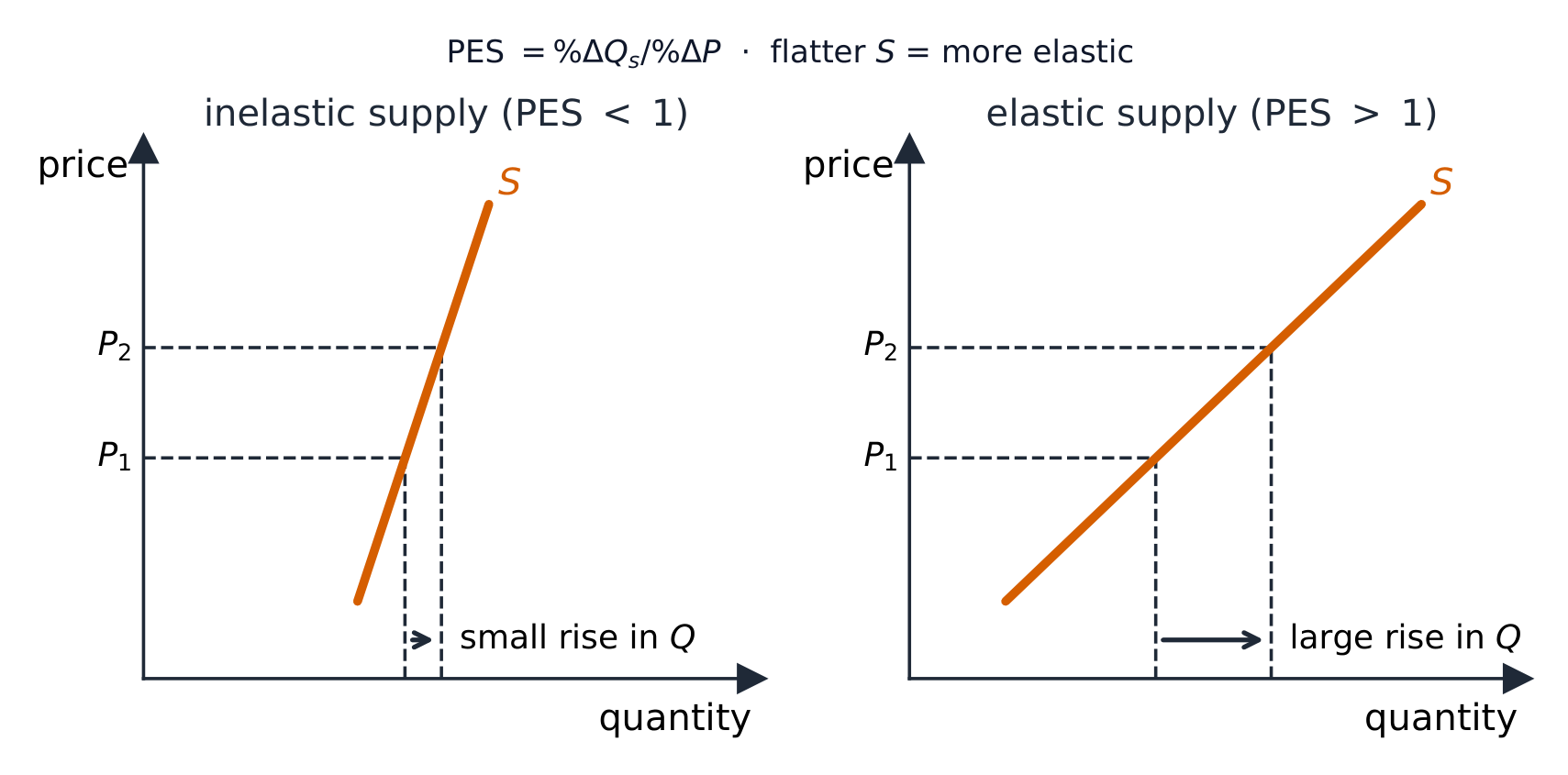
แผนภาพอุปทานสองแบบ: การขึ้นราคาเท่ากันทำให้ปริมาณเพิ่มขึ้นเล็กน้อยเมื่ออุปทานไม่ยืดหยุ่นและเพิ่มขึ้นมากเมื่ออุปทานยืดหยุ่น
การขึ้นราคาเท่ากัน: ปริมาณตอบสนองน้อยเมื่ออุปทานไม่ยืดหยุ่น และตอบสนองมากเมื่ออุปทานยืดหยุ่น

ปัจจัยกำหนดความยืดหยุ่นของอุปทานต่อราคา ได้แก่:

  • เวลา — อุปทานมีความยืดหยุ่นมากขึ้นในระยะยาว เนื่องจากกิจการสามารถปรับปริมาณการผลิตได้
  • กำลังการผลิตสำรอง — หากกิจการมีเครื่องจักรและแรงงานที่เหลืออยู่ สามารถเพิ่มผลผลิตได้อย่างรวดเร็ว อุปทานจึงมีความยืดหยุ่น
  • สต็อกสินค้า — สินค้าคงคลังสามารถนำไปขายได้เร็ว ทำให้อุปทานมีความยืดหยุ่น
  • ความสะดวกในการเปลี่ยนปัจจัยการผลิต — หากกิจการสามารถย้ายปัจจัยการผลิตมาผลิตสินค้านี้ได้ง่าย อุปทานจะมีความยืดหยุ่นมากขึ้น

สินค้าเกษตรมักมีอุปทานไม่ยืดลุนในระยะสั้น เนื่องจากพืชผลต้องใช้เวลาหลายเดือนในการเจริญเติบโต

Explore · ⁨สำรวจ⁩

Demand & supply · ⁨อุปสงค์ & อุปทาน (Demand & supply)⁩

Supply elasticity is how quantity responds to price. · ⁨供给弹性 衡量的是数量对价格的响应程度。⁩

2.8

The market economic system · ⁨ระบบเศรษฐกิจตลาด⁩

Syllabus · ⁨หลักสูตร⁩
English
  1. explain how a market economy allocates resources through the price mechanism
  2. explain the advantages and disadvantages of the market economic system
ไทย
  1. อธิบายว่าเศรษฐกิจตลาด分配ทรัพยากรผ่านกลไกราคาอย่างไร
  2. อธิบายข้อดีและข้อเสียของระบบเศรษฐกิจตลาด

Source: Cambridge International syllabus · ⁨แหล่งที่มา: หลักสูตร Cambridge International⁩

English

In a market economy 市场经济, the price mechanism makes all the choices. There is no government planning. (The opposite is a planned economy 计划经济, where the government makes the choices.)

Advantages of the market system:

  • Prices guide resources to where they are wanted, without anyone planning.
  • Firms compete, so they cut costs and create new and better goods.
  • Consumers have wide choice.

Disadvantages:

  • Some useful goods are not made because they earn no profit.
  • The strong (rich firms and people) do well; the weak may be left with nothing.
  • Markets can fail (see below).
ไทย

ในระบบ เศรษฐกิจตลาด กลไกราคาเป็นสิ่งที่ตัดสินใจทุกเรื่อง ไม่มีวางแผนจากรัฐบาล (ตรงกันข้ามคือ เศรษฐกิจวางแผน ซึ่งรัฐบาลเป็นผู้ตัดสินใจ)

ข้อดี ของระบบตลาด:

  • ราคาช่วยนำทรัพยากรไปยังจุดที่ต้องการ โดยไม่ต้องมีการวางแผนจากใคร
  • กิจการแข่งขันกัน จึงลดต้นทุนและสร้างสินค้าใหม่ๆ ที่ดีขึ้น
  • ผู้บริโภคมีทางเลือกที่หลากหลาย

ข้อเสีย :

  • สินค้าที่มีประโยชน์บางชนิดไม่ได้ถูกผลิตเพราะไม่ทำกำไร
  • กลุ่มที่เข้มแข็ง (กิจการและบุคคลรวยๆ) ทำได้ดี ในขณะที่กลุ่มที่อ่อนแອอาจไม่มีอะไรเหลือเลย
  • ตลาดล้มเหลวได้ (ดูด้านล่าง)
Explore · ⁨สำรวจ⁩

How a market allocates · ⁨วิธีการที่ตลาดจัดสรร ⟦number⟧⁩

In a market system, price moves to where demand meets supply — that price signal decides what gets made. Shift the curves and watch it settle. · ⁨ในระบบตลาด ราคาจะเคลื่อนที่ไปที่จุดที่ความต้องการตรงกับอุปทาน — สัญญาณราคานี้คือตัวกำหนดว่าอะไรจะถูกผลิต เมื่อเลื่อนเส้นโค้งแล้วดูการปรับสมดุล ⟦number⟧⁩

2.9

Market failure · ⁨ความล้มเหลวของตลาด⁩

Syllabus · ⁨หลักสูตร⁩
English
  1. define market failure as the inefficient allocation of resources
  2. explain the causes: external costs and external benefits (social vs private costs/benefits), merit and demerit goods, public goods and the abuse of monopoly power
ไทย
  1. นิยาม market failure เป็นการ分配ทรัพยากรที่ไม่มีประสิทธิภาพ
  2. อธิบายสาเหตุ: ต้นทุนภายนอกและประโยชน์ภายนอก (สังคมเทียบกับต้นทุน/ประโยชน์ส่วนตัว), สินค้า merit และ demerit, สินค้าสาธารณะ และการ滥用ของอำนาจ monopoly

Source: Cambridge International syllabus · ⁨แหล่งที่มา: หลักสูตร Cambridge International⁩

English

Market failure 市场失灵 happens when the price mechanism leads to an inefficient 低效率 use of resources — resources are not shared out in the best way for society. The main causes:

External costs and benefits

When you produce or consume something, the cost or benefit to you is not always the cost or benefit to everyone.

  • a private cost 私人成本 is the cost to the person doing the activity.
  • an external cost 外部成本 is a cost paid by other people — for example, smoke from a factory harms nearby families.
  • the social cost 社会成本 is the private cost plus the external cost (the cost to the whole of society).

In the same way:

  • a private benefit 私人效益 is the benefit to the person doing the activity.
  • an external benefit 外部效益 is a benefit that others get for free — for example, your neighbour's tidy garden is nice for you too.
  • the social benefit 社会效益 is the private benefit plus the external benefit.

Markets fail because firms and consumers only think about their private costs and benefits, not the external ones.

Merit, demerit and public goods

  • merit goods 有益物品 are better for you than you realise, so the market makes too few (education, healthcare).
  • demerit goods 有害物品 are worse for you than you realise, so the market makes too many (cigarettes, alcohol).
  • public goods 公共物品 are things everyone can use and no one can be stopped from using, like street lights or national defence. The market makes none, because firms cannot charge for them.

Abuse of monopoly power

A monopoly 垄断 is a single firm that controls a market. With no competition, it can charge high prices and make poor-quality goods. This is another market failure.

ไทย

ความล้มเหลวของตลาด เกิดขึ้นเมื่อกลไกราคานำไปสู่การใช้ทรัพยากรที่ ไม่มีประสิทธิภาพ — ทรัพยากรไม่ได้ถูกจัดสรรในวิธีที่ดีที่สุดต่อสังคม สาเหตุหลักๆ ได้แก่:

ต้นทุนและผลประโยชน์ภายนอก

หอคอระบายความร้อนของโรงไฟฟ้าถ่านหินปล่อยควันหนาแน่น
มลพิษจากโรงไฟฟ้าเป็นต้นทุนภายนอก — ภาระตกกับบุคคลที่สาม ไม่ใช่แค่ผู้ผลิต

เมื่อคุณผลิตหรือบริโภคสิ่งใด ต้นทุนหรือผลประโยชน์ที่เกิดขึ้นกับ คุณ อาจไม่ใช่ต้นทุนหรือผลประโยชน์ที่เกิดขึ้นกับ ทุกคน

  • ต้นทุนส่วนตัว คือต้นทุนที่ผู้กระทำกิจกรรมต้องจ่ายเอง
  • ต้นทุนภายนอก คือต้นทุนที่ผู้อื่นต้องรับ เช่น ควันจากโรงงานทำลายสุขภาพครอบครัวใกล้เคียง
  • ต้นทุนทางสังคม คือต้นทุนส่วนตัวบวกกับต้นทุนภายนอก (ต้นทุนทั้งหมดต่อสังคม)

ในลักษณะเดียวกันนี้:

  • ผลประโยชน์ส่วนตัว คือผลประโยชน์ที่ผู้กระทำกิจกรรมได้รับเอง
  • ผลประโยชน์ภายนอก คือผลประโยชน์ที่คนอื่นได้รับโดยไม่เสียเงิน เช่น สวนหน้าบ้านเพื่อนที่ดูแลเรียบร้อยทำให้คุณรู้สึกดีด้วย
  • ผลประโยชน์ทางสังคม คือผลประโยชน์ส่วนตัวบวกกับผลประโยชน์ภายนอก

ตลาดล้มเหลวเพราะกิจการและผู้บริโภคคิดแต่ถึงต้นทุนและผลประโยชน์ ส่วนตัว ของตนเอง ไม่คำนึงถึงผลประโยชน์ภายนอก

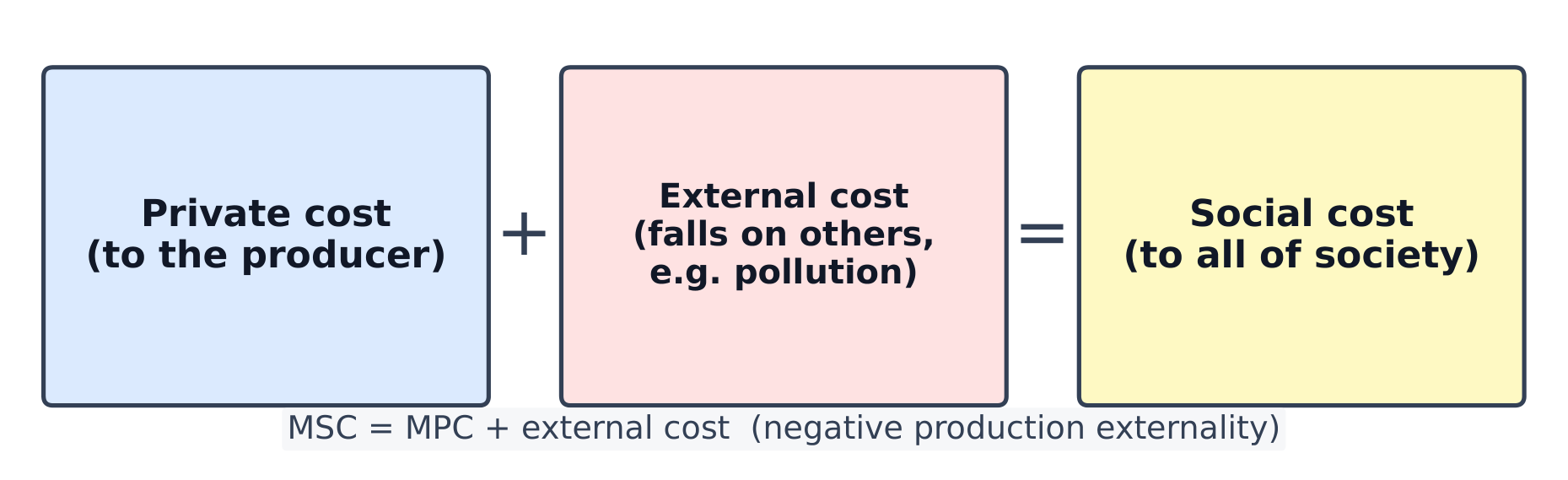
ต้นทุนส่วนตัวบวกต้นทุนภายนอกเท่ากับต้นทุนทางสังคม
ต้นทุนภายนอก (เช่น มลพิษ) ตกลงกับบุคคลที่สาม ทำให้ต้นทุนทางสังคมสูงกว่าต้นทุนส่วนตัวของผู้ผลิต

สินค้าสาธารณะ

  • สินค้าเชิงคุณธรรม คือสินค้าที่ดีต่อคุณเกินกว่าที่คุณตระหนัก ดังนั้นตลาดจึงผลิตมาน้อยเกินไป (การศึกษา การดูแลสุขภาพ)
  • สินค้าเชิงลบ คือสินค้าที่แย่ต่อคุณเกินกว่าที่คุณตระ故此因此市场生产过多 (บุหรี่ แอลกอฮอล์)
  • สินค้าสาธารณะ คือสิ่งของที่ทุกคนสามารถใช้และไม่มีการกีดกันใครไม่ให้ใช้ เช่น โคมไฟถนน หรือการป้องกันประเทศ ตลาดไม่ผลิตเลย เพราะกิจการไม่สามารถเรียกเก็บเงินจากสิ่งเหล่านี้ได้
สินค้าส่วนตัวเทียบกับสินค้าสาธารณะและผู้จัดหาแต่ละประเภท
สินค้าส่วนตัวมีความขัดแย้งและการกีดกัน (กิจการจัดหา); สินค้าสาธารณะไม่มีความขัดแย้งและไม่มีการกีดกัน (รัฐบาลต้องจัดหา)
สินค้าที่มีประโยชน์ถูกบริโภคน้อยเกินไปและสินค้าที่ไม่ดีถูกบริโภคมากเกินไป
สินค้าที่มีประโยชน์และสินค้าที่ไม่ดีถูกตัดสินผิดพลาดเนื่องจากความล้มเหลวของข้อมูล

การใช้อำนาจผูกขาด

การผูกขาด คือบริษัทเดียวที่ควบคุมตลาด เมื่อไม่มีการแข่งขัน บริษัทสามารถกำหนดราคาสูงและผลิตสินค้าคุณภาพต่ำได้ นี่คือความล้มเหลวของตลาดอีกแบบหนึ่ง

Explore · ⁨สำรวจ⁩

Demand & supply · ⁨อุปสงค์ & อุปทาน (Demand & supply)⁩

Market failure: the free-market crossing isn't always best for society. · ⁨ความล้มเหลวของตลาด: การแลกเปลี่ยนในตลาดอิสระไม่จำเป็นต้องดีที่สุดสำหรับสังคมเสมอไป⁩

Vocabulary · ⁨คำศัพท์⁩ Train · ⁨ฝึกฝน⁩
English ไทย
good/ɡʊd/ ดี
consumers/kənˈsuːməz/ ผู้บริโภคหลัก
law of demand/lɔː ɒv dɪˈmænd/ กฎแห่งการต้องการ
inverse relationship/ɪnˈvɜːs rɪˈleɪʃənʃɪp/ ความสัมพันธ์ผกผัน
Watch lesson · ⁨ดูบทเรียน⁩
2.10

The mixed economic system · ⁨ระบบเศรษฐกิจผสม⁩

Syllabus · ⁨หลักสูตร⁩
English
  1. explain the features of a mixed economy (private sector and public sector)
  2. explain methods of government intervention to address market failure: maximum and minimum prices, indirect taxes, subsidies, regulation and direct provision
  3. evaluate the effects of intervention
ไทย
  1. อธิบายลักษณะของเศรษฐกิจผสม (ภาคเอกชนและภาคสาธารณะ)
  2. อธิบายวิธีการแทรกแซงของรัฐบาลเพื่อแก้ไข market failure: ราคาสูงสุดและต่ำสุด, ภาษีทางอ้อม, เงินอุดหนุน, กฎระเบียบ และการจัดจำหน่ายโดยตรง
  3. ประเมินผลกระทบของการแทรกแซง

Source: Cambridge International syllabus · ⁨แหล่งที่มา: หลักสูตร Cambridge International⁩

English
A maximum price creates a shortage

A mixed economy 混合经济 has both:

  • a private sector 私营部门 — firms owned by people, guided by the price mechanism.
  • a public sector 公共部门 — activity run by the government.

Most real economies are mixed; China's, for example, is a socialist market economy. The government steps in to correct market failure. This is government intervention 干预. The main methods:

Method What it does
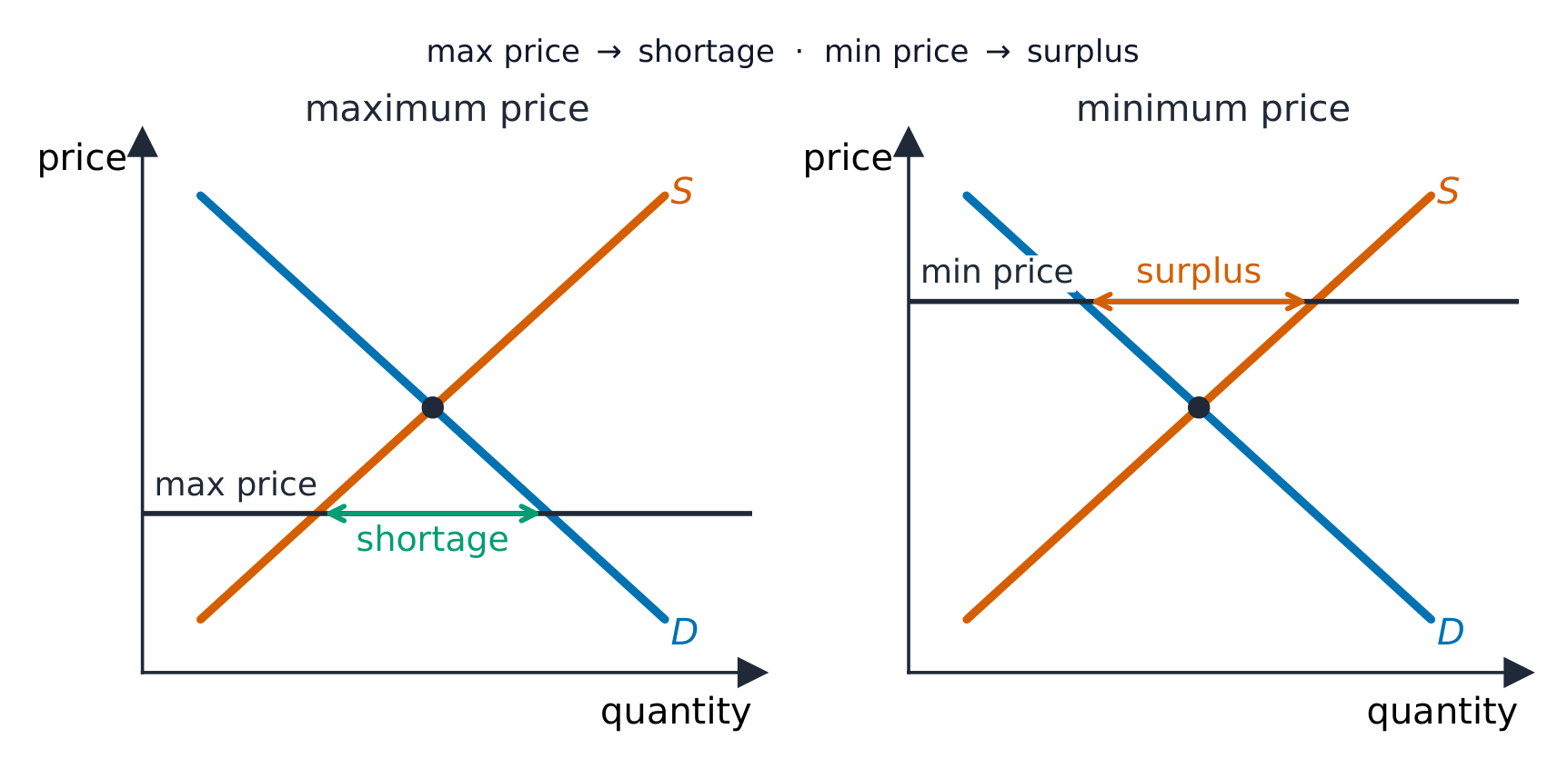
maximum price 最高价格 a price ceiling, set below equilibrium, to keep a good (like rent) cheap — but it causes a shortage
minimum price 最低价格 a price floor, set above equilibrium, to keep a price up (like a fair wage) — but it causes a surplus
indirect tax 间接税 a tax on a good (added to its price) to cut demand for demerit goods
subsidy money paid to firms to cut the price and raise output of merit goods
regulation 监管 rules and laws, like banning smoking in public
direct provision 直接提供 the government makes and gives out goods itself, like state schools

Judging intervention

Intervention can fix market failure, but it has costs. Taxes and rules cost money to collect and check. Governments can get things wrong too (this is called government failure). So you should always weigh the good effects against the bad ones before deciding.

ไทย
ราคาสูงสุดทำให้เกิดการขาดแคลน

เศรษฐกิจผสม มีทั้ง:

  • ภาคเอกชน — บริษัทที่เป็นเจ้าของโดยบุคคล นำโดยกลไกราคา
  • ภาครัฐ — กิจกรรมที่ดำเนินการโดยรัฐบาล

เศรษฐกิจจริงส่วนใหญ่เป็นระบบผสม เช่น เศรษฐกิจตลาดสังคมนิยมของจีน รัฐบาลเข้ามาแก้ไขความล้มเหลวของตลาด สิ่งนี้เรียกว่า การแทรกแซง รัฐบาล วิธีหลักๆ ได้แก่:

วิธีการ ทำอะไร
ราคาสูงสุด ราคาเพดาน กำหนดต่ำกว่าจุดสมดุล เพื่อรักษาให้สินค้า (เช่น ค่าเช่า) มีราคาถูก — แต่มันทำให้เกิดภาวะขาดแคลน
ราคาขั้นต่ำ ราคาพื้น กำหนดสูงกว่าจุดสมดุล เพื่อรักษาระดับราคา (เช่น เงินเดือนที่เป็นธรรม) — แต่มันทำให้เกิดภาวะล้นตลาด
ภาษีทางอ้อม ภาษีบนสินค้า (เพิ่มลงในราคา) เพื่อลดความต้องการสินค้าที่ไม่ดี
เงินอุดหนุน เงินที่จ่ายให้บริษัทเพื่อลดราคาและเพิ่มผลผลิตของสินค้าที่มีประโยชน์
กฎระเบียบ กฎและกฎหมาย เช่น การห้ามสูบบุหรี่ในที่สาธารณะ
การจัดสรรโดยตรง รัฐบาลผลิตและจัดจำหน่ายสินค้าเอง เช่น โรงเรียนของรัฐ
ราคาสูงสุดที่ทำให้เกิดขาดแคลนและราคาต่ำสุดที่ทำให้เกิดส่วนเกิน
ราคาสูงสุดที่กำหนดต่ำกว่าจุดสมดุลจะทำให้เกิดภาวะขาดแคลน; ราคาขั้นต่ำที่กำหนดสูงกว่าจุดสมดุลจะทำให้เกิดภาวะล้นตลาด

การประเมินการแทรกแซง

การแทรกแซงสามารถแก้ไขความล้มเหลวของตลาดได้ แต่มีต้นทุน ภาษีและกฎระเบียบต้องใช้เงินในการเก็บและตรวจสอบ รัฐบาลก็ทำผิดได้เช่นกัน (สิ่งนี้เรียกว่าความล้มเหลวของรัฐบาล) ดังนั้นคุณควรชั่งน้ำหนักผลกระทบที่ดีกับผลกระทบที่ไม่ดีเสมอ ก่อนตัดสินใจ

Explore · ⁨สำรวจ⁩

Economics case lab · ⁨ห้องปฏิบัติการกรณีศึกษาเศรษฐศาสตร์⁩

Classify real examples by the economic idea they show. · ⁨จำแนกตัวอย่างจริงตามแนวคิดทางเศรษฐศาสตร์ที่แสดงออก⁩

Watch lesson · ⁨ดูบทเรียน⁩
2.10

Exam tips · ⁨ข้อแนะนำสำหรับการสอบ⁩

English
  • A change in a good's own price is a movement along the curve; a change in anything else (income, tastes, related prices) shifts the whole curve.
  • Equilibrium is where demand meets supply. Below it there is excess demand (a shortage, so price rises); above it there is excess supply (a surplus, so price falls).
  • PED = %ΔQ ÷ %ΔP. Demand is inelastic if PED < 1 (raising price raises revenue) and elastic if PED > 1 (raising price lowers revenue).
  • Market failure (external costs, merit/demerit/public goods, monopoly) means resources are used badly; the government corrects it with taxes, subsidies, rules and direct provision.
ไทย
  • การเปลี่ยนแปลงใน ราคาของสินค้านั้นๆ เป็น การเคลื่อนที่ตาม กราฟ; การเปลี่ยนแปลงในสิ่งอื่นใด (รายได้ รสนิยม ราคาที่เกี่ยวข้อง) จะ เลื่อน กราฟทั้งหมด
  • จุดสมดุล คือจุดที่ความต้องการพบกับการเสนอขาย ต่ำกว่าจุดนี้มีความต้องการเกิน (ภาวะขาดแคลน ทำให้ราคาขึ้น); สูงกว่าจุดนี้มีการเสนอขายเกิน (ภาวะล้นตลาด ทำให้ราคาลดลง)
  • PED = %ΔQ ÷ %ΔP. ความต้องการเป็น ** elasticity ต่ำ** หาก PED < 1 (raising price raises revenue) and elastic if PED > 1 (การขึ้นราคาทำให้รายได้ลดลง)
  • ความล้มเหลวของตลาด (ต้นทุนภายนอก สินค้าที่มีประโยชน์/ไม่ดี/สาธารณะ การผูกขาด) หมายความว่าทรัพยากรถูกใช้ไปอย่างไม่เหมาะสม รัฐบาลแก้ไขด้วยภาษี เงินอุดหนุน กฎระเบียบ และการจัดจำหน่ายโดยตรง

Interactive lessons on this topic · ⁨บทเรียนเชิงโต้ตอบสำหรับหัวข้อนี้⁩

Work through it step by step, with instant-check exercises. · ⁨ทำทีละขั้นตอน พร้อมแบบฝึกหัดตรวจสอบผลทันที⁩

Past Papers · ⁨ข้อสอบย้อนหลัง⁩

More topics in IGCSE Economics · ⁨Economics IGCSE⁩ · ⁨หัวข้อเพิ่มเติมใน IGCSE Economics · ⁨Economics IGCSE⁩⁩

Log in or create account · ⁨เข้าสู่ระบบหรือสร้างบัญชี⁩

IGCSE, A-Level & AP