ข้ามไปยังเนื้อหา
รายวิชา

AQA · GCSE · Biology

  • 1

    ชีววิทยาเซลล์

    1.1

    Cell biology: the unit of life

    Every living thing is built from cells, and the differences between them decide what each can do. This reference covers AQA GCSE Biology 8461, topic 4.1 Cell biology.

    How the exam treats this topic:

    • Paper 1 (4.1–4.4) carries Cell biology. Required practicals: RP1 (light microscope), RP2 (antiseptics/antibiotics on agar, biology only) and RP3 (osmosis in plant tissue).
    • Culturing microorganisms is biology only; standard-form answers for bacterial numbers are HT only.
    • Calculations the exam demands: magnification (image ÷ real), real size from image and magnification, area by πr², percentage change in mass, surface-area-to-volume ratio, bacterial division counts.
    1.1

    Cell structure: eukaryotes and prokaryotes

    หลักสูตร

    โครงสร้างเซลล์ การจำเพาะทางชีวภาพ กล้องจุลทรรศน์ และการเลี้ยงเชื้อ (AQA 8461 ข้อstatement 4.1.1.1-4.1.1.6, RP1, RP2)

    1. อธิบายเซลล์พืช สัตว์ และแบคทีเรีย โดยระบุชื่อโครงสร้างและหน้าที่
    2. เชื่อมโยงโครงสร้างของเซลล์ที่มีลักษณะเฉพาะเข้ากับหน้าที่ของเซลล์
    3. อธิบายความสำคัญของการแบ่งแยกชนิดของเซลล์ (cell differentiation)
    4. คำนวณอัตราส่วนขยาย ขนาดจริง และขนาดภาพ โดยใช้เลขยกกำลังและพหุคูณ
    5. อธิบายเทคนิคการไร้เชื้อพร้อมเหตุผล จำนวนการแบ่งตัวของแบคทีเรีย และพื้นที่ของเขต (ชีววิทยาเท่านั้น)

    แหล่งที่มา: หลักสูตร Cambridge International

    An animal cell, a plant cell and a bacterial cell with their key structures labelled.
    Learn the labels — the exam asks you to name and function them.
    Structure Function
    nucleus genetic material (DNA); controls the cell
    cytoplasm jelly where reactions happen
    cell membrane controls what enters and leaves
    mitochondria aerobic respiration releases energy
    ribosomes protein synthesis
    chloroplast (plant) photosynthesis
    permanent vacuole (plant) cell sap, keeps the cell firm
    cell wall (plant, cellulose) strength and support
    • Eukaryotic 真核 cells (plant and animal): genetic material enclosed in a nucleus.
    • Prokaryotic 原核 cells (bacteria) are much smaller; cytoplasm and cell membrane surrounded by a cell wall; genetic material is not in a nucleus — a single DNA loop plus one or more plasmids (small rings of DNA).

    Scale: use the prefixes centi (10⁻²), milli (10⁻³), micro (10⁻⁶), nano (10⁻⁹) and order-of-magnitude comparisons in standard form.

    คำศัพท์ ฝึกฝน
    English ไทย
    eukaryotic/ˌjuːkərɪˈɒtɪk/ เซลล์มีนิวเคลียส
    prokaryotic/ˌprɒkərɪˈɒtɪk/ เซลล์ไม่มีนิวเคลียส
    1.1

    Cell specialisation, differentiation and microscopy

    หลักสูตร

    โครงสร้างเซลล์ การจำเพาะทางชีวภาพ กล้องจุลทรรศน์ และการเลี้ยงเชื้อ (AQA 8461 ข้อstatement 4.1.1.1-4.1.1.6, RP1, RP2)

    1. อธิบายเซลล์พืช สัตว์ และแบคทีเรีย โดยระบุชื่อโครงสร้างและหน้าที่
    2. เชื่อมโยงโครงสร้างของเซลล์ที่มีลักษณะเฉพาะเข้ากับหน้าที่ของเซลล์
    3. อธิบายความสำคัญของการแบ่งแยกชนิดของเซลล์ (cell differentiation)
    4. คำนวณอัตราส่วนขยาย ขนาดจริง และขนาดภาพ โดยใช้เลขยกกำลังและพหุคูณ
    5. อธิบายเทคนิคการไร้เชื้อพร้อมเหตุผล จำนวนการแบ่งตัวของแบคทีเรีย และพื้นที่ของเขต (ชีววิทยาเท่านั้น)

    แหล่งที่มา: หลักสูตร Cambridge International

    เซลล์จำเพาะ relate structure to function (learn one feature ↔ one advantage each):

    Cell Adaptation Function
    sperm cell tail for swimming, many mitochondria, acrosome with enzymes fertilisation
    nerve cell long axon, insulating sheath carrying impulses
    muscle cell many proteins fibres, many mitochondria contraction
    root hair cell large surface area, thin wall absorbing water and minerals
    xylem cell hollow, lignified walls, no end walls transporting water
    phloem cell sieve plates, few organelles transporting sugars

    การหาอนุพันธ์ 分化: cells acquire different sub-cellular structures to become specialised. Animal cells differentiate mostly at an early stage; plant cells throughout life. In mature animals, cell division is mainly for repair and replacement.

    Microscopy: a light microscope uses lenses; an electron microscope has much higher magnification and resolving power 分辨能力, so far more sub-cellular structures could be seen and understood.

    $$\text{magnification} = \frac{\text{size of image}}{\text{size of real object}}$$

    Worked example. A cell image is 4.8 cm wide at magnification ×1200.

    • Convert first: $4.8\ \text{cm} = 4.8\times10^{-2}$ m $= 48\,000\ \mu\text{m}$.
      $$\text{real size} = \frac{\text{image size}}{\text{magnification}} = \frac{48\,000\ \mu\text{m}}{1200} = 40\ \mu\text{m}$$

    RP1: observe, draw and label plant and animal cells with a magnification scale included (e.g. a scale bar or the printed magnification).

    คำศัพท์ ฝึกฝน
    English ไทย
    Differentiation/ˌdɪfəˌrenʃɪˈeɪʃn/ การแยกแยะชนิดของเซลล์
    resolving power/rɪˈzɒlvɪŋ ˈpaʊə/ ความละเอียด
    1.1

    Culturing microorganisms (biology only)

    หลักสูตร

    โครงสร้างเซลล์ การจำเพาะทางชีวภาพ กล้องจุลทรรศน์ และการเลี้ยงเชื้อ (AQA 8461 ข้อstatement 4.1.1.1-4.1.1.6, RP1, RP2)

    1. อธิบายเซลล์พืช สัตว์ และแบคทีเรีย โดยระบุชื่อโครงสร้างและหน้าที่
    2. เชื่อมโยงโครงสร้างของเซลล์ที่มีลักษณะเฉพาะเข้ากับหน้าที่ของเซลล์
    3. อธิบายความสำคัญของการแบ่งแยกชนิดของเซลล์ (cell differentiation)
    4. คำนวณอัตราส่วนขยาย ขนาดจริง และขนาดภาพ โดยใช้เลขยกกำลังและพหุคูณ
    5. อธิบายเทคนิคการไร้เชื้อพร้อมเหตุผล จำนวนการแบ่งตัวของแบคทีเรีย และพื้นที่ของเขต (ชีววิทยาเท่านั้น)

    แหล่งที่มา: หลักสูตร Cambridge International

    Bacteria multiply by binary fission 二分裂 as often as once every 20 minutes with enough nutrients and a suitable temperature. They grow in nutrient broth or as colonies on agar gel.

    Aseptic technique 无菌操作 (each point earns a mark — know the ทำไม):

    • sterilise Petri dishes and culture media before use — kills unwanted microorganisms;
    • flame the inoculating loop before transferring bacteria — kills contaminants on the loop;
    • secure the lid with adhesive tape and store upside down — stops airborne contamination and condensation dripping;
    • in schools, incubate at a maximum of 25 °C — prevents growth of pathogens harmful to humans.

    Worked example (division count). One bacterium divides every 20 minutes for 3 hours.

    • 3 hours = 180 min = 9 division times; number $= 2^9 = 512$.

    Worked example (zone area). A clear zone of radius 4 mm around an antibiotic disc.

    $$A = \pi r^2 = \pi \times 4^2 = 50\ \text{mm}^2\ \text{(2 s.f.)}$$

    RP2: effect of antiseptics/antibiotics on bacterial growth — measure zones of inhibition with a ruler (several diameters, mean, ÷2), controls with no substance.

    คำศัพท์ ฝึกฝน
    English ไทย
    binary fission/ˈbaɪnəri ˈfɪʃn/ การแบ่งตัวแบบทวิภาคี
    Aseptic technique/æˈseptɪk tekˈniːk/ เทคนิคการปลอดเชื้อ
    1.2

    Cell division: chromosomes, mitosis and the cell cycle

    หลักสูตร

    การแบ่งเซลล์และเซลล์ต้นกำเนิด (AQA 8461 ข้อ4.1.2.1-4.1.2.3)

    1. อธิบายโครโมโซมและการจับคู่ในเซลล์ร่างกาย
    2. อธิบายวัฏจักรของเซลล์ รวมถึงสามขั้นตอนหลักและการแบ่งเซลล์แบบมีทอซิส
    3. อธิบายหน้าที่ของเซลล์ต้นกำเนิดในEmbryo สัตว์เต็มวัย และเนื้อเยื่อเจริญของพืช
    4. ประเมินการใช้เซลล์ต้นกำเนิดในทางการแพทย์และการโคลนนิ่งพืช รวมถึงความเสี่ยงและข้อโต้แย้งด้านจริยธรรม

    แหล่งที่มา: หลักสูตร Cambridge International

    • เลข nucleus contains chromosomes 染色体 made of DNA; each chromosome carries many genes; body cells have chromosomes in pairs (humans: 23 pairs).
    • เลข cell cycle: DNA replicates → growth (more ribosomes and mitochondria) → mitosis 有丝分裂 (one set of chromosomes pulled to each end; nucleus divides) → cytoplasm and membranes divide → two identical cells.

    Mitosis matters for growth and development of multicellular organisms, and repair. Recognise contexts where mitosis is occurring (a growing root tip, healing skin, a tumour).

    คำศัพท์ ฝึกฝน
    English ไทย
    chromosomes/ˈkrəʊməsəʊmz/ โครโมโซม
    mitosis/maɪˈtəʊsɪs/ การแบ่งเซลล์แบบมีไมโทซิส
    1.2

    เซลล์ต้นกำเนิด

    หลักสูตร

    การแบ่งเซลล์และเซลล์ต้นกำเนิด (AQA 8461 ข้อ4.1.2.1-4.1.2.3)

    1. อธิบายโครโมโซมและการจับคู่ในเซลล์ร่างกาย
    2. อธิบายวัฏจักรของเซลล์ รวมถึงสามขั้นตอนหลักและการแบ่งเซลล์แบบมีทอซิส
    3. อธิบายหน้าที่ของเซลล์ต้นกำเนิดในEmbryo สัตว์เต็มวัย และเนื้อเยื่อเจริญของพืช
    4. ประเมินการใช้เซลล์ต้นกำเนิดในทางการแพทย์และการโคลนนิ่งพืช รวมถึงความเสี่ยงและข้อโต้แย้งด้านจริยธรรม

    แหล่งที่มา: หลักสูตร Cambridge International

    A stem cell 干细胞 is an undifferentiated cell that can give rise to many more of the same type and, by differentiation, to other cell types.

    แหล่งที่มา Can become
    embryo most types of human cell
    adult bone marrow many cells, including blood cells
    plant meristems any type of plant cell, throughout life

    Uses and evaluation (the credited pairs — benefit และ risk/objection):

    • การแพทย์: potential treatment for diabetes and paralysis; therapeutic cloning makes an embryo with the patient's own genes, so cells are not rejected.
    • Risks/ethics: transfer of viral infection; ethical and religious objections to using embryos.
    • Plants: meristem clones — rare species preserved from extinction; disease-resistant crops cloned quickly and economically.
    คำศัพท์ ฝึกฝน
    English ไทย
    stem cell/stem sel/ เซลล์ต้นกำเนิด
    1.3

    Transport in cells

    หลักสูตร

    การขนส่งในเซลล์ (AQA 8461 ข้อ4.1.3, RP3)

    1. นิยามการแพร่ การซึมผ่าน และการลำเลียงแบบแอคทีฟ พร้อมตัวอย่างและความแตกต่างด้านพลังงาน
    2. อธิปัจจัยที่ส่งผลต่ออัตราการแพร่
    3. คำนวณและเปรียบเทียบอัตราส่วนพื้นที่ผิวต่อปริมาตร; อธิบายการปรับตัวของพื้นผิวแลกเปลี่ยน
    4. ตรวจสอบผลของความเข้มข้นของสารละลายต่อมวลของเนื้อเยื่อพืชและคำนวณเปอร์เซ็นต์การเปลี่ยนแปลง (RP3)

    แหล่งที่มา: หลักสูตร Cambridge International

    Process ทิศทาง พลังงาน ตัวอย่าง
    diffusion 扩散 high → low concentration (net) ไม่ใช่ O₂/CO₂ in gas exchange; urea from cells to blood plasma
    osmosis 渗透 water from dilute → concentrated solution through a partially permeable membrane ไม่ใช่ water into plant cells
    active transport 主动运输 low → high (against the gradient) yes — from respiration mineral ions into root hairs; glucose from gut to blood

    Rate of diffusion increases with: concentration gradient, อุณหภูมิ, surface area of the membrane.

    Diffusion, osmosis and active transport compared in three panels.
    Direction and energy separate the three processes.
    Two cubes showing how doubling the side halves the surface-area-to-volume ratio.
    Bigger organisms need exchange surfaces.

    อัตราส่วนพื้นที่ผิวต่อปริมาตร: single-celled organisms have a large SA:V — enough exchange across the surface alone. Multicellular organisms need exchange surfaces and a transport system. Exchange surfaces are effective by: large surface area, thin membrane (short diffusion path), (animals) good blood supply, (animals, gas exchange) ventilation.

    Adapted exchange surfaces to know: small intestine and lungs in mammals, gills in fish, roots and leaves in plants.

    Worked example (SA:V). A cube of side 2 mm: SA $= 6\times2^2 = 24$ mm², V $= 8$ mm³, SA:V $= 3:1$. A cube of side 4 mm: SA $= 96$, V $= 64$, SA:V $= 1.5:1$ — doubling the side halves the ratio.

    RP3 (osmosis): potato pieces (same surface area, blotted dry, exact masses) in a range of sugar or salt solutions; measure percentage change in mass:

    $$\%\ \text{change} = \frac{\text{change in mass}}{\text{initial mass}} \times 100$$

    Interpretation: gain in dilute solutions (water enters); no change where the solution matches the cell concentration; loss in concentrated solutions (water leaves). Control variables: volume of solution, temperature, time, surface area.

    คำศัพท์ ฝึกฝน
    English ไทย
    diffusion/dɪˈfjuːʒn/ การแพร่
    osmosis/ɒzˈməʊsɪs/ การแพร่ผ่านเยื่อเลือกส่ง
    active transport/ˈæktɪv ˈtrænspɔːt/ การขนส่งแบบใช้พลังงาน
    1.3

    Checklist before you call this topic done

    • Label animal, plant and bacterial cells; match every structure to its function.
    • Specialised cells: one structural feature linked to one function each.
    • Magnification, real size and image size — convert units before dividing.
    • Aseptic technique whys; binary-fission counts; πr² zones (RP1, RP2).
    • Cell cycle stages and where mitosis occurs; stem cell sources with benefits and risks.
    • Diffusion, osmosis, active transport: direction, energy, examples; the three rate factors.
    • SA:V calculations; four exchange-surface features; percentage change in mass (RP3).
  • 2

    การจัดองค์ประกอบ

    2.1

    Organisation: from cells to systems

    Cells form tissues, tissues form organs, organs form systems — and the digestive system, blood and plants each show the pattern. This reference covers AQA GCSE Biology 8461, topic 4.2 Organisation.

    How the exam treats this topic:

    • Paper 1 carries Organisation. Required practicals: RP4 (food tests) and RP5 (pH and amylase rate).
    • You must evaluate heart-disease treatments and stem-cell/lifestyle risk data, and interpret graphs and tables of risk factors.
    • Recall exactly: the enzymes table, the heart's vessels, blood components, plant tissues, transpiration factors.
    2.1

    Principles of organisation

    หลักสูตร

    หลักการการจัดระดับและระบบทางเดินอาหาร (AQA 8461 ข้อ4.2.1-4.2.2.1, RP4, RP5)

    1. เรียงลำดับเซลล์ เนื้อเยื่อ อวัยวะ ระบบอวัยวะ และสิ่งมีชีวิต
    2. อธิบายธรรมชาติของเอนไซม์และการทำงานแบบกุญแจกับล็อค; เชื่อมโยงกิจกรรมกับอุณหภูมิและค่า pH
    3. จำตำแหน่งและการทำงานของแอมิเลส โปรเตเอส และไลเปส พร้อมสมการคำ
    4. อธิบายหน้าที่สองอย่างของน้ำดี; ทดสอบอาหาร (RP4) และตรวจสอบผลของค่า pH ต่อแอมิเลส (RP5)

    แหล่งที่มา: หลักสูตร Cambridge International

    Cells → tissues → organs → organ systems → organism.

    • A tissue 组织 is a group of cells with a similar structure and function.
    • An organ 器官 aggregates tissues performing specific functions.
    • Organ systems 器官系统 work together to form the whole organism.

    The digestive system is the named example of an organ system.

    คำศัพท์ ฝึกฝน
    English ไทย
    tissue/ˈtɪʃuː/ เนื้อเยื่อ
    organ/ˈɔːɡən/ อวัยวะ
    organ systems/ˈɔːɡən ˈsɪstəmz/ ระบบอวัยวะ
    2.1

    The human digestive system (4.2.2.1)

    หลักสูตร

    หลักการการจัดระดับและระบบทางเดินอาหาร (AQA 8461 ข้อ4.2.1-4.2.2.1, RP4, RP5)

    1. เรียงลำดับเซลล์ เนื้อเยื่อ อวัยวะ ระบบอวัยวะ และสิ่งมีชีวิต
    2. อธิบายธรรมชาติของเอนไซม์และการทำงานแบบกุญแจกับล็อค; เชื่อมโยงกิจกรรมกับอุณหภูมิและค่า pH
    3. จำตำแหน่งและการทำงานของแอมิเลส โปรเตเอส และไลเปส พร้อมสมการคำ
    4. อธิบายหน้าที่สองอย่างของน้ำดี; ทดสอบอาหาร (RP4) และตรวจสอบผลของค่า pH ต่อแอมิเลส (RP5)

    แหล่งที่มา: หลักสูตร Cambridge International

    เอนไซม์ 酶 are biological catalysts: proteins with an active site whose shape fits one substrate — the lock and key model. Temperature and pH change the rate; far from the optimum the enzyme denatures (active site changes shape).

    酶 Made in Acts on Products
    amylase (a carbohydrase) salivary glands, pancreas, small intestine starch simple sugars (glucose)
    protease stomach, pancreas, small intestine โปรตีน amino acids
    lipase pancreas, small intestine lipids glycerol + 3 fatty acids

    Digestive enzymes turn food into small soluble molecules that can be absorbed into the bloodstream. The products build new carbohydrates, lipids and proteins; some glucose is used in respiration.

    น้ำดี 胆汁: made in the liver, stored in the gall bladder. It is อัลคาไล, neutralising hydrochloric acid from the stomach, and emulsifies fat into small droplets, increasing the surface area — both raise the rate of fat breakdown by lipase.

    RP4 food tests (learn reagent, colour change, substance):

    ทดสอบ Reagent Positive result
    sugars (reducing) Benedict's, heat blue → brick-red
    starch ไอโอดีน orange/brown → blue-black
    โปรตีน Biuret blue → purple
    lipids Sudan III red-stained layer on top

    RP5 (pH and amylase): buffer solutions at pH values, amylase + starch, continuous sampling onto a spotting tile with iodine, record the time for the starch to disappear — shortest time = fastest rate at the optimum pH.

    คำศัพท์ ฝึกฝน
    English ไทย
    enzyme/ˈenzaɪm/ เอนไซม์
    Bile/baɪl/ น้ำดี
    2.2

    The heart, blood vessels and blood (4.2.2.2–4.2.2.3)

    หลักสูตร

    หัวใจ หลอดเลือด เลือด และโรคหลอดเลือดหัวใจ (AQA 8461 ข้อ4.2.2.2-4.2.2.4)

    1. อธิบายหัวใจและระบบไหลเวียนเลือดแบบสองรอบพร้อมระบุเส้นเลือดทั้งห้าชนิดและเซลล์ตัวเร่งจังหวะการเต้นของหัวใจ
    2. เชื่อมโยงโครงสร้างของหลอดเลือดแดง หลอดเลือดดำ และหลอดเลือดฝอยเข้ากับหน้าที่
    3. ทราบเกี่ยวกับพลาสมา เซลล์เม็ดเลือดแดง เซลล์เม็ดเลือดขาว และเกล็ดเลือด พร้อมลักษณะปรับตัว
    4. อธิบายโรคหัวใจแต่กำเนิด (CHD) และประเมินสเทนต์ สแตติน วาล์ว การปลูกถ่าย และหัวใจเทียม

    แหล่งที่มา: หลักสูตร Cambridge International

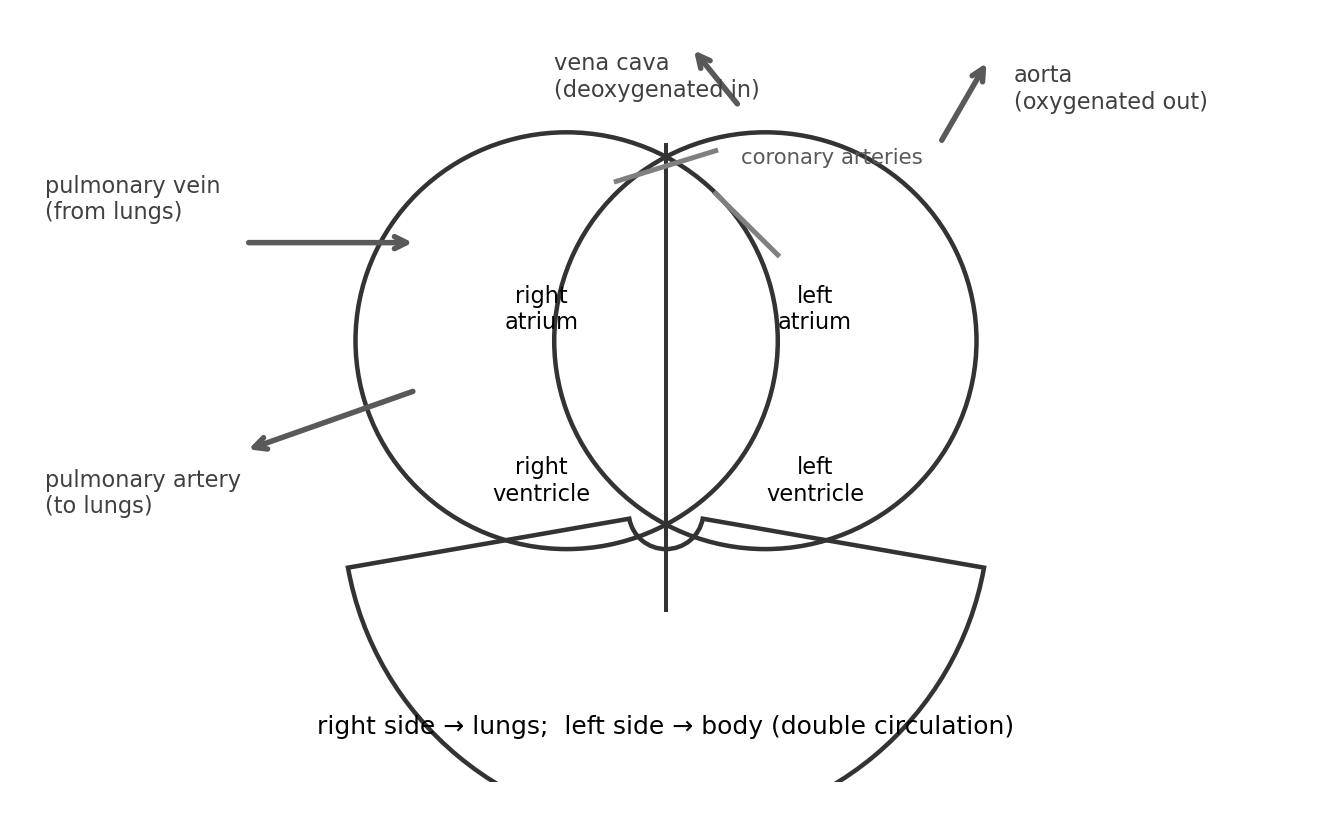
    The human heart with its four chambers and the five named vessels.
    Right side to the lungs; left side to the body.
    • The heart pumps blood in a double circulatory system: the right ventricle pumps blood to the lungs (gas exchange); the left ventricle pumps it around the rest of the body.
    • Vessels to know: aorta, vena cava, pulmonary artery, pulmonary vein, coronary arteries.
    • The resting heart rate is set by cells in the right atrium — the natural pacemaker; artificial pacemakers correct irregular rates.
    • Lungs: trachea → bronchi → alveoli 肺泡, surrounded by capillaries; alveoli are adapted by a large surface area, thin walls, good blood supply and ventilation.
    Vessel Structure Function
    artery thick, elastic, muscular walls; small lumen carries blood away at high pressure
    vein thin walls, large lumen, valves returns blood at low pressure
    capillary one cell thick exchange with tissues
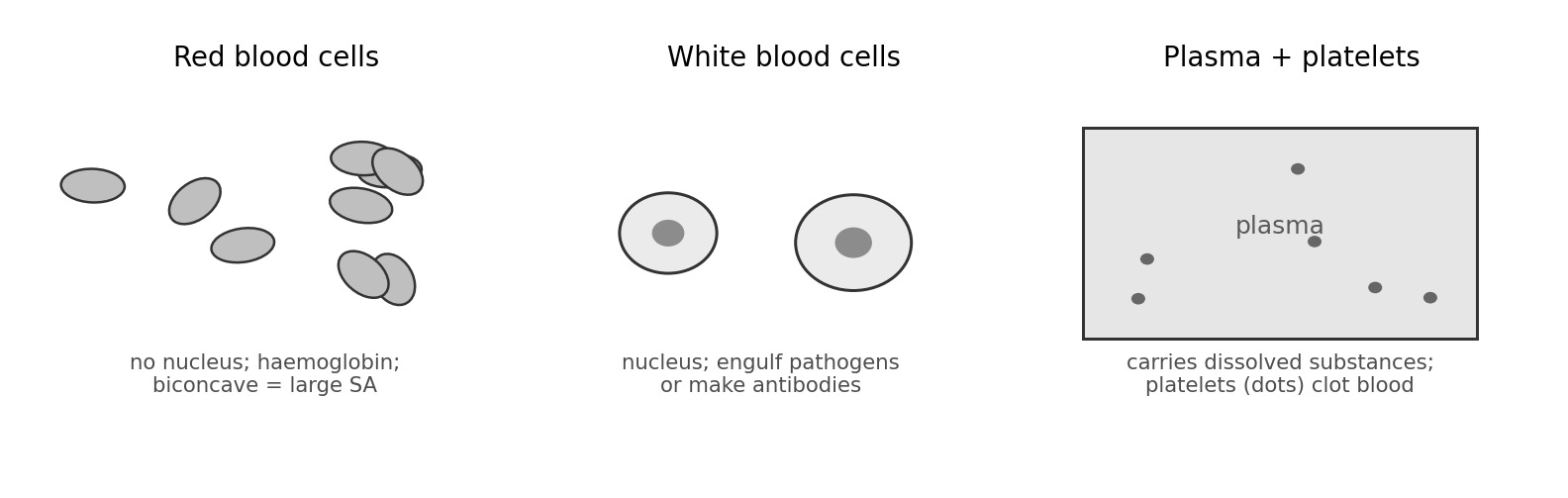
    Red cells, white cells, plasma and platelets.

    เลือด is a tissue: plasma 血浆 (carries dissolved sugars, amino acids, CO₂, urea, hormones, and heat), red blood cells 红细胞 (no nucleus, packed with haemoglobin, biconcave — large surface area for oxygen transport), white blood cells 白细胞 (engulf pathogens or make antibodies), platelets 血小板 (clotting).

    คำศัพท์ ฝึกฝน
    English ไทย
    alveoli/ˈælvɪɒli/ ถุงลมในปอด
    plasma/ˈplæzmə/ พลาสมา
    red blood cells/red blʌd selz/ เม็ดเลือดแดง
    white blood cells/waɪt blʌd selz/ เม็ดเลือดขาว
    platelets/ˈpleɪtlɪts/ เกล็ดเลือด
    2.2

    Coronary heart disease (4.2.2.4) and treatments

    หลักสูตร

    หัวใจ หลอดเลือด เลือด และโรคหลอดเลือดหัวใจ (AQA 8461 ข้อ4.2.2.2-4.2.2.4)

    1. อธิบายหัวใจและระบบไหลเวียนเลือดแบบสองรอบพร้อมระบุเส้นเลือดทั้งห้าชนิดและเซลล์ตัวเร่งจังหวะการเต้นของหัวใจ
    2. เชื่อมโยงโครงสร้างของหลอดเลือดแดง หลอดเลือดดำ และหลอดเลือดฝอยเข้ากับหน้าที่
    3. ทราบเกี่ยวกับพลาสมา เซลล์เม็ดเลือดแดง เซลล์เม็ดเลือดขาว และเกล็ดเลือด พร้อมลักษณะปรับตัว
    4. อธิบายโรคหัวใจแต่กำเนิด (CHD) และประเมินสเทนต์ สแตติน วาล์ว การปลูกถ่าย และหัวใจเทียม

    แหล่งที่มา: หลักสูตร Cambridge International

    In CHD layers of fatty material build up inside the coronary arteries, narrowing them — less blood, so less oxygen for the heart muscle. Evaluate each treatment with benefits and risks:

    การรักษา Benefit Risk/limitation
    stents 支架 keeps the artery open, restores flow surgery risk; doesn't treat the cause
    statins 他汀 reduce blood cholesterol, slowing fatty deposits long-term medication with side effects (liver)
    valve replacement (biological or mechanical) restores one-way flow major surgery; mechanical need lifelong anti-clotting drugs
    transplant (heart / heart and lungs) cures failure donor shortage; rejection — immunosuppressants
    artificial heart keeps the patient alive while waiting, or lets the heart rest infection, clotting, bulky
    คำศัพท์ ฝึกฝน
    English ไทย
    stents/stents/ ขดลวดขยายหลอดเลือด
    statins/ˈstætɪnz/ สแตติน
    2.3

    สุขภาพ วิถีชีวิต และมะเร็ง (4.2.2.5–4.2.2.7)

    หลักสูตร

    สุขภาพ พฤติกรรม lifestyle และมะเร็ง (AQA 8461 ข้อความ 4.2.2.5-4.2.2.7)

    1. นิยามคำว่าสุขภาพและอธิบายปฏิสัมพันธ์ระหว่างโรคกับปัจจัยอื่นๆ
    2. ระบุปัจจัยเสี่ยงที่มีกลไกเชิงสาเหตุที่พิสูจน์แล้วสำหรับโรคไม่ติดต่อ
    3. แยกแยะเนื้องอก jinak และเนื้องอก恶性肿瘤 และอธิบายเนื้องอกระยะที่สอง
    4. ตีความข้อมูลปัจจัยเสี่ยง โดยแยกความแตกต่างระหว่างความสัมพันธ์กับความเป็นเหตุเป็นผล

    แหล่งที่มา: หลักสูตร Cambridge International

    Health is the state of physical and mental well-being — not just the absence of disease. Diet, stress and life situations affect both; different diseases interact (immune defects → more infections; viruses → some cancers; immune reactions trigger asthma; severe physical illness → depression).

    Risk factors 危险因素 are linked to an increased rate of a disease — aspects of lifestyle or substances in the body/environment. A causal mechanism is proven for some, not others: diet/smoking/exercise → cardiovascular disease; obesity → Type 2 diabetes; alcohol → liver damage and brain function; smoking → lung disease and lung cancer; smoking and alcohol → unborn babies; carcinogens including ionising radiation → cancer. Interpret risk-factor data as correlation; proven mechanism makes it causation.

    Cancer results from changes in cells producing uncontrolled growth and division:

    • Benign tumours: contained in one area, usually within a membrane; do not invade.
    • Malignant tumours (cancers) invade neighbouring tissues and spread in the blood to form secondary tumours.

    Risk factors include lifestyle and, for some cancers, genes.

    คำศัพท์ ฝึกฝน
    English ไทย
    Risk factors/rɪsk ˈfæktəz/ ปัจจัยเสี่ยง
    2.4

    Plant tissues and transport (4.2.3)

    หลักสูตร

    เนื้อเยื่อพืช อวัยวะและการขนส่ง (AQA 8461 ข้อความ 4.2.3)

    1. เชื่อมโยงเนื้อเยื่อพืช (ผิวหนัง, เนื้อเยื่อพาลิเซด, พอง, เกลียว, โทเลียม, เมเรستم, เซลล์พิทักษ์) กับหน้าที่
    2. อธิบายลักษณะปรับตัวของรากผม เกลียว และโทเลียม รวมถึงกระบวนการระเหยน้ำและการเคลื่อนย้ายสาร
    3. อธิบายผลกระทบของอุณหภูมิ ความชื้น การเคลื่อนตัวของอากาศ และระดับความเข้มของแสงต่ออัตราการระเหยน้ำ

    แหล่งที่มา: หลักสูตร Cambridge International

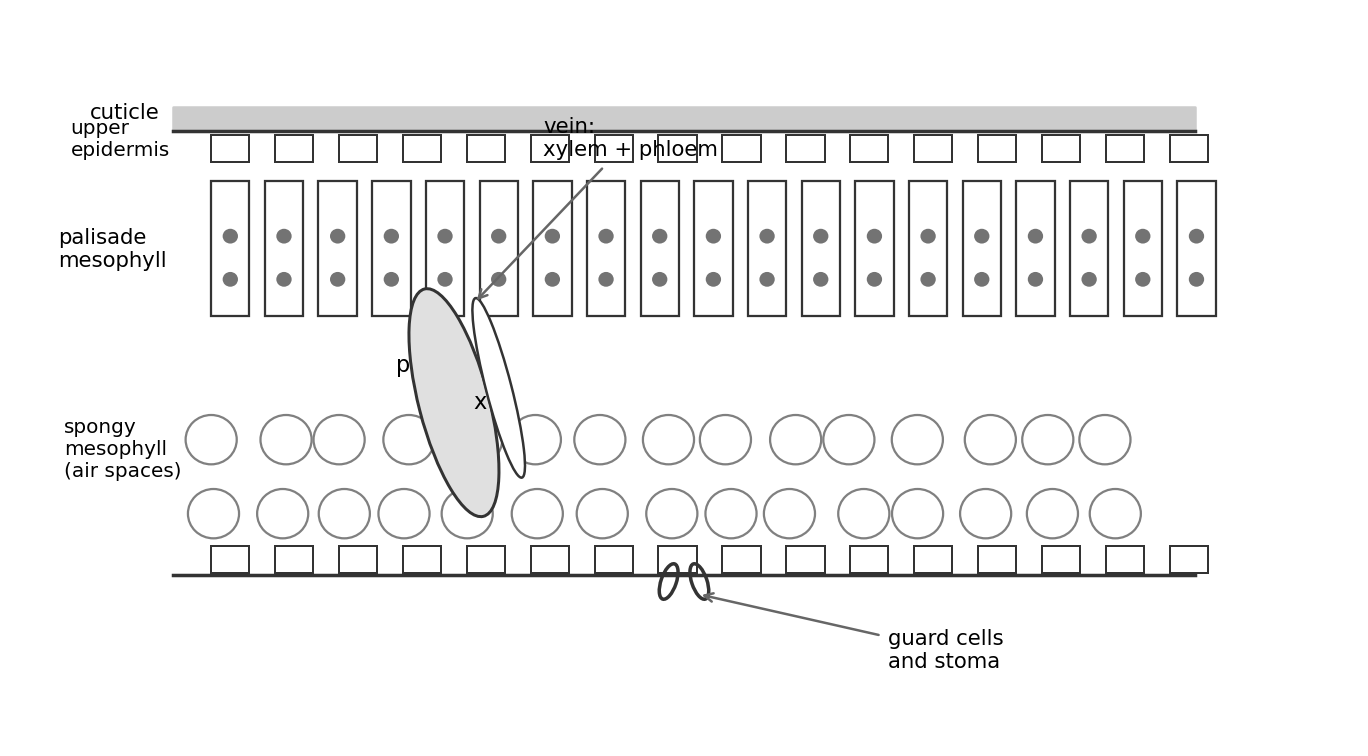
    A leaf in cross-section with its tissues labelled.
    Each tissue has one main job.
    • Epidermal tissue: protective covering; waxy cuticle on top.
    • เนื้อเยื่อเมโซฟิลล์แบบก้าน 栅栏组织: packed chloroplasts — most photosynthesis.
    • เนื้อเยื่อเมโซฟิลล์แบบฟองน้ำ: air spaces for gas exchange.
    • Xylem 木质部: hollow tubes strengthened by lignin — carries water and mineral ions from roots to leaves in the transpiration stream.
    • ท่อลำเลียง 韧皮部: sieve tubes — carries dissolved sugars from leaves to the rest of the plant (translocation 运输).
    • Meristem: at the growing tips of shoots and roots (stem cells).
    • Guard cells 保卫细胞 surround stomata 气孔, controlling gas exchange and water loss.
    • Root hair cells: large surface area; water enters by osmosis, mineral ions by active transport.

    การคายน้ำ 蒸腾作用 is the loss of water vapour from the leaves (mostly through stomata); it pulls the transpiration stream. The rate increases with: temperature ↑, air movement ↑, light intensity ↑ (stomata open); decreases with humidity ↑. Measure rate by water uptake with a potometer.

    คำศัพท์ ฝึกฝน
    English ไทย
    palisade mesophyll/ˈpælɪseɪd ˈmesəfɪl/ เนื้อเยื่อเมโซฟิลล์แบบก้านใบ
    Xylem/ˈzaɪləm/ เนื้อเยื่อท่อน้ำ
    Phloem/ˈfləʊɪm/ เนื้อเยื่อท่อน้ำตาล
    Guard cells/ɡɑːd selz/ เซลล์พิณ
    stomata/ˈstəʊmətə/ รูพรุน
    Transpiration/trænspəˈreɪʃn/ การคายน้ำ
    translocation/trænsləʊˈkeɪʃn/ การลำเลียงสารอาหาร
    2.4

    Checklist before you call this topic done

    • Order cells → tissues → organs → systems with one example each.
    • Enzyme table: name, site, substrate, products; lock and key; denaturing.
    • Bile: two functions with reasons; RP4 tests and colours; RP5 method.
    • Label the heart with all five named vessels; double circulation; pacemaker.
    • Artery/vein/capillary structure ↔ function; four blood components with adaptations.
    • CHD: cause + each treatment's benefit and risk.
    • Risk factors with causal mechanisms; benign vs malignant tumours.
    • Plant tissues and their jobs; xylem vs phloem; four transpiration factors.
  • 3

    การติดเชื้อและการตอบสนอง

    3.1

    การติดเชื้อและการตอบสนอง: สงครามภายในร่างกาย

    เชื้อโรคบุกรุก ระบบป้องกันตอบสนอง และยารับมือต่อสู้ การอ้างอิงนี้ครอบคลุม AQA GCSE Biology 8461, หัวข้อ 4.3 การติดเชื้อและการตอบสนอง

    วิธีการทดสอบหัวข้อนี้ในการสอบ:

    • ข้อสอบ 1 ครอบคลุมหัวข้อนี้; RP2 (ยาต้านจุลชีพ/ยาฆ่าเชื้อบนอาหารเลี้ยงเชื้อ) เชื่อมโยงจากหัวข้อ 1
    • แอนติบอดีชนิดโมโนคลอนัล (4.3.2) และ โรคพืช (4.3.3) เป็นเนื้อหาเฉพาะวิชาชีววิทยา และแอนติบอดีชนิดโมโนคลอนักรวมถึงการตรวจพบโรคพืชเป็นระดับสูง (HT) เท่านั้น
    • จำให้แม่น: โรคที่ระบุชื่อแต่ละชนิด → ประเภทของเชื้อโรค, อาการ และการแพร่กระจาย; ระบบป้องกัน; ขั้นตอนการทดสอบยา
    3.1

    โรคติดต่อและเชื้อโรค (4.3.1.1)

    หลักสูตร

    โรคติดเชื้อ ประเภทเชื้อโรค และชื่อโรค (AQA 8461 ข้อความ 4.3.1.1-4.3.1.5)

    1. อธิบายวิธีที่ไวรัส แบคทีเรีย โปรโตซัว และราแพร่กระจายในสัตว์และพืช以及如何ลดการแพร่กระจาย
    2. จำชื่อโรค เช่น ไข้หัดเยอรมัน HIV TMV Salmonella กอนอเรีย Rose black spot และ malaria连同病原体类型、传播途径、症状和控制方法

    แหล่งที่มา: หลักสูตร Cambridge International

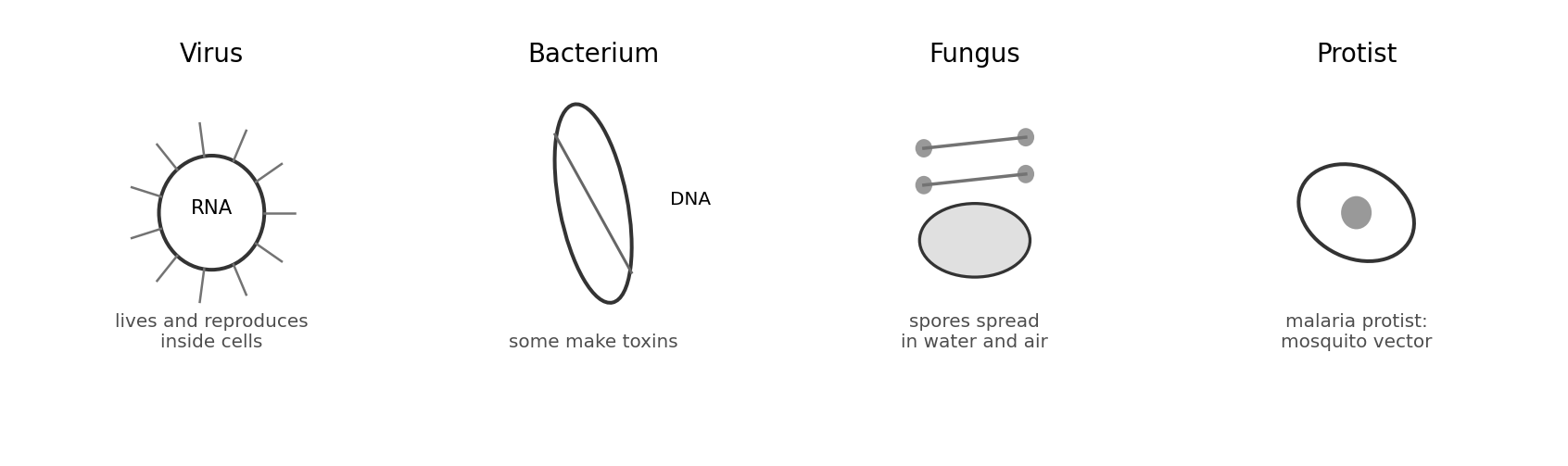
    ประเภทของเชื้อโรคทั้งสี่พร้อมคุณสมบัติสำคัญ

    เชื้อโรค คือจุลินทรีย์ที่ทำให้เกิดโรคติดเชื้อ: ไวรัส, แบคทีเรีย, โปรทิสต์, fungi它们 infect พืชหรือสัตว์และแพร่กระจายผ่าน การสัมผัสโดยตรง, น้ำ หรืออากาศ แบคทีเรียอาจสร้าง สารพิษ ที่ทำลายเนื้อเยื่อ; ไวรัสอาศัยและสืบพันธุ์ภายในเซลล์

    การลดการแพร่กระจาย:สุขอนามัย (ล้างมือ), การฆ่าเชื้อในแผล, น้ำสะอาด, การบำบัดน้ำเสีย, การใช้ถุงกันครรภ์, การควบคุมพาหะ (มุ้งกันยุง, การระบายน้ำขัง)

    คำศัพท์ ฝึกฝน
    English ไทย
    Pathogens/ˈpæθədʒnz/ เชื้อโรค
    toxins/ˈtɒksɪnz/ สารพิษ
    3.1

    โรคที่มีชื่อเรียก (4.3.1.2–4.3.1.5)

    หลักสูตร

    โรคติดเชื้อ ประเภทเชื้อโรค และชื่อโรค (AQA 8461 ข้อความ 4.3.1.1-4.3.1.5)

    1. อธิบายวิธีที่ไวรัส แบคทีเรีย โปรโตซัว และราแพร่กระจายในสัตว์และพืช以及如何ลดการแพร่กระจาย
    2. จำชื่อโรค เช่น ไข้หัดเยอรมัน HIV TMV Salmonella กอนอเรีย Rose black spot และ malaria连同病原体类型、传播途径、症状和控制方法

    แหล่งที่มา: หลักสูตร Cambridge International

    โรค เชื้อโรค การแพร่กระจาย อาการ/สัญญาณ การควบคุม
    ไข้สุกใส Virus การหายใจรับละออง (จาม, ไอ) มีไข้, ผื่นแดงตามผิว; อาจเป็นอันตรายถึงชีวิต วัคซีนสำหรับเด็กเล็ก
    HIV Virus การสัมผัสทางเพศ, การแลกเปลี่ยนของเหลวในร่างกาย (การใช้เข็มร่วมกัน) 类似于อาการหวัด;โจมตีเซลล์ภูมิคุ้มกัน → เอดส์ระยะท้าย ยาต้านไวรัส; ความปลอดภัยทางเพศ; เข็มสะอาด
    TMV (ไวรัสมosaicใบยาสูบ) Virus (พืช) การสัมผัสระหว่างพืช ใบมีสีลาย mosaic; การสังเคราะห์แสงและการเจริญเติบโตลดลง สรรพพันธุ์ทนทาน; สุขอนามัย
    Salmonella Bacterium การบริโภคอาหารในสภาพที่ไม่ถูกสุขอนามัย มีไข้, ปวดท้อง, อาเจียน, ท้องเสีย (แบคทีเรีย + สารพิษ) วัคซีนไก่ (UK); การเตรียมอาหารที่ถูกสุขอนามัย
    หนองใน Bacterium การสัมผัสทางเพศ มีขี้เปื่อยสีเหลือง/เขียวหนา, ปวดเมื่อปัสสาวะ ยาปฏิชีวนะ (ความต้านทานเพิ่มขึ้น); ถุงกันครรภ์
    Rose black spot Fungi (พืช) สปอร์ในน้ำ/อากาศ จุดดำบนใบ; ใบเหลืองและร่วง การตัด/เผาใบ; ยากำจัดเชื้อรา
    malaria Protist พาหะยุง มีไข้ซ้ำซ้อน; อาจเป็นอันตรายถึงชีวิต มุ้ง; การหยุดยั้งการ繁殖ยุง
    3.2

    ระบบป้องกันร่างกายและภูมิคุ้มกันของมนุษย์ (4.3.1.6–4.3.1.7)

    หลักสูตร

    ระบบป้องกันร่างกายมนุษย์ การฉีดวัคซีนและยา (AQA 8461 ข้อความ 4.3.1.6-4.3.1.9)

    1. อธิบายระบบป้องกันที่ไม่จำเพาะและ tigargo ของเม็ดเลือดขาวสามชนิด
    2. อธิบายการฉีดวัคซีนในระดับบุคคลและผลกระทบในระดับประชากร
    3. แยกแยะยาต้านจุลชีพกับยาบรรเทาอาการปวด อธิบายว่าทำไมยาต้านจุลชีพจึงไม่สามารถรักษาไวรัสได้ และอธิบายเรื่องความต้านทาน
    4. อธิบายแหล่งที่มาของการค้นพบยาและขั้นตอนการทดสอบก่อนคลินิก/คลินิก รวมถึงการทดลองแบบบอดคู่

    แหล่งที่มา: หลักสูตร Cambridge International

    ชั้นป้องกันและกระบวนการทดสอบยา

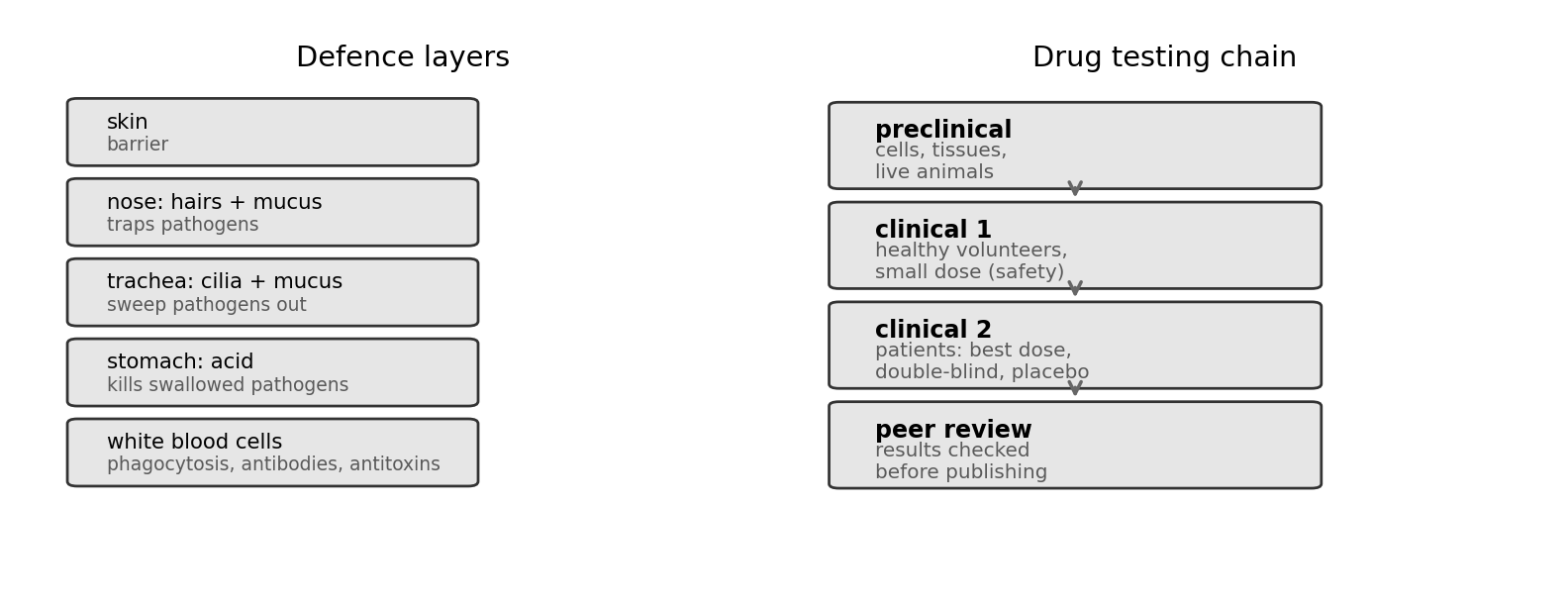
    การป้องกันที่ไม่จำเพาะ: ผิวหนัง (เกราะป้องกัน, การเกิดแผลเป็น); จมูก (ขนจมูก, น้ำมูก); หลอดลมและหลอดลมย่อย (น้ำมูก, ขนกระพริบ); กระเพาะอาหาร (กรดไฮโดรคลอริก)

    ระบบภูมิคุ้มกัน ทำลายเชื้อโรคที่เข้าสู่ร่างกาย เม็ดเลือดขาว ป้องกันโดย:

    1. การกินเข้าของเซลล์ (phagocytosis) — การกลืนกินเชื้อโรค;
    2. การผลิตแอนติบอดี — โปรตีนที่จับกับแอนติเจนเฉพาะเจาะจง;
    3. การผลิตแอนติทอกซิน — การลดฤทธิ์ของสารพิษ

    การฉีดวัคซีน: ปริมาณเล็กน้อยของ เชื้อโรคที่ตายแล้วหรือไม่มีฤทธิ์ กระตุ้นให้เม็ดเลือดขาวผลิตแอนติบอดี; เมื่อติดเชื้อซ้ำ เซลล์ความจำจะตอบสนอง อย่างรวดเร็ว โดยผลิตแอนติบอดีที่ถูกต้อง เพื่อป้องกันการติดเชื้อ ผลกระทบต่อกลุ่มประชากร: การมีภูมิคุ้มกันในสัดส่วนมากช่วยลดการแพร่กระจายให้กับทุกคน ประเมิน: ผลประโยชน์ (ควบคุมการระบาด เช่น ไข้สุกเสี้ยว) เทียบกับผลข้างเคียงที่พบได้น้อย

    คำศัพท์ ฝึกฝน
    English ไทย
    phagocytosis/ˌfæɡəsɪˈtəʊsɪs/ การกลืนกิน
    antibody production/ˈæntɪbɒdi prəˈdʌkʃn/ การสร้างแอนติบอดี
    antitoxin production/ˌæntɪˈtɒksɪn prəˈdʌkʃn/ การสร้างแอนทีโทaksin
    Vaccination/ˌvæksɪˈneɪʃn/ การฉีดวัคซีน
    Antibiotics/ˌæntɪbaɪˈɒtɪks/ ยาปฏิชีวนะ
    Monoclonal antibodies/ˈmɒnəʊklɒnl ˈæntɪbɒdiz/ แอนติบอดีแบบโมโนคลอนอล
    hybridoma/ˌhaɪbrɪˈdəʊmə/ ไฮบริโดมา
    3.2

    ยาปฏิชีวนะ ยาลดปวด และการพัฒนาวยา (4.3.1.8–4.3.1.9)

    หลักสูตร

    ระบบป้องกันร่างกายมนุษย์ การฉีดวัคซีนและยา (AQA 8461 ข้อความ 4.3.1.6-4.3.1.9)

    1. อธิบายระบบป้องกันที่ไม่จำเพาะและ tigargo ของเม็ดเลือดขาวสามชนิด
    2. อธิบายการฉีดวัคซีนในระดับบุคคลและผลกระทบในระดับประชากร
    3. แยกแยะยาต้านจุลชีพกับยาบรรเทาอาการปวด อธิบายว่าทำไมยาต้านจุลชีพจึงไม่สามารถรักษาไวรัสได้ และอธิบายเรื่องความต้านทาน
    4. อธิบายแหล่งที่มาของการค้นพบยาและขั้นตอนการทดสอบก่อนคลินิก/คลินิก รวมถึงการทดลองแบบบอดคู่

    แหล่งที่มา: หลักสูตร Cambridge International

    • ยาปฏิชีวนะ (เช่น เพนิซิลลิน) รักษาโรคแบคทีเรียโดยการฆ่าแบคทีเรียในร่างกาย — ยาปฏิชีวนะชนิดหนึ่งใช้กับแบคทีเรียชนิดหนึ่งเท่านั้น They ไม่สามารถฆ่าไวรัสได้ (ไวรัสอาศัยอยู่ในเซลล์ภายใน การฆ่ามันอาจทำลายเนื้อเยื่อร่างกาย) ความต้านทาน เป็นปัญหาสำคัญ — การแข่งขันเพื่อหาปฏิชีวนะใหม่
    • ยาลดปวด รักษา อาการ แต่ไม่ฆ่าเชื้อโรค

    การพัฒนาวยา: ในอดีตสกัดจากพืช/จุลินทรีย์ — ดิจิตอลิสจาก ฟอกซ์กลอว์ (หัวใจ), แอสไพรินจาก ต้นไวโอล์, เพนิซิลลินจาก ราเพนิซิลเลียม (เฟลமிง) ยาส่วนใหญ่ที่พัฒนาขึ้นใหม่สังเคราะห์ทางเคมี แต่จุดเริ่มต้นอาจยังคงเป็นสารจากพืช

    ขั้นตอนการทดสอบ: ก่อนคลินิก (เซลล์, เนื้อเยื่อ, สัตว์มีชีวิต) → การทดลองทางคลินิกบน ผู้บริจาคสุขภาพดี ( dosis ต่ำ, ความปลอดภัย) แล้วผู้ป่วย (dosis ที่เหมาะสม, ประสิทธิภาพ) → การทดลองแบบ ** blindness คู่** พร้อม พลาซีโบ; ผลการทดสอบผ่านการตรวจสอบโดยผู้เชี่ยวชาญ

    3.3

    แอนติบอดีโมโนโคลนัล (ชีววิทยาเท่านั้น, HT)

    หลักสูตร

    แอนติบอดีชนิดโมโนคลอนัล, สรีรวิทยาเท่านั้น และระดับสูง (AQA 8461 ข้อ 4.3.2)

    1. อธิบายการผลิตไฮบริโดมาของแอนติบอดีชนิดโมโนคลอนัล
    2. อธิบายการใช้งานในการวินิจฉัย การวัดผล การวิจัย และการรักษาโรคมะเร็ง

    แหล่งที่มา: หลักสูตร Cambridge International

    แอนติบอดีโมโนโคลนัล ผลิตจากคลอนเซลล์เดียว มีปฏิกิริยากับตำแหน่งจับเพียงจุดเดียวบนโปรตีนแอนติเจน วิธีการผลิต: กระตุ้น ไลโฟไซต์ ของหนูให้ผลิตแอนติบอดี → ผสมกับ เซลล์เนื้องอก เพื่อสร้าง ไฮบริโดมา —它将แบ่งตัว AND ผลิตแอนติบอดี → คลอนไฮบริโดมา → เก็บและทำให้บริสุทธิ์ปริมาณมากของแอนติบอดีเฉพาะชนิดหนึ่ง

    การใช้งาน: การตรวจตั้งครรภ์; การวัดระดับฮอร์โมน/สารเคมีในเลือด; การตรวจหาเชื้อโรค; การวิจัย — แอนติบอดีเรืองแสงระบุตำแหน่งโมเลกุล; การรักษาโรคมะเร็ง — แอนติบอดีผูกกับสารกัมมันตรังสี/สารพิษส่งไป เฉพาะเซลล์มะเร็งเท่านั้น

    3.4

    โรคพืช (ชีววิทยาเท่านั้น)

    หลักสูตร

    โรคพืช, สรีรวิทยาเท่านั้น (AQA 8463 ข้อ 4.3.3)

    1. ตรวจหาโรคพืชจากอาการและระบุโดยวิธีทางมือ,ในห้องแล็บ หรือด้วยแอนติบอดีชนิดโมโนคลอนัล
    2. อธิบายภาวะขาดไอออนไนเตรตและแมกนีเซียม
    3. อธิบายการตอบสนองทางป้องกันของพืชทั้งด้านกายภาพ เคมี และกลไก

    แหล่งที่มา: หลักสูตร Cambridge International

    การตรวจหา (HT): การเจริญเติบโตช้า, จุดบนใบ,areas of decay, การงอก, ก้าน/ใบผิดรูป, การเปลี่ยนสี, การมีอยู่ของศัตรูพืช

    การระบุ (HT): คู่มือ/เว็บไซต์ทำสวน; การวิเคราะห์ในห้องปฏิบัติการ; ชุดทดสอบโดยใช้ แอนติบอดีโมโนโคลนัล

    ปัญหาพืชที่มีชื่อ: TMV (ไวรัส), rose black spot (เชื้อรา), aphids (แมลง)

    การขาดไอออน: ไนเตรต น้อยเกินไป → การเจริญเติบโตช้า (ไนเตรตจำเป็นสำหรับ กรดอะมิโน/โปรตีน); การขาด แมกนีเซียม → chlorosis (ใบเหลือง — แมกนีเซียมจำเป็นในการสร้าง คลอโรฟิลล์)

    การตอบสนองทางป้องกัน: ทางกายภาพ — ผนังเซลล์เซลลูโลส, คิวติเคิลขี้ผึ้ง, เปลือก/ชั้นตาย; ทางเคมี — สารต้านแบคทีเรีย, สารพิษ; ทางกลไก — หนาม, ขน, ใบห้อย/ม้วน, การเลียนแบบ

    คำศัพท์ ฝึกฝน
    English ไทย
    aphids/ˈeɪfɪdz/ แมลงหอยทาก
    chlorosis/ˈklɔːrəʊsiz/ ใบเหลือง
    3.4

    รายการตรวจสอบก่อนจะจบหัวข้อนี้

    • สี่ประเภทของเชื้อโรค; สามช่องทางในการแพร่กระจาย; สองวิธีลดการแพร่กระจายของโรคที่ระบุไว้แต่ละชนิด
    • ท่องตารางโรค: เชื้อโรค, การแพร่กระจาย, อาการ, การควบคุม
    • สี่การป้องกันที่ไม่จำเพาะ; สามการกระทำของเม็ดเลือดขาว
    • กลไกการให้วัคซีน + ผลต่อประชากร; ยาแก้ปวด vs ยาปฏิชีวนะ; เหตุผลที่ยาปฏิชีวนะไม่สามารถรักษาไวรัสได้
    • แหล่งที่มาของยา (ฟอกส์กลอว์, วัลโลว์, Penicillium) และขั้นตอนก่อนคลินิก/คลินิกพร้อมพลาซีโบและแบบบอดคู่
    • (HT, Biology) ลำดับการผลิตไฮบริดโดมาและสี่การใช้งานโมโนโคลนัล
    • (Biology) สัญญาณโรคพืช, วิธีระบุ, การขาดไนเตรต/แมกนีเซียม, สามประเภทของการป้องกัน
  • 4

    ชีวพลังงานศาสตร์

    4.1

    Bioenergetics: photosynthesis and respiration

    Plants capture the Sun's energy; every cell releases it again. This reference covers AQA GCSE Biology 8461, topic 4.4 Bioenergetics.

    How the exam treats this topic:

    • Paper 1 carries Bioenergetics. RP6: light intensity and the rate of photosynthesis using pondweed.
    • Limiting-factor graphs with two or three factors, the inverse square law and greenhouse economics are HT only.
    • Equations are word equations — know the symbol forms too (CO₂, H₂O, O₂, C₆H₁₂O₆).
    4.1

    Photosynthesis (4.4.1.1)

    หลักสูตร

    Photosynthesis (AQA 8461 statements 4.4.1.1-4.4.1.2, RP6).

    1. Write the photosynthesis word and symbol equations, and describe it as endothermic.
    2. Explain how light intensity, CO2 concentration and temperature limit the rate of photosynthesis, including interpreting limiting-factor graphs.
    3. (HT) Use the inverse-square relation between light intensity and distance, and reasons for greenhouse economics.
    4. Describe RP6: light intensity and the rate of photosynthesis with pondweed, its controls and the rate calculation.

    แหล่งที่มา: หลักสูตร Cambridge International

    $$\text{carbon dioxide} + \text{water} \xrightarrow{\ \text{light}\ } \text{glucose} + \text{oxygen}$$
    $$6\,\text{CO}_2 + 6\,\text{H}_2\text{O} \rightarrow \text{C}_6\text{H}_{12}\text{O}_6 + 6\,\text{O}_2$$

    Photosynthesis is an ดูดความร้อน 吸热 reaction: energy is transferred from the environment to the chloroplasts by light.

    คำศัพท์ ฝึกฝน
    English ไทย
    endothermic/ˌendəʊˈθɜːmɪk/ ดูดความร้อน
    4.1

    Rate of photosynthesis and limiting factors (4.4.1.2)

    หลักสูตร

    Photosynthesis (AQA 8461 statements 4.4.1.1-4.4.1.2, RP6).

    1. Write the photosynthesis word and symbol equations, and describe it as endothermic.
    2. Explain how light intensity, CO2 concentration and temperature limit the rate of photosynthesis, including interpreting limiting-factor graphs.
    3. (HT) Use the inverse-square relation between light intensity and distance, and reasons for greenhouse economics.
    4. Describe RP6: light intensity and the rate of photosynthesis with pondweed, its controls and the rate calculation.

    แหล่งที่มา: หลักสูตร Cambridge International

    Rate of photosynthesis against one limiting factor at a time.
    Each curve rises then flattens where another factor limits.

    Rate increases with: light intensity, CO₂ concentration, temperature (to the enzyme optimum), and the amount of chlorophyll.

    Reading single-factor graphs: the flat top means something else has become the limiting factor 限制因素. (HT) On two- or three-factor graphs, decide which factor is limiting at each point.

    (HT) Inverse square law: doubling the distance from the lamp quarters the light intensity:

    $$\text{light intensity} \propto \frac{1}{\text{distance}^2}$$

    (HT) Greenhouse economics: adding heat, light or CO₂ raises the rate — but each costs money; the grower adds the cheapest factor that is limiting, up to the point where extra yield no longer pays.

    RP6 set-up: pondweed under an inverted funnel in a beaker, with a lamp at a measured distance.

    RP6: pondweed in water at different lamp distances; count the oxygen bubbles per minute (or collect the gas); control temperature and CO₂ (sodium hydrogencarbonate); repeat and mean; rate = bubbles ÷ time.

    Worked example. Bubbles: 30 per minute at 10 cm; at 20 cm the light intensity is a quarter, so expect about 8 per minute (if light is still limiting).

    คำศัพท์ ฝึกฝน
    English ไทย
    limiting factor/ˈlɪmɪtɪŋ ˈfæktə/ ปัจจัยจำกัด
    4.1

    Uses of glucose (4.4.1.3)

    หลักสูตร

    Photosynthesis (AQA 8461 statements 4.4.1.1-4.4.1.2, RP6).

    1. Write the photosynthesis word and symbol equations, and describe it as endothermic.
    2. Explain how light intensity, CO2 concentration and temperature limit the rate of photosynthesis, including interpreting limiting-factor graphs.
    3. (HT) Use the inverse-square relation between light intensity and distance, and reasons for greenhouse economics.
    4. Describe RP6: light intensity and the rate of photosynthesis with pondweed, its controls and the rate calculation.

    แหล่งที่มา: หลักสูตร Cambridge International

    Glucose from photosynthesis is used for:

    • respiration;
    • converted to insoluble starch for storage;
    • fat or oil for storage;
    • cellulose for cell walls;
    • amino acids for protein — this also needs nitrate ions from the soil.
    4.2

    Respiration (4.4.2.1)

    หลักสูตร

    Respiration and metabolism (AQA 8461 statements 4.4.1.3, 4.4.2.1-4.4.2.3).

    1. Name five uses of glucose from photosynthesis.
    2. Compare aerobic and anaerobic respiration in muscle and yeast, with word equations, and fermentation's economic importance.
    3. Explain the body's response to exercise and (HT) oxygen debt and the liver's role.
    4. Define metabolism and list the reactions it includes.

    แหล่งที่มา: หลักสูตร Cambridge International

    Respiration is an คายความร้อน 放热 reaction occurring continuously in living cells, transferring the energy for: building larger molecules, movement, and keeping warm.

    Aerobic Anaerobic (muscle) Anaerobic (plant/yeast)
    oxygen needed not needed not needed
    equation glucose + oxygen → CO₂ + water glucose → lactic acid glucose → ethanol + CO₂
    พลังงาน much more much less much less

    Anaerobic respiration in yeast is fermentation 发酵, economically important in bread (CO₂ makes it rise) and alcoholic drinks.

    คำศัพท์ ฝึกฝน
    English ไทย
    exothermic/eɡzəˈðɜːmɪk/ ปฏิกิริยาคายความร้อน
    fermentation/fɜːmənˈteɪʃn/ การหมัก
    4.2

    Response to exercise (4.4.2.2)

    หลักสูตร

    Respiration and metabolism (AQA 8461 statements 4.4.1.3, 4.4.2.1-4.4.2.3).

    1. Name five uses of glucose from photosynthesis.
    2. Compare aerobic and anaerobic respiration in muscle and yeast, with word equations, and fermentation's economic importance.
    3. Explain the body's response to exercise and (HT) oxygen debt and the liver's role.
    4. Define metabolism and list the reactions it includes.

    แหล่งที่มา: หลักสูตร Cambridge International

    During exercise the heart rate, breathing rate and breath volume เพิ่มขึ้น to deliver more oxygenated blood to muscles. If oxygen supply is insufficient, muscles switch to anaerobic respiration: incomplete glucose oxidation builds up lactic acid 乳酸 → fatigue; an oxygen debt 氧债 builds.

    (HT) Blood carries lactic acid to the liver, which converts it back to glucose. The oxygen debt is the extra oxygen needed after exercise to react with and remove the accumulated lactic acid.

    คำศัพท์ ฝึกฝน
    English ไทย
    oxygen debt/ˈɒksɪdʒn det/ หนี้氧 (Oxygen debt)
    lactic acid/ˈlæktɪk ˈæsɪd/ กรดแลคติก
    4.2

    Metabolism (4.4.2.3)

    หลักสูตร

    Respiration and metabolism (AQA 8461 statements 4.4.1.3, 4.4.2.1-4.4.2.3).

    1. Name five uses of glucose from photosynthesis.
    2. Compare aerobic and anaerobic respiration in muscle and yeast, with word equations, and fermentation's economic importance.
    3. Explain the body's response to exercise and (HT) oxygen debt and the liver's role.
    4. Define metabolism and list the reactions it includes.

    แหล่งที่มา: หลักสูตร Cambridge International

    Metabolism 代谢 is the sum of all reactions in a cell or body; respiration fuels them. It includes:

    • glucose → starch, glycogen, cellulose;
    • glycerol + 3 fatty acids → lipids;
    • glucose + nitrate ions → amino acids → proteins;
    • respiration;
    • breakdown of excess protein → urea for excretion.
    คำศัพท์ ฝึกฝน
    English ไทย
    Metabolism/məˈtæbəlɪzəm/ เมตาบอลิซึม
    4.2

    Checklist before you call this topic done

    • Write the photosynthesis word and symbol equations; say endothermic + light→chloroplasts.
    • Explain the four rate factors; read flattening single-factor graphs; (HT) inverse square law and greenhouse economics.
    • Describe RP6 with its controls and the rate calculation.
    • List five uses of glucose (with nitrate for protein).
    • Compare aerobic with both anaerobic equations; name fermentation's two products and uses.
    • Exercise: three increases; lactic acid and oxygen debt; (HT) the liver's role.
    • Define metabolism with its five strands.
  • 5

    ความคงที่ภายในและการตอบสนอง

    5.1

    Homeostasis and response: keeping conditions steady

    • Homeostasis is the regulation of the internal conditions of a cell or organism, to maintain optimum conditions for enzyme action and all cell functions, in response to internal and external changes.
    • The body controls blood glucose concentration, body temperature and water levels.
    • Every automatic control system has: receptors (detect stimuli), coordination centres (brain, spinal cord, pancreas — receive and process information) and effectors (muscles or glands — bring about the response that restores optimum levels).
    • Nervous responses are fast and short-lived; hormonal responses are slower but act for longer.
    คำศัพท์ ฝึกฝน
    English ไทย
    Homeostasis/ˌhəʊmiːəˈstɑːsiz/ สมดุลภายในร่างกาย
    neurone/ˈnjuːrəʊn/ เซลล์ประสาท
    5.1

    การรักษาสมดุลภายในร่างกายและระบบประสาท (4.5.1–4.5.2.1, RP7)

    หลักสูตร

    การรักษาสภาวะสมดุลและระบบประสาท (AQA 8461 ข้อ 4.5.1-4.5.2.1, RP7)

    1. นิยามการรักษาสภาวะสมดุลและชื่อสภาวะ 3 อย่างที่ร่างกายควบคุม
    2. อธิบายตัวรับสัญญาณ ศูนย์ประสานงาน และอวัยวะเป้าหมาย รวมถึงเส้นทางการตอบสนองต่อสิ่งเร้า: สิ่งเร้า-ตัวรับสัญญาณ-ศูนย์ประสานงาน-อวัยวะเป้าหมาย-การตอบสนอง
    3. อธิบายวงจรการตอบสนองแบบสะท้อนกลับ (reflex arc) ซึ่งประกอบด้วยประสาทสัมผัส ประสาทกลาง และประสาทสั่งการ พร้อมอธิบายว่าทำไมการตอบสนองแบบสะท้อนกลับจึงเกิดขึ้นโดยอัตโนมัติและรวดเร็ว
    4. อธิบาย RP7: ผลของปัจจัยใด因素หนึ่งที่มีต่อเวลาตอบสนองของมนุษย์ โดยมีการควบคุมตัวแปรและการจัดการข้อมูล

    แหล่งที่มา: หลักสูตร Cambridge International

    เส้นทาง: กระตุ้น → ตัวรับสัญญาณ → ศูนย์ประสานงาน (CNS: สมอง + มดลูกหมาก) → ตัวออกฤทธิ์ (กล้ามเนื้อหดตัว / ต่อมหลั่งสาร) → ผลตอบสนอง

    ข้อมูลส่งผ่านตามเซลล์ที่เรียกว่า เซลล์ประสาท ในรูปของ กระแสไฟฟ้า CNS ทำหน้าที่ประสานการตอบสนองของตัวออกฤทธิ์

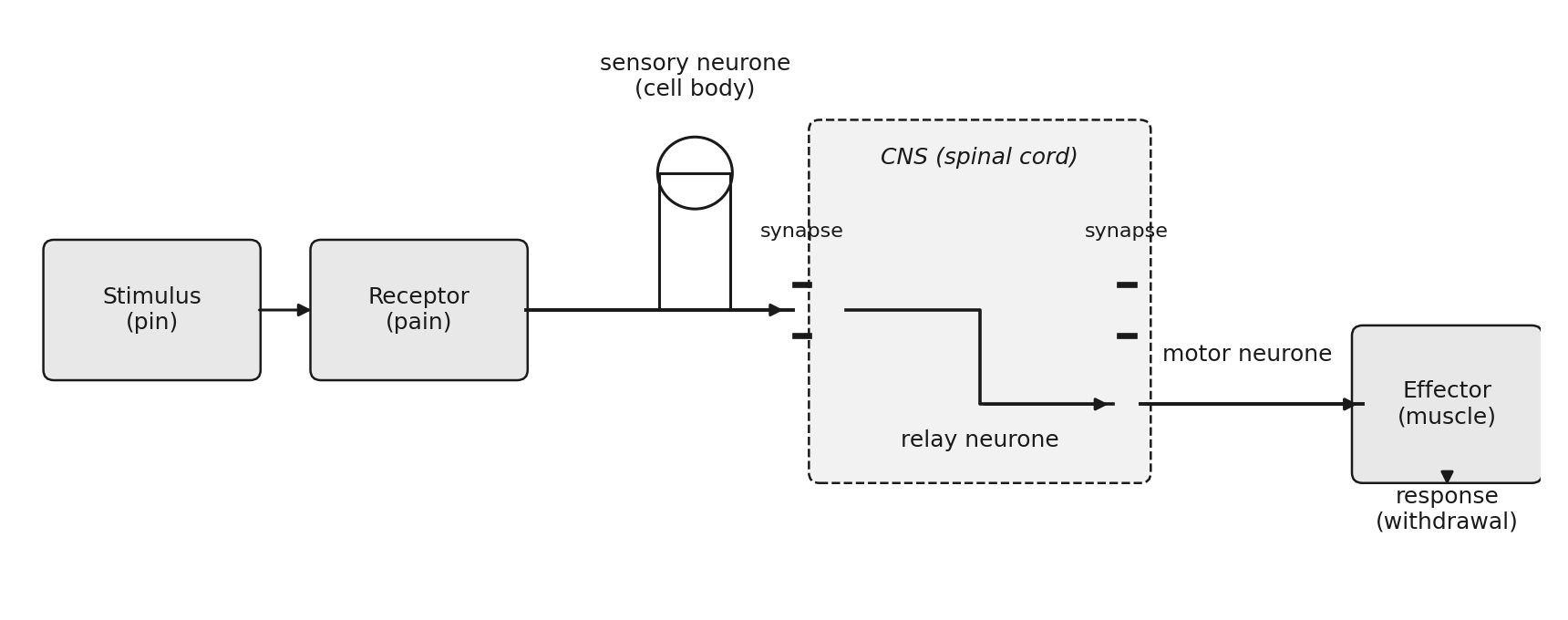
    วงจรสะท้อนกลับ: กระตุ้นไปยังตัวรับสัญญาณ, เซลล์ประสาทสัมผัสที่มีตัวเซลล์, เซลล์ประสาทเชื่อมโยงใน CNS, เซลล์ประสาทสั่งการไปยังตัวออกฤทธิ์, พร้อมซันاپส์ระหว่างเซลล์ประสาท

    วงจรสะท้อนกลับ — การปกป้องอัตโนมัติและรวดเร็วที่ไม่ได้เกี่ยวข้องกับส่วนสติของสมอง:

    กระตุ้น → ตัวรับสัญญาณ → เซลล์ประสาทสัมผัส → ซันاپส์ → เซลล์ประสาทเชื่อมโยง (ใน CNS) → ซันاپส์ → เซลล์ประสาทสั่งการ → ตัวออกฤทธิ์ → ผลตอบสนอง

    ที่ ซันاپส์ กระแสไฟฟ้าจะมาถึงปลายของเซลล์ประสาทและมีการปล่อยสารเคมี; สารนี้จะแพร่ข้ามช่องว่างและกระตุ้นให้เกิดกระแสไฟฟ้าในเซลล์ประสาทถัดไป

    RP7 — เวลาตอบสนอง: วางแผนและตรวจสอบผลกระทบของปัจจัยหนึ่ง (เช่น คาเฟอีน) ต่อเวลาตอบสนองของมนุษย์ ปล่อยไม้บรรทัดระหว่างนิ้วโป้งและนิ้วชี้ของคู่ทดลอง; วัดระยะจับ; แปลงเป็นเวลา (หรือใช้แบบทดสอบคอมพิวเตอร์); ควบคุมตัวแปร (ใช้มือเดียวกัน, ความสูงเท่าเดิม); ทำซ้ำและหาค่าเฉลี่ย วิเคราะห์ข้อมูลเวลาตอบสนองจากกราฟและตาราง

    5.2

    สมอง, ตา และอุณหภูมิ —ชีววิทยาเท่านั้น (4.5.2.2–4.5.2.4)

    หลักสูตร

    The brain, the eye and body temperature — biology only (AQA 8461 statements 4.5.2.2-4.5.2.4).

    1. Identify cerebral cortex, cerebellum and medulla with their functions, and (HT) difficulties of investigating and treating the brain.
    2. Relate eye structures to functions and explain accommodation for near and distant objects.
    3. Explain myopia and hyperopia and their correction with lenses and new technologies.
    4. Explain how vasodilation, sweating, vasoconstriction and shivering control body temperature (HT in context).

    แหล่งที่มา: หลักสูตร Cambridge International

    สมอง (HT เพิ่มเติม)

    ระบุบนแผนภาพ: ** коре cerebrum** (สติ, ความจำ, ภาษา), ซีเรเบลลัม (สมดุล, การประสานงานของการเคลื่อนไหว), เมดูลา (อัตราการเต้นของหัวใจ, การหายใจ)

    (HT) ความยากในการศึกษาและรักษาสมอง: มีความซับซ้อนและบอบบาง, บาดเจ็บง่าย, และเข้าถึงยาก วิธีการทำแผนที่: การศึกษาผู้ป่วยที่มี ความเสียหายของสมอง, การกระตุ้นด้วยไฟฟ้าบริเวณต่างๆ, และการ สแกน MRI ประเมินประโยชน์และความเสี่ยงของการดำเนินการทางสมอง

    ตา

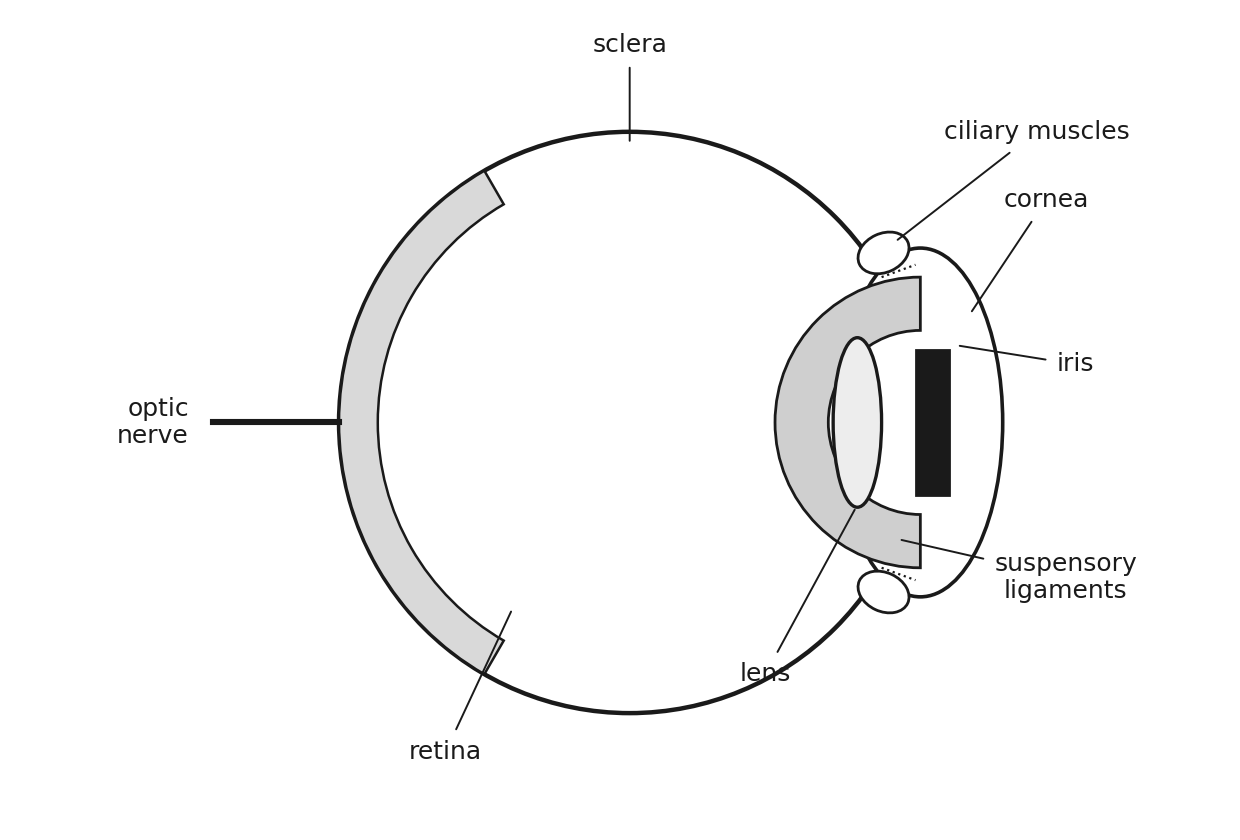
    ภาคตัดขวางของตา: สเคลรา, แครเนีย, ไอริส, เลนส์, กล้ามเนื้อไซลารี, เส้นใยรองรับ, เรตินา และเส้นประสาทตา

    ระบุและอธิบาย: เรตินา (เซลล์ตัวรับไวต่อความเข้มแสงและสี), เส้นประสาทตา (ส่งกระแสจากเรตินาไปยังสมอง), สเคลรา (ชั้นนอกที่แข็งแรง), แครเนีย (หักเหแสง), ไอริส (กล้ามเนื้อสีควบคุมขนาดรูม่านตา — การปรับตัวแบบสะท้อนกลับต่อกึ่งมืด/สว่าง), กล้ามเนื้อไซลารี และ เส้นใยรองรับ (ควบคุมรูปร่างเลนส์)

    การปรับโฟกัส — เปลี่ยนรูปร่างเลนส์เพื่อโฟกัส:

    วัตถุใกล้ วัตถุไกล
    กล้ามเนื้อไซลารี หดตัว ผ่อนคลาย
    เส้นใยรองรับ หลวม ดึงตึง
    เลนส์ หนาขึ้น, หักเหแรง บางลง, หักเหเล็กน้อย

    ความผิดปกติ: สายตาสั้น (มองระยะไกลไม่ชัด — ภาพตกอยู่หน้าจอประสาทตา; แก้ไขด้วยเลนส์เว้า), สายตายาว (มองใกล้ไม่ชัด — ภาพตกอยู่หลังจอประสาทตา; เลนส์นูน). การรักษา: แว่นสายตา, แว่นสัมผัสตา, การผ่าตัดเลเซอร์เพื่อปรับรูปร่างกระจกตา, การเปลี่ยนเลนส์ตา.

    การควบคุมอุณหภูมิร่างกาย

    ศูนย์ควบคุมอุณหภูมิ (thermoregulatory centre) ในสมองมีตัวรับที่ตอบสนองต่ออุณหภูมิเลือด; ตัวรับในผิวหนังส่งสัญญาณกระตุ้นไปยังศูนย์นี้

    • ร้อนเกินไป: หลอดเลือดขยายตัว (vasodilation) — เลือดไหลเข้าผิวมากขึ้นเพื่อถ่ายเทความร้อนสู่สิ่งแวดล้อม; การผลิตเหงื่อ → เหงื่อระเหยจะพาความร้อนออกไป
    • เย็นเกินไป: หลอดเลือดหดตัว (vasoconstriction); การหยุดผลัดเหงื่อ; กล้ามเนื้อลายกระตุก (shivering — กระบวนการหายใจช่วยถ่ายเทความร้อนให้เลือดอุ่นขึ้น)

    (HT) อธิบายในบริบทว่ากลไกแต่ละอย่างลดหรือเพิ่มอุณหภูมิกลับสู่ระดับที่เหมาะสมได้อย่างไร

    คำศัพท์ ฝึกฝน
    English ไทย
    vasodilation/ˌvæsədɪˈleɪʃn/ การขยายตัวของหลอดเลือด
    vasoconstriction/ˌvæsəkənˈstrɪkʃn/ การหดตัวของหลอดเลือด
    5.3

    การประสานงานโดยฮอร์โมนในมนุษย์ (4.5.3)

    หลักสูตร

    การประสานงานด้วยฮอร์โมนในมนุษย์ (AQA 8461 statements 4.5.3)

    1. อธิบายระบบต่อมไร้ท่อ: ต่อมน้ำลาย ฮอร์โมน อวัยวะเป้าหมาย และต่อมทั้งหกชนิด
    2. อธิบายการควบคุมระดับน้ำตาลในเลือดด้วยอินซูลิน (HT) กลูคาگون และฟีดแบคเชิงลบ เปรียบเทียบเบาหวานประเภท 1 และประเภท 2
    3. (Bio) อธิบายสมดุลน้ำและไนโตรเจน: ไต การกรอง และการดูดซึมกลับ selectively (HT) ADH และการเปรียบเทียบระหว่าง hemodialysis กับ transplant
    4. (HT) อธิบายการทำงานร่วมกันของ FSH LH อีสเทรเจน และโปรเจสเตอร์ในรอบเดือน วิธีการคุมกำเนิด และ IVF
    5. (HT) อธิบาย adrenaline และ thyroxine พร้อมกลไก negative feedback

    แหล่งที่มา: หลักสูตร Cambridge International

    ระบบต่อมไร้ท่อ (endocrine system) คือกลุ่มต่อมที่หลั่ง hormones เข้ากระแสเลือดโดยตรง; เลือดนำฮอร์โมนไปยัง อวัยวะเป้าหมาย ช้ากว่าระบบประสาทแต่มีผลยาวนานกว่า ระบุตำแหน่งบนแผนภาพร่างกาย: ต่อมใต้สมอง (เป็น 'ต่อมหลัก' ของสมอง), ตับอ่อน, ต่อมไทรอยด์, ต่อม suprarenal, รังไข่, ลูกอัณฑะ

    น้ำตาลในเลือด ถูกตรวจสอบและควบคุมโดย ตับอ่อน:

    • สูงเกินไป → ตับอ่อนหลั่ง อินซูลิน → น้ำตาลเคลื่อนที่จากเลือดเข้าสู่เซลล์; ในเซลล์ตับและกล้ามเนื้อ น้ำตาลส่วนเกินจะถูกเปลี่ยนเป็น ไกลโคเจน เพื่อเก็บไว้
    • (HT) ต่ำเกินไป → ตับอ่อนหลั่ง กลูคาโกน → ไกลโคเจนถูกเปลี่ยนกลับเป็นน้ำตาล ปล่อยเข้าสู่กระแสเลือด อินซูลิน–กลูคาโกนเป็นวงจร negative feedback

    เบาหวาน: Type 1 — ตับอ่อนไม่สามารถสร้างอินซูลินได้เพียงพอ; น้ำตาลในเลือดสูงโดยไม่ควบคุม; รักษาด้วยการฉีด อินซูลิน Type 2 — เซลล์ในร่างกายไม่ตอบสนองต่ออินซูลินอีกต่อไป; รักษาด้วย อาหารควบคุมคาร์โบไฮเดรตและการออกกำลังกาย; โรคอ้วนเป็นปัจจัยเสี่ยง วิเคราะห์กราฟน้ำตาลในเลือดในกรณีปกติและในผู้ป่วยเบาหวาน

    สมดุลน้ำและไนโตรเจน —ชีววิทยาเท่านั้น

    น้ำออกทาง ปอด (การหายใจออก) และ ผิวหนัง (เหงื่อ ซึ่งประกอบด้วยไอออนและยูเรีย) — ไม่มีกลไกควบคุม这两个途径 Excess water, ions and urea are removed by the kidneys in urine. Cells that lose or gain too much water by osmosis do not work efficiently. (HT) Excess amino acids from the diet are deaminated in the liver: ammonia (toxic) → urea for safe excretion.

    ไต กรอง เลือดและ ดูดซึมกลับ selectively กลูโคส ไอออนบางชนิด และน้ำ (HT) หากเลือดมีความเข้มข้นสูงเกินไป ต่อมใต้สมอง จะปล่อย ADH ซึ่งทำให้ท่อนไตมี permeability มากขึ้น sehingga มีการดูดซึมน้ำมากขึ้น — เป็น negative feedback อีกครั้ง

    ภาวะไตวาย: รักษาโดยการ ปลูกถ่าย หรือ ฟอกเลือด — เลือดไหลผ่านเยื่อบางๆ ในของเหลวฟอกเลือดที่มีค่าความเข้มข้นของน้ำ/ไอออนที่เหมาะสม เพื่อให้ของเสียแพร่ออกleanup mientras glucosa y sustancias útiles se retienen; evaluar dispositivo mecánico vs trasplante.

    ฮอร์โมนในการสืบพันธุ์ของมนุษย์

    Estradiol (รังไข่) — ฮอร์โมนหญิงหลัก; ในช่วงวัยรุ่นไข่เจริญสมบูรณ์และปล่อยออกมาประมาณทุก 28 วัน (ovulation) Testosterone (ลูกอัณฑะ) — กระตุ้นการสร้างสเปิร์ม

    (HT) วัฏจักรประจำเดือน:

    ฮอร์โมน แหล่งที่มา บทบาท
    FSH ต่อมหมวกไตส่วนหน้า กระตุ้นให้ไข่สุกในรังไข่ (ในถุงไข่)
    LH ต่อมหมวกไตส่วนหน้า กระตุ้นการปล่อยไข่ (การตกไข่)
    เอสโตรเจน รังไข่ (ถุงไข่) บำรุงและสร้างผนังมดลูก; กระตุ้นการเพิ่มขึ้นของ LH
    โปรเจสเตอโรน รังไข่ (.ToDouble ลูเตียม) บำรุงผนังมดลูก; ยับยั้ง FSH และ LH
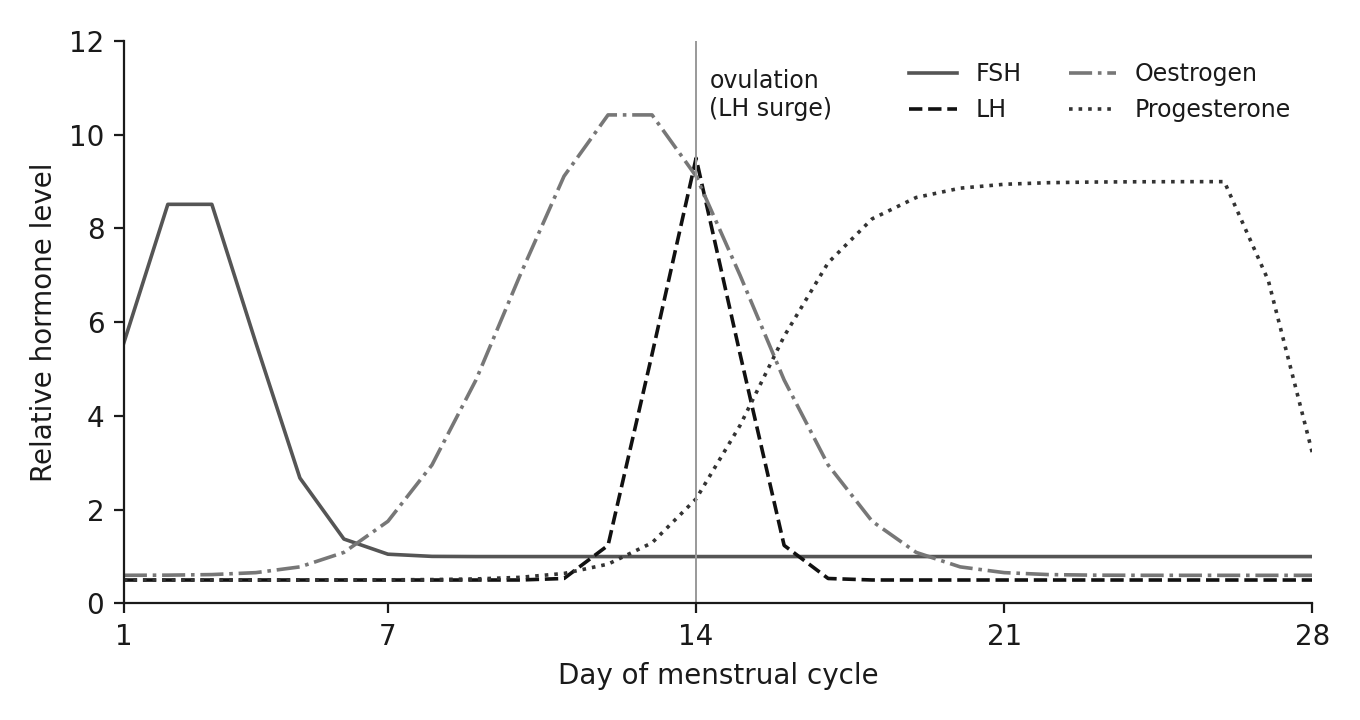
    ระดับฮอร์โมนตลอด 28 วันของรอบเดือน: FSH ในต้นรอบ, เอสโตรเจนเพิ่มขึ้น, การพุ่งสูงขึ้นของ LH ในวันที่ 14 และการตกไข่, จากนั้นโปรเจสเตอโรน.

    (HT) วิเคราะห์กราฟระดับฮอร์โมนตลอดรอบเดือน: FSH เริ่มการเจริญเติบโตของถุงไข่ → เอสโตรเจนเพิ่มขึ้น → การพุ่งสูงขึ้นของ LH กระตุ้นการตกไข่ (ประมาณวันที่ 14) → โปรเจสเตอโรนรักษาความหนาของผนังมดลูกจนลดลงและเริ่มรอบใหม่

    การคุมกำเนิด — ประเมินวิธีการใช้ฮอร์โมนและไม่ใช้ฮอร์โมน: ยาคุมกำเนิด (ยับยั้ง FSH sehingga ไข่ไม่สุก),ฉีด/ฝัง/แปะโปรเจสเตอโรนแบบปลดปล่อยช้า, วิธีกันทางกายภาพ (ยางอนามัย, อวัยวะป้องกัน), อุปกรณ์ภายในมดลูก, สารฆ่าอสุจิ, งด性行为เมื่ออาจมีไข่ในท่อนำไข่, การทำหมัน

    ภาวะมีบุตรยาก (HT): 'ยากระตุ้นการเจริญพันธุ์' (FSH + LH) กระตุ้นให้ไข่สุก. IVF: FSH และ LH กระตุ้นให้ไข่หลายฟอง → เก็บไข่และปฏิสนธิกับอสุจิในห้องปฏิบัติการ → эмบริโอ เติบโตเป็นกลุ่มเซลล์เล็กๆ →ถ่ายโอนหนึ่งหรือสองตัวเข้าไปในมดลูก. ประเมิน: ความเครียดทางอารมณ์/ร่างกาย, อัตราความสำเร็จต่ำ, ความเสี่ยงต่อการมีครรภ์หลายคน.

    กลไกปฏิกิริยาลบ (HT): อะดรีนาลีน (ต่อมหมวกไต, ความกลัว/ความเครียด) เพิ่มอัตราการเต้นของหัวใจและการส่งออกซิเจนและกลูโคสไปยังสมองและกล้ามเนื้อ — 'สู้หรือหนี'. ไทรอกซίνη (ต่อมไทรอยด์) กระตุ้น อัตราการเผาผลาญพื้นฐาน และสำคัญต่อการเจริญเติบโตและพัฒนาการ; ระดับของมันถูกควบคุมโดยกลไกปฏิกิริยาลบ. อ่านแผนภูมิกลไกปฏิกิริยาลบอย่างง่ายได้

    คำศัพท์ ฝึกฝน
    English ไทย
    hormone/ˈhɔːməʊn/ ฮอร์โมน
    insulin/ˈɪnsjuːlɪn/ อินซูลิน
    glycogen/ˈɡlaɪkədʒn/ ไกลโคเจน
    glucagon/ˈɡluːkæɡən/ กลูคาโกน
    negative feedback/ˈneɡətɪv ˈfiːdbæk/ ระบบปฏิกิริยาตอบกลับเชิงลบ
    urea/juːˈrɪə/ ยูเรีย
    ADH/ˌeɪ diː ˈeɪtʃ/ ฮอร์โมน ADH
    oestrogen/ˈiːstrədʒn/ เอสโตรเจน
    ovulation/ˌɒvjʊˈleɪʃn/ การตกไข่
    testosterone/teˈstɒstərəʊn/ เทสโทสเตอโรน
    auxin/ˈɔːksɪn/ ออกซิน
    phototropism/ˌfəʊtəʊˈtrəʊpɪzəm/ การเจริญเติบโตตามแสง
    gravitropism/ˈɡrævɪtrəʊpɪzəm/ การตอบสนองต่อแรงโน้มถ่วง
    sweat/swet/ เหงื่อ
    5.4

    ฮอร์โมนพืช — ชีววิทยาเท่านั้น (4.5.4)

    หลักสูตร

    ฮอร์โมนพืช — เนื้อหาชีววิทยาเท่านั้น (AQA 8461 statements 4.5.4, RP8)

    1. อธิบาย phototropism และ gravitropism ผ่านการกระจาย auxin ที่ไม่สม่ำเสมอในลำต้นและราก
    2. อธิบาย RP8: ผลของแสงหรือแรงโน้มถ่วงต่อต้นกล้าที่งอกใหม่ พร้อมการวัดความยาวและภาพวาดที่มีฉลาก
    3. (HT) อธิบายการใช้ auxins gibberellins และ ethene ในเกษตรกรรม เกษตรกรรม และอุตสาหกรรมอาหาร

    แหล่งที่มา: หลักสูตร Cambridge International

    พืชผลิตฮอร์โมนเพื่อประสานงานและควบคุมการเจริญเติบโตและการตอบสนองต่อแสง (การเคลื่อนที่เข้าหาแสง) และแรงโน้มถ่วง (การเคลื่อนที่ตามแรงโน้มถ่วง). การกระจายตัวของออกซินที่ไม่เท่ากัน ทำให้อัตราการเจริญเติบโตไม่เท่ากันในรากและลำต้น — ลำต้นงอเข้าหาแสง; รากเจริญเติบโตลงด้านล่าง

    RP8: ตรวจสอบผลกระทบของแสงหรือแรงโน้มถ่วงต่อดอกไม้ที่กำลังงอกใหม่ — บันทึกเป็นค่าความยาวและการวาดภาพชีววิทยาที่มีฉลากอย่างละเอียด

    (HT) จิบเบอเรลลิน เริ่มต้นการงอกของเมล็ด; เอทิลีน ควบคุมการแบ่งเซลล์และการสุกของผลไม้

    (HT) การใช้งาน: ออกซินเป็น สารกำจัดวัชพืช, ผงเร่งราก และส่งเสริมการเจริญเติบโตใน การเพาะเลี้ยงเนื้อเยื่อ; เอทิลีนควบคุม การสุก ระหว่างการจัดเก็บและการขนส่ง; จิบเบอเรลลินเพื่อ หยุดการพักตัวของเมล็ด, ส่งเสริมการออกดอก และ เพิ่มขนาดผลไม้. พิจารณาผลกระทบของสารกำจัดวัชพืชต่อความหลากหลายทางชีวภาพ

    5.4

    รายการตรวจสอบก่อนจะจบหัวข้อนี้

    • นิยาม homeostasis; receptor–coordination centre–effector บอกตามลำดับ; Reflex arc วาดด้วย synapse
    • ส่วนต่างๆ ของตาและการปรับโฟกัสตารางเย็น; Myopia vs hyperopia พร้อมวิธีแก้ไข
    • อุณหภูมิ: การขยายหลอดเลือด/เหงื่อออก vs การหดตัวของหลอดเลือด/การสั่น寒, ในบริบท (HT)
    • อินซูลินและ (HT) กลูคาگونพร้อมกลไกปฏิกิริยาลบ; การรักษา Type 1 vs Type 2
    • (Bio) การกรองของไต + การดูดซึมกลับอย่างเลือกสรร; (HT) ADH; การฟอกเลือด vs การปลูกถ่าย
    • (HT) FSH–เอสโตรเจน–LH–โปรเจสเตอโรน การโต้ตอบและกราฟ; รายการการคุมกำเนิด; ขั้นตอน IVF; อะดรีนาลีนและไทรอกซίνη
    • (Bio) ทropicisms กับออกซิน; RP8; (HT) การใช้ฮอร์โมนทั้งสาม
    คำศัพท์ ฝึกฝน
    English ไทย
    synapse/ˈsɪnæps/ ซินาปส์
    retina/ˈretɪnə/ จอประสาทตา
    accommodation/əˌkɒməˈdeɪʃn/ การปรับโฟกัสของสายตา
    myopia/maɪˈəʊpɪə/ ตาสั้น
    hyperopia/ˌhaɪpəˈrəʊpɪə/ ตามองไกล
  • 6

    การสืบทอด ความหลากหลาย และการวิวัฒนาการ

    6.1

    Inheritance, variation and evolution: passing it on

    • Sexual reproduction mixes genetic information; asexual reproduction clones it. Meiosis halves chromosomes for gametes; fertilisation restores them.
    • DNA → genes → alleles → phenotype: the Punnett square turns this into probabilities.
    • Natural selection changes inherited characteristics across generations. Selective breeding, genetic engineering and cloning (biology only) use different mechanisms. Fossils and resistant bacteria provide evolutionary evidence; classification uses evidence of relationships.
    6.1

    การสืบพันธุ์, DNA และจีโนม (4.6.1.1–4.6.1.5)

    หลักสูตร

    การสืบพันธุ์ DNA และจีโนม (AQA 8461 statements 4.6.1.1-4.6.1.5)

    1. เปรียบเทียบการสืบพันธุ์แบบอาศัยเพศและไม่อาศัยเพศ พร้อมระบุชื่อสิ่งมีชีวิตที่ใช้ทั้งสองวิธี
    2. อธิบายว่ากระบวนการแบ่งเซลล์แบบไมโอซิสลดจำนวนโครโมโซมลงครึ่งหนึ่ง以及如何การปฏิสนธิคืนจำนวนโครโมโซมให้กลับเป็นปกติ และติดตามการพัฒนาของตัวอ่อน
    3. อธิบายเกี่ยวกับดีเอ็นเอ ยีน และจีโนม รวมถึงความสำคัญของจีโนมมนุษย์
    4. (ชีววิทยา) อธิบายโครงสร้างนิวคลีโอไทด์ของดีเอ็นเอและรหัสเบส; (ชีววิทยาขั้นสูง) การสังเคราะห์โปรตีนและผลกระทบจากการกลายพันธุ์

    แหล่งที่มา: หลักสูตร Cambridge International

    Sexual reproduction — fusion of male and female gametes (sperm + egg in animals; pollen + egg in flowering plants). Meiosis forms gametes; mixing of genetic information gives variety in offspring. การสืบพันธุ์แบบไม่อาศัยเพศ — one parent, no fusion, mitosis only: genetically identical offspring (clones 克隆).

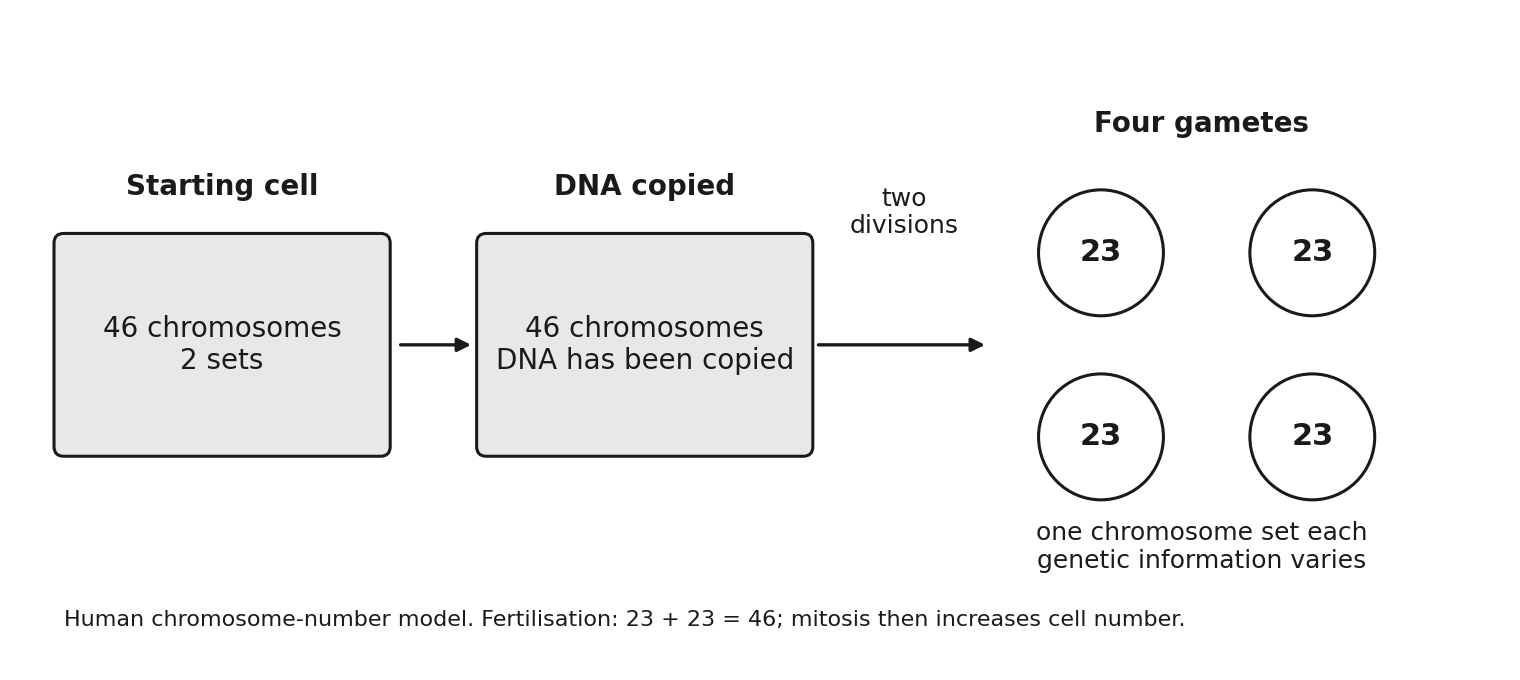
    Meiosis: one parent cell's chromosomes are copied, then two divisions give four genetically different gametes, each with a single set of chromosomes.

    Meiosis 减数分裂: in reproductive organs, copies of the genetic information are made first, then the cell divides สองครั้ง to form four gametes, each with a single set of chromosomes — all genetically different. Fertilisation restores the normal number; the new cell divides by mitosis and cells differentiate as the embryo develops.

    (Bio) Sexual vs asexual: sexual gives variation — a survival advantage if the environment changes, and the variation selective breeding uses; asexual needs no mate (time and energy efficient), is faster, and produces many identical offspring when conditions are favourable. Malarial parasites: asexual in the human host, sexual in the mosquito; many fungi: asexual spores + sexual; strawberry plants: sexual seeds + asexual runners; daffodils: bulb division.

    DNA and the genome: DNA is a polymer of two strands forming a double helix, held in the nucleus as chromosomes. A gene 基因 is a small section of DNA that codes for a sequence of amino acids → a specific protein. The genome 基因组 is the entire genetic material of the organism. Importance of the human genome: searching for genes linked to disease; understanding and treating inherited disorders; tracing human migration patterns from the past.

    (Bio) DNA structure: a polymer of four different nucleotides 核苷酸 — common sugar + phosphate group + one of four bases — A 腺嘌呤, C 胞嘧啶, G 鸟嘌呤, T 胸腺嘧啶; alternating sugar–phosphate backbone; a sequence of three bases codes for one amino acid, and the base order controls the amino-acid order of the protein.

    (HT Bio) Protein synthesis: on ribosomes, from a template; carrier molecules bring specific amino acids in the correct order; the chain folds into a unique shape that lets the protein work as an enzyme, hormone or structural protein (e.g. collagen). In complementary strands C pairs with G, T with A. Mutations change the base sequence: a mutation may leave the protein unchanged, alter it slightly, or change its shape so an enzyme no longer fits its substrate or a structural protein loses strength. Variants in non-coding DNA can switch genes on and off, changing how genes are expressed.

    Apply the reproduction and DNA knowledge

    Try first — strawberries. Seeds form after fertilisation; runners form without gamete fusion. Identify the two routes and explain which may help a population survive a new disease.

    Worked reasoning. Seeds result from sexual reproduction: meiosis makes gametes and fertilisation mixes genetic information. Variation means some offspring may resist the disease. Runners form by mitosis from one parent: clones, apart from mutation. Asexual reproduction needs no mate and is fast in favourable conditions; neither route guarantees survival.

    Try first — chromosome number. A human cell has 46 chromosomes before meiosis. Predict the number of gametes, their chromosome number, the number after fertilisation and the division growing the embryo.

    Worked reasoning. DNA is copied before two divisions form four gametes, each with 23 chromosomes (one set). DNA copying does not change the count to 92 chromosomes at that point. Fertilisation combines 23 + 23 = 46; mitosis increases embryo cell number and cells differentiate. The diagram models chromosome numbers, not the stages of meiosis.

    Try first — scale and code. Distinguish a gene, chromosome and genome. (HT Bio) Write the bases complementary to A C G T and explain whether a mutation must stop an enzyme working.

    Worked reasoning. A gene is a DNA section coding an amino-acid sequence for a protein; a chromosome contains a long DNA molecule and many genes; a genome is all the organism’s genetic material. Complementary bases are T G C A. At ribosomes, a template and carrier molecules determine the amino-acid order; the chain folds. A mutation may leave the protein unchanged or change its shape and function. Non-coding variants can change whether genes are expressed.

    คำศัพท์ ฝึกฝน
    English ไทย
    meiosis/meɪˈəʊsɪs/ การแบ่งเซลล์แบบลดจำนวน
    clone/kləʊn/ คลอน
    gene/dʒiːn/ ยีน
    genome/ˈdʒiːnəʊm/ จีโนม
    nucleotide/ˈnjuːklɪɒtaɪd/ นิวคลีโอไทด์
    6.2

    การสืบทอดทางพันธุกรรม ภาวะผิดปกติ และการกำหนดเพศ (4.6.1.6–4.6.1.8)

    หลักสูตร

    การสืบทอดทางพันธุกรรม ภาวะผิดปกติ และการกำหนดเพศ (AQA 8461 ข้อสอบ 4.6.1.6-4.6.1.8)

    1. นิยามคำศัพท์: กามิโต, โครโมโซม, ยีน, อัลลีล, ลักษณะเด่น, ลักษณะด้อย, โฮโมไซกัส, เฮเทอโรไซกัส, จีโนไทป์ และฟีโนไทป์
    2. เติมตารางเพนเนตต์และวาดแผนภูมิต้นไม้ครอบครัว พร้อมคำนวณอัตราส่วนและความน่าจะเป็น
    3. อธิบายการสืบทอดลักษณะนิ้วมือเกินและโรค囊性纤维化 (Cystic Fibrosis) serta ประเมินประเด็นจริยธรรมของการคัดกรองตัวอ่อน
    4. คำนวณการกำหนดเพศด้วยแบบจำลอง XX/XY รวมถึงอัตราส่วนที่คาดหวัง

    แหล่งที่มา: หลักสูตร Cambridge International

    Learn the terms: gamete 配子 (sex cell), chromosome 染色体 (DNA structure), gene (section coding a protein), allele 等位基因 (a form of a gene), หลัก (dominant) 显性 (expressed with one copy), recessive 隐性 (expressed only with two), homozygous 纯合 (two same alleles), heterozygous 杂合 (two different), genotype 基因型 (alleles present), phenotype 表现型 (characteristics expressed).

    Single-gene examples: fur colour in mice; red-green colour blindness. Most characteristics result from multiple genes interacting.

    Punnett squares and crosses: complete a Punnett square, extract ratios (e.g. 3:1, 1:1) and probabilities from genetic crosses and family trees. (HT) Construct a cross from parent genotypes and predict outcomes with probability.

    Inherited disorders: polydactyly 多指症 (extra fingers or toes) — หลัก (dominant) allele; cystic fibrosis 囊性纤维化 (a disorder of cell membranes) — recessive allele. Make informed judgements about the economic, social and ethical issues of embryo screening.

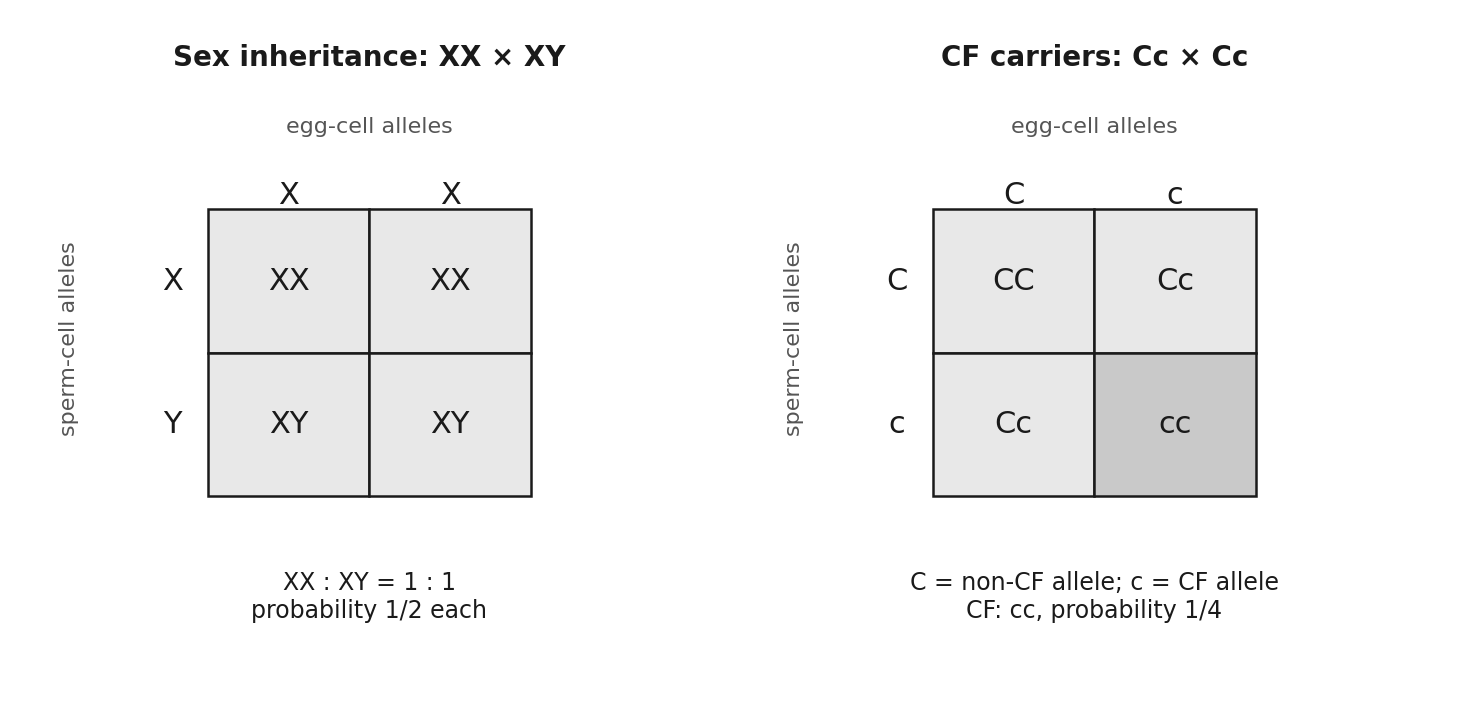
    Left: the XX × XY sex cross giving a 1:1 ratio. Right: two cystic-fibrosis carriers (Cc × Cc), with a 1/4 probability of cc.

    Sex determination: body cells have 23 pairs of chromosomes; 22 pairs control characteristics, one pair carries the sex genes — female XX, male XY. A sex cross (X×X, X×Y) gives a 1:1 ratio, 50 % chance each.

    From terms to family inference and probabilities

    Try first — terminology. D causes dominant polydactyly; d does not. Classify Dd and predict its phenotype and gamete alleles.

    Worked reasoning. Dd is heterozygous (two different alleles); DD and dd are homozygous. Genotype means the alleles present; phenotype means the characteristics expressed. Dd is affected because one D is expressed. “Dominant” does not mean stronger or more common. Gametes contain D or d, not Dd.

    Guided family inference — adapted from AQA June 2024 Paper 2H Q06.2. An affected father and unaffected mother have an unaffected son. Deduce the father’s genotype before reading the answer.

    Worked reasoning. The mother and son are dd. The father passed d to his son, but must also carry D because he is affected. Therefore he is Dd. The child’s genotype supplies evidence that the father’s phenotype alone cannot provide.

    Construct a cross (HT). Two unaffected CF carriers are Cc and Cc. Each produces gametes C or c. Combining them gives CC, Cc, Cc, cc: probability of CF = 1/4; probability of being a carrier = 1/2. Carriers do not have CF in this recessive model. The separate XX × XY cross gives XX, XX, XY, XY: probability 1/2 each in the GCSE sex-determination model.

    Exam transfer — adapted from AQA June 2024 Paper 2H Q06.3. An affected mother Dd and unaffected father dd have three unaffected sons. Construct a cross and predict whether the fourth child will be affected.

    Worked reasoning. Egg alleles D/d combine with sperm alleles d/d to give Dd, dd, Dd, dd. Two of four equally likely combinations are affected: probability = 2/4 = 1/2. Earlier births do not change this probability. The four boxes describe possible combinations, not four promised children.

    Evaluate — teacher-written screening scenario. Screening can identify embryos with the CF genotype, but treatment is costly and some embryos may not be used. A biological benefit is identifying cc embryos to inform the couple’s decisions. Cost can limit access and creates funding choices. Some families object to selecting or not using embryos; others prioritise reducing inherited disease. An informed judgement uses the stated evidence and recognises different values.

    คำศัพท์ ฝึกฝน
    English ไทย
    gamete/ˈɡæmiːt/ เซลล์สืบพันธุ์
    chromosome/ˈkrəʊməsəʊm/ โครโมโซม
    allele/əˈliːl/ อัลลีล
    dominant/ˈdɒmɪnənt/ _links_显性_
    recessive/rɪˈsesɪv/ links_隐性_
    homozygous/ˌhɒməˈzɪɡəs/ -links_纯合_
    heterozygous/ˌhetrəˈzɪɡəs/ เฮเทอโรไซกัส
    genotype/ˈdʒenətaɪp/ จีโนไทป์
    phenotype/ˈfenətaɪp/ ฟีโนไทป์
    polydactyly/ˌpɒlɪˈdæktili/ polydactyly (นิ้วเกิน)
    cystic fibrosis/ˈsɪstɪk fɪˈbrəʊsɪs/ cystic fibrosis (โรค囊性纤维化)
    6.3

    ความหลากหลาย การเพาะพันธุ์โดยคัดเลือก การดัดแปลงพันธุกรรม และการสร้างสิ่งมีชีวิตซ้ำ (4.6.2)

    หลักสูตร

    ความแปรปรวน, การเพาะพันธุ์โดยเลือกสรร, วิศวกรรมทางพันธุกรรม และการโคลนนิ่ง (AQA 8461 ข้อสอบ 4.6.2)

    1. อธิบายความสัมพันธ์ระหว่างจีโนมกับสิ่งแวดล้อม สาเหตุสามประการของความแปรปรวน และบทบาทของการกลายพันธุ์
    2. อธิบายวิวัฒนาการด้วยการคัดเลือกตามธรรมชาติและการเกิดชนิดใหม่
    3. อธิบายการเพาะพันธุ์โดยเลือกสรร การใช้ประโยชน์ และความเสี่ยงจากการผสมพันธุ์ในตระกูลเดียวกัน
    4. อธิบายวิศวกรรมทางพันธุกรรม (รวมขั้นตอนหลัก ผลดี ความเสี่ยง และความขัดแย้ง สำหรับ A-Level Biology)
    5. (ชีววิทยา) อธิบายการเพาะเลี้ยงเนื้อเยื่อ การตัดตอน การ移植ตัวอ่อน และการโคลนนิ่งเซลล์วัยผู้ใหญ่

    แหล่งที่มา: หลักสูตร Cambridge International

    Variation 变异 — differences between individuals in a population — comes from genes inherited (genetic), conditions of development (environmental), or a combination. There is usually extensive genetic variation within a population; all genetic variants arise from mutations — most have no effect on the phenotype, some influence it, very few determine it. A rare mutation giving a new phenotype suited to an environmental change can change the species rapidly.

    วิวัฒนาการ: a change in the inherited characteristics of a population over time, through natural selection 自然选择, which may result in a new species. All species evolved from simple life forms that first developed over three billion years ago. Natural selection: variation → the phenotype best suited to the environment survives and breeds → those characteristics are passed on. If two populations become so different they cannot interbreed to produce fertile offspring, two new species have formed.

    การเพาะพันธุ์แบบคัดเลือก (artificial selection): choose parents with the desired characteristic from a mixed population → breed → choose the best offspring → repeat over many generations. Uses: disease resistance in food crops; animals with more meat or milk; dogs with gentle natures; large or unusual flowers. Risk: inbreeding 近交 — breeds prone to disease or inherited defects.

    Genetic engineering: modifying the genome by introducing a gene from another organism to give a desired characteristic — GM crops resistant to insect attack or herbicides (increased yields); bacteria engineered to make human insulin. (HT) Steps: enzymes isolate the required gene → inserted into a vector (bacterial plasmid or virus) → vector inserts the gene into the required cells → transferred early in development so the organism develops with the desired characteristic. Weigh benefits (medicine, agriculture) against risks (wild-flower and insect populations, unexplored health effects) and ethical objections.

    (Bio) Cloning: tissue culture — small groups of plant cells grown into identical new plants (preserving rare species; nurseries); cuttings — simple, older gardeners' method; embryo transplants — splitting unspecialised cells of a developing animal embryo into identical embryos placed in host mothers; adult cell cloning — nucleus removed from an unfertilised egg cell → nucleus from an adult body cell inserted → electric shock makes it divide into an embryo → ball of cells placed in the womb.

    Apply variation, selection and biotechnology

    Start with variation — teacher-written seedling case. Seedlings differ in inherited disease resistance. Genetically identical plants grow to different heights under different light conditions. Identify genetic and environmental variation, then explain what may happen during a disease outbreak.

    Worked reasoning. Resistance alleles provide genetic variation; light conditions can cause environmental differences in height. Phenotype often depends on both. Resistant plants may survive the disease and reproduce more successfully, passing favourable alleles to offspring. Over generations, resistance alleles can become more common. Mutations change DNA; they do not occur because an organism needs a particular change.

    Exam transfer — adapted from AQA June 2024 Paper 2H Q01.2. Describe natural selection using insects that already vary in inherited insecticide resistance.

    Worked reasoning. The insecticide is a selection pressure: more susceptible insects die. Resistant survivors reproduce and pass resistance alleles to offspring. The population’s inherited characteristics change across generations; an individual does not evolve just by being sprayed. Speciation requires populations to become unable to interbreed to produce fertile offspring.

    Compare mechanisms — teacher-written crop case. A grower wants inherited disease resistance without transferring a gene. Select resistant parents from a mixed population, breed them, select resistant offspring and repeat over many generations. This is selective breeding, not natural selection or genetic engineering. Repeatedly breeding close relatives risks inherited defects and reduced genetic variation.

    Linked exam explanation — adapted from AQA June 2024 Paper 2H Q09.1. GM soya plants resist glyphosate. Explain how spraying the field can increase yield.

    Worked reasoning. Glyphosate kills weeds but the resistant crop survives. Less competition gives the crop more light, water and mineral ions. More light and water can support photosynthesis, producing glucose for respiration and building biomass. Nitrate ions support amino-acid and protein synthesis. Link resources to growth and harvested yield; “GM means higher yield” omits the mechanism. These are authored explanation points checked against the scheme, not an official model or a guaranteed score.

    HT — follow a gene. Enzymes isolate a required gene (for example, human insulin). Insert it into a vector such as a bacterial plasmid; use the vector to introduce it into the required cells. The modified cells express the gene and produce the substance. For a developing animal or plant, introduce the gene early so the organism develops with the desired characteristic.

    Evaluate — teacher-written GM scenario. An insect-resistant crop suffers less target-pest damage, but a study reports fewer nearby non-target insects without establishing why. Reduced damage may improve harvest. The insect decline raises a food-web concern; compare modified and unmodified fields while accounting for habitat and pesticide use. Association alone does not prove the inserted gene caused the decline. Judge the particular modification and evidence.

    Biology — choose and order cloning methods. A nursery can use tissue culture to grow plants from small groups of cells, or cuttings from a parent plant. Embryo transplants split cells before they specialise and place identical embryos into host mothers. Adult cell cloning removes an unfertilised egg’s nucleus, inserts an adult body-cell nucleus, stimulates division with an electric shock, and transfers the ball of cells to a womb. The adult body-cell donor supplies the nuclear genetic information. Environmental differences can still affect a clone’s phenotype.

    คำศัพท์ ฝึกฝน
    English ไทย
    variation/ˌveərɪˈeɪʃn/ ความแปรปรวน
    natural selection/ˈnætʃərəl sɪˈlekʃn/ การเลือกโดยธรรมชาติ
    inbreeding/ˈɪnbriːdɪŋ/ การผสมพันธุ์ในสายพันธุ์เดียวกัน
    adenine/ˈædəniːn/ adenine (腺嘌呤)
    cytosine/ˈsaɪtəsaɪn/ cytosine (胞嘧啶)
    guanine/ˈɡwɑːnaɪn/ guanine (鸟嘌呤)
    thymine/ˈθaɪmaɪn/ thymine (胸腺嘧啶)
    6.4

    Evolution, genetics and evidence (4.6.3, biology only)

    หลักสูตร

    วิวัฒนาการ พันธุศาสตร์ และหลักฐาน (AQA 8461 ข้อสอบ 4.6.3, ชีววิทยาเท่านั้น)

    1. อธิบายทฤษฎีของheardwin เหตุผลที่ยอมรับอย่างค่อยเป็นค่อยไป และทฤษฎีของLamarck
    2. อธิบายบทบาทของWallace และMendel以及พัฒนาการของพันธุศาสตร์
    3. อธิบายซากดึกดำบรรพ์และกระบวนการเกิด ทำไมบันทึกจึงไม่สมบูรณ์ สาเหตุการสูญพันธุ์ และต้นไม้วิวัฒนาการ
    4. อธิบายแบคทีเรียต้านทานยาปฏิชีวนะและวิธีการชะลอการดื้อยา

    แหล่งที่มา: หลักสูตร Cambridge International

    (Bio) Darwin's theory: wide variation within a species; individuals best suited to the environment survive to breed; the useful characteristics are passed on. Published in On the Origin of Species (1859). Accepted only gradually: it challenged the idea that God made all living things; insufficient evidence at publication; the mechanism of inheritance was unknown for another 50 years. Lamarck's rival theory — that changes acquired during an organism's lifetime are inherited — is now known to be wrong in almost all cases.

    (Bio) Wallace: independently proposed evolution by natural selection; joint 1858 publications with Darwin prompted Darwin to publish; best known for warning colouration and pioneering work on speciation — the steps by which new species arise.

    (Bio) Mendel and the growth of genetics: mid-19th-century breeding experiments showed each characteristic is inherited through 'units' passed unchanged to descendants; late 19th century — chromosomes observed in cell division; early 20th century — the units behave like chromosomes → genes on chromosomes; mid-20th century — DNA structure determined and gene function worked out. Mendel's work was unrecognised in his lifetime.

    (Bio) Evidence for evolution: genes show characteristics pass to offspring; fossils; antibiotic resistance in bacteria.

    (Bio) Fossils form when parts do not decay (a decay condition is absent), when parts are replaced by minerals as they decay, or as preserved traces (footprints, burrows, rootlet traces). Early soft-bodied life left few traces, mostly destroyed by geological activity — so science cannot be certain how life began. Extinction means no individuals of a species remain — causes include new diseases, new predators, competition, environmental change, catastrophic events. Evolutionary trees use current classification data and fossil data.

    (Bio) Resistant bacteria: mutations produce genetic variants; some are resistant to a particular antibiotic. Susceptible bacteria are killed, while resistant survivors reproduce quickly and pass on resistance genes. The resistant strain becomes more common and can spread (for example, MRSA). This population change is evidence for evolution. Resistance can make infection harder to treat; it does not mean every antibiotic is ineffective or that people have no immune defence. Reducing inappropriate prescribing and unnecessary agricultural antibiotic use reduces avoidable selection pressure. Developing new antibiotics takes time and resources.

    Try first — resistance explanation. A population contains susceptible and resistant variants before antibiotic exposure. Explain why resistant bacteria become more common, and correct “the antibiotic makes every bacterium mutate because it needs resistance”.

    Worked reasoning. Genetic variation already exists; mutations are not directed by need. Antibiotic exposure selects survivors. Resistant bacteria reproduce and pass resistance genes to offspring, increasing their share of the population. Selection and inheritance explain the change without claiming that every individual becomes resistant.

    Use historical and fossil evidence

    Explain the history (Biology). Darwin and Wallace independently proposed natural selection; their joint writings appeared in 1858 and Darwin published his book in 1859. Acceptance was gradual: the theory challenged prevailing creation beliefs, some scientists found the evidence insufficient, and inheritance mechanisms were unknown. Mendel’s plant breeding suggested inherited units. His work’s importance was recognised after his death; later chromosome behaviour, genes on chromosomes and DNA structure connected these units to physical mechanisms.

    Apply speciation — teacher-written case. A barrier separates a population into different habitats. Different selection pressures favour different variants; survivors reproduce and pass favourable alleles to offspring. Mutations supply genetic variants. Over many generations the populations may diverge. Separation alone does not prove a new species: inability to interbreed to produce fertile offspring is the stated species criterion.

    Interpret evidence — teacher-written fossil case. A footprint preserved in rock is a trace fossil; a shell replaced by minerals illustrates mineral replacement. Conditions that prevent decay can also preserve remains. Soft-bodied organisms may leave no trace, and geological activity destroys fossils. An incomplete record still supplies evidence of past organisms and change. A species missing from one site is not necessarily extinct: extinction means no living individuals remain anywhere.

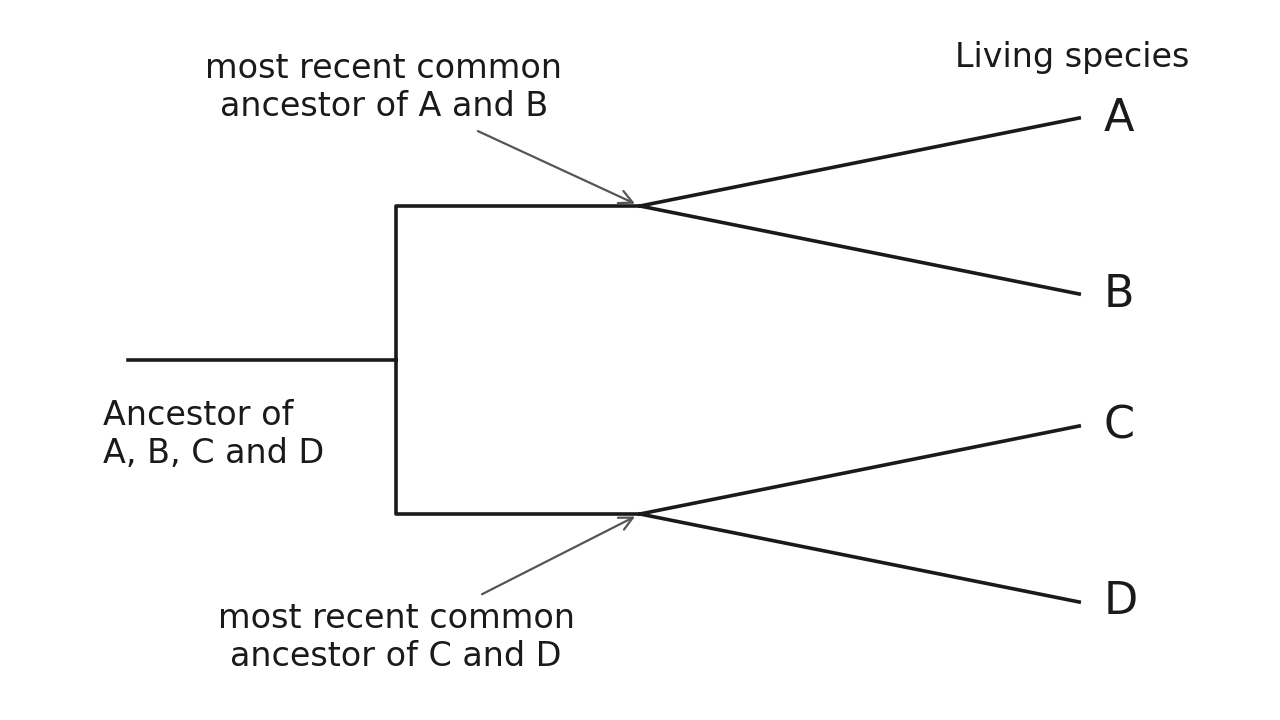
    Read the diagram. Trace A and B back to their first shared fork: this is their most recent common ancestor. A and C share the older ancestor of all four species, so A and B are more closely related. This is a schematic without a time scale; do not infer dates from branch lengths or relationships from vertical spacing. Trees use classification and fossil evidence.

    6.5

    การจัดหมวดหมู่สิ่งมีชีวิต (4.6.4)

    หลักสูตร

    การจัดหมวดหมู่สิ่งมีชีวิต (AQA 8461 ข้อสอบ 4.6.4)

    1. อธิบายระบบของลินเนอัสและการตั้งชื่อแบบทวินาม
    2. อธิบายระบบสามโดเมนของวูซและปัจจัยที่กระตุ้นให้เกิดขึ้น
    3. ตีความต้นไม้วิวัฒนาการโดยใช้ข้อมูลการจำแนกประเภทและซากดึกดำบรรพ์

    แหล่งที่มา: หลักสูตร Cambridge International

    Linnaeus: classification by structure and characteristics into kingdom, phylum, class, order, family, genus, species; organisms named by the binomial system (genus + species).

    Three-domain system (Carl Woese), from chemical-analysis evidence: archaea (a distinct domain of prokaryotes, including many organisms from extreme environments), bacteria (true bacteria), eukaryota (protists, fungi, plants, animals). Improvements in microscopes and biochemistry drove the new models.

    An evolutionary tree: branches from a common ancestor; identify the first shared fork when tracing two tips back to their most recent common ancestor; drawn lengths here are not a time scale.

    Evolutionary trees show how scientists believe organisms are related — interpret them using classification and fossil data.

    Apply classification. In Panthera leo และ Panthera tigris, Panthera identifies the shared genus; the second word distinguishes the species within it. The ranks are kingdom → phylum → class → order → family → genus → species. New microscopy and chemical-analysis evidence can reveal relationships that external appearance does not show, leading to revised classification. Woese’s three domains are archaea, bacteria and eukaryota.

    Final retrieval. Without the answers, explain (1) how 23-chromosome gametes restore 46 at fertilisation; (2) the next affected-child probability for Dd × dd after three unaffected births; (3) how antibiotic exposure changes a bacterial population. Check: two gamete sets combine; the cross gives a 1/2 probability independently at each birth; resistant survivors reproduce and pass on resistance genes. Then use the earlier worked examples to retrieve gene transfer, cloning order and common ancestry.

    6.5

    Checklist before you call this topic done

    • Meiosis (four gametes, halved number) vs mitosis; sexual vs asexual advantages with named organisms.
    • All ten genetics terms; Punnett squares with ratios; polydactyly vs cystic fibrosis; XX/XY cross 1:1.
    • (Bio) DNA nucleotides and bases; (HT) protein synthesis and mutations.
    • Variation three sources; natural selection sequence; selective breeding steps and inbreeding risk; (HT) genetic engineering steps; (Bio) four cloning methods.
    • (Bio) Darwin/Wallace/Mendel history, fossil formation and why the record is incomplete, MRSA story, Linnaeus ranks and the three domains.
  • 7

    นิเวศวิทยา

    7.1

    Ecology: communities, cycles and human impacts

    • The Sun's energy passes through ecosystems; carbon and water cycle between the living and non-living world.
    • Communities compete and depend on each other; adaptations fit organisms to their conditions.
    • Human activity — waste, land use, deforestation, global warming — threatens biodiversity, and trophic-level biology (bio only) explains why food chains are short.
    7.1

    การปรับตัว ความสัมพันธ์ระหว่างกันและการแข่งขัน (4.7.1)

    หลักสูตร

    การปรับตัว ความสัมพันธ์ระหว่างสิ่งมีชีวิตและการแข่งขัน (AQA 8461 ข้อstatement 4.7.1)

    1. อธิบายระดับการจัดระเบียบในระบบนิเวศ และนิยามระบบนิเวศ ชุมชน สิ่งมีชีวิต และสิ่งไม่มีชีวิต
    2. เสนอปัจจัยที่พืชและสัตว์แข่งขันกัน และอธิบายความสัมพันธ์ระหว่างสิ่งมีชีวิต
    3. อธิบายว่าความเปลี่ยนแปลงของปัจจัยสิ่งไม่มีชีวิตและสิ่งมีชีวิตที่มีกำหนดมีผลต่อชุมชนอย่างไร
    4. อธิบายการปรับตัวเชิงโครงสร้าง พฤติกรรม และหน้าที่ รวมถึงสิ่งมีชีวิตในสภาวะแวดล้อมสุดขั้ว

    แหล่งที่มา: หลักสูตร Cambridge International

    An ecosystem 生态系统 is the interaction of a community of living organisms (biotic 生物因子) with the non-living (abiotic factor 非生物因子) parts of their environment. Levels of organisation: individual → population → community → ecosystem.

    Competition 竞争: plants compete for light, space, water and mineral ions; animals compete for food, mates and territory. Interdependence 相互依赖: each species depends on others for food, shelter, pollination, seed dispersal — remove one species and the whole community can be affected.

    Abiotic factors affecting a community: light intensity, temperature, moisture levels, soil pH and mineral content, wind intensity and direction, carbon dioxide levels (plants), oxygen levels (aquatic animals). Biotic factors : availability of food, new predators arriving, new pathogens, one species outcompeting another until numbers fall too low to breed. Explain the effect of a change in any of these from given data.

    การปรับตัว 适应性 — features that enable survival in normal conditions — are structural (shape/body), behavioural (actions) or functional (processes, e.g. camouflage chemistry, venom). Extremophiles 极端微生物 live in extreme environments — high temperature, pressure or salt — e.g. bacteria in deep-sea vents.

    คำศัพท์ ฝึกฝน
    English ไทย
    ecosystem/ˈiːkəʊsɪstəm/ ecosystem (生态系统)
    biotic factor/baɪˈɒtɪk ˈfæktə/ ปัจจัยมีชีวิตร
    abiotic factor/ˌæbɪˈɒtɪk ˈfæktə/ ปัจจัยไม่живая (non-living factor)
    competition/ˌkɒmpəˈtɪʃn/ competition (竞争)
    interdependence/ˌɪntədɪˈpendəns/ ความพึ่งพาอาศัยกัน
    adaptation/ˌædæpˈteɪʃn/ การปรับตัว
    extremophile/ekˈstreməfaɪl/ จุลินทรีย์ที่อาศัยอยู่ในสภาพแวดล้อมสุดขั้ว
    7.2

    องค์ประกอบของระบบนิเวศและวัฏจักรสาร (4.7.2, RP9/RP10)

    หลักสูตร

    การจัดระเบียบของระบบนิเวศและวัฏจักรวัสดุ (AQA 8461 ข้อstatement 4.7.2, RP9/RP10)

    1. ใช้คำศัพท์จากห่วงโซ่อาหารตั้งแต่ผู้ผลิตถึงผู้บริโภคอันดับสาม และตีความวัฏจักรนักล่า-เหยื่อ
    2. อธิบายการสุ่มตัวอย่างด้วยสายวัดและตารางสุ่มตามมาตรฐาน RP9 พร้อมหาค่าเฉลี่ย ค่านิยม และค่ามัธยฐาน
    3. อธิบายวัฏจักรคาร์บอนและน้ำ รวมถึงบทบาทของจุลินทรีย์
    4. (Bio) อธิบายว่าอุณหภูมิ น้ำ และออกซิเจนมีผลต่ออัตราการสลายตัวอย่างไร พร้อมเชื่อมโยงกับมาตรฐาน RP10 และก๊าซชีวภาพ

    แหล่งที่มา: หลักสูตร Cambridge International

    Photosynthetic organisms are the producers 生产者 of biomass for life on Earth. Food chains: producer (green plant/alga making glucose by photosynthesis) → primary consumers 初级消费者 → secondary consumers 次级消费者 → tertiary consumers 三级消费者. A predator-prey cycle: prey numbers rise first, the predator population follows with a delay, and both oscillate.

    Predators kill and eat prey; in a stable community their numbers rise and fall in cycles — interpret the classic predator–prey graph (prey rises first, predator follows).

    Sampling (RP9): transects and quadrats measure the distribution and abundance of species; calculate mean, mode, median of abundance; plot graphs with suitable scales.

    The carbon cycle: photosynthesis takes CO2 into plants, feeding passes carbon to animals, decay by decomposers returns it, with respiration and combustion releasing CO2.

    Carbon cycle: returns carbon from organisms to the atmosphere as carbon dioxide for photosynthesis — respiration (plants, animals, decomposers), decay, combustion. Water cycle: evaporation and precipitation provide fresh water before it drains to the sea. Microorganisms recycle materials — returning carbon to the atmosphere as CO₂ and mineral ions to the soil. The nitrogen cycle is NOT required.

    (Bio) Decomposition (RP10): temperature, water and oxygen affect the rate of decay. Gardeners and farmers provide optimum conditions for rapid decay 腐解 of waste into compost — a natural fertiliser. Anaerobic decay produces methane — biogas generators. RP10: effect of temperature on the rate of decay of fresh milk by measuring pH change.

    (HT Bio) Environmental change: temperature, water availability, atmospheric-gas composition — changes may be seasonal, geographic or human-caused — shift the distribution of species.

    คำศัพท์ ฝึกฝน
    English ไทย
    producer/prəˈdjuːsə/ ผู้ผลิต
    primary consumer/ˈpraɪməri kənˈsuːmə/ ผู้บริโภคระดับต้น
    secondary consumer/ˈsekəndəri kənˈsuːmə/ secondary consumer (次级消费者)
    tertiary consumer/ˈtɜːʃjəri kənˈsuːmə/ tertiary consumer (三级消费者)
    decomposition/ˌdiːkɒmpəˈzɪʃn/ การย่อยสลาย
    7.3

    ความหลากหลายทางชีวภาพและความสัมพันธ์กับมนุษย์ (4.7.3)

    หลักสูตร

    ความหลากหลายทางชีวภาพและความสัมพันธ์กับมนุษย์ (AQA 8461 ข้อstatement 4.7.3)

    1. นิยามความหลากหลายทางชีวภาพ และอธิบายเหตุผลที่ทำให้ช่วยรักษาเสถียรภาพของระบบนิเวศ
    2. อธิบายว่าของเสีย การใช้ที่ดิน การตัดไม้ทำลายป่า และการ变暖ของโลก ลดทอนความหลากหลายทางชีวภาพได้อย่างไร
    3. อธิบายโครงการที่ช่วยรักษาความหลากหลายทางชีวภาพ

    แหล่งที่มา: หลักสูตร Cambridge International

    ความหลากหลายทางชีวภาพ 生物多样性 is the variety of all different species on Earth or within an ecosystem; it stabilises ecosystems by reducing the dependence of one species on another, and our own future relies on maintaining it.

    • Waste management: population growth and living standards increase resource use and waste → pollution 污染 in water (sewage, fertiliser, toxic chemicals), air (smoke, acidic gases) and on land (landfill, toxic chemicals) — killing plants and animals.
    • Land use: building, quarrying, farming and dumping waste reduce land for other species; destroying peat bogs for garden compost destroys habitat and biodiversity, and decaying or burnt peat releases CO₂.
    • Deforestation in tropical areas: land for cattle and rice fields, crops for biofuels.
    • Global warming: rising atmospheric CO₂ and methane contribute to global warming; describe biological consequences (distribution shifts, migration changes, biodiversity loss).

    Maintaining biodiversity — programmes reducing negative human effects: breeding programmes for endangered species; protection and regeneration of rare habitats; field margins and hedgerows reintroduced in single-crop areas; reduced deforestation and CO₂ emissions; recycling rather than landfill.

    คำศัพท์ ฝึกฝน
    English ไทย
    biodiversity/ˌbaɪəʊdaɪˈvɜːsɪti/ ความหลากหลายทางชีวภาพ
    pollution/pəˈluːʃn/ มลพิษ
    7.4

    ระดับโภชนาการและความมั่นคงทางอาหาร —生物学เท่านั้น (4.7.4–4.7.5)

    หลักสูตร

    ระดับทางโภชนาการและความมั่นคงทางอาหาร (ชีววิทยาเท่านั้น) (AQA 8461 ข้อstatement 4.7.4-4.7.5)

    1. ชื่อระดับทางโภชนาการ อธิบายผู้ย่อยสลาย และสร้างปิรามิดมวลชีวภาพ
    2. อธิบายการสูญเสียมวลชีวภาพระหว่างระดับ และคำนวณประสิทธิภาพการถ่ายโอน
    3. อธิบายปัจจัยทางชีวภาพที่คุกคามความมั่นคงทางอาหาร
    4. ประเมินเทคนิคการเกษตร การประมงที่ยั่งยืน และบทบาทของเทคโนโลยีชีวภาพ

    แหล่งที่มา: หลักสูตร Cambridge International

    Trophic levels: 1 producers (plants, algae); 2 primary consumers (herbivores); 3 secondary consumers (carnivores eating herbivores); 4 tertiary consumers (carnivores eating carnivores). Apex predators have no predators. Decomposers secrete enzymes onto dead material and absorb the small soluble food molecules.

    A pyramid of biomass with producers at the bottom and about 10 percent of biomass passing to each level above.

    Pyramids of biomass: trophic level 1 at the bottom; construct from data. Transfer of biomass: producers transfer ~1 % of incident light energy into biomass; only ~10 % of biomass passes from each level to the next — losses from egested faeces (not all ingested material is absorbed) and waste (CO₂ and water from respiration, water and urea in urine); glucose used in respiration. Calculate efficiency by percentage or fraction of mass.

    Food security 粮食安全 — having enough food for the population — is threatened by: rising birth rate; changing diets in developed countries; new pests and pathogens; environmental changes (famine when rains fail); the cost of agricultural inputs; conflicts affecting water or food availability.

    Farming techniques improve efficiency by restricting energy transfer from food animals to the environment — limiting movement และ controlling temperature; high-protein feeds increase growth. Weigh these against ethical objections to intensive farming.

    Sustainable fisheries: maintain fish stocks where breeding continues — control net size and fishing quotas .

    Role of biotechnology: culturing microorganisms for food — Fusarium fungus grown on glucose syrup in aerobic conditions produces mycoprotein 菌蛋白 (protein-rich, vegetarian); GM bacteria produce insulin; GM crops such as golden rice add food or nutritional value.

    คำศัพท์ ฝึกฝน
    English ไทย
    food security/fuːd sɪˈkjʊərɪti/ ความมั่นคงทางอาหาร
    mycoprotein/ˈmaɪkəprəʊtiːn/ โปรตีนจากเชื้อรา
    7.4

    Checklist before you call this topic done

    • Definitions chain: ecosystem, community, abiotic/biotic factors with examples.
    • Plant vs animal competition; interdependence consequences; three adaptation types + extremophiles.
    • Food-chain vocabulary; predator–prey cycle read off a graph; RP9 sampling with mean/mode/median.
    • Carbon and water cycles with decomposers' role; (bio) decay factors + biogas + RP10.
    • Four human threats + five biodiversity programmes named.
    • (Bio) Trophic levels, pyramid shape, 10 % rule with efficiency calculation.
    • (Bio) Six food-security threats; efficiency farming, net size and quotas, mycoprotein, golden rice.

เข้าสู่ระบบหรือสร้างบัญชี

IGCSE, A-Level & AP