Skip to content · ⁨ข้ามไปยังเนื้อหา⁩

Biological Bases of Behavior · ⁨รากฐานทางชีววิทยาของพฤติกรรม⁩

AP Psychology · ⁨AP จิตวิทยา⁩ · Topic 1 · ⁨หัวข้อ 1⁩

Video lesson for this topic · ⁨บทเรียนวิดีโอสำหรับหัวข้อนี้⁩ Open the video page · ⁨เปิดหน้าวิดีโอ⁩
18:17

รากฐานทางชีววิทยาของพฤติกรรม

ครูแจกข้อสอบ ก่อนที่คุณจะอ่านคำเดียว คุณก็รู้สึกหัวใจเต้นเร็วขึ้นและมือเย็นออกแล้ว คุณไม่ได้เลือกสิ่งนั้น...

English narration · English + 中文 subtitles burned in · ⁨การบรรยายภาษาอังกฤษ · คำบรรยายภาษาอังกฤษ + 中文 ลอยตัวบนภาพ⁩

1.1

Nature and Nurture · ⁨ธรรมชาติและการเลี้ยงดู⁩

Syllabus · ⁨หลักสูตร⁩
English

Learning Objective 1.1.A: Explain the relationship between heredity and environment in shaping behavior and mental processes.

  • 1.1.A.1 Heredity and environmental factors interact to shape behavior and mental processes.
    • 1.1.A.1.i Heredity, or “nature,” refers to genetic or predisposed characteristics that influence physical, behavioral, and mental traits and processes.
    • 1.1.A.1.ii Environmental factors, or “nurture,” refers to the external factors that one experiences, such as family interactions or education.
      • Exclusion Statement: Specific information about genetics (genotype, phenotype, DNA, chromosomes, and recessive and dominant gene expression) is beyond the scope of the AP Psychology Exam.
  • 1.1.A.2 The evolutionary perspective explores how natural selection affects the expression of behavior and mental processes to increase survival and reproductive success. Some theorists have sought to apply principles of the evolutionary perspective in ways that discriminate against others (eugenics).
  • 1.1.A.3 Research on the effects of genes on individual behavior and mental processes is often conducted using twin studies, family studies, and adoption studies.
ไทย

จุดประสงค์การเรียนรู้ 1.1.A: อธิบายความสัมพันธ์ระหว่างพันธุกรรมและสิ่งแวดล้อมในการกำหนดพฤติกรรมและกระบวนการทางจิตใจ

  • 1.1.A.1 พันธุกรรมและปัจจัยสิ่งแวดล้อมมีการผสมผสานกันเพื่อกำหนดพฤติกรรมและกระบวนการทางจิตใจ
    • 1.1.A.1.i พันธุกรรม หรือ “ธรรมชาติ” หมายถึงลักษณะทางพันธุกรรมหรือแนวโน้มที่ส่งผลต่อลักษณะทางกายภาพ พฤติกรรม และกระบวนการทางจิตใจ
    • 1.1.A.1.ii ปัจจัยสิ่งแวดล้อม หรือ “การเลี้ยงดู” หมายถึงปัจจัยภายนอกที่บุคคลได้รับ เช่น ความสัมพันธ์ภายในครอบครัวหรือการศึกษา
      • คำ声明: ข้อมูลเฉพาะเกี่ยวกับพันธุศาสตร์ (ยีนotype, ยีนtype, DNA, โครโมโซม และการแสดงออกของยีนด้อยและยีนเด่น) อยู่นอกขอบเขตของข้อสอบจิตวิทยา AP
  • 1.1.A.2 มุมมองวิวัฒนาการสำรวจว่า Selection by Nature ส่งผลต่อการแสดงออกของพฤติกรรมและกระบวนการทางจิตใจอย่างไรเพื่อเพิ่มโอกาสในการอยู่รอดและการสืบพันธุ์ นักทฤษฎีบางคนได้พยายามนำหลักการมุมมองวิวัฒนาการไปใช้ในทางที่เลือกปฏิบัติต่อผู้อื่น ( Eugenics )
  • 1.1.A.3 การวิจัย关于ผลกระทบของยีนต่อบุคคลพฤติกรรมและกระบวนการทางจิตใจมักดำเนินการโดยใช้การศึกษาคู่แฝด การศึกษาครอบครัว และการศึกษาเด็กรับ领养

Source: College Board AP Course and Exam Description · ⁨แหล่งที่มา: คำอธิบายหลักสูตรและข้อสอบ College Board AP⁩

English

Psychology studies behavior 行为 (what a person does) and mental processes 心理过程 (what a person thinks and feels). Unit 1 asks where these come from in the body.

Every trait grows from two sources working together. Heredity 遗传 is what a person inherits from their parents. Environment 环境 is everything that happens around them. Neither one acts alone.

  • Nature and nurture 先天与后天 always interact. Height is inherited, but poor nutrition lowers it.
  • The evolutionary perspective 进化论视角 explains behavior that helped ancestors survive and reproduce. Fear of snakes is easy to learn because it once kept people alive.
  • Twin and adoption studies 双生子与收养研究 separate the two sources. If identical twins raised apart are still similar, heredity matters for that trait.

Note: the exam does not ask about genes, DNA, or chromosomes. It asks how heredity and environment together shape behavior.

ไทย

จิตวิทยาศึกษา พฤติกรรม (สิ่งที่บุคคลกระทำ) และ กระบวนการทางจิตใจ (สิ่งที่บุคคลคิดและรู้สึก) หน่วย 1 ตั้งคำถามว่าสิ่งเหล่านี้เกิดจากอะไรในร่างกาย

ทุกลักษณะพัฒนาจากสองแหล่งที่ทำงานร่วมกัน พันธุกรรม คือสิ่งที่บุคคลได้รับมาจากรับ父母 สิ่งแวดล้อม คือทุกสิ่งที่เกิดขึ้นรอบตัวบุคคล Neither one acts alone.

  • ธรรมชาติและการเลี้ยงดู ทำงานร่วมกันเสมอ ส่วนสูงอาจถูกกำหนดโดยพันธุกรรม แต่โภชนาการที่ไม่ดีจะลดส่วนสูงลงได้
  • มุมมองทางวิวัฒนาการ อธิบายพฤติกรรมที่ช่วยให้บรรพบุรุษสามารถอยู่รอดและสืบพันธุ์ได้ ความกลัวงูเป็นเรื่องง่ายที่จะเรียนรู้เพราะในอดีตมันช่วยรักษาชีวิตคนไว้ได้
  • การศึกษาเรื่อง双胞胎และการ收养 (Twin and adoption studies) แยกแหล่งกำเนิดทั้งสองออกจากกัน หาก fraternal twins ที่เลี้ยงแยกจากกันยังคงมีความคล้ายคลึงกัน heredity มีผลต่อลักษณะนั้น

หมายเหตุ: การสอบไม่ถามเกี่ยวกับยีน DNA หรือโครโมโซม แต่ถามว่า heredity และ environment ทำงานร่วมกันอย่างไรในการกำหนดพฤติกรรม

Vocabulary · ⁨คำศัพท์⁩ Train · ⁨ฝึกฝน⁩
English ไทย
Heredity/həˈredɪti/ พันธุกรรม
Environment/enˈvaɪrənmənt/ Environment
Nature and nurture/ˈneɪtʃə ænd ˈnɜːtʃə/ พันธุกรรมและสิ่งแวดล้อม
evolutionary perspective/ɪvəˈluːʃənəri pəˈspektɪv/ มุมมองวิวัฒนาการ
Twin and adoption studies/twɪn ænd əˈdɒpʃn ˈstʌdiz/ การศึกษาคู่และเด็กรับเลี้ยง
Watch lesson · ⁨ดูบทเรียน⁩
1.2

The Nervous System · ⁨ระบบประสาท (The Nervous System)⁩

Syllabus · ⁨หลักสูตร⁩
English

Learning Objective 1.2.A: Differentiate among the subsystems of the human nervous system and their functions.

  • 1.2.A.1 The central nervous system includes the brain and the spinal cord and interacts with all processes in the body.
  • 1.2.A.2 The peripheral nervous system relays messages from the central nervous system to the rest of the body and includes the autonomic and somatic nervous systems.
    • 1.2.A.2.i The autonomic nervous system governs processes that are involuntary and includes the parasympathetic and sympathetic nervous systems.
    • 1.2.A.2.ii The somatic nervous system governs processes that are voluntary.
ไทย

จุดประสงค์การเรียนรู้ 1.2.A: แยกแยะระหว่าง子系统ของระบบประสาทมนุษย์และหน้าที่ของ subsystems นั้น

  • 1.2.A.1 ระบบประสาทส่วนกลางประกอบด้วยสมองและไขสันหลังและมีปฏิสัมพันธ์กับทุกกระบวนการในร่างกาย
  • 1.2.A.2 ระบบประสาทส่วนปลายส่งต่อข้อความจากระบบประสาทส่วนกลางไปยังส่วนอื่นของร่างกายและประกอบด้วยระบบประสาทอัตโนมัติและระบบประสาทร่างกาย
    • 1.2.A.2.i ระบบประสาทอัตโนมัติควบคุมกระบวนการที่ไม่สามารถควบคุมได้และประกอบด้วยระบบประสาทพารา симพาเทติกและระบบประสาท sympathe tic
    • 1.2.A.2.ii ระบบประสาทร่างกายควบคุมกระบวนการที่สามารถควบคุมได้

Source: College Board AP Course and Exam Description · ⁨แหล่งที่มา: คำอธิบายหลักสูตรและข้อสอบ College Board AP⁩

English

The nervous system 神经系统 carries information around the body. It has two main parts.

The central nervous system (CNS) 中枢神经系统 is the brain and the spinal cord 脊髓. It interacts with every process in the body.

The peripheral nervous system (PNS) 周围神经系统 relays messages between the CNS and the rest of the body. It divides again:

  • The somatic nervous system 躯体神经系统 controls voluntary 随意的 movement, such as raising your hand.
  • The autonomic nervous system 自主神经系统 controls involuntary 不随意的 processes, such as heartbeat and digestion. It has two branches that work against each other: the sympathetic nervous system 交感神经系统 prepares the body for action (the "fight or flight" response), and the parasympathetic nervous system 副交感神经系统 calms the body down afterwards.
ไทย

ระบบประสาท ทำหน้าที่ส่งข้อมูลไปทั่วร่างกาย โดยมีส่วนประกอบหลัก 2 ส่วน

ระบบประสาทส่วนกลาง (CNS) ประกอบด้วยสมองและไขสันหลัง มีปฏิสัมพันธ์กับทุกกระบวนการในร่างกาย

ระบบประสาทส่วนปลาย (PNS) ทำหน้าที่ส่งข้อความระหว่าง CNS กับส่วนอื่นๆ ของร่างกาย โดยแบ่งย่อยออกเป็น:

  • ระบบประสาทแบบควบคุมการเคลื่อนไหวโดยเจตนา (somatic nervous system) ควบคุมการเคลื่อนไหวแบบ voluntary เช่น การยกมือขึ้น
  • ระบบประสาทอัตโนมัติ (autonomic nervous system) ควบคุมกระบวนการแบบ involuntary เช่น การเต้นของหัวใจและการย่อยอาหาร มีสองสาขาที่ทำงานขัดแย้งกัน: ระบบประสาทซิมพาเทติก (sympathetic nervous system) เตรียมพร้อมให้ร่างกายทำกิจกรรม (ปฏิกิริยา "fight or flight") และ ระบบประสาทพาราซิมพาเทติก (parasympathetic nervous system) ช่วยสงบร่างกายลงหลังจากนั้น
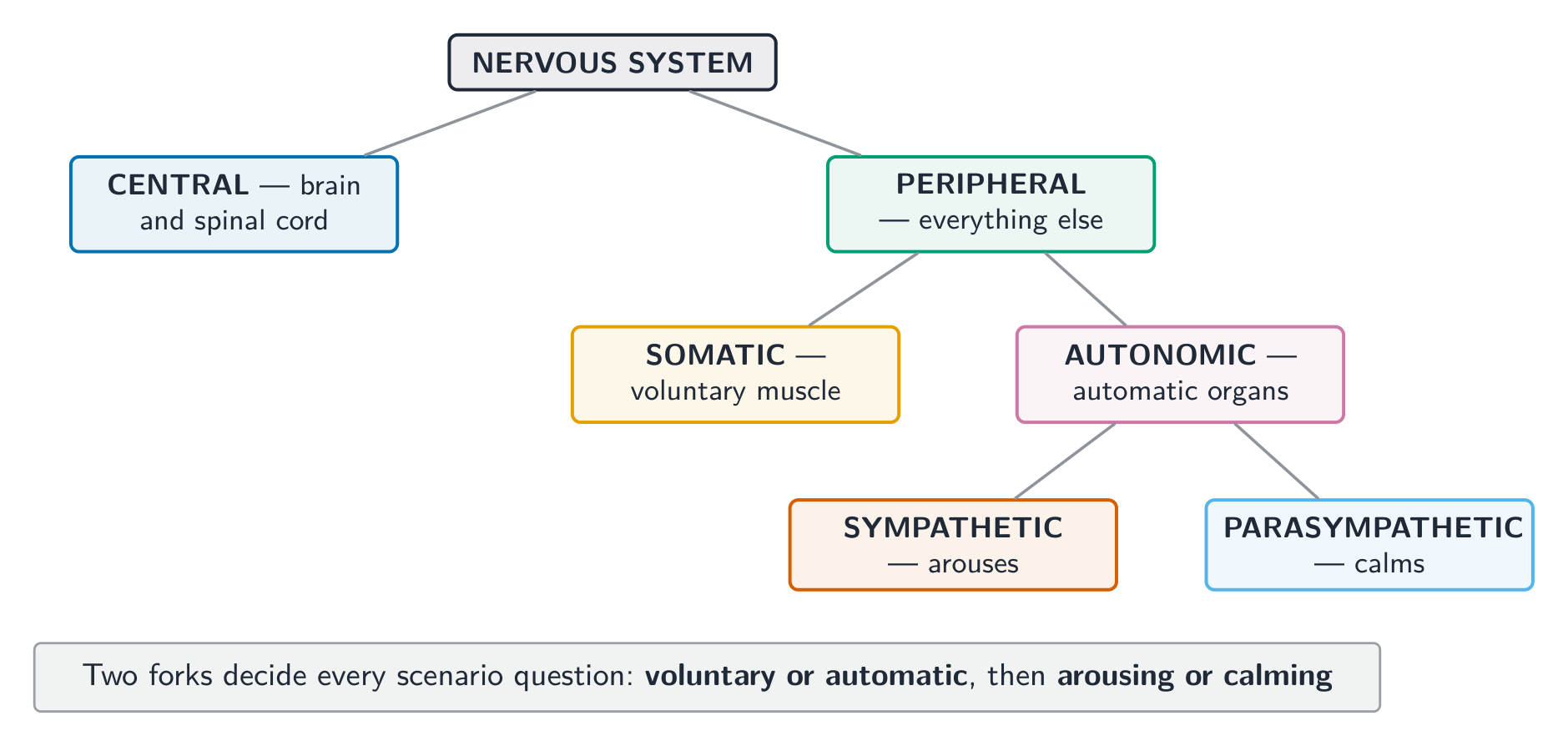
Two forks decide every scenario question: voluntary or automatic, then arousing or calming
Explore · ⁨สำรวจ⁩

Place each function on the nervous-system tree · ⁨วางฟังก์ชันแต่ละตัวบนต้นไม้ระบบประสาท⁩

Two forks decide every scenario question: voluntary or automatic, then arousing or calming. · ⁨คำถามสถานการณ์มีทางแยกสองทาง: เจตจำนงหรืออัตโนมัติ แล้วตามด้วยการกระตุ้นหรือผ่อนคลาย⁩

Vocabulary · ⁨คำศัพท์⁩ Train · ⁨ฝึกฝน⁩
English ไทย
nervous system/ˈnɜːvəs ˈsɪstəm/ ระบบประสาท
central nervous system (CNS)/ˈsentrəl ˈnɜːvəs ˈsɪstəm/ ระบบประสาทส่วนกลาง (CNS)
spinal cord/ˈspaɪnl kɔːd/ ไขสันหลัง
peripheral nervous system (PNS)/pəˈrɪfərəl ˈnɜːvəs ˈsɪstəm/ ระบบประสาทส่วนปลาย (PNS)
somatic nervous system/səˈmætɪk ˈnɜːvəs ˈsɪstəm/ somatic nervous system
voluntary/ˈvɒləntəri/ โดยสมัครใจ
autonomic nervous system/ɔːtəˈnɒmɪk ˈnɜːvəs ˈsɪstəm/ ระบบประสาทอัตโนมัติ
involuntary/ɪnˈvɒləntəri/ ไม่ได้ควบคุม
sympathetic nervous system/ˌsɪmpəˈθetɪk ˈnɜːvəs ˈsɪstəm/ sympathetic nervous system
parasympathetic nervous system/ˌpærəˌsɪmpəˈθetɪk ˈnɜːvəs ˈsɪstəm/ parasympathetic nervous system
1.3

Neurons and How They Fire · ⁨เซลล์ประสาทและการส่งสัญญาณ (Neurons and How They Fire)⁩

Syllabus · ⁨หลักสูตร⁩
English

Learning Objective 1.3.A: Explain how the structures and functions of typical neurons in the central nervous system affect behavior and mental processes.

  • 1.3.A.1 Two common types of neural cells in the brain are neurons (neural cells that transmit information) and glial cells (cells that provide structure, insulation, communication, and waste transport). These types of cells form the basis of the nervous system and are the building blocks of all behavior and mental processes.
  • 1.3.A.2 In the spinal cord, the reflex arc demonstrates how neurons within the central and peripheral nervous systems work together to respond to stimuli. Three types of neurons work together in the spinal cord to create a reflex arc: sensory neurons, motor neurons, and interneurons.

Learning Objective 1.3.B: Explain how the basic process of neural transmission is related to behavior and mental processes.

  • 1.3.B.1 The process of neural transmission most commonly occurs in an orderly, systematic way and involves the all-or-none principle, depolarization, refractory period, resting potential, reuptake, and threshold. Disruptions to this process could lead to disorders such as multiple sclerosis or myasthenia gravis.
    • Exclusion Statement: The sodium-potassium pump is outside the scope of the AP Psychology Exam.
  • 1.3.B.2 Each neurotransmitter has specific function(s) related to behavior and mental processes, which may depend on the neurotransmitter’s location in the nervous system. Neurotransmitters generally communicate either excitatory (making an action potential more likely) or inhibitory (making an action potential less likely) messages. Neurotransmitters related to behavior and mental processes for study in AP Psychology are limited to dopamine, serotonin, norepinephrine, glutamate, GABA, endorphins, substance p, and acetylcholine.
    • Exclusion Statement: The AP Psychology Exam will only address the listed neurotransmitters in EK 1.3.B.2.
  • 1.3.B.3 Outside of the nervous system, hormones perform actions similar to neurotransmitters. Hormones related to behavior and mental processes for study in AP Psychology are limited to adrenaline, leptin, ghrelin, melatonin, and oxytocin.
    • Exclusion Statement: The AP Psychology Exam will only address the listed hormones in EK 1.3.B.3.
    • Exclusion Statement: Specific information about the glands of the endocrine system (with the exception of the pituitary gland as referenced in EK 1.4.A.4) is outside the scope of the AP Psychology Exam.

Learning Objective 1.3.C: Explain how psychoactive drugs affect behavior and mental processes.

  • 1.3.C.1 Psychoactive drugs can influence neurotransmitter function in various ways throughout the neural communication process. Some act as agonists which encourage neural firing. Some act as antagonists which discourage neural firing. Some act as reuptake inhibitors which block the reabsorption of neurotransmitters back into the cell.
  • 1.3.C.2 Psychoactive drugs have psychological and physiological effects.
    • 1.3.C.2.i Stimulants, such as caffeine and cocaine, typically cause increased neural activity.
    • 1.3.C.2.ii Depressants, such as alcohol, typically cause decreased neural activity.
    • 1.3.C.2.iii Hallucinogens, such as marijuana, typically cause distortions in perception and/or cognition.
    • 1.3.C.2.iv Opioids, such as heroin, typically act as pain relievers.
  • 1.3.C.3 Psychoactive drug use can lead to tolerance and/or addiction. Addiction can create significant withdrawal symptoms if the psychoactive drugs are no longer consumed.
ไทย

จุดประสงค์การเรียนรู้ 1.3.A: อธิบายว่าโครงสร้างและหน้าที่ของเซลล์ประสาททั่วไปในระบบประสาทส่วนกลางส่งผลต่อพฤติกรรมและกระบวนการทางจิตใจอย่างไร

  • 1.3.A.1 เซลล์ประสาทสองชนิดที่พบบ่อยในสมองคือ เซลล์ประสาท (เซลล์ประสาทที่ส่งข้อมูล) และเซลล์กลียา (เซลล์ที่ให้บริการโครงสร้าง Isolating การสื่อสารและการขนส่งของเสีย) เซลล์เหล่านี้เป็นรากฐานของระบบประสาทและเป็นอิฐสร้างพื้นฐานของพฤติกรรมและกระบวนการทางจิตใจทั้งหมด
  • 1.3.A.2 ในไขสันหลัง วงจรการตอบสนองสะท้อน (reflex arc) แสดงให้เห็นว่าเซลล์ประสาทในระบบประสาทส่วนกลางและส่วนกลาย worked together เพื่อตอบสนองต่อสิ่งเร้า. เซลล์ประสาทสามชนิดทำงานร่วมกันในไขสันหลังเพื่อสร้างวงจรการตอบสนองสะท้อน: เซลล์ประสาทรับความรู้สึก, เซลล์ประสาทสั่งการ, และเซลล์ประสาทเชื่อมโยง

จุดประสงค์การเรียนรู้ 1.3.B: อธิบายว่ากระบวนการพื้นฐานของการส่งต่อกระแสประสาทเกี่ยวข้องกับพฤติกรรมและกระบวนการทางจิตใจอย่างไร

  • 1.3.B.1 กระบวนการส่งต่อกระแสประสาทมักเกิดขึ้นอย่างมีระเบียบและมีระบบและเกี่ยวข้องกับหลักการ All-or-none, Depolarization, Refractory period, Resting potential, Reuptake, และ Threshold disruptions ของกระบวนการนี้อาจนำไปสู่โรคเช่น Multiple sclerosis หรือ Myasthenia gravis
    • คำ声明: Sodium-potassium pump อยู่นอกขอบเขตของข้อสอบจิตวิทยา AP
  • 1.3.B.2 Neurotransmitter แต่ละชนิดมีหน้าที่เฉพาะที่เกี่ยวข้องกับพฤติกรรมและกระบวนการทางจิตใจ ซึ่งอาจขึ้นอยู่กับตำแหน่งของ neurotransmitter นั้นในระบบประสาท Neurotransmitter โดยทั่วไปจะส่งข้อความแบบ Excitatory (ทำให้ Action potential มีโอกาสเกิดขึ้นมากขึ้น) หรือ Inhibitory (ทำให้ Action potential มีโอกาสเกิดขึ้นน้อยลง) Neurotransmitter ที่เกี่ยวข้องกับพฤติกรรมและกระบวนการทางจิตใจสำหรับการเรียนในจิตวิทยา AP จำกัดอยู่ที่ Dopamine, Serotonin, Norepinephrine, Glutamate, GABA, Endorphins, Substance P, และ Acetylcholine
    • คำ声明: ข้อสอบจิตวิทยา AP จะพิจารณาเฉพาะ neurotransmitters ที่ระบุไว้ใน EK 1.3.B.2 เท่านั้น
  • 1.3.B.3 นอกเหนือจากระบบประสาท Hormones ทำงานคล้ายกับ neurotransmitters Hormones ที่เกี่ยวข้องกับพฤติกรรมและกระบวนการทางจิตใจสำหรับการเรียนในจิตวิทยา AP จำกัดอยู่ที่ Adrenaline, Leptin, Ghrelin, Melatonin, และ Oxytocin
    • คำ声明: ข้อสอบจิตวิทยา AP จะพิจารณาเฉพาะ hormones ที่ระบุไว้ใน EK 1.3.B.3 เท่านั้น
    • คำ声明: ข้อมูลเฉพาะเกี่ยวกับต่อมของระบบ endocrine (ยกเว้นต่อม Pituitary ตามที่อ้างถึงใน EK 1.4.A.4) อยู่นอกขอบเขตของข้อสอบจิตวิทยา AP

จุดประสงค์การเรียนรู้ 1.3.C: อธิบายว่าสารกระตุ้นระบบประสาทมีผลต่อพฤติกรรมและกระบวนการทางจิตอย่างไร

  • 1.3.C.1 ยาที่มีผลต่อจิตสามารถมีอิทธิพลต่อการทำงานของสารสื่อประสาทในหลายรูปแบบตลอดกระบวนการสื่อสารทางประสาท. บางชนิดทำหน้าที่เป็นanitize which encourages neural firing. บางชนิดทำหน้าที่เป็นantagonist which discourages neural firing. บางชนิดทำหน้าที่เป็นreuptake inhibitors which block the reabsorption of neurotransmitters back into the cell.
  • 1.3.C.2 สารกระตุ้นระบบประสาทมีทั้งผลกระทบทางจิตใจและทางสรีรวิทยา
    • 1.3.C.2.i สารกระตุ้น เช่น คาเฟอีนและโคเคน มักจะทำให้เกิดการกระตุ้นทางประสาทเพิ่มขึ้น
    • 1.3.C.2.ii สารระงับ เช่น แอลกอฮอล์ มักจะทำให้การกระตุ้นทางประสาทลดลง
    • 1.3.C.2.iii สารหลอน เช่น กัญชา มักทำให้เกิดความผิดปกติในการรับรู้และ/หรือกระบวนการทางปัญญา
    • 1.3.C.2.iv โอปิโออยด์ เช่น เฮโรอีน มักทำหน้าที่เป็นยาบรรเทาปวด
  • 1.3.C.3 การใช้สารกระตุ้นระบบประสาทอาจนำไปสู่การทนทานต่อยาและ/หรือการติดสารเสพติด การติดสารเสพติดอาจก่อให้เกิดอาการWithdrawal ที่รุนแรงหากหยุดใช้สารกระตุ้นระบบประสาท

Source: College Board AP Course and Exam Description · ⁨แหล่งที่มา: คำอธิบายหลักสูตรและข้อสอบ College Board AP⁩

English

Two kinds of cell do the work. Neurons 神经元 transmit information. Glial cells 神经胶质细胞 provide structure, insulation, communication, and waste transport. Together they are the building blocks of all behavior and mental processes.

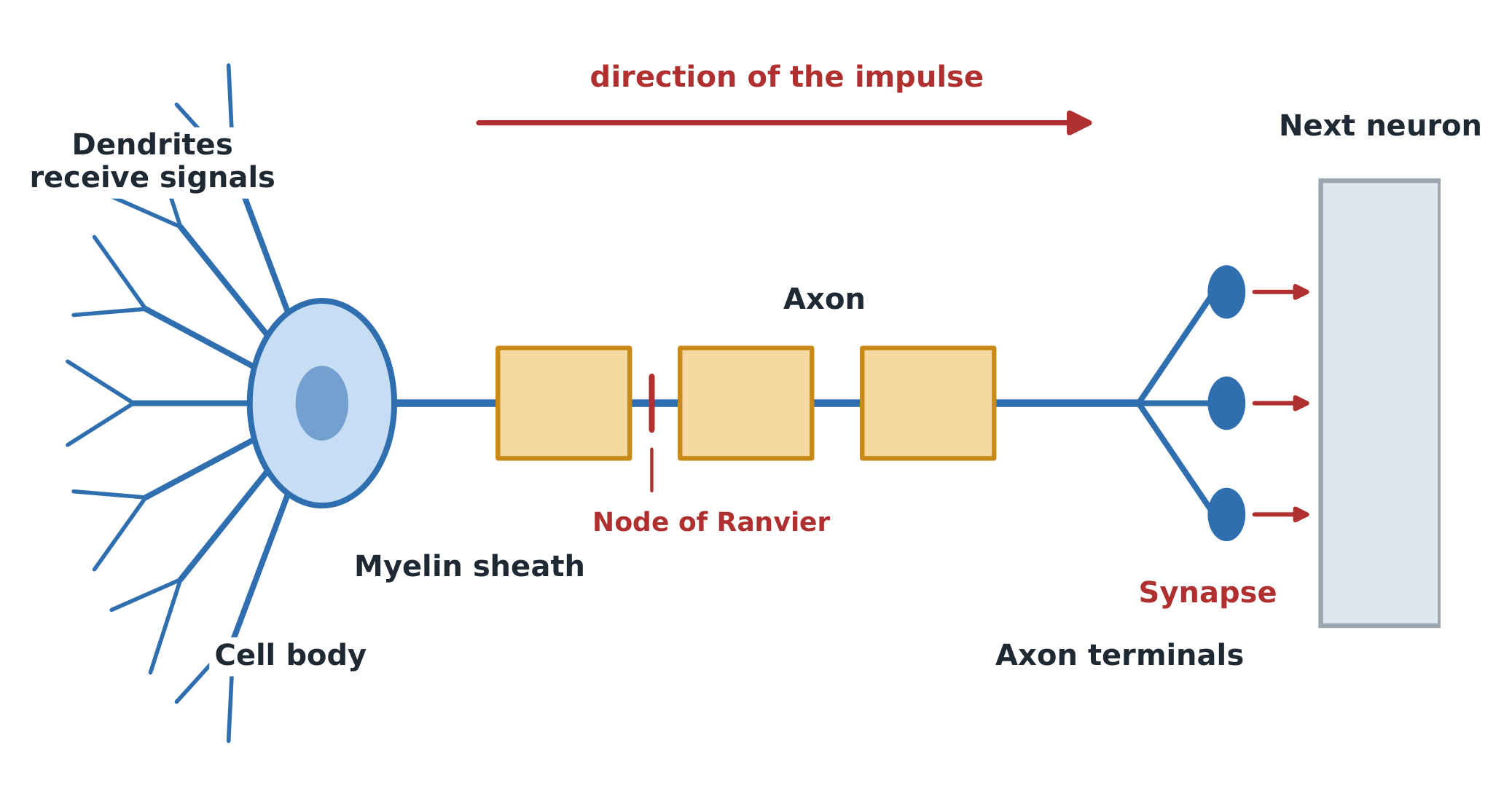
A neuron has dendrites 树突 that receive signals, a cell body 细胞体, and an axon 轴突 that carries the signal away. Many axons are wrapped in a myelin sheath 髓鞘, which speeds the signal up.

Neural transmission follows a set order:

  • At rest the neuron holds a resting potential 静息电位, ready but not firing.
  • If incoming signals pass the threshold 阈限, the neuron depolarizes 去极化 and fires.
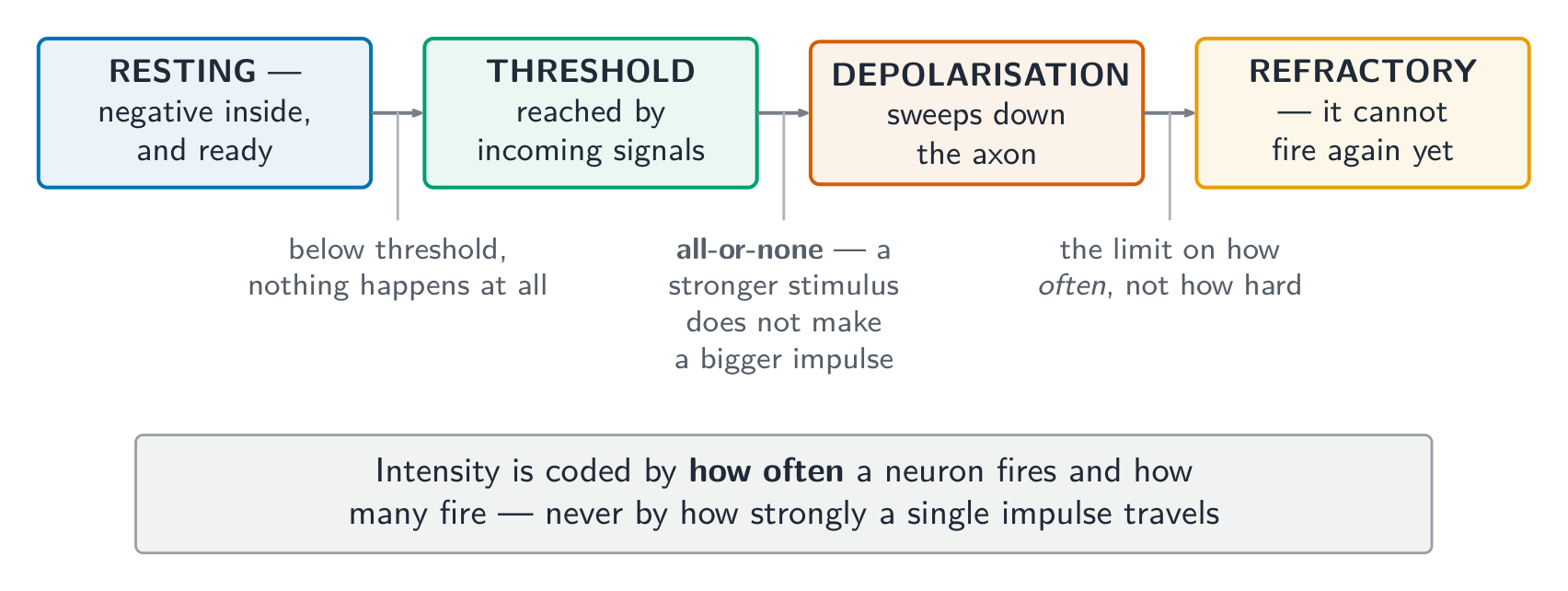
  • Firing follows the all-or-none principle 全或无原则: the neuron fires at full strength or not at all. A stronger stimulus makes it fire more often, not harder.
  • Straight after firing there is a refractory period 不应期 when the neuron cannot fire again.
  • At the synapse 突触, the gap between neurons, chemicals cross to the next cell. Leftover chemicals are taken back in a process called reuptake 再摄取.

Damage to this process can cause disorders such as multiple sclerosis 多发性硬化 or myasthenia gravis 重症肌无力.

In the spinal cord, the reflex arc 反射弧 shows the system working as a unit. Sensory neurons 感觉神经元 carry information in, interneurons 中间神经元 connect inside the cord, and motor neurons 运动神经元 carry the command out - all before the brain is involved.

ไทย
Labelled diagram of a neuron: dendrites receive signals, the cell body integrates them, and the axon carries the impulse to the terminals
เซลล์ประสาทรับสัญญาณที่ dendrites ส่งผ่าน axon และส่งข้อความข้าม synapse

มีเซลล์ 2 ประเภทที่ทำหน้าที่นี้ Neurons ส่งต่อข้อมูล Glial cells ให้โครงสร้างฉนวน สื่อสาร และขนส่งของเสีย ทั้งคู่เป็นหน่วยสร้างพื้นฐานของพฤติกรรมและกระบวนการทางจิตทั้งหมด

เซลล์ประสาทประกอบด้วย dendrites ที่รับสัญญาณ cell body และ axon ที่ส่งสัญญาณออกไป Axon หลายเส้นหุ้มด้วย myelin sheath ซึ่งช่วยเร่งความเร็วในการส่งสัญญาณ

การส่งสัญญาณประสาทเป็นไปตามลำดับที่กำหนด:

  • เมื่อพัก neuron จะคงสภาพ resting potential พร้อมแต่ยังไม่ส่งสัญญาณ
  • หากสัญญาณที่เข้ามาเกิน threshold neuron จะเกิด depolarization และส่งสัญญาณ
  • การส่งสัญญาณเป็นไปตาม all-or-none principle: neuron ส่งสัญญาณด้วยความแรงเต็มหรือไม่ได้ส่งเลย สัญญาณที่แรงขึ้นจะทำให้ส่งสัญญาณบ่อยขึ้น ไม่ใช่แรงขึ้น
  • ทันทีหลังการส่งสัญญาณจะมี refractory period ซึ่งเป็นช่วงที่ neuron ไม่สามารถส่งสัญญาณได้อีก
  • ที่ synapse ช่องว่างระหว่างเซลล์ประสาท สารเคมีจะข้ามไปยังเซลล์ถัดไป สารเคมีที่เหลือจะถูกดูดกลับเข้าไปใหม่ในกระบวนการที่เรียกว่า reuptake

ความเสียหายต่อกระบวนการนี้สามารถนำไปสู่โรคต่างๆ เช่น multiple sclerosis หรือ myasthenia gravis

ในไขสันหลัง reflex arc แสดงให้เห็นการทำงานเป็นหน่วยของระบบ Sensory neurons นำข้อมูลเข้า interneurons เชื่อมต่อกันภายในไขสันหลัง และ motor neurons นำคำสั่งออก - ทั้งหมดนี้เกิดขึ้นก่อนที่สมองจะมีส่วนร่วม

Intensity is coded by how often a neuron fires, never by how strongly one impulse travels
Explore · ⁨สำรวจ⁩

Fire a neuron, step by step · ⁨ส่งสัญญาณเซลล์ประสาท ขั้นตอนต่อขั้นตอน⁩

All-or-none: a stronger stimulus does not make a bigger impulse. Intensity is coded by how often, and by how many. · ⁨หลักการทั้งหมดหรือไม่มีเลย: กระตุ้นที่แรงกว่าไม่ทำให้สัญญาณใหญ่ขึ้น ความเข้มถูกเข้ารหัสโดยความถี่และจำนวน⁩

Vocabulary · ⁨คำศัพท์⁩ Train · ⁨ฝึกฝน⁩
English ไทย
Neurons/ˈnjuːrɒnz/ เซลล์ประสาท Neurons
Glial cells/ˈɡlaɪəl selz/ เซลล์กลียา
dendrites/ˈdendraɪts/ เดนไดรต์ dendrites
cell body/sel ˈbɒdi/ เซลล์เยื่อหุ้ม
axon/ˈæksɒn/ แอกซอน
myelin sheath/ˈmaɪɪlɪn ʃiːθ/ ปลอกไมelin
resting potential/ˈrestɪŋ pəˈtenʃl/ สภาวะพัก
threshold/ˈθreʃəʊld/ 阈値 (threshold)
depolarizes/diːˈpəʊlɑːraɪzɪz/ การ depolarizes
all-or-none principle/ɔːl ɔː nɒn ˈprɪnsɪpl/ หลักการทั้งหมดหรือไม่มีเลย
refractory period/rɪˈfræktəri ˈpɪərɪəd/ ช่วง refractory
synapse/ˈsɪnæps/ ซินาปส์ (synapse)
reuptake/ˈruːpteɪk/ การดูดซึมกลับ
multiple sclerosis/ˈmʌltɪpl skləˈrəʊsɪs/ โรคพหุ sclerosis
myasthenia gravis/ˌmaɪəsˈθiːnɪə ˈɡrævɪs/ โรคกล้ามเนื้ออ่อนแรง
reflex arc/ˈriːfleks ɑːk/ วงจอปฏิกิริยาสะท้อน
Sensory neurons/ˈsensəri ˈnjuːrɒnz/ ประสาทรับความรู้สึก
interneurons/ˌɪntəˈnjuːrɒnz/ ประสาทเชื่อมโยง
motor neurons/ˈməʊtə ˈnjuːrɒnz/ ประสาทสั่งการ
Watch lesson · ⁨ดูบทเรียน⁩
1.3

Neurotransmitters, Hormones, and Drugs · ⁨สารสื่อประสาท ฮอร์โมน และยา (Neurotransmitters, Hormones, and Drugs)⁩

Syllabus · ⁨หลักสูตร⁩
English

Learning Objective 1.3.A: Explain how the structures and functions of typical neurons in the central nervous system affect behavior and mental processes.

  • 1.3.A.1 Two common types of neural cells in the brain are neurons (neural cells that transmit information) and glial cells (cells that provide structure, insulation, communication, and waste transport). These types of cells form the basis of the nervous system and are the building blocks of all behavior and mental processes.
  • 1.3.A.2 In the spinal cord, the reflex arc demonstrates how neurons within the central and peripheral nervous systems work together to respond to stimuli. Three types of neurons work together in the spinal cord to create a reflex arc: sensory neurons, motor neurons, and interneurons.

Learning Objective 1.3.B: Explain how the basic process of neural transmission is related to behavior and mental processes.

  • 1.3.B.1 The process of neural transmission most commonly occurs in an orderly, systematic way and involves the all-or-none principle, depolarization, refractory period, resting potential, reuptake, and threshold. Disruptions to this process could lead to disorders such as multiple sclerosis or myasthenia gravis.
    • Exclusion Statement: The sodium-potassium pump is outside the scope of the AP Psychology Exam.
  • 1.3.B.2 Each neurotransmitter has specific function(s) related to behavior and mental processes, which may depend on the neurotransmitter’s location in the nervous system. Neurotransmitters generally communicate either excitatory (making an action potential more likely) or inhibitory (making an action potential less likely) messages. Neurotransmitters related to behavior and mental processes for study in AP Psychology are limited to dopamine, serotonin, norepinephrine, glutamate, GABA, endorphins, substance p, and acetylcholine.
    • Exclusion Statement: The AP Psychology Exam will only address the listed neurotransmitters in EK 1.3.B.2.
  • 1.3.B.3 Outside of the nervous system, hormones perform actions similar to neurotransmitters. Hormones related to behavior and mental processes for study in AP Psychology are limited to adrenaline, leptin, ghrelin, melatonin, and oxytocin.
    • Exclusion Statement: The AP Psychology Exam will only address the listed hormones in EK 1.3.B.3.
    • Exclusion Statement: Specific information about the glands of the endocrine system (with the exception of the pituitary gland as referenced in EK 1.4.A.4) is outside the scope of the AP Psychology Exam.

Learning Objective 1.3.C: Explain how psychoactive drugs affect behavior and mental processes.

  • 1.3.C.1 Psychoactive drugs can influence neurotransmitter function in various ways throughout the neural communication process. Some act as agonists which encourage neural firing. Some act as antagonists which discourage neural firing. Some act as reuptake inhibitors which block the reabsorption of neurotransmitters back into the cell.
  • 1.3.C.2 Psychoactive drugs have psychological and physiological effects.
    • 1.3.C.2.i Stimulants, such as caffeine and cocaine, typically cause increased neural activity.
    • 1.3.C.2.ii Depressants, such as alcohol, typically cause decreased neural activity.
    • 1.3.C.2.iii Hallucinogens, such as marijuana, typically cause distortions in perception and/or cognition.
    • 1.3.C.2.iv Opioids, such as heroin, typically act as pain relievers.
  • 1.3.C.3 Psychoactive drug use can lead to tolerance and/or addiction. Addiction can create significant withdrawal symptoms if the psychoactive drugs are no longer consumed.
ไทย

จุดประสงค์การเรียนรู้ 1.3.A: อธิบายว่าโครงสร้างและหน้าที่ของเซลล์ประสาททั่วไปในระบบประสาทส่วนกลางส่งผลต่อพฤติกรรมและกระบวนการทางจิตใจอย่างไร

  • 1.3.A.1 เซลล์ประสาทสองชนิดที่พบบ่อยในสมองคือ เซลล์ประสาท (เซลล์ประสาทที่ส่งข้อมูล) และเซลล์กลียา (เซลล์ที่ให้บริการโครงสร้าง Isolating การสื่อสารและการขนส่งของเสีย) เซลล์เหล่านี้เป็นรากฐานของระบบประสาทและเป็นอิฐสร้างพื้นฐานของพฤติกรรมและกระบวนการทางจิตใจทั้งหมด
  • 1.3.A.2 ในไขสันหลัง วงจรการตอบสนองสะท้อน (reflex arc) แสดงให้เห็นว่าเซลล์ประสาทในระบบประสาทส่วนกลางและส่วนกลาย worked together เพื่อตอบสนองต่อสิ่งเร้า. เซลล์ประสาทสามชนิดทำงานร่วมกันในไขสันหลังเพื่อสร้างวงจรการตอบสนองสะท้อน: เซลล์ประสาทรับความรู้สึก, เซลล์ประสาทสั่งการ, และเซลล์ประสาทเชื่อมโยง

จุดประสงค์การเรียนรู้ 1.3.B: อธิบายว่ากระบวนการพื้นฐานของการส่งต่อกระแสประสาทเกี่ยวข้องกับพฤติกรรมและกระบวนการทางจิตใจอย่างไร

  • 1.3.B.1 กระบวนการส่งต่อกระแสประสาทมักเกิดขึ้นอย่างมีระเบียบและมีระบบและเกี่ยวข้องกับหลักการ All-or-none, Depolarization, Refractory period, Resting potential, Reuptake, และ Threshold disruptions ของกระบวนการนี้อาจนำไปสู่โรคเช่น Multiple sclerosis หรือ Myasthenia gravis
    • คำ声明: Sodium-potassium pump อยู่นอกขอบเขตของข้อสอบจิตวิทยา AP
  • 1.3.B.2 Neurotransmitter แต่ละชนิดมีหน้าที่เฉพาะที่เกี่ยวข้องกับพฤติกรรมและกระบวนการทางจิตใจ ซึ่งอาจขึ้นอยู่กับตำแหน่งของ neurotransmitter นั้นในระบบประสาท Neurotransmitter โดยทั่วไปจะส่งข้อความแบบ Excitatory (ทำให้ Action potential มีโอกาสเกิดขึ้นมากขึ้น) หรือ Inhibitory (ทำให้ Action potential มีโอกาสเกิดขึ้นน้อยลง) Neurotransmitter ที่เกี่ยวข้องกับพฤติกรรมและกระบวนการทางจิตใจสำหรับการเรียนในจิตวิทยา AP จำกัดอยู่ที่ Dopamine, Serotonin, Norepinephrine, Glutamate, GABA, Endorphins, Substance P, และ Acetylcholine
    • คำ声明: ข้อสอบจิตวิทยา AP จะพิจารณาเฉพาะ neurotransmitters ที่ระบุไว้ใน EK 1.3.B.2 เท่านั้น
  • 1.3.B.3 นอกเหนือจากระบบประสาท Hormones ทำงานคล้ายกับ neurotransmitters Hormones ที่เกี่ยวข้องกับพฤติกรรมและกระบวนการทางจิตใจสำหรับการเรียนในจิตวิทยา AP จำกัดอยู่ที่ Adrenaline, Leptin, Ghrelin, Melatonin, และ Oxytocin
    • คำ声明: ข้อสอบจิตวิทยา AP จะพิจารณาเฉพาะ hormones ที่ระบุไว้ใน EK 1.3.B.3 เท่านั้น
    • คำ声明: ข้อมูลเฉพาะเกี่ยวกับต่อมของระบบ endocrine (ยกเว้นต่อม Pituitary ตามที่อ้างถึงใน EK 1.4.A.4) อยู่นอกขอบเขตของข้อสอบจิตวิทยา AP

จุดประสงค์การเรียนรู้ 1.3.C: อธิบายว่าสารกระตุ้นระบบประสาทมีผลต่อพฤติกรรมและกระบวนการทางจิตอย่างไร

  • 1.3.C.1 ยาที่มีผลต่อจิตสามารถมีอิทธิพลต่อการทำงานของสารสื่อประสาทในหลายรูปแบบตลอดกระบวนการสื่อสารทางประสาท. บางชนิดทำหน้าที่เป็นanitize which encourages neural firing. บางชนิดทำหน้าที่เป็นantagonist which discourages neural firing. บางชนิดทำหน้าที่เป็นreuptake inhibitors which block the reabsorption of neurotransmitters back into the cell.
  • 1.3.C.2 สารกระตุ้นระบบประสาทมีทั้งผลกระทบทางจิตใจและทางสรีรวิทยา
    • 1.3.C.2.i สารกระตุ้น เช่น คาเฟอีนและโคเคน มักจะทำให้เกิดการกระตุ้นทางประสาทเพิ่มขึ้น
    • 1.3.C.2.ii สารระงับ เช่น แอลกอฮอล์ มักจะทำให้การกระตุ้นทางประสาทลดลง
    • 1.3.C.2.iii สารหลอน เช่น กัญชา มักทำให้เกิดความผิดปกติในการรับรู้และ/หรือกระบวนการทางปัญญา
    • 1.3.C.2.iv โอปิโออยด์ เช่น เฮโรอีน มักทำหน้าที่เป็นยาบรรเทาปวด
  • 1.3.C.3 การใช้สารกระตุ้นระบบประสาทอาจนำไปสู่การทนทานต่อยาและ/หรือการติดสารเสพติด การติดสารเสพติดอาจก่อให้เกิดอาการWithdrawal ที่รุนแรงหากหยุดใช้สารกระตุ้นระบบประสาท

Source: College Board AP Course and Exam Description · ⁨แหล่งที่มา: คำอธิบายหลักสูตรและข้อสอบ College Board AP⁩

English

Neurotransmitters 神经递质 are the chemicals that cross the synapse. Each has its own job, and the effect can depend on where in the nervous system it acts. A message is either excitatory 兴奋性的 (making firing more likely) or inhibitory 抑制性的 (making firing less likely).

Only these are examinable: dopamine 多巴胺 (reward and movement), serotonin 血清素 (mood and sleep), norepinephrine 去甲肾上腺素 (alertness), glutamate 谷氨酸 (the main excitatory transmitter), GABA γ-氨基丁酸 (the main inhibitory transmitter), endorphins 内啡肽 (pain relief), substance P P物质 (pain signalling), and acetylcholine 乙酰胆碱 (muscle movement and memory).

Hormones 激素 act outside the nervous system but do a similar job, travelling more slowly through the blood. Again only five are examinable: adrenaline 肾上腺素, leptin 瘦素 (reduces hunger), ghrelin 胃饥饿素 (increases hunger), melatonin 褪黑素 (sleep), and oxytocin 催产素 (bonding).

Psychoactive drugs 精神药物 change behavior by acting on neurotransmission in three ways:

  • An agonist 激动剂 encourages neural firing.
  • An antagonist 拮抗剂 discourages it.
  • A reuptake inhibitor 再摄取抑制剂 blocks reabsorption, leaving more transmitter in the synapse.

Drug categories: stimulants 兴奋剂 (caffeine, cocaine) increase neural activity; depressants 抑制剂 (alcohol) decrease it; hallucinogens 致幻剂 (marijuana) distort perception; opioids 阿片类药物 (heroin) relieve pain. Repeated use can lead to tolerance 耐受性, where more is needed for the same effect, and to addiction 成瘾, with withdrawal 戒断反应 symptoms when use stops.

ไทย

Neurotransmitters คือสารเคมีที่ข้าม synapse แต่ละชนิดมีหน้าที่เฉพาะ ผลลัพธ์อาจขึ้นอยู่กับตำแหน่งในระบบประสาทที่มันทำงาน ข้อความ要么是 excitatory (เพิ่มโอกาสในการส่งสัญญาณ) หรือ inhibitory (ลดโอกาสในการส่งสัญญาณ)

มีเพียงthese ที่ต้องสอบ: dopamine (รางวัลและการเคลื่อนไหว), serotonin (อารมณ์และการนอนหลับ), norepinephrine (ความตื่นตัว), glutamate (สารสื่อประสาท excitatory หลัก), GABA γ- (สารสื่อประสาท inhibitory หลัก), endorphins (บรรเทาปวด), substance P P (การส่งสัญญาณปวด), และ acetylcholine (การเคลื่อนไหวของกล้ามเนื้อและความจำ)

Hormones ทำงานนอกระบบประสาทแต่ทำหน้าที่คล้ายกัน โดยเคลื่อนที่ช้ากว่าผ่านเลือด มีเพียง five ที่ต้องสอบ: adrenaline, leptin (ลดความหิว), ghrelin (เพิ่มความหิว), melatonin (การนอนหลับ), และ oxytocin (การสร้างพันธะ)

Psychoactive drugs เปลี่ยนแปลงพฤติกรรมโดยส่งผลต่อการส่งสัญญาณประสาทในสามวิธี:

  • Agonist กระตุ้นการส่งสัญญาณประสาท
  • Antagonist ยับยั้งการส่งสัญญาณ
  • Reuptake inhibitor ป้องกันการดูดกลับ ทำให้มี neurotransmitter เหลืออยู่ใน synapse มากขึ้น

หมวดหมู่ของยา: Stimulants (คาเฟอีน โคเคน) เพิ่มกิจกรรมทางประสาท; Depressants (แอลกอฮอล์) ลดลง; Hallucinogens (กัญชา) บิดเบือนการรับรู้; Opioids (เฮโรइन) บรรเทาปวด การใช้ซ้ำๆ อาจทำให้เกิด tolerance ซึ่งต้องใช้ปริมาณมากขึ้นเพื่อผลลัพธ์เท่าเดิม และนำไปสู่ addiction พร้อมอาการ withdrawal เมื่อหยุดใช้

Vocabulary · ⁨คำศัพท์⁩ Train · ⁨ฝึกฝน⁩
English ไทย
Neurotransmitters/ˈnjuːrətrænsmɪtəz/ สารสื่อประสาท
excitatory/ekˈsɪtətəri/ กระตุ้น
inhibitory/ɪnˈhɪbɪtəri/ ยับยั้ง
dopamine/ˈdɒpəmiːn/ โดปามีน
serotonin/ˌserəˈtəʊnɪn/ เซโรโทนิน
norepinephrine/ˈnɔːpaɪnfriːn/ นอร์เอพิเนฟริน
glutamate/ˈɡluːtəmeɪt/ กลูตาเมต
GABA/ˈɡɑːbə/ GABA
endorphins/enˈdɔːfɪnz/ เอนดอร์ฟิน
substance P/ˈsʌbstəns piː/ สารพี
acetylcholine/ˈæsɪtɪlkəliːn/ อะซีทิลโคลีน
Hormones/ˈhɔːməʊnz/ ฮอร์โมน
adrenaline/əˈdrenəlɪn/ อะดรีนาลีน
leptin/ˈleptɪn/ เลปติน
ghrelin/ˈdʒiːhrelɪn/ กรรีลิน
melatonin/ˈmelətɒnɪn/ เมลาโทนิน
oxytocin/ˌɒksɪˈtɒsɪn/ ออกซิโตซิน
Psychoactive drugs/ˌsaɪkəʊˈæktɪv drʌɡz/ ยาที่มีผลต่อจิต
agonist/ˈæɡənɪst/ anitizeส
antagonist/ænˈtæɡənɪst/ ตัวละครร้าย
reuptake inhibitor/ˈruːpteɪk ɪnˈhɪbɪtə/ ตัวยับยั้งการดูดกลับ
stimulants/ˈstɪmjʊlənts/ ยากระตุ้น
depressants/dɪˈpresənts/ ยานumbing
hallucinogens/həˈluːsɪnədʒnz/ ยาหลอน
opioids/ˈəʊpɪɔɪdz/ โอปิออยด์
tolerance/ˈtɒlərəns/ ความทนทาน
addiction/əˈdɪkʃn/ การติดสาร
withdrawal/wɪθˈdrɔːl/ การถอนออก
Watch lesson · ⁨ดูบทเรียน⁩
1.4

The Brain · ⁨สมอง (The Brain)⁩

Syllabus · ⁨หลักสูตร⁩
English

Learning Objective 1.4.A: Explain how the structures and functions of the brain apply to behavior and mental processes.

  • 1.4.A.1 The brain stem (including the medulla) generally controls basic functioning such as breathing and heart rate.
  • 1.4.A.2 The reticular activating system and the brain’s reward center generally control alertness, some voluntary movement, eye movement, and some types of learning, cognition, and emotion.
  • 1.4.A.3 The cerebellum generally controls coordination of muscle movement, balance, and some forms of procedural learning.
  • 1.4.A.4 The cerebral cortex is divided into two hemispheres and includes the limbic system (thalamus, hypothalamus, pituitary gland, hippocampus, amygdala), corpus callosum, and the lobes of the cortex.
    • 1.4.A.4.i The occipital lobes generally control visual information processing and are located in the rear of the brain.
    • 1.4.A.4.ii The temporal lobes generally control auditory and linguistic processing and are located on the sides of the brain.
    • 1.4.A.4.iii The parietal lobes generally control association areas, which process and organize information, and the somatosensory cortex, which processes touch sensitivity. These lobes are located near the back crown of the brain.
    • 1.4.A.4.iv The frontal lobes, located just behind the forehead, generally control linguistic processing, higher-order thinking, and executive functioning, especially in the prefrontal cortex. The motor cortex is located at the rear of the frontal lobes and controls most types of skeletal movement.
  • 1.4.A.5 Split brain research, achieved by severing the corpus callosum (often a treatment for severe epilepsy), reveals that the right and left hemispheres of the brain may specialize in different activities and functions.
    • 1.4.A.5.i Areas of the brain that affect language are typically located in the left hemisphere and include Broca’s area (responsible for speech production) and Wernicke’s area (responsible for speech comprehension). Damage to these parts of the brain can lead to aphasia.
    • 1.4.A.5.ii Researchers test for cortex specialization with split-brain patients by showing information in each visual field, taking advantage of the brain’s contralateral hemispheric organization.
  • 1.4.A.6 Brain plasticity is the ability of the brain to rewire itself or modify or create new connections throughout development and generally allows for the function of a damaged part of the brain to be assumed by a different part of the brain.
  • 1.4.A.7 Research on the brain is done using scans (including EEG and fMRI), case studies, and surgical procedures (such as lesioning) to promote understanding of how the different structures of the brain work and how the brain functions together as a whole.
ไทย

จุดประสงค์การเรียนรู้ 1.4.A: อธิบายว่าโครงสร้างและหน้าที่ของสมองเชื่อมโยงกับพฤติกรรมและกระบวนการทางจิตได้อย่างไร

  • 1.4.A.1 ก้านสมอง (รวมถึงForma Medulla) ควบคุมการทำงานพื้นฐานเช่นการหายใจและอัตราการเต้นของหัวใจ
  • 1.4.A.2 ระบบเรติคูลาร์แอคทีเวตติ้งและศูนย์รางวัลของสมองควบคุมความตื่นตัว การเคลื่อนไหวอย่าง voluntarily บางส่วน การเคลื่อนไหวของตา และการเรียนรู้ some types of learning, cognition, and emotion
  • 1.4.A.3小脑 generally controls coordination of muscle movement, balance, and some forms of procedural learning.
  • 1.4.A.4 Cortece cerebral แบ่งออกเป็นสองซีกและประกอบด้วยระบบลิมบิก (thalamus, hypothalamus, pituitary gland, hippocampus, amygdala), corpus callosum และlobes of the cortex
    • 1.4.A.4.i Lobes occipital ควบคุมการประมวลผลข้อมูลภาพและอยู่บริเวณด้านหลังของสมอง
    • 1.4.A.4.ii Lobes temporal ควบคุมการประมวลผลเสียงและการประมวลผลภาษาและอยู่ด้านข้างของสมอง
    • 1.4.A.4.iii Lobes parietal ควบคุมพื้นที่association ซึ่งประมวลผลและจัดระเบียบข้อมูล และsomatosensory cortex ซึ่งประมวลผลความไวสัมผัส Lobes เหล่านี้อยู่ใกล้กับด้านบนด้านหลังของสมอง
    • 1.4.A.4.iv Lobes frontal อยู่ถัดจากหน้าผาก ควบคุมการประมวลผลภาษา การคิดระดับสูงและการoperate executive โดยเฉพาะในprefrontal cortex Motor cortex อยู่ด้านหลังของlobes frontal ควบคุมการเคลื่อนที่ของกระดูกส่วนใหญ่
  • 1.4.A.5 การวิจัยเรื่องสมองแยก (split brain research) ซึ่งทำได้โดยการตัดcorpus callosum (มักเป็นการรักษาโรค=yes epilepsy) แสดงให้เห็นว่าสมองซีกขวาและซ้ายอาจเชี่ยวชาญในกิจกรรมและหน้าที่ต่างกัน
    • 1.4.A.5.i พื้นที่ของสมองที่เกี่ยวข้องกับภาษาโดยทั่วไปจะอยู่ในซีกซ้าย ได้แก่Broca’s area (รับผิดชอบการผลิตคำพูด) และWernicke’s area (รับผิดชอบการเข้าใจคำพูด) ความเสียหายในพื้นที่เหล่านี้可能导致 aphasia
    • 1.4.A.5.ii นักวิจัยทดสอบความเชี่ยวชาญของcortex กับผู้ป่วย split-brain โดยแสดงข้อมูลในแต่ละvisual field ใช้ประโยชน์จากการจัด organization contralateral hemispheric ของสมอง
  • 1.4.A.6 Brain plasticity คือความสามารถของสมองในการ rewiring ตัวเองหรือ modify หรือสร้าง connections ใหม่ตลอดการพัฒนา โดยทั่วไปช่วยให้หน้าที่ของส่วนที่ damaged ของสมองถูก assum by ส่วนอื่นของสมอง
  • 1.4.A.7 การวิจัยเกี่ยวกับสมองใช้การ scan (รวม EEG และ fMRI), case studies และ surgical procedures (เช่น lesioning) เพื่อส่งเสริมความเข้าใจว่าโครงสร้างต่างๆ ของสมองทำงานอย่างไรและสมองทำงานร่วมกันเป็น整体อย่างไร

Source: College Board AP Course and Exam Description · ⁨แหล่งที่มา: คำอธิบายหลักสูตรและข้อสอบ College Board AP⁩

English

The brain is studied from the bottom up, because the lower structures handle the most basic jobs.

  • The brain stem 脑干, including the medulla 延髓, controls breathing and heart rate.
  • The reticular activating system 网状激活系统 controls alertness and arousal.
  • The cerebellum 小脑 controls coordination, balance, and some procedural learning 程序性学习.
  • The limbic system 边缘系统 sits inside the cerebral cortex and includes the thalamus 丘脑 (a relay station for the senses), the hypothalamus 下丘脑 (hunger, thirst, temperature), the pituitary gland 脑垂体, the hippocampus 海马体 (forming new memories), and the amygdala 杏仁核 (fear and emotion).

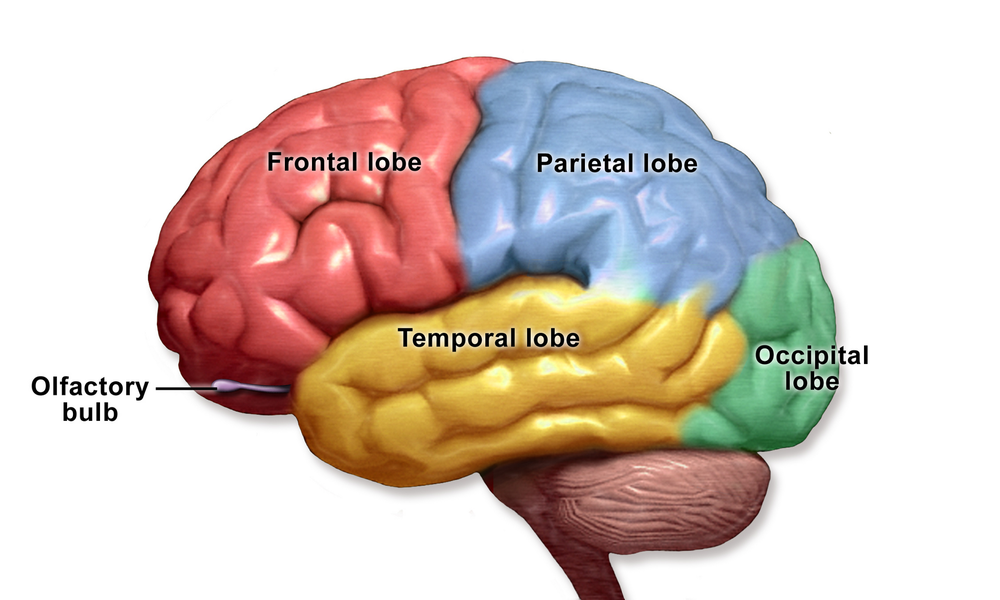
The cerebral cortex 大脑皮层 is divided into two hemispheres 半球 and four lobes: the occipital lobes 枕叶 process vision at the rear; the temporal lobes 颞叶 process hearing and language at the sides; the parietal lobes 顶叶 hold the somatosensory cortex 体感皮层 for touch; and the frontal lobes 额叶 handle higher-order thinking and executive function 执行功能.

Language sits mainly in the left hemisphere: Broca's area 布罗卡区 for speech production and Wernicke's area 韦尼克区 for comprehension.

Split-brain research 裂脑研究, done on patients whose corpus callosum 胼胝体 was cut to treat severe epilepsy, shows the two hemispheres can work independently. Researchers present information to one visual field 视野 at a time, because each field is processed by the opposite hemisphere.

Brain plasticity 大脑可塑性 is the brain's ability to rewire itself and form new connections, which supports recovery after damage. Research methods include EEG 脑电图 and fMRI 功能性磁共振成像 scans, case studies, and lesioning 损毁法.

ไทย

สมองถูกศึกษาจากล่างขึ้นบน เนื่องจากโครงสร้างด้านล่างจัดการงานพื้นฐานที่สุด

  • Brain stem รวมถึง medulla ควบคุมการหายใจและอัตราการเต้นของหัวใจ
  • Reticular activating system ควบคุมความตื่นตัวและการกระตุ้น
  • Cerebellum ควบคุมการประสานงาน สมดุล และการเรียนรู้บางประเภทอย่าง procedural learning
  • Limbic system อยู่ภายใน cerebral cortex ประกอบด้วย thalamus (สถานีส่งต่อของ senses), hypothalamus (ความหิว ความกระหาย อุณหภูมิ), pituitary gland, hippocampus (การสร้างความทรงจำใหม่) และ amygdala (ความกลัวและอารมณ์)

Cerebral cortex แบ่งเป็นสอง hemispheres และสี่ lobes: occipital lobes ประมวลผลภาพที่ด้านหลัง; temporal lobes ประมวลผลเสียงและภาษาที่ด้านข้าง; parietal lobes เก็บ somatosensory cortex สำหรับสัมผัส; และ frontal lobes จัดการการคิดระดับสูงและ executive function

ภาษาตั้งอยู่หลักในซีกสมองซ้าย: Broca's area สำหรับการผลิตคำพูด และ Wernicke's area สำหรับการเข้าใจความหมาย

Split-brain research ซึ่งทำกับผู้ป่วย whose corpus callosum ถูกตัดเพื่อรักษาโรค_TitleSevere epilepsya แสดงให้เห็นว่าซีกสมองทั้งสองสามารถทำงานแยกจากกันได้ นักวิจัยนำเสนอข้อมูลให้ซีก visual field เดียวกันในแต่ละครั้ง เนื่องจากแต่ละ visual field จะถูกประมวลผลโดยซีกสมองตรงข้าม

Brain plasticity คือความสามารถของสมองในการปรับโครงสร้างใหม่และสร้างการเชื่อมต่อใหม่ ซึ่งช่วยในการฟื้นฟูหลังเกิดความเสียหาย ระเบียบวิธีวิจัยประกอบด้วย EEG และการสแกน fMRI กรณีศึกษา และการ lesioning

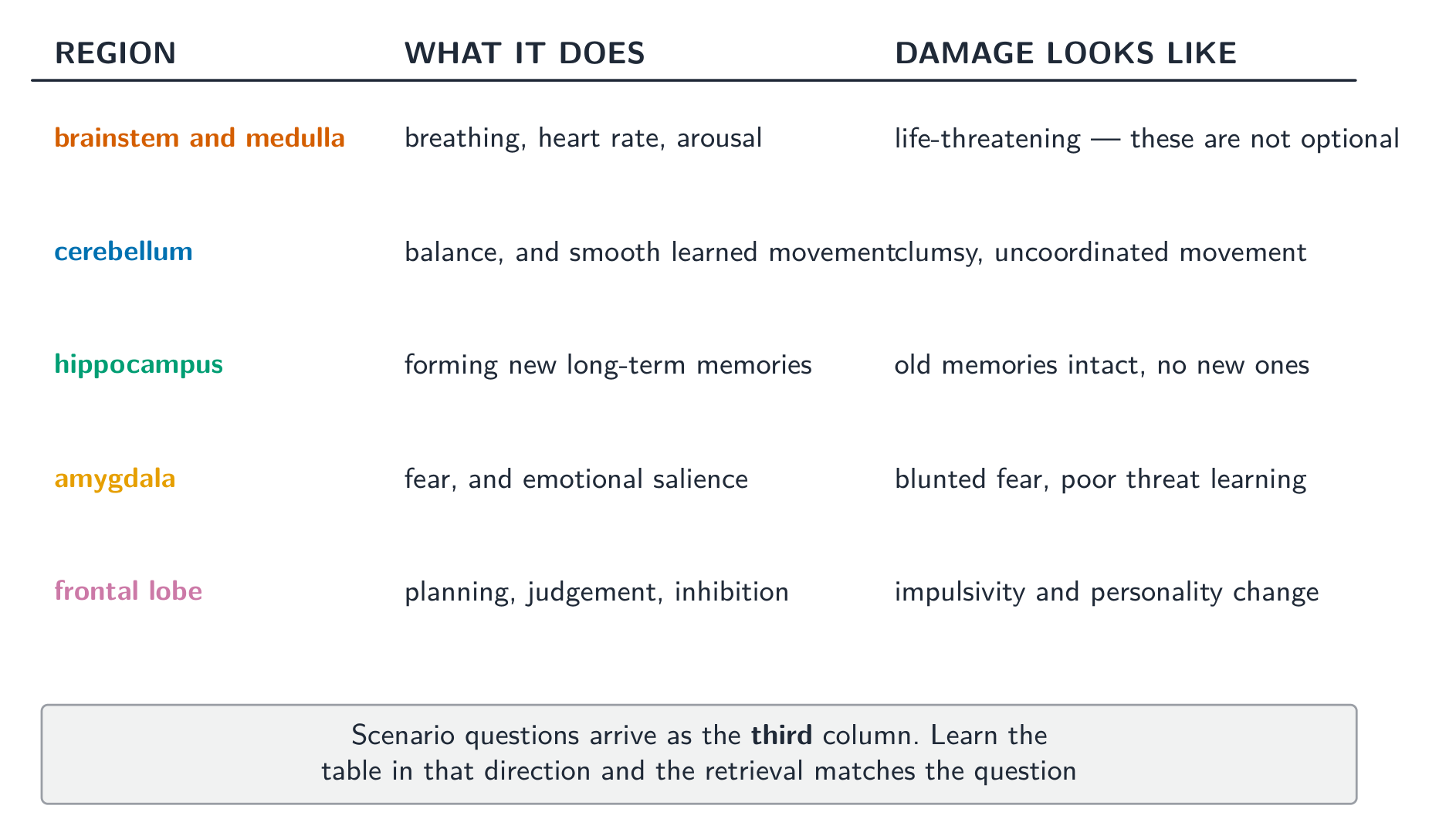
Scenario questions arrive as the third column - learn the table in that direction
The four lobes of the cerebral cortex
Explore · ⁨สำรวจ⁩

Match each deficit to the region · ⁨จับคู่ความบกพร่องแต่ละชนิดกับบริเวณ⁩

Scenario questions arrive as a deficit, so learn the table in that direction. · ⁨คำถามสถานการณ์ปรากฏเป็นความบกพร่อง ดังนั้นเรียนรู้ตารางจากด้านนี้ไปอีกด้านหนึ่ง⁩

Vocabulary · ⁨คำศัพท์⁩ Train · ⁨ฝึกฝน⁩
English ไทย
brain stem/breɪn stem/ ก้านสมอง
medulla/ˈmedʌlə/ เมดูลลา
reticular activating system/reˈtɪkjʊlə ˈæktɪveɪtɪŋ ˈsɪstəm/ ระบบกระตุ้นแบบเรติคูลาร์
cerebellum/ˌserɪˈbeləm/ ซีเบลลุ่ม (cerebellum)
procedural learning/prəˈsiːdʒərəl ˈlɜːnɪŋ/ การเรียนรู้เชิงขั้นตอน
limbic system/ˈlɪmbɪk ˈsɪstəm/ ระบบลิมบิก
thalamus/ˈθælæməs/ талаมัส (thalamus)
hypothalamus/ˌhaɪpəʊˈθælæməs/ ไฮโปทาลามัส (hypothalamus)
pituitary gland/pɪˈtjuːɪtəri ɡlænd/ ต่อมหมวกไตส่วนกลาง
hippocampus/ˈhɪpəkæmpəs/ ฮิปโปแคมปัส
amygdala/ˌæmɪɡˈdɑːlə/ อะมigdala (amygdala)
cerebral cortex/ˈserɪbrəl ˈkɔːteks/ кореเท็กซ์สมอง (cerebral cortex)
hemispheres/ˈhemɪsfɪəz/ ซีกสมอง
occipital lobes/ˈɒksɪpɪtl ləʊbz/ กลีบหลัง
temporal lobes/ˈtempərəl ləʊbz/ กลีบข้าง
parietal lobes/ˈpæraɪətl ləʊbz/ กลีบยอด
somatosensory cortex/ˈsɒmətəʊsənsəri ˈkɔːteks/ คอร์เทกซ์สัมผัส
frontal lobes/ˈfrʌntl ləʊbz/ กลีบหน้า
executive function/eɡˈzekjuːtɪv ˈfʌŋkʃn/ หน้าที่ทางการบริหาร
Broca's area/ˈbrəʊkəz ˈeərɪə/ บริเวณบรอก้า
Wernicke's area/ˈwɜːnɪks ˈeərɪə/ บริเวณเวอร์นิค
Split-brain research/splɪt breɪn rɪˈsɜːtʃ/ การวิจัยสมองแยก
corpus callosum/ˈkɔːpəs ˈkælɒsəm/ คอรัสคัลโลซัม (corpus callosum)
visual field/ˈvɪʒuːəl fiːld/ สนามภาพ
Brain plasticity/breɪn plæˈstɪsɪti/ ความยืดหยุ่นของสมอง
EEG/ˌiː iː ˈdʒiː/ EEG
fMRI/ef ˌeˌmɑːˈraɪ/ fMRI
lesioning/ˈliːʒənɪŋ/ การตัดอวัยวะ
1.5

Consciousness and Sleep

Syllabus · ⁨หลักสูตร⁩
English

Learning Objective 1.5.A: Explain how the sleep/wake cycle affects behavior and mental processes throughout the day and night.

  • 1.5.A.1 Consciousness has varying levels of awareness of thoughts, feelings, behavior, and events in individuals’ internal and external worlds. Sleep and wakefulness are two types of consciousness.
  • 1.5.A.2 The sleep/wake cycle is a circadian rhythm, which in humans is about a 24-hour cycle. Jet lag and shift work are disruptions of the circadian rhythm.
  • 1.5.A.3 The stages of sleep are identified by their specific EEG patterns.
    • 1.5.A.3 .i NREM sleep occurs in Stages 1 through 3 and decreases in duration throughout the cycle. Hypnagogic sensations occur as one enters Initial Stage 1 sleep.
    • 1.5.A.3 .ii REM sleep is considered paradoxical because it produces waves similar to wakefulness, but the body is at its most relaxed. Dreaming typically occurs in REM sleep. The frequency of REM sleep typically increases as the cycle progresses. When deprived of REM sleep, REM rebound can occur.
  • 1.5.A.4 Theories regarding the structure and function of dreams include activation-synthesis and consolidation theory.
    • Exclusion Statement: The psychoanalytic theory of dreams is outside of the scope of the AP Psychology Exam.
  • 1.5.A.5 Memory consolidation and restoration are current theories about why sleep occurs. These theories suggest that sleep is useful for organizing and consolidating memories or restoring depleted resources used throughout a given day.
  • 1.5.A.6 Many disorders interrupt healthy sleep, and their effects on waking behavior and health vary. Sleep disruptions can affect physical and cognitive performance during wakefulness. Treating sleep disorders and following regular schedules for sleeping can improve waking performance and overall well-being. Disorders commonly studied in introductory psychology include insomnia, narcolepsy, REM sleep behavior disorder, sleep apnea, and somnambulism.
    • Exclusion Statement: The AP Psychology Exam will only address the listed disorders in EK 1.5.A.6.
ไทย

จุดประสงค์การเรียนรู้ 1.5.A: อธิบายว่าวงจรการนอนหลับ/ตื่นมีผลต่อพฤติกรรมและกระบวนการทางจิตตลอดทั้งวันและคืนอย่างไร

  • 1.5.A.1 Consciousness มีระดับการ awareness ที่แตกต่างกันของ thoughts, feelings, behavior และ events ในโลกภายในและภายนอกของบุคคล การนอนหลับและความตื่นคือสองประเภทของ consciousness
  • 1.5.A.2 วงจรการนอนหลับ/ตื่นคือ circadian rhythm ซึ่งในมนุษย์มีรอบประมาณ 24 ชั่วโมง Jet lag และ shift work เป็นการรบกวน circadian rhythm
  • 1.5.A.3 ระยะของการนอนหลับระบุโดย EEG patterns เฉพาะ
    • 1.5.A.3 .i NREM sleep เกิดขึ้นในช่วง Stage 1 ถึง 3 และลดระยะเวลาลงตลอด cycle Hypnagogic sensations เกิดขึ้นเมื่อเข้าสู่ Initial Stage 1 sleep
    • 1.5.A.3 .ii การนอนหลับระยะ REM ถือว่าขัดแย้งเพราะสร้างคลื่นคล้ายกับการตื่น แต่ร่างกายอยู่ในภาวะผ่อนคลายที่สุด. การฝันมักเกิดขึ้นduring REM sleep. ความถี่ของการนอนหลับระยะ REM มักเพิ่มขึ้นเมื่อรอบการนอนหลับดำเนินไป. เมื่อขาดการนอนหลับระยะ REM อาจเกิดREM rebound ได้
  • 1.5.A.4 ทฤษฎีเกี่ยวกับโครงสร้างและหน้าที่ของฝัน รวมถึง activation-synthesis และ consolidation theory
    • ข้อยกเว้น: ทฤษฎีจิตวิเคราะห์เกี่ยวกับความฝันอยู่นอกขอบเขตของการสอบ AP Psychology
  • 1.5.A.5 Memory consolidation และ restoration เป็นทฤษฎีปัจจุบันเกี่ยวกับเหตุผลที่คนนอนหลับ ทฤษฎีเหล่านี้ชี้ว่าการนอนหลับมีประโยชน์ต่อการ organize และ consolidate ความทรงจำหรือ restore resources ที่ depleted ตลอดวันที่กำหนด
  • 1.5.A.6 รบกวนการนอนหลับหลายชนิดสามารถขัดขวางการนอนหลับที่มีสุขภาพดี และผลกระทบต่อการพฤติกรรมและสุขภาพขณะตื่นจะแตกต่างกัน การรบกวนการนอนหลับอาจส่งผลต่อประสิทธิภาพทางกายภาพและสติปัญญาขณะตื่น การรักษาความผิดปกติของการนอนหลับและการปฏิบัติตามตารางเวลาการนอนหลับที่สม่ำเสมอสามารถปรับปรุงประสิทธิภาพขณะตื่นและสุขภาวะโดยรวมได้ ความผิดปกติที่มักถูกศึกษาในจิตวิทยาพื้นฐาน ได้แก่ ภาวะนอนไม่หลับ ภาวะง่วงนอนเรื้อรัง ภาวะพฤติกรรมช่วงหลับ REM ภาวะหยุดหายใจขณะหลับ และภาวะเดินเล่น
    • คำ声明เรื่องข้อยกเว้น: การสอบ AP Psychology จะครอบคลุมเฉพาะความผิดปกติที่ระบุไว้ใน EK 1.5.A.6 เท่านั้น

Source: College Board AP Course and Exam Description · ⁨แหล่งที่มา: คำอธิบายหลักสูตรและข้อสอบ College Board AP⁩

English

Consciousness 意识 is awareness of internal and external events, and it varies in level.

The sleep/wake cycle is a circadian rhythm 昼夜节律 of about 24 hours. Jet lag 时差反应 and shift work disrupt it.

Sleep stages are identified by EEG patterns. NREM sleep 非快速眼动睡眠 covers stages 1 to 3; hypnagogic sensations 入睡幻觉 occur as you fall asleep. REM sleep 快速眼动睡眠 is called paradoxical sleep 异相睡眠 because the brain looks awake while the body is most relaxed, and most dreaming happens here.

Two examinable theories explain dreams: activation-synthesis theory 激活-综合理论 (the brain interprets random activity) and consolidation theory 巩固理论 (dreams reflect memory processing). Sleep itself is explained by memory consolidation 记忆巩固 and restoration 恢复 theories.

Note: the psychoanalytic theory of dreams is outside the exam's scope.

Sleep disorders disrupt waking behavior and health: insomnia 失眠, narcolepsy 发作性睡病, sleep apnea 睡眠呼吸暂停, somnambulism 梦游 (sleepwalking), and REM sleep behavior disorder 快速眼动睡眠行为障碍.

ไทย

Consciousness คือการตระหนักรู้ถึงเหตุการณ์ภายในและภายนอก และมีระดับที่แตกต่างกัน

วงจรการนอนหลับ/ตื่นคือ circadian rhythm ที่มีความยาวประมาณ 24 ชั่วโมง Jet lag และการทำงานเป็นกะจะรบกวนวงจรนี้

ระยะของการนอนหลับระบุได้จากลวดลาย EEG NREM sleep ครอบคลุมระยะที่ 1 ถึง 3; hypnagogic sensations เกิดขึ้นขณะเรากำลังหลับ REM sleep เรียกว่า paradoxical sleep เพราะสมองดูเหมือนตื่นแต่ร่างกายผ่อนคลายที่สุด และมีการฝันส่วนใหญ่เกิดขึ้นในระยะนี้

ทฤษฎีสองทฤษฎีที่ออกข้อสอบเพื่ออธิบายการฝัน ได้แก่ activation-synthesis theory- (สมองตีความกิจกรรมแบบสุ่ม) และ consolidation theory (การฝันสะท้อนกระบวนการจัดเก็บความจำ) การนอนหลับเองอธิบายได้ด้วยทฤษฎี memory consolidation และ restoration

หมายเหตุ: ทฤษฎีจิตวิเคราะห์เกี่ยวกับการฝันอยู่นอกขอบเขตของข้อสอบ

การรบกวนการนอนหลับส่งผลต่อพฤติกรรมและความสุขภาพตอนตื่น: insomnia, narcolepsy, sleep apnea, somnambulism (เดินเล่นขณะหลับ), และ REM sleep behavior disorder

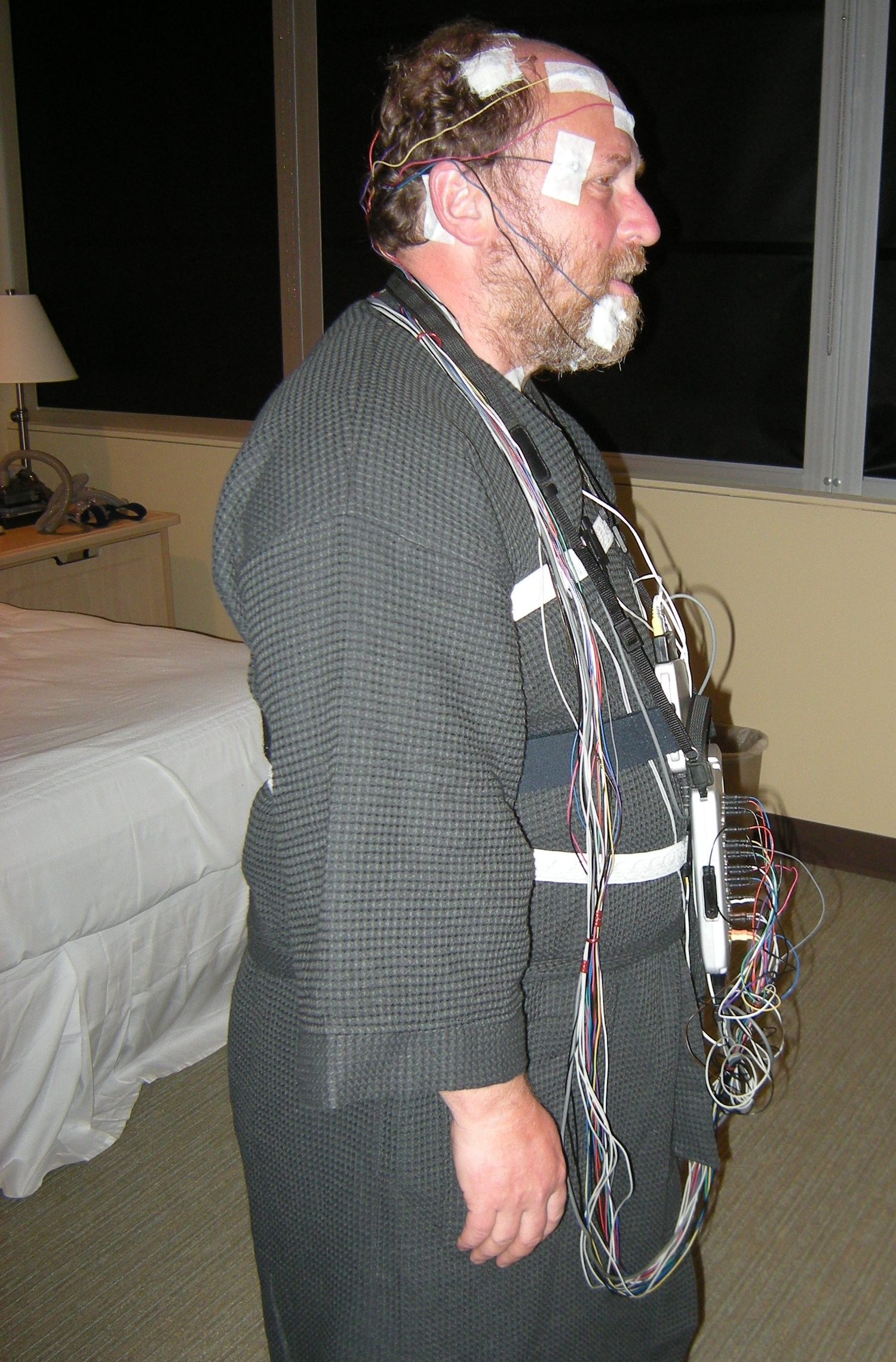
A participant wired for polysomnography - this is what measuring sleep stages actually looks like
Vocabulary · ⁨คำศัพท์⁩ Train · ⁨ฝึกฝน⁩
English ไทย
behavior/bɪˈheɪvjə/ พฤติกรรม
mental processes/ˈmentl ˈprəʊsesɪz/ กระบวนการทางจิตใจ
Consciousness/ˈkɒnʃəsnəs/ สติรู้ตัว
circadian rhythm/sɜːˈkeɪdɪən ˈrɪðəm/ จังหวะรอบวัน
Jet lag/dʒet læɡ/ เวลาJET ลาก
NREM sleep/ˌenˈrem sliːp/ การนอนหลับ NREM
hypnagogic sensations/ˌhɪpnəˈɡɒɡɪk senˈseɪʃnz/ ความรู้สึกก่อนนอน
REM sleep/rem sliːp/ REM sleep
paradoxical sleep/ˌpærəˈdɒksɪkl sliːp/ การนอนหลับแบบพาราดอกซ์
activation-synthesis theory/ˌæktɪˈveɪʃn ˈsɪnθəsɪs ˈθɪəri/ ทฤษฎีการกระตุ้นและการสังเคราะห์
consolidation theory/kənˌsɒlɪˈdeɪʃn ˈθɪəri/ ทฤษฎีการรวมความจำ
memory consolidation/ˈmeməri kənˌsɒlɪˈdeɪʃn/ การรวมความจำ (memory consolidation)
restoration/ˌrestəˈreɪʃn/ การฟื้นฟู (restoration)
insomnia/ɪnˈsɒmnɪə/ ภาวะนอนไม่หลับ
narcolepsy/ˈnɑːkəʊlepsi/ narcolepsy
sleep apnea/sliːp əpˈnɪə/ ภาวะหยุดหายใจขณะนอนหลับ
somnambulism/sɒmˈnæmbjuːlɪzəm/ ภาวะเดินเล่นตอนกลางคืน
REM sleep behavior disorder/rem sliːp bɪˈheɪvjə dɪˈsɔːdə/ ความผิดปกติของการนอนหลับแบบมีลูกตาเคลื่อนไหวเร็ว (RBD)
Sensation/senˈseɪʃn/ ความรู้สึก (Sensation)
1.6

Sensation

Syllabus · ⁨หลักสูตร⁩
English

Learning Objective 1.6.A: Explain how the process of sensation is related to behavior and mental processes.

  • 1.6.A.1 Sensation is the process of detecting information from the environment that meets a certain threshold and transducing stimuli into neurochemical messages for processing (perception) in the brain. The absolute threshold occurs when a stimulus can be detected at least 50% of the time.
  • 1.6.A.2 Detection of change in stimuli or diminished sensitivity to stimuli can be explained by the just-noticeable difference and sensory adaptation. Weber’s law describes the degree to which stimuli need to be different for the difference to be detected.
  • 1.6.A.3 The sensory systems constantly work together in a process called sensory interaction. Synesthesia is an experience of sensation in which one system of sensation is experienced through another.

Learning Objective 1.6.B: Explain how the structures and functions of the visual sensory system relate to behavior and mental processes.

  • 1.6.B.1 The retina is the photosensitive surface at the back of the eye. Cells in the retina capture visual information that is transduced to the brain for processing. Evidence of incomplete images captured by the retina is demonstrated by the presence of the blind spot, where the visual nerve exits the eye. The brain fills in the gaps in the incomplete retinal images to perceive a relatively complete picture of the world.
  • 1.6.B.2 Visual stimuli are focused onto the retina by the lens via a process called accommodation. When this process is altered, nearsightedness or farsightedness can result.
  • 1.6.B.3 Cells that lie in the periphery of the eye and detect shapes and movement, but not color, are called rods. These cells are mainly activated in low-light environments. These cells play a role in light and dark adaptation.
  • 1.6.B.4 Color vision is explained by both the trichromatic theory and the opponent-process theory.
    • 1.6.B.4.i Photoreceptor cells located in the fovea of the eye that process color and detail are called cones. Researchers have identified blue (detecting short wavelengths), green (detecting medium wavelengths) and red (detecting long wavelengths) cones in the retina.
    • 1.6.B.4.ii Afterimages result when certain ganglion cells in the retina are activated while others are not. The ganglion cells involved in this opponent process are red/green, blue/ yellow/ and black/white.
    • 1.6.B.4.iii Color vision deficiency involves damage or irregularities to one or more cones or ganglion cells (red/green, blue/ yellow). Color vision deficiency includes dichromatism or monochromatism.
  • 1.6.B.5 Damage to parts of the brain responsible for vision (mainly the occipital lobes) can result in disorders such as prosopagnosia (face blindness) and blindsight.

Learning Objective 1.6.C: Explain how the structures and functions of the auditory sensory system relate to behavior and mental processes.

  • 1.6.C.1 Sound occurs through the movement of air molecules at different wavelengths (called pitch) and amplitudes (called loudness).
  • 1.6.C.2 Theories that help explain pitch perception include place theory, volley theory, and frequency theory.
  • 1.6.C.3 Sound localization describes how we identify where sounds in our environment are coming from.
  • 1.6.C.4 Hearing difficulties can result from aging and various kinds of damage to auditory structures. Types of hearing loss include conduction deafness and sensorineural deafness.

Learning Objective 1.6.D: Explain how the structures and functions of the chemical sensory systems relate to behavior and mental processes.

  • 1.6.D.1 Structures in the nose and brain process and/ or transduce olfactory stimuli. Smell is the only sense not processed first in the thalamus of the brain. Pheromones produce chemical messages for the olfactory system.
  • 1.6.D.2 Gustation is the sense of taste, and types of tastes include sweet, sour, salty, bitter, umami, and oleogustus.
  • 1.6.D.3 Structures in the tongue, mouth, and brain process and/or transduce basic tastes. The number of taste receptors on the tongue is related to how sensitive people are to tastes, classifying them as supertasters, medium tasters, or nontasters.
  • 1.6.D.4 The chemical senses interact to create the sensation of taste. Without the sense of smell, taste sensations are either muted or not experienced.

Learning Objective 1.6.E: Explain how the structures and functions of the touch sensory system relate to behavior and mental processes.

  • 1.6.E.1 Structures within the skin and brain process and/or transduce touch stimuli. The sensation of “hot” is produced by the activation of warm and cold receptors in the skin.

Learning Objective 1.6.F: Explain how the structures and functions of the pain sensory system relate to behavior and mental processes.

  • 1.6.F.1 Pain is processed both in the body and in the brain. Gate control theory is one attempt to describe the complexities of pain. Phantom limb sensation occurs when people who have lost limbs report sensation or pain where the limb used to be.

Learning Objective 1.6.G: Explain how the structures and functions that maintain balance (vestibular) and body movement (kinesthetic) relate to behavior and mental processes.

  • 1.6.G.1 The vestibular sense controls balance and is primarily detected by the semicircular canals and structures in the brain.
  • 1.6.G.2 Kinesthesis the sense of one’s body movement. Kinesthesis allows the body to move in coordinated ways without having to look at the various parts of the body as it moves.
ไทย

จุดประสงค์การเรียนรู้ 1.6.A: อธิบายว่ากระบวนการรับรู้ด้วยประสาทสัมพันธ์กับพฤติกรรมและกระบวนการทางจิตใจอย่างไร

  • 1.6.A.1 การรับรู้ด้วยประสาทสัมผัสคือกระบวนการตรวจจับข้อมูลจากสิ่งแวดล้อมซึ่งมีค่าเกินเกณฑ์ tertentu และแปลงกระตุ้นให้กลายเป็นสัญญาณเคมีเพื่อส่งไปประมวลผล (การรับรู้) ในสมอง เกณฑ์สัมบูรณ์เกิดขึ้นเมื่อกระตุ้นสามารถถูกตรวจจับได้อย่างน้อย 50% ของเวลา
  • 1.6.A.2 การตรวจจับการเปลี่ยนแปลงของกระตุ้นหรือความไวต่อกระตุ้นที่ลดลงสามารถอธิบายได้ด้วยผลต่างที่สังเกตได้เล็กน้อย (just-noticeable difference) และการปรับตัวทางประสาทสัมผัส กฎของ Weber อธิบายถึงระดับที่กระตุ้นต้องแตกต่างกันมากเพียงใดจึงจะตรวจจับความแตกต่างนั้นได้
  • 1.6.A.3 ระบบประสาทสัมผัสทำงานร่วมกันอย่างต่อเนื่องในกระบวนการที่เรียกว่า ปฏิสัมพันธ์ทางประสาทสัมผัส (sensory interaction) ปรากฏการณ์******/esthesia* คือประสบการณ์การรับรู้โดยที่ระบบประสาทสัมผัสหนึ่งถูกสัมผัสผ่านอีกระบบหนึ่ง

จุดประสงค์การเรียนรู้ 1.6.B: อธิบายว่าโครงสร้างและหน้าที่ของระบบประสาทสัมผัสทางการมองเห็นเกี่ยวข้องกับพฤติกรรมและกระบวนการทางจิตใจอย่างไร

  • 1.6.B.1 จอตาเป็นพื้นผิวไวแสงที่อยู่ด้านหลังของตา เซลล์ในจอตาจับข้อมูลภาพและแปลงสัญญาณไปยังสมองเพื่อประมวลผล หลักฐานที่แสดงว่าจอตาจับภาพไม่สมบูรณ์คือจุดบอด (blind spot) ซึ่งเป็นตำแหน่งที่เส้นประสาทตาออกจากดวงตา สมองจะเติมเต็มช่องว่างในภาพที่ขาดหายไปจากจอตาเพื่อให้เราเห็นภาพโลกที่สมบูรณ์-ish
  • 1.6.B.2 กระตุ้นทางสายตาจะถูกโฟกัส onto จอตาโดยเลนส์ตาผ่านกระบวนการที่เรียกว่า การปรับระยะ (accommodation) เมื่อกระบวนการนี้เปลี่ยนไป อาจเกิดภาวะสายใกล้หรือสายไกลได้
  • 1.6.B.3 เซลล์ที่อยู่บริเวณขอบของดวงตาซึ่งตรวจจับรูปร่างและการเคลื่อนไหวแต่ไม่ตรวจจับสี เรียกว่า เซลล์แท่ง (rods) เซลล์เหล่านี้ถูกกระตุ้นหลักๆ ในสภาพแวดล้อมที่มีแสงน้อย และมีบทบาทในการปรับตัวต่อแสงและมืด
  • 1.6.B.4 การมองเห็นสีอธิบายได้ทั้งทฤษฎีสามสี (trichromatic theory) และทฤษฎีกระบวนการตรงข้าม (opponent-process theory)
    • 1.6.B.4.i เซลล์รับแสง (photoreceptor cells) ที่อยู่ในฟิวเวา (fovea) ของดวงตาซึ่งประมวลผลสีและรายละเอียดเรียกว่า เซลล์กรวย (cones) นักวิจัยพบเซลล์กรวยสีน้ำเงิน (ตรวจจับคลื่นสั้น) สีเขียว (ตรวจจับคลื่นกลาง) และสีแดง (ตรวจจับคลื่นยาว) ในจอตา
    • 1.6.B.4.ii ภาพค้าง (afterimages) เกิดขึ้นเมื่อเซลล์ ганเกลียนบางชนิดในจอตาส่งสัญญาณในขณะที่อีกบางชนิดไม่ส่งสัญญาณ เซลล์ ганเกลียนที่เกี่ยวข้องในกระบวนการตรงข้ามนี้ ได้แก่ สีแดง/เขียว สีน้ำเงิน/เหลือง และสีดำ/ขาว
    • 1.6.B.4.iii ภาวะบกพร่องทางการมองเห็นสีเกี่ยวข้องกับความเสียหายหรือความผิดปกติของเซลล์กรวยหรือเซลล์ ганเกลียน (สีแดง/เขียว, น้ำเงิน/เหลือง) ภาวะบกพร่องทางการมองเห็นสีรวมถึงภาวะสองสี (dichromatism) หรือภาวะสีเดียว (monochromatism)
  • 1.6.B.5 ความเสียหายต่อส่วนต่างๆ ของสมองที่รับผิดชอบการมองเห็น (ส่วนใหญ่คือกลีบหลัง occipital lobes) สามารถนำไปสู่ความผิดปกติเช่น ภาวะจำหน้าไม่ได้ (prosopagnosia หรือ face blindness) และภาวะ.number blindness blindsight

จุดประสงค์การเรียนรู้ 1.6.C: อธิบายว่าโครงสร้างและหน้าที่ของระบบประสาทสัมผัสทางการได้ยินเกี่ยวข้องกับพฤติกรรมและกระบวนการทางจิตใจอย่างไร

  • 1.6.C.1 เสียงเกิดขึ้นจากการเคลื่อนที่ของโมเลกุลอากาศที่มีความยาวคลื่นต่างกัน (ซึ่งเรียกว่า ระดับเสียง pitch) และความสูงต่ำของคลื่น (ซึ่งเรียกว่า ความดัง loudness)
  • 1.6.C.2 ทฤษฎีที่ช่วยอธิบายการรับรู้ระดับเสียง ได้แก่ ทฤษฎีตำแหน่ง (place theory), ทฤษฎีกลุ่ม (volley theory), และทฤษฎีความถี่ (frequency theory)
  • 1.6.C.3 การระบุแหล่งกำเนิดเสียง (sound localization) อธิบายวิธีการที่เราระบุได้ว่าเสียงในสิ่งแวดล้อมมา откуда
  • 1.6.C.4 ปัญหาทางการได้ยินอาจเกิดจากความเสื่อมตามวัยและความเสียหายต่างๆ กับโครงสร้างทางการได้ยิน ประเภทของการสูญเสียการได้ยิน ได้แก่ ภาวะหูหนวกจากการนำเสียง (conduction deafness) และภาวะหูหนวกจากประสาทสัมผัส (sensorineural deafness)

จุดประสงค์การเรียนรู้ 1.6.D: อธิบายว่าโครงสร้างและหน้าที่ของระบบประสาทสัมผัสทางเคมีเกี่ยวข้องกับพฤติกรรมและกระบวนการทางจิตใจอย่างไร

  • 1.6.D.1 โครงสร้างในจมูกและสมองประมวลผลและ/หรือแปลงสัญญาณกลิ่น กลิ่นเป็นประสาทสัมผัสเดียวที่ไม่ถูกประมวลผลครั้งแรกใน талаมัสของร่างกาย พหามอน (pheromones) สร้างสัญญาณเคมีสำหรับระบบรับกลิ่น
  • 1.6.D.2 การลิ้มรส (gustation) คือประสาทสัมผัสแห่งรสชาติ โดยประเภทของรสชาติได้แก่ หวาน เปรี้ยว เค็ม ขม อูมามิ และโอเลโกกุส (oleogustus)
  • 1.6.D.3 โครงสร้างในลิ้น ปาก และสมองประมวลผลและ/หรือแปลงรสชาติพื้นฐาน จำนวนตัวรับรสชาติบนลิ้นมีความสัมพันธ์กับความไวต่อรสชาติของบุคคล โดยแบ่งออกเป็น ผู้ลิ้มรสแรง (supertasters), ผู้ลิ้มรสปานกลาง (medium tasters) และผู้ไม่ลิ้มรส (nontasters)
  • 1.6.D.4 ประสาทสัมผัสทางเคมีทำงานร่วมกันเพื่อสร้างความรู้สึกแห่งรสชาติ หากขาดประสาทสัมผัสแห่งกลิ่น รสชาติที่ ลิ้มได้จะจางลงหรือไม่รู้สึกเลย

จุดประสงค์การเรียนรู้ 1.6.E: อธิบายว่าโครงสร้างและหน้าที่ของระบบประสาทสัมผัสแห่งสัมผัสเกี่ยวข้องกับพฤติกรรมและกระบวนการทางจิตใจอย่างไร

  • 1.6.E.1 โครงสร้างภายในผิวหนังและสมองประมวลผลและ/หรือแปลงสัญญาณสัมผัส ความรู้สึก "ร้อน" ถูกผลิตขึ้นโดยการกระตุ้นตัวรับความร้อนและเย็นในผิวหนัง

จุดประสงค์การเรียนรู้ 1.6.F: อธิบายว่าโครงสร้างและหน้าที่ของระบบประสาทสัมผัสแห่งความเจ็บปวดเกี่ยวข้องกับพฤติกรรมและกระบวนการทางจิตใจอย่างไร

  • 1.6.F.1 ความเจ็บปวดถูกประมวลผลทั้งในร่างกายและในสมอง ทฤษฎีการควบคุมประตู (Gate control theory) เป็นหนึ่งในความพยายามที่จะอธิบายความซับซ้อนของความเจ็บปวด การรู้สึกถึงอวัยวะที่หายไป (Phantom limb sensation) เกิดขึ้นเมื่อบุคคลที่สูญเสียอวัยวะรายงานว่ามีความรู้สึกหรือความเจ็บปวดในพื้นที่ที่อวัยวะนั้นเคยอยู่

วัตถุประสงค์การเรียนรู้ 1.6.G: อธิบายความสัมพันธ์ระหว่างโครงสร้างและหน้าที่ที่รักษาสมดุล (ระบบเวสติบูลาร์) และการเคลื่อนไหวของร่างกาย (ไคนิสเทติก) กับพฤติกรรมและกระบวนการทางจิตใจ

  • 1.6.G.1 ระบบเวสติบูลาร์ (Vestibular sense) ควบคุมการสมดุลและถูกตรวจจับโดยส่วนใหญ่จากท่อครึ่งวงกลมและโครงสร้างในสมอง
  • 1.6.G.2 ไคนิสเทสิก (Kinesthesia) คือความรู้สึกต่อการเคลื่อนไหวของร่างกาย ไคนิสเทสิกช่วยให้ร่างกายสามารถเคลื่อนไหวได้อย่างประสานกันโดยไม่ต้องมองส่วนต่างๆ ของร่างกายขณะเคลื่อนที่

Source: College Board AP Course and Exam Description · ⁨แหล่งที่มา: คำอธิบายหลักสูตรและข้อสอบ College Board AP⁩

English

Sensation 感觉 is detecting information from the environment and transducing 转导 it into neural signals the brain can use. Detection needs a certain absolute threshold 绝对阈限.

  • The just-noticeable difference 最小可觉差 is the smallest change a person can detect.
  • Sensory adaptation 感觉适应 is reduced sensitivity to an unchanging stimulus - you stop noticing a smell.
  • Sensory interaction 感觉相互作用 means the senses work together. Synesthesia 联觉 is when one sense triggers another.

Vision. Light is focused onto the retina 视网膜 by the lens 晶状体 changing shape, a process called visual accommodation 视觉调节; when this fails the result is nearsightedness 近视 or farsightedness 远视. Rods 视杆细胞 lie in the periphery and detect shape and movement in low light. Cones 视锥细胞 sit in the fovea 中央凹 and detect colour and detail. Colour vision needs two theories: trichromatic theory 三色理论 (blue, green and red cones) and opponent-process theory 对立过程理论, which explains afterimages 后像. Damage to the occipital lobes can cause prosopagnosia 面孔失认症, or face blindness.

Hearing. Sound is air movement; wavelength gives pitch 音高 and amplitude gives loudness 响度. Pitch perception is explained by place theory 位置理论, volley theory 齐射理论, and frequency theory 频率理论. Sound localization 声源定位 tells us where a sound comes from. Hearing loss may be conduction deafness 传导性耳聋 or sensorineural deafness 感音神经性耳聋.

The chemical senses. Olfaction 嗅觉 is the only sense not relayed first through the thalamus. Gustation 味觉 covers sweet, sour, salty, bitter, umami 鲜味, and oleogustus 脂味. The two interact: without smell, taste is muted.

Touch, pain, and body position. Skin receptors transduce touch; "hot" comes from warm and cold receptors firing together. Pain is processed in body and brain, and gate control theory 闸门控制理论 explains why attention changes how much it hurts; phantom limb 幻肢 sensations show the brain's role. The vestibular sense 前庭觉 controls balance through the semicircular canals 半规管, and kinesthesis 动觉 is the sense of body movement.

Worked example (a real AP exam question). The 2025 Article Analysis Question asked students to "Identify the research method used in the study" and then to "Explain the extent to which the research findings may or may not be generalizable using specific and relevant evidence from the study." A full-mark answer to the second part names the limitation and ties it to evidence: "The findings may not generalize widely because participants were undergraduate students at one university, so the sample was not representative of the general population." Notice the shape: Explain needs a claim plus the evidence behind it. Naming the method alone answers part A, not part E.

ไทย

Sensation คือการตรวจจับข้อมูลจากสิ่งแวดล้อมและ transducing เป็นสัญญาณประสาทที่สมองสามารถใช้ การตรวจจับต้องการ absolute threshold บางอย่าง

  • just-noticeable difference คือการเปลี่ยนแปลงที่น้อยที่สุดที่บุคคลสามารถตรวจจับได้
  • Sensory adaptation คือความไวลดลงต่อสิ่งกระตุ้นที่ไม่เปลี่ยนแปลง - คุณเริ่มไม่รู้สึกถึงกลิ่นอีกต่อไป
  • Sensory interaction หมายถึงการที่ประสาทสัมผัสทำงานร่วมกัน Synesthesia คือเมื่อประสาทสัมผัสหนึ่งกระตุ้นอีกประสาทสัมผัสหนึ่ง

Vision. แสงถูกโฟกัส onto retina โดย lens เปลี่ยนรูปร่าง กระบวนการนี้เรียกว่า visual accommodation; เมื่อสิ่งนี้ล้มเหลวผลลัพธ์คือ nearsightedness หรือ farsightedness. Rods อยู่บริเวณรอบนอกและตรวจจับรูปทรงและการเคลื่อนไหวในที่แสงน้อย Cones ตั้งอยู่ใน fovea และตรวจจับสีและรายละเอียด การมองเห็นสีต้องใช้ทฤษฎีสองทฤษฎี: trichromatic theory (cones สีน้ำเงิน เขียว และแดง) และ opponent-process theory ซึ่งอธิบาย afterimages ความเสียหายที่ occipital lobes อาจทำให้เกิด prosopagnosia หรือภาวะบอดใบหน้า

Hearing. เสียงคือการเคลื่อนตัวของอากาศ; ความยาวคลื่นกำหนด pitch และความเข้มกำหนด loudness. การรับรู้ pitch อธิบายได้ด้วย place theory, volley theory, และ frequency theory. Sound localization บอกเราว่าเสียงมาจากที่ใด การสูญเสียการได้ยินอาจเป็น conduction deafness หรือ sensorineural deafness

The chemical senses. Olfaction เป็นประสาทสัมผัสเดียวที่ไม่ส่งผ่าน thalamus ก่อน Gustation ครอบคลุมรสหวาน กรด เค็ม ขม umami, และ oleogustus. ทั้งสองมีปฏิสัมพันธ์กัน: หากไม่มีกลิ่น รสชาติจะจางลง

Touch, pain, and body position. ตัวรับความรู้สึกในผิวหนัง transduce สัมผัส; “ร้อน” มาจากการที่ตัวรับอุ่นและเย็นยิงสัญญาณพร้อมกัน ความเจ็บปวดถูกประมวลผลในร่างกายและสมอง และ gate control theory อธิบายว่าทำไมการใส่ใจจึงเปลี่ยนปริมาณความเจ็บปวด; phantom limb sensations แสดงบทบาทของสมอง vestibular sense ควบคุมการสมดุลผ่าน semicircular canals, และ kinesthesis คือการรับรู้การเคลื่อนไหวของร่างกาย

Worked example (a real AP exam question). The 2025 Article Analysis Question asked students to "Identify the research method used in the study" และจากนั้น "Explain the extent to which the research findings may or may not be generalizable using specific and relevant evidence from the study." คำตอบเต็มคะแนนสำหรับส่วนที่สองระบุว่าข้อจำกัด and เชื่อมโยง它与 evidence: "The findings may not generalize widely because participants were undergraduate students at one university, so the sample was not representative of the general population." ระวังรูปแบบ: Explain ต้องการ claim plus evidence ที่รองรับการตั้งคำถาม การระบุวิธีการเพียงอย่างเดียวตอบส่วน A ไม่ใช่ส่วน E

Vocabulary · ⁨คำศัพท์⁩ Train · ⁨ฝึกฝน⁩
English ไทย
transducing/trænsˈdjuːsɪŋ/ การแปลงสัญญาณ
absolute threshold/ˈæbsəluːt ˈθreʃəʊld/ ขีดจำกัด绝对
just-noticeable difference/dʒʌst ˈnəʊtɪsəbl ˈdɪfrəns/ ความแตกต่างที่สังเกตได้ทันที
Sensory adaptation/ˈsensəri ˌædæpˈteɪʃn/ การปรับตัวทางประสาทสัมผัส
Sensory interaction/ˈsensəri ˌɪntəˈrækʃn/ การโต้ตอบของประสาทสัมผัส
Synesthesia/ˌsaɪnɪsˈθiːzɪə/ ภาวะรวมประสาทสัมผัส
retina/ˈretɪnə/ retina
lens/lenz/ lens
visual accommodation/ˈvɪʒuːəl əˌkɒməˈdeɪʃn/ การปรับภาพทางสายตา
nearsightedness/ˈnɪəsaɪtɪdnəs/ สายตาใกล้
farsightedness/ˈfɑːsaɪtɪdnəs/ สายตายาว
Rods/rɒdz/ แท่งรับแสง
Cones/kəʊnz/ เซลล์กร้าน
fovea/ˈfəʊvɪə/ จุดกึ่งกลางจอ
trichromatic theory/ˌtrɪkrəʊˈmætɪk ˈθɪəri/ ทฤษฎีสามสี
opponent-process theory/əˈpəʊnənt ˈprəʊses ˈθɪəri/ ทฤษฎีกระบวนการตรงข้าม
afterimages/ˈæftərɪmɪdʒɪz/ ภาพค้าง
prosopagnosia/ˌprɒsəpəɡˈnəʊzɪə/ ภาวะ不认识หน้า
pitch/pɪtʃ/ ระดับเสียง
loudness/ˈlaʊdnəs/ ระดับเสียงดัง
place theory/pleɪs ˈθɪəri/ ทฤษฎีสถานที่ (place theory)
volley theory/ˈvɒli ˈθɪəri/ ทฤษฎีวอลเลย์
frequency theory/ˈfriːkwənsi ˈθɪəri/ ทฤษฎีความถี่
Sound localization/saʊnd ˌləʊkəlaɪˈzeɪʃn/ การระบุตำแหน่งเสียง
conduction deafness/kənˈdʌkʃn ˈdefnəs/ การสูญเสียการได้ยินจากการนำส่ง (conduction deafness)
sensorineural deafness/ˈsensɔːraɪnjuːrəl ˈdefnəs/ การสูญเสียการได้ยินจากประสาทสัมผัส (sensorineural deafness)
Olfaction/ɒlˈfækʃn/ Olfaction
Gustation/ɡʌˈsteɪʃn/ การรับรส
umami/juːˈmɑːmi/ รสมะ umo
oleogustus/ˈəʊləɡʌstəs/ oleogustus
gate control theory/ɡeɪt kənˈtrəʊl ˈθɪəri/ gate control theory
phantom limb/ˈfæntəm lɪm/ 肢 phantom (phantom limb)
vestibular sense/veˈstɪbjʊlə sens/ vestibular sense
semicircular canals/ˌsemɪˈsɜːkjʊlə kəˈnælz/ semicircular canals
kinesthesis/ˈkaɪnsθəsɪs/ kinesthesis
Watch lesson · ⁨ดูบทเรียน⁩
1.6

Exam tips · ⁨ข้อแนะนำสำหรับการสอบ⁩

English
  • Learn only the listed neurotransmitters and hormones; the exam will not ask about others, and the endocrine glands are out of scope apart from the pituitary.
  • Keep sensation separate from perception: sensation is detecting and transducing, perception is interpreting (Unit 2).
  • The all-or-none principle means intensity is coded by how often a neuron fires, never by how strongly.
  • Match structure to job before you write: hippocampus forms memories, amygdala handles fear, cerebellum coordinates movement.
  • Sympathetic arouses, parasympathetic calms. If a question describes a racing heart, name the sympathetic branch.
  • Say what a scan can and cannot show. fMRI shows activity over time; EEG shows electrical patterns and identifies sleep stages.
ไทย
  • เรียนรู้เฉพาะ neurotransmitters และ hormones ที่ระบุไว้เท่านั้น; ข้อสอบจะไม่ถามเรื่องอื่น และต่อม endocrine จะอยู่นอกขอบเขตยกเว้นต่อม pituitary
  • แยก sensation ออกจาก perception: sensation คือการตรวจจับและ transducing, perception คือการตีความ (Unit 2)
  • all-or-none principle หมายความว่าความเข้มถูกเข้ารหัสโดย how often neuron ยิงสัญญาณ ไม่เคย by how strongly
  • จับคู่ structure กับ job ก่อนเขียน: hippocampus สร้างความจำ, amygdala จัดการความกลัว, cerebellum ประสานการเคลื่อนไหว
  • Sympathetic กระตุ้น, parasympathetic ผ่อนคลาย. หากโจทย์อธิบายการเต้นหัวใจเร็ว ให้ระบุ sympathetic branch
  • บอกว่า scan สามารถแสดงอะไรได้และไม่แสดงอะไร fMRI แสดง activity ตามเวลา; EEG แสดง electrical patterns และระบุระยะการนอนหลับ

Interactive lessons on this topic · ⁨บทเรียนเชิงโต้ตอบสำหรับหัวข้อนี้⁩

Work through it step by step, with instant-check exercises. · ⁨ทำทีละขั้นตอน พร้อมแบบฝึกหัดตรวจสอบผลทันที⁩

Past Papers · ⁨ข้อสอบย้อนหลัง⁩

More topics in AP Psychology · ⁨AP จิตวิทยา⁩ · ⁨หัวข้อเพิ่มเติมใน AP Psychology · ⁨AP จิตวิทยา⁩⁩

Log in or create account · ⁨เข้าสู่ระบบหรือสร้างบัญชี⁩

IGCSE, A-Level & AP