Price elasticity of supply (PES)
Введено| English | Значение |
|---|---|
| price elasticity of supply/praɪs ɪlæˈstɪsɪti ɒv səˈplaɪ/ | эластичность предложения по цене |
| inelastic/ɪnɪˈlæstɪk/ | неэластичный |
| elastic/ɪˈlæstɪk/ | эластичный |
| spare capacity/speə kəˈpæsɪti/ | свободные мощности |
| short run/ʃɔːt rʌn/ | краткосрочный период |
| perishable/ˈperɪʃəbl/ | скоропортящийся |
Can sellers react fast?
- When strawberry prices jump, a farmer can't grow more overnight — the crop takes months. A factory can add a shift tomorrow.
- Price elasticity of supply 供给价格弹性 measures how quickly and easily sellers respond.
Defining PES
- PES = how much quantity supplied responds to a price change.
- It is normally positive: a higher price brings more supply. $Q_s$ means quantity supplied.
Worked example. The price of a T-shirt rises from 8 dollars to 10 dollars. A factory raises its output from 500 to 750 a week. Find the PES.
- % change in price = (10 − 8) ÷ 8 × 100 = 25%
- % change in quantity supplied = (750 − 500) ÷ 500 × 100 = 50%
- PES = 50 ÷ 25 = 2. This is greater than 1, so supply is elastic 富有弹性: output changes by a bigger percentage than price.
- Common mistake: dividing by the new value. Always divide each change by the original value.
| PES value | Meaning |
|---|---|
| greater than 1 | elastic: quantity supplied changes by a bigger % than price |
| less than 1 | inelastic 缺乏弹性: quantity supplied changes by a smaller % than price |
| equal to 1 | unit elastic: both change by the same % |
| 0 | perfectly inelastic: quantity cannot change at all (seats in a stadium on match day) |
Спрос и предложение
Supply elasticity is how quantity responds to price.
Price rises 20% and quantity supplied rises 10%. What is PES?
Сложность 2/5 · 140 монет + небольшой бонус за первое завершение сегодня
PES = 10% / 20% = 0.5 — inelastic.
PES is normally positive because supply curves slope upward.
Сложность 1/5 · 100 монет + небольшой бонус за первое завершение сегодня
Higher price → more supplied, so PES is positive.
The price of bread rises from 2.00 dollars to 2.50 dollars. A bakery increases the quantity supplied from 200 to 220 loaves a day. Calculate the PES.
Сложность 2/5 · 140 монет + небольшой бонус за первое завершение сегодня
% change in price = 0.50 ÷ 2.00 × 100 = 25%. % change in quantity = 20 ÷ 200 × 100 = 10%. PES = 10 ÷ 25 = 0.4, so supply is inelastic.
What makes supply elastic
| Supply is more elastic when… | because… |
|---|---|
| there is spare capacity 闲置产能 | idle machines and workers can be used at once |
| firms hold stocks | goods in a warehouse can be sold straight away |
| factors can switch easily | workers and machines can move from making one product to another |
| production is quick | T-shirts take hours to make; apple trees take years |
- Supply is inelastic when these are missing: farming, mining and goods needing skilled labour are typical examples.
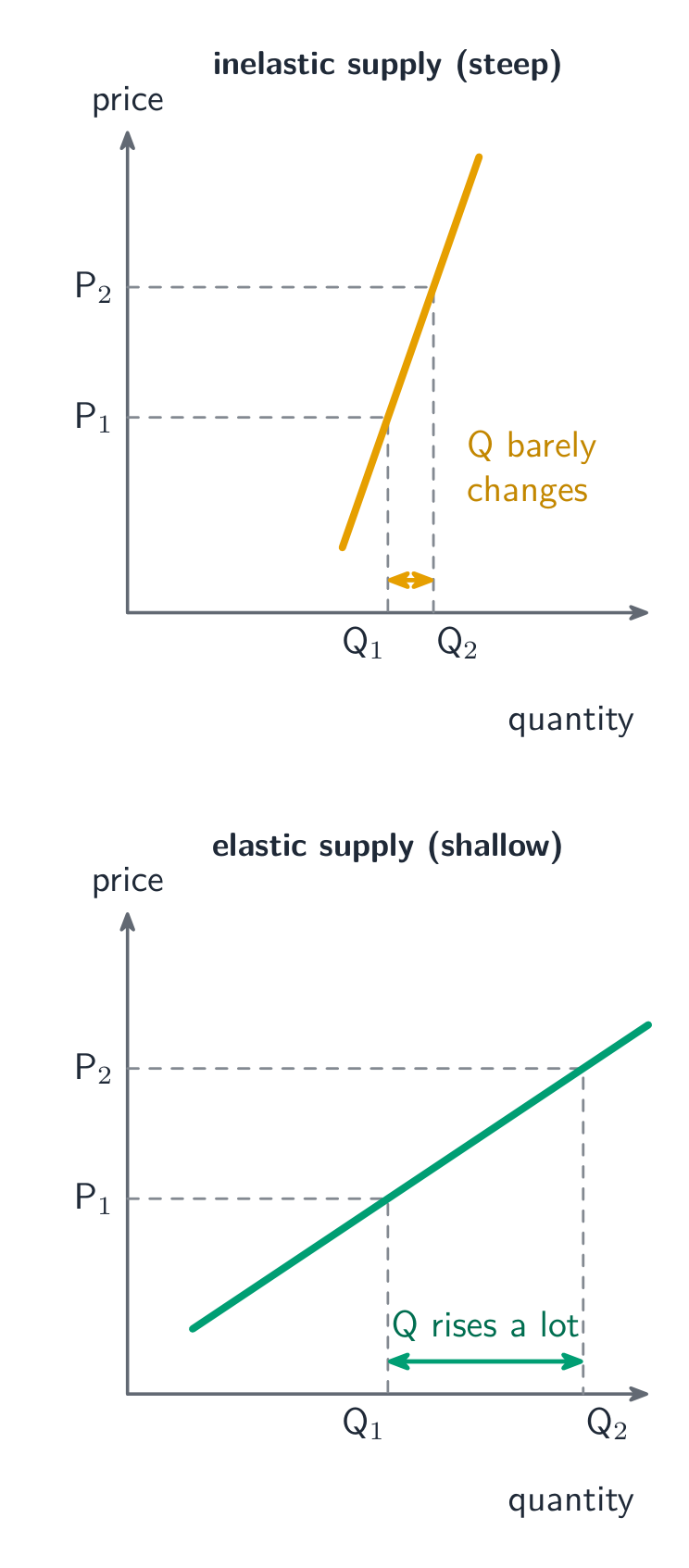
Which makes supply more elastic?
Сложность 1/5 · 100 монет + небольшой бонус за первое завершение сегодня
Spare capacity lets firms raise output quickly.
Time matters most
- In the short run 短期, supply is usually inelastic — factors are fixed.
- Given time, firms build capacity and supply becomes more elastic.
Perishable 易腐的 or slow-to-grow goods are supply-inelastic. Fresh fruit and minerals can't be produced quickly, so a price rise brings little extra supply at first.
Exam question. Explain why the supply of fresh strawberries is price inelastic in the short run. [4]
- Model answer: Strawberries take months to grow, so farmers cannot increase output quickly when the price rises (1). They are perishable, so farmers cannot keep stocks to sell later (1). Land and workers cannot easily be switched into strawberries during a season (1). So quantity supplied changes by a smaller percentage than price: PES is less than 1 (1).
- Mark-scheme reasoning: each reason must be linked to strawberries, and the last mark is for saying what inelastic means. A list of general factors earns less.
Supply tends to be most inelastic:
Сложность 1/5 · 100 монет + небольшой бонус за первое завершение сегодня
In the short run firms cannot easily change output, so supply is inelastic.
Given more ______, firms can build capacity and supply becomes more elastic.
Сложность 1/5 · 100 монет + небольшой бонус за первое завершение сегодня
Time lets fixed factors be varied, raising elasticity.
You've got it
- $\text{PES} = \dfrac{\%\Delta Q_s}{\%\Delta P}$ — its size measures supply responsiveness
- PES > 1 elastic, < 1 inelastic, = 1 unit, 0 perfectly inelastic; divide each change by the original value
- elastic supply needs spare capacity, stocks, easy switching of factors or quick production
- supply is more inelastic in the short run, more elastic over time
Write from the data: find the PES
- Price rises 8 percent. Quantity supplied rises 16 percent.
- Find PES.
Price rises by 8 percent and quantity supplied rises by 16 percent. What is PES, and is supply elastic?
16 divided by 8 is 2.
What is PES?
Сложность 1/5 · 100 монет + небольшой бонус за первое завершение сегодня
16 divided by 8 is 2, and 2 is above 1.