Acid–base titrations
Введено| English | Значение |
|---|---|
| titration/taɪˈtreɪʃn/ | титрование |
| burette/bjʊəˈret/ | бюретка |
| pipette/pɪˈpet/ | пипетка |
| end point/end pɔɪnt/ | конец титрования |
| titre/ˈtɪtə/ | объём титранта |
Measuring exactly how much
- How do you find the exact concentration of an acid or alkali? With a precise technique called a titration 滴定.
- It finds exactly when an acid and alkali have neutralised each other.
In a titration, the piece of apparatus that delivers an exact, measured volume is the:
Сложность 1/5 · 100 монет + небольшой бонус за первое завершение сегодня
The burette delivers a precise, variable volume.
The apparatus
- A burette 滴定管 delivers an exact, measured volume of one solution.
- A pipette 移液管 measures a fixed volume of the other into a flask.
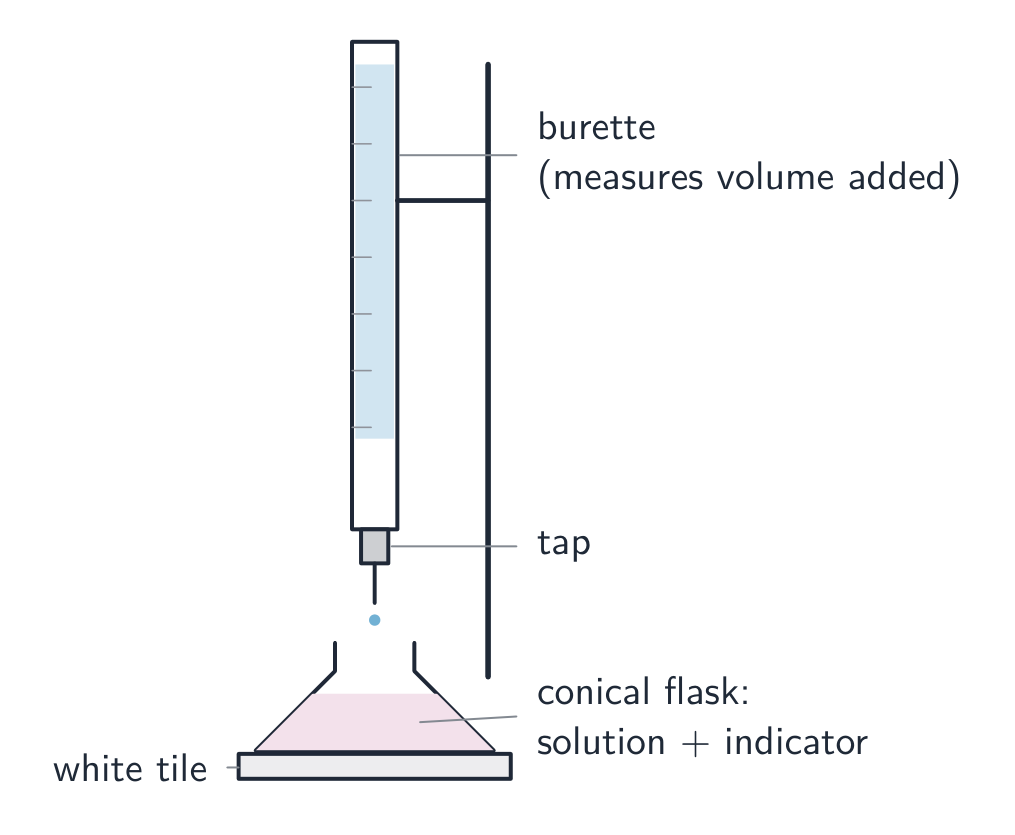
A titration finds the exact volume of one solution that reacts with another
Кислотно-основное титрование
pH jumps at the equivalence point
Track the pH as base is added — it leaps through neutral at the эквивалентная точка.
The end point of a titration is shown by:
Сложность 1/5 · 100 монет + небольшой бонус за первое завершение сегодня
The indicator changes colour at neutralisation.
The volume of solution added from the burette is called the ______.
Сложность 1/5 · 100 монет + небольшой бонус за первое завершение сегодня
The titre is read from the burette.
The end point 终点
- An indicator changes colour at the end point — when neutralisation is complete.
- You record the volume of solution added from the burette (the titre 滴定量).
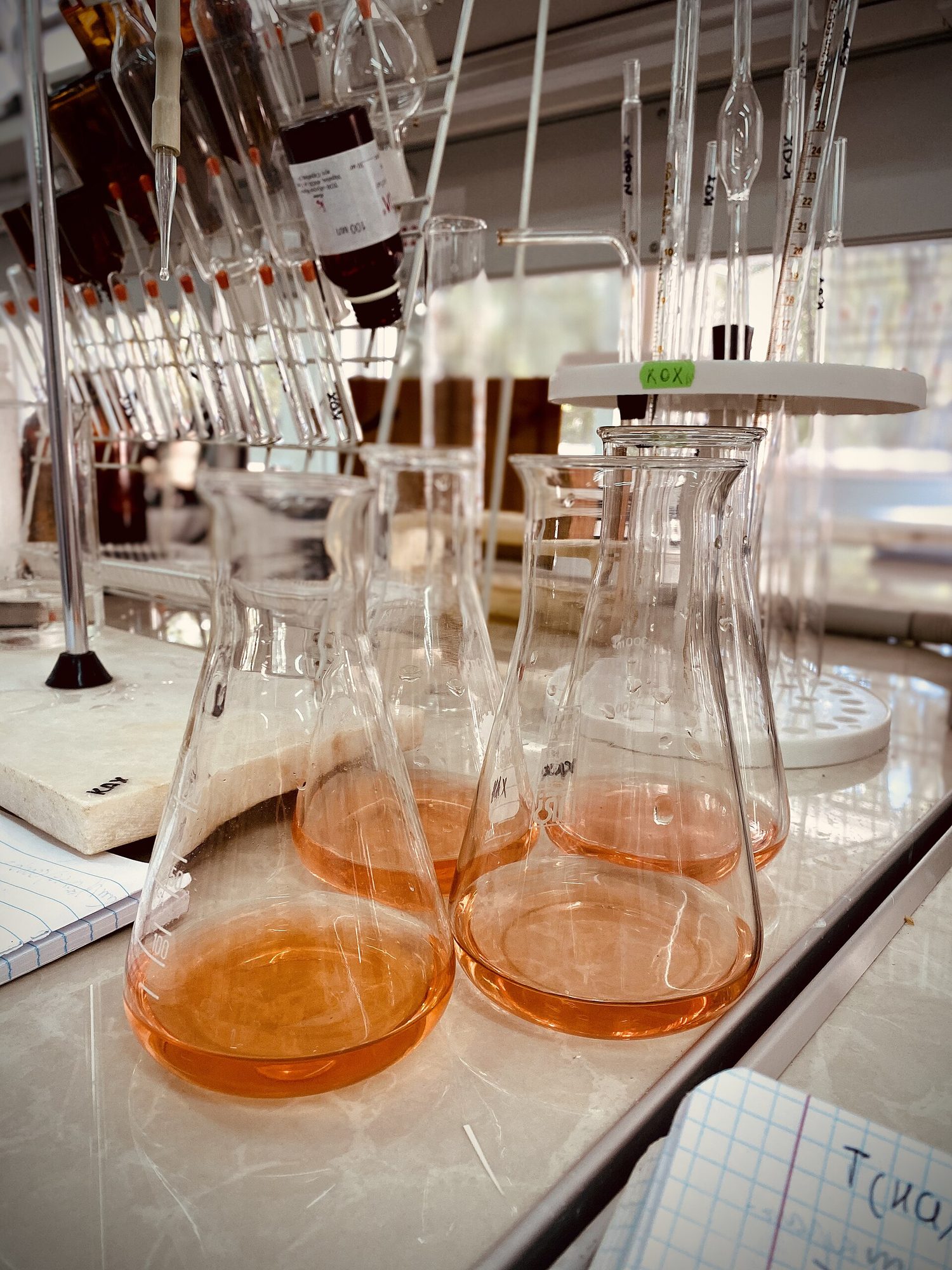
Solution is run from the burette into the flask until the indicator changes colour
How many moles are in 20 cm³ of acid of concentration 0.5 mol/dm³? (moles = conc × volume in dm³)
Сложность 2/5 · 140 монет + небольшой бонус за первое завершение сегодня
0.5 × (20 ÷ 1000) = 0.01 mol.
If 0.01 mol of alkali is in 25 cm³, what is its concentration (mol/dm³)?
Сложность 2/5 · 140 монет + небольшой бонус за первое завершение сегодня
0.01 ÷ (25 ÷ 1000) = 0.4 mol/dm³.
Using the result
- From the volumes and one known concentration, you calculate the unknown concentration.
- Use moles = concentration × volume and the equation's mole ratio.
Worked example. 25 cm³ of alkali is neutralised by 20 cm³ of acid of concentration 0.5 mol/dm³ (1:1 ratio). Moles of acid = 0.5 × (20 ÷ 1000) = 0.01 mol. So moles of alkali = 0.01, and its concentration = 0.01 ÷ (25 ÷ 1000) = 0.4 mol/dm³.
Worked example: concentration of an acid
25.0 cm³ of sodium hydroxide, 0.100 mol/dm³, is pipetted into a flask. Hydrochloric acid is added from a burette; the mean titre is 20.0 cm³. Find the acid's concentration.
- Moles of NaOH $= 0.100 \times \dfrac{25.0}{1000} = 0.00250$ mol.
- The ratio is 1 : 1, so moles of HCl $= 0.00250$ mol.
- Concentration of HCl $= \dfrac{0.00250}{20.0 / 1000} = 0.125$ mol/dm³.
- Convert cm³ to dm³ by dividing by 1000. Use the mean of concordant titres (within 0.10 cm³).
20.0 cm³ of 0.150 mol/dm³ NaOH is neutralised by 24.0 cm³ of HCl. What is the concentration of the HCl in mol/dm³?
Сложность 2/5 · 140 монет + небольшой бонус за первое завершение сегодня
Moles NaOH = 0.150 × 0.0200 = 0.00300 = moles HCl. Concentration = 0.00300 ÷ 0.0240 = 0.125 mol/dm³.
H₂SO₄ + 2NaOH → Na₂SO₄ + 2H₂O. 0.00400 mol of NaOH is neutralised. How many moles of H₂SO₄ reacted?
Сложность 2/5 · 140 монет + небольшой бонус за первое завершение сегодня
The ratio is 1 H₂SO₄ : 2 NaOH, so 0.00400 ÷ 2 = 0.00200 mol.
You've got it
- a titration finds an unknown concentration by neutralising acid with alkali
- a burette delivers a measured volume; an indicator marks the end point
- calculate using moles = concentration × volume and the mole ratio
Write from the data given
- 25 cm3 of acid has concentration 0.2 mol per dm3.
- The lesson sample of 20 cm3 at 0.5 mol per dm3 contains 0.01 mol.
How many moles of acid are in the 25 cm3?
Amount equals concentration times volume in cubic decimetres.
How many moles are in this 25 cm3 sample?
Сложность 1/5 · 100 монет + небольшой бонус за первое завершение сегодня
0.2 times 0.025 is 0.005.