Chemical equations
Введено| English | Значение |
|---|---|
| reactants/rɪˈæktənts/ | исходные вещества |
| products/ˈprɒdʌkts/ | продукты реакции |
| chemical equation/ˈkemɪkl ɪˈkweɪʒn/ | химическое уравнение |
| balanced/ˈbælənst/ | уравненный |
| conservation of mass/ˌkɒnsəˈveɪʃn ɒv mæs/ | закон сохранения массы |
| coefficients/ˌkəʊɪˈfɪʃənts/ | коэффициенты |
Writing what happens in a reaction
- A chemical reaction turns reactants 反应物 into products 生成物.
- We record it with a chemical equation 化学方程式 — and it must be balanced 配平.
Equation balancing route
Watch atom counts stay equal on both sides of an equation.
In an equation, the substances on the left of the arrow are the:
Сложность 1/5 · 100 монет + небольшой бонус за первое завершение сегодня
Reactants → products.
Word and symbol equations
- A word equation uses names: methane + oxygen → carbon dioxide + water.
- A symbol equation uses formulae: CH₄ + 2O₂ → CO₂ + 2H₂O.
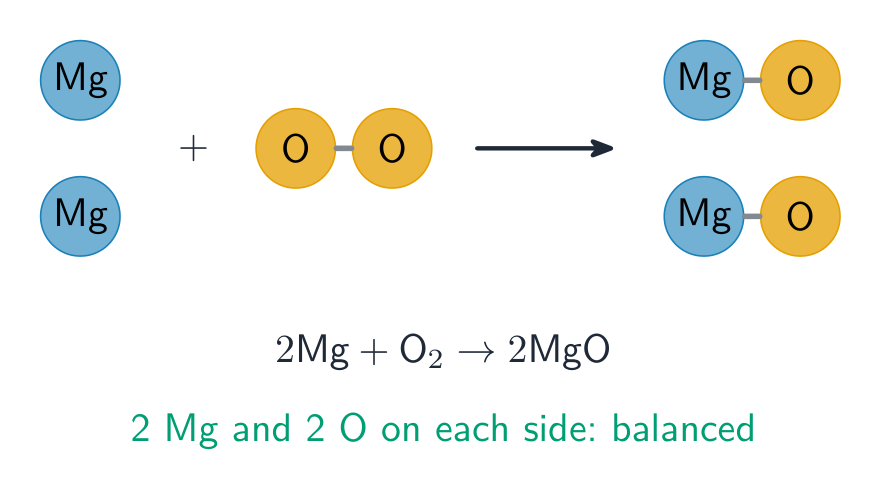
A balanced symbol equation has the same number of each atom on both sides
A balanced equation must have the same number of each atom on both sides because:
Сложность 1/5 · 100 монет + небольшой бонус за первое завершение сегодня
Conservation of mass: atoms are only rearranged.
A balanced equation obeys the law of conservation of ______.
Сложность 1/5 · 100 монет + небольшой бонус за первое завершение сегодня
No atoms are gained or lost.
Conservation of mass 质量守恒
- Atoms are not created or destroyed in a reaction — they are rearranged.
- So there must be the same number of each atom on both sides. This is balancing.
To balance an equation you change the:
Сложность 1/5 · 100 монет + небольшой бонус за первое завершение сегодня
Only coefficients may be changed, not subscripts.
In the equation 2H₂ + O₂ → 2H₂O, how many hydrogen atoms are on the left?
Сложность 2/5 · 140 монет + небольшой бонус за первое завершение сегодня
2 × H₂ = 4 hydrogen atoms.
How to balance
- Adjust the big numbers (in front of formulae) — never change a formula's subscripts.
- Count each element on both sides and add coefficients 系数 until they match.
Worked example. H₂ + O₂ → H₂O is not balanced (2 O on the left, 1 on the right). Balance it: 2H₂ + O₂ → 2H₂O — now 4 H and 2 O on each side.
Include the physical states
- State symbols are (s) solid, (l) liquid, (g) gas and (aq) dissolved in water. Aqueous does not mean a pure liquid: NaCl(aq) is a solution; H₂O(l) is liquid water.
- For example, Mg(s) + 2HCl(aq) → MgCl₂(aq) + H₂(g). Check both the atom counts and the state of every substance from the information given.
What does (aq) mean in NaCl(aq)?
Сложность 1/5 · 100 монет + небольшой бонус за первое завершение сегодня
Aqueous means dissolved in water. Liquid as a state symbol is (l).
Show only the reacting ions
- Supplement: AgNO₃(aq) + NaCl(aq) → AgCl(s) + NaNO₃(aq). The reacting ions are Ag⁺(aq) and Cl⁻(aq); Na⁺ and NO₃⁻ remain unchanged in solution.
- Remove those unchanged spectator ions to give Ag⁺(aq) + Cl⁻(aq) → AgCl(s). An ionic equation must balance both atoms and total charge: +1 − 1 = 0 here, matching the neutral solid.
A coefficient changes the number of whole particles; a subscript changes the substance. In ionic equations, cancel only unchanged ions and retain the solid, liquid or gas that forms.
For Ag⁺(aq) + Cl⁻(aq) → AgCl(s), what is the total charge on the left?
Сложность 2/5 · 140 монет + небольшой бонус за первое завершение сегодня
+1 plus −1 is 0, matching the neutral product. Both atoms and charge balance.
You've got it
- a reaction turns reactants → products; a symbol equation uses formulae
- mass is conserved: the same number of each atom on both sides
- balance by changing the big numbers (coefficients), never the subscripts
Check an unfamiliar equation
- The equation is N2 + 3 H2 to 2 NH3.
- Count nitrogen and hydrogen on both sides; a coefficient multiplies the whole formula.
For N₂ + 3H₂ → 2NH₃, count the hydrogen atoms on each side and explain whether hydrogen is balanced.
Three molecules of H2 hold six hydrogen atoms.
For N₂ + 3H₂ → 2NH₃, how many hydrogen atoms are on the left?
Сложность 1/5 · 100 монет + небольшой бонус за первое завершение сегодня
Each H2 contributes two atoms. Other options — 4 (the lesson hydrogen count); 3 (the number of H2 molecules).