Ваш учебный план · Продолжить · Обзор →
跟 + Person + Verb (with someone)
ВведеноВаше сохранённое положение остаётся в этом браузере. Возобновление не завершает урок и не отвечает на его вопросы.
 6:06
HSK 3 Грамматика 7: Союзы и условия
Рассказывание, вопросы, условия. 或者 говорит, 还是 спрашивает; 只要 требует любой вариант, только один вариант; 为了 направлено вперед, 因为 смотрит назад. Самая часто встречающаяся ловушка — замена союзом «или». Каждое…
Английские объяснения + примеры на мандаринском · субтитры следуют за звучащим текстом
In this lesson
Who are you going with?
- Your mum asks about your plans for the holiday.
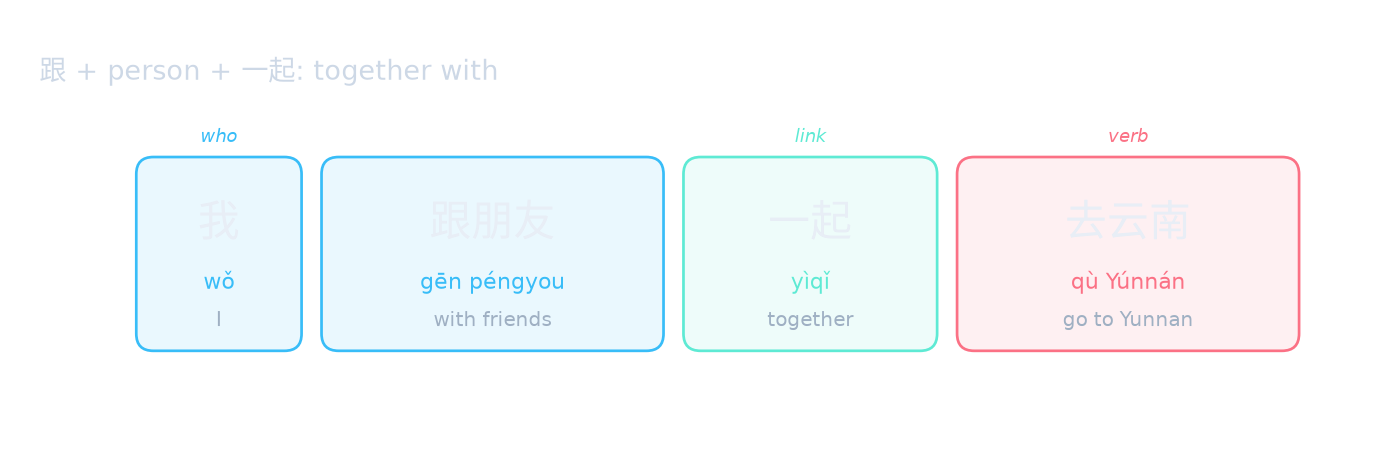
- I我with跟friends朋友together一起go to去Yunnan云南。 — "I'm going to Yunnan with friends."
Subject + with跟 + Person + (together一起) + Verb
- with跟 + person = "with", placed before the verb. together一起 (together) often follows: with跟he他together一起to have a meal吃饭.
- and / with和 works the same way: I我and / with和classmate同学together一起to study; to learn学习.
I我with跟friends朋友together一起go to去Yunnan云南。
Complete: “I play basketball with my brother.” 我____哥哥一起打篮球。
Сложность 1/5 · 100 монет + небольшой бонус за первое завершение сегодня
跟 + person + 一起 + verb.
Talking to someone
- with跟 also marks who you talk to: I我want想with跟you你tell说一件matter事。 — "I want to tell you something."
- you你with跟teacher老师tell说(completed / change)了(yes/no ?)吗? — "Have you told the teacher?"
I我want想to跟you你tell说something一件事。
Build: “I want to tell you something.”
Сложность 3/5 · 200 монет + небольшой бонус за первое завершение сегодня
跟 + person + 说.
with跟 goes before the verb
- "With friends" comes before the verb: with跟friends朋友go to去, not go to去with跟friends朋友 (unless with跟 means "and" between two nouns).
- Put not不 or not / haven't没 before with跟: I我not不with跟he他go to去 — "I won't go with him" — not I我with跟he他not不go to去, which means "he and I are not going".
Which says “I won't go with him.”?
Сложность 1/5 · 100 монет + небольшой бонус за первое завершение сегодня
The negative goes before 跟. 我跟他不去 means “he and I are not going”, a different message.
with跟 as "and"
- Between two nouns, with跟 = "and": I我with跟he他both都are是students学生 — "He and I are both students."
- Before a verb phrase, with跟 + person = "with".
I我and跟he他both都are是students学生。
In 我跟他都是学生, 跟 means “and”.
Сложность 1/5 · 100 монет + небольшой бонус за первое завершение сегодня
Between two nouns, 跟 joins them.
Recap
- with跟 + person + (together一起) + Verb = do it with someone; with跟 + person + tell说 = tell someone.
- with跟 comes before the verb; negatives go before with跟. Between nouns, with跟 = and.
Read the full reference: HSK 3 grammar — Conjunctions.
Your mum asks about your plans for the holiday. Close the examples. Say a Mandarin response, then write it in Chinese. Explain briefly in English what the lesson’s pattern adds. Compare with the model, then change one detail and try again.
This is supported productive practice. Compare meaning and structure; your answer need not copy the model. A partner or teacher must hear the spoken response to comment on pronunciation.