Ваш учебный план · Продолжить · Обзор →
Комплемент направления 来 / 去 (к / от)
ВведеноВаше сохранённое положение остаётся в этом браузере. Возобновление не завершает урок и не отвечает на его вопросы.
 4:29
Грамматика HSK 3 3: Глаголы, способность и дополнения
Эта тема о том, что сообщают глаголы. «着» удерживает состояние. «了» в конце предложения объявляет об изменении: теперь это правда. Результативные дополнения сообщают о…
Английские объяснения + примеры на мандаринском · субтитры следуют за звучащим текстом
В этом уроке
Come in, go out
- A friend knocks at your door; later your little brother runs off to play outside.
- please请to enter; to come in进(here)来! Qǐng jìnlai! — "Please come in!" he他to go out出去(completed / change)了。 Tā chūqu le. — "He's gone out." (here)来 is towards the speaker, (away)去 is away.
- Goal: choose (here)来 or (away)去 by where the speaker is, and say how someone moved: to enter走进(here)来, to run跑out / to happen出(away)去, to stand站get up / (start, become)起来.
Verb + (here)来 / (away)去
- (here)来 = movement towards the speaker; (away)去 = movement away from the speaker.
- Combine with direction verbs: to come in进来/to go in进去, come out / (result: see, think up)出来/to go out出去, to come up上来/to go up上去, come down下来/go down / (keep on)下去, to return回来/to return回去, to come over过来/past过去.
you你quickly快come down下来吧!
You are inside the room and call to your friend at the door: “Come in!” 进____!
Сложность 1/5 · 100 монет + небольшой бонус за первое завершение сегодня
Movement towards the speaker takes 来.
A place goes before (here)来 / (away)去
- Verb + place + (here)来/(away)去: he他to return home回家(away)去(completed / change)了。 — "He has gone back home." fast-forward (media player)快进classroom教室(here)来! — "Come into the classroom, quick!"
- A thing you carry can come after: he他to bring带来(completed / change)了one / a一this (formal) / originally / (measure: books)本the book书 / he他to bring带(completed / change)了one / a一this (formal) / originally / (measure: books)本the book书(here)来.
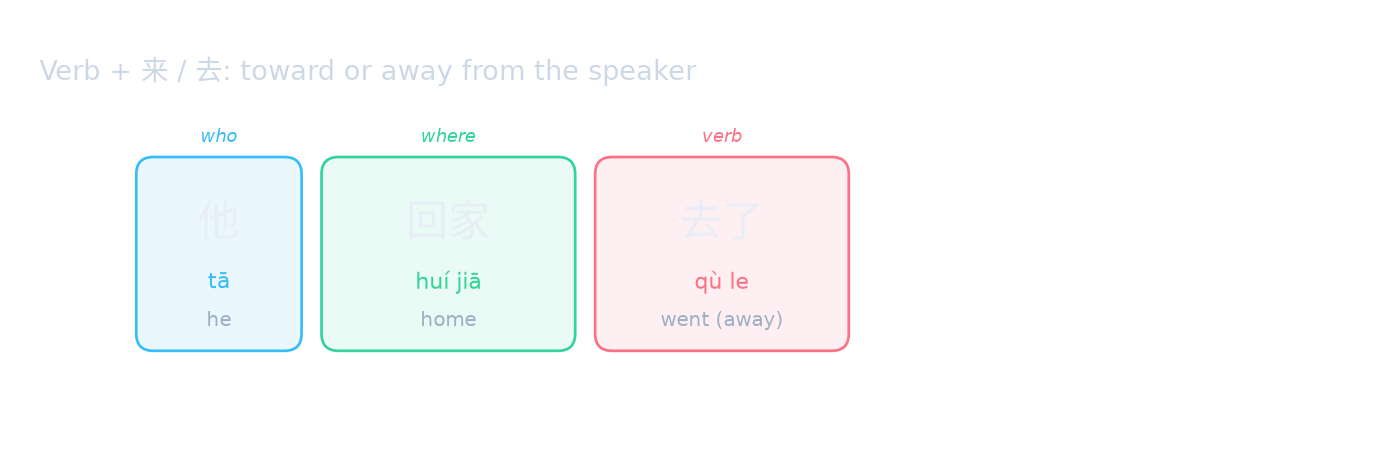
he他return回home家(away)去了。
Build: “Come into the classroom, quick!”
Сложность 3/5 · 200 монет + небольшой бонус за первое завершение сегодня
Verb + place + 来.
How did they move? Action + direction + (here)来 / (away)去
| Chinese | Meaning |
|---|---|
| teacher老师to enter走进(here)来(completed / change)了。 | The teacher walked in (towards me). |
| child孩子(plural)们to run跑out / to happen出(away)去(completed / change)了。 | The children ran out (away from me). |
| he他from从bag / to wrap包inside; in里bring拿come out / (result: see, think up)出来one / a一this (formal) / originally / (measure: books)本the book书。 | He took a book out of his bag. |
| please请to stand站get up / (start, become)起来。 | Please stand up. |
- Three parts: how (to walk / to leave走, to run跑, bring拿) + which way (to enter; to come in进, out / to happen出, up / on / last; to get on, attend上, down / next; to fall (rain), get off下, return回, to rise / (start to)起) + (here)来 / (away)去 (towards or away from the speaker). to rise / (start to)起 only takes (here)来: to stand站get up / (start, become)起来.
You are in the classroom. A student runs in. Which sentence fits?
Сложность 1/5 · 100 монет + небольшой бонус за первое завершение сегодня
How (跑) + which way (进) + 来, because the student comes towards you.
The speaker decides (here)来 or (away)去
- Choose by where the speaker is: you are upstairs → to come up上来 (come up); you are downstairs → to go up上去 (go up).
- A place word never comes after (here)来/(away)去: to enter; to come in进classroom教室(here)来, not to come in进来classroom教室.
You are on the ground floor talking about your friend upstairs: “He went up.” Which fits?
Сложность 1/5 · 100 монет + небольшой бонус за первое завершение сегодня
He moved away from you (upwards), so 上去.
他进来教室了 is correct.
Сложность 1/5 · 100 монет + небольшой бонус за первое завершение сегодня
The place goes before 来: 他进教室来了.
to bring拿来, to bring带(away)去, to give (as a gift); to see off送(here)来
- Bringing and taking work the same way: please请(把: marks the object)把the book书to bring拿来。 — "Please bring the book (here)."
- I / me我to / for / give给he他to give (as a gift); to see off送(away)去(completed / change)了some一些fruit水果。 — "I took some fruit over to him."
please请把the book书bring拿(here)来。
Recap
- Verb + (here)来 = towards the speaker; Verb + (away)去 = away from the speaker.
- A place goes before (here)来/(away)去 (to return home回家(away)去, to enter; to come in进classroom教室(here)来); to bring拿来/to bring带(away)去 work the same way.
- How + which way + (here)来/(away)去: to enter走进(here)来, to run跑out / to happen出(away)去, to stand站get up / (start, become)起来.
Read the full reference: HSK 3 grammar — Complements.
A friend knocks at your door; later your little brother runs off to play outside. Close the examples. Say a Mandarin response, then write it in Chinese. Explain briefly in English what the lesson’s pattern adds. Compare with the model, then change one detail and try again.
This is supported productive practice. Compare meaning and structure; your answer need not copy the model. A partner or teacher must hear the spoken response to comment on pronunciation.