Ваш учебный план · Продолжить · Обзор →
Reported questions and commands
ВведеноВаше сохранённое положение остаётся в этом браузере. Возобновление не завершает урок и не отвечает на его вопросы.
 4:46
Английский язык B2 · Косвенные вопросы и приказы
B1 научил вас передавать утверждения и вопросы. B2 добавляет приказы, просьбы, советы и предложения — всё, что люди говорят, чтобы побудить других к действию. Память…
Озвучивание на английском · переключаемые субтитры на английском и китайском языках
В этом уроке
| English |
|---|
| instruction/ɪnˈstrʌkʃn/ |
| command/kəˈmænd/ |
| reported question/rɪˈpɔːtɪd ˈkwestʃn/ |
| tense/tens/ |
Косвенная речь вопросов и инструкций
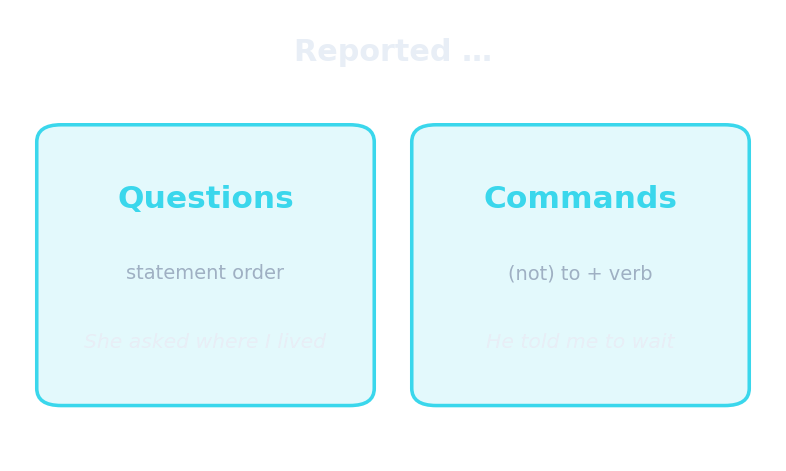
- Мы можем сообщать содержание вопросов, просьб и приказов: She asked where I lived. He told me to wait. Report не воспроизводит каждое исходное слово дословно.
- Результат: сохраните, кто кого просил или указывал, и intended meaning, используя appropriate reporting frame. Начните с reported statements. Начальная проверка: содержит ли She asked what I did ошибку исключительно из-за наличия в нем did? Нет.
She asked where the meeting was; the calendar asked the same thing.
Косвенные вопросы
- Вложенный вопрос использует порядок слов утверждения: She asked where I lived, а не where did I live. Используйте if / whether для вопроса типа да/нет: He asked if I was busy. Сохраняйте wh-word для информационного вопроса.
- Уберите question-forming do/does/did, а не все формы do: She asked what I did звучит естественно. Эмфатический did может оставаться, если он несет contrastive emphasis: “But you DO want the job!” → She insisted that I did want the job.. Время и местоимения следуют контексту report; backshift — это не автоматическая замена слов.
- Утвердительное предложение в косвенной речи заканчивается точкой: She asked where I lived. Если основное предложение является вопросом, оно может заканчиваться вопросительным знаком: Did she ask where I lived? Вложенная часть при этом сохраняет прямой порядок слов.
Among these options, choose a report of “Where do you live?” with embedded statement order.
Сложность 1/5 · 100 монет + небольшой бонус за первое завершение сегодня
Among these options, where I lived has the required embedded statement order. Where did I live retains direct-question inversion. A present live can also be natural in another report if the location remains current; backshift depends on context.
Report the yes/no question “Are you busy?”: “He asked ___ I was busy.”
Сложность 1/5 · 100 монет + небольшой бонус за первое завершение сегодня
Yes/No questions are reported with “if” or “whether”.
Translate into English: 她问我住在哪里。
Сложность 3/5 · 200 монет + небольшой бонус за первое завершение сегодня
She asked where I lived is the model with embedded statement order. Where I live can also fit a still-current residence; the unrestricted translation does not require automatic backshift.
Which sentence asks whether a question was asked, while keeping its embedded clause in statement order?
Сложность 1/5 · 100 монет + небольшой бонус за первое завершение сегодня
Only the outer did she ask has inversion. Where the tickets were keeps embedded order. Its question mark belongs to the whole question, not an inverted embedded clause.
Косвенная речь просьб и приказов
- Полезная конструкция: tell / ask + кто-то + to + инфинитив: She told me to wait. He asked me to help. Лицо, которое просят или приказывают действовать. Сама по себе эта форма не гарантирует вежливости или резкости тона.
- Другие конструкции имеют иное значение: He asked to leave означает, что он попросил разрешения уйти самому; He asked me to leave просит меня пойти. Не ставьте лицо после каждого употребления ask.
Compare “Maya asked to carry the box” and “Maya asked Jo to carry the box”. What changes?
Сложность 1/5 · 100 монет + небольшой бонус за первое завершение сегодня
Ask to carry concerns Maya’s own requested action. Ask Jo to carry makes Jo the requested actor. Naming the actor is part of meaning, not an optional mechanical insertion.
Отрицательные инструкции
- Для запрета действия используйте not to: He asked me not to be late. She told us not to enter передает запрет на вход.
- Сохраняйте явность отрицания: He didn't ask me to leave отказывает в просьбе; He asked me not to leave передает просьбу остаться. Это разные виды пересказа.
Question, command or negative command?
Distinguish the question and instruction frames in these examples; preserve embedded order, participants and negative scope.
Is this a grammatical reported negative request? “He asked me not to be late.”
Сложность 1/5 · 100 монет + небольшой бонус за первое завершение сегодня
Asked me not to be late is a grammatical reported negative request. Me is the person asked to act; not to be late is the requested restraint. It does not establish that the request was obeyed.
“They didn’t tell us to stop” means the same as “They told us not to stop”.
Сложность 1/5 · 100 монет + небольшой бонус за первое завершение сегодня
The first denies an instruction to stop; it does not establish an instruction to continue. The second reports an instruction against stopping. Keep the negative attached to the meaning you intend.
Распространенные ошибки
- В данном пересказе используйте He asked me if I was busy, not He asked me am I busy. The original question Am I busy? — грамматически верно как прямая речь в другом контексте.
- Используйте He told me not to be late, not He told me don't be late, применяя эту конструкцию для передачи запрета.
- Используйте She suggested going или She suggested that I go, а не She suggested me to go. She suggested to me that I go — другая конструкция; сохраняйте грамматику и вовлеченных лиц вместе.
Match the direct speech to its reported form.
Сложность 2/5 · 140 монет + небольшой бонус за первое завершение сегодня
These supplied reports preserve questions with embedded order and requests/instructions with (not) to. Asked me not to shout asks me to refrain from shouting; didn’t ask me to shout would only deny a request. Other natural reports can use different appropriate frames.
Which sentence is correct?
Сложность 1/5 · 100 монет + небольшой бонус за первое завершение сегодня
Told me to sit down fits tell + person + to + base verb. The other supplied options do not fit this instruction frame. Said to me, “Sit down” would be grammatical direct speech in another frame; the supplied said me to sit down is not that construction.
A guest says “Could you carry this bag, please?” as a request. Which report preserves that intended action?
Сложность 1/5 · 100 монет + небольшой бонус за первое завершение сегодня
The first reports a request for me to act. The others assert completed action or reverse the requested actor. A suitable if I could report can also preserve the request; the infinitive is not the only possible frame.
- Косвенные вопросы сохраняют прямой порядок слов. Лексическое или усилительное do не то же самое, что вопросительное do; пунктуация относится ко всему предложению.
- В инструкциях отслеживайте, кто должен действовать, и где находится отрицание. Замена ask to на ask someone to может изменить исполнителя.
Think of a question someone asked you, or invent one. Report it in one English sentence using She/He asked or an equivalent reporting frame. Preserve who asked whom and the topic.
Сложность 3/5 · 200 монет + небольшой бонус за первое завершение сегодня
Example: “My teacher asked if I had finished my homework.”
Разбор различий: сохранение отчета
- Основной вопрос: Did Noor ask where the keys were? спрашивает, сделал ли Нуур запрос информации. Только внешняя часть Did Noor ask имеет вопросительный порядок слов; where the keys were сохраняет прямой порядок.
- Кто уходит: Alex asked to leave early передает просьбу Алекса уйти. Alex asked Lee to leave early просит Ли уйти. Обе формы грамматически верны; добавление Lee меняет исполнителя, а не просто улучшает первое предложение.
- Выполните действие: “What do you do after school?” может стать She asked what I did after school. Первый do образует прямой вопрос; второй называет деятельность и превращается в did при возврате к прошлому. Текущий пересказ может сохранить do, если это оправдано настоящим контекстом.
A tutor asks, “What do you do on Saturdays?” You later report, “The tutor asked what I did on Saturdays.” Why is did acceptable?
Сложность 1/5 · 100 монет + небольшой бонус за первое завершение сегодня
In what I did, I precedes the verb and did is the activity verb. The direct question’s question-forming do has been removed. Repair: identify each do by its job before deleting it. Fresh check: report What did you do yesterday? while preserving the activity verb.
Применение и повторение
- Передайте вопрос и отрицательную просьбу на английском языке. Проверьте порядок слов во вставном предложении, кто совершает действие и что именно отрицает просьба. Не навязывайте слова, обозначающие прошлое время (например, yesterday), при передаче сообщения, сделанного сегодня.
- Позже объясните разницу между didn't ask me to wait и asked me not to wait без повторения. Продолжайте с модальных глаголов прошлого. Потренируйтесь в новых решениях; самостоятельный повтор остается незавершенным.
A meeting note says, “Ravi asked to leave early.” Which restatement preserves who requested permission to go?
Сложность 1/5 · 100 монет + небольшой бонус за первое завершение сегодня
Ask to leave reports Ravi’s own request. Adding someone after asked would make that person the requested actor and change the report. The original does not say permission was granted. Repair: identify the requester and intended actor separately. Fresh check: explain Ravi asked Chen to leave without adding a claim about whether Chen left.
Facts: yesterday Noor asked you, “Where do you keep the spare keys?” She also said, “Please don’t lock the side door yet.” The keys are still kept in the same place. Write two English sentences reporting the question and request. Keep the person asked and the negative clear. Compare, then revise one word-order, time or participant mismatch.
Compare the stated facts, your English forms and the intended meaning. Revise one actual mismatch, or explain why no change is needed. This written self-review does not award correctness or certify proficiency.
Supply a yes/no reporting linker: “Omar asked ___ the desk was open.”
Сложность 1/5 · 100 монет + небольшой бонус за первое завершение сегодня
Whether and if both introduce this embedded yes/no question. Neither asks for a time; keep the desk before was.
Complete this stated instruction frame: “The guide told us ___ wait beside the gate.”
Сложность 1/5 · 100 монет + небольшой бонус за первое завершение сегодня
Tell + person + to + base verb gives told us to wait. Us names the people instructed; the report alone does not say they waited.
The instruction is not to touch the switch. Complete: “The engineer told me ___ to touch the switch.”
Сложность 1/5 · 100 монет + небольшой бонус за первое завершение сегодня
Not before to touch preserves the negative instruction. Didn’t tell me to touch would deny a request instead of reporting this prohibition.
Use the past form of the action verb do: “The interviewer asked what I ___ at the repair shop.”
Сложность 1/5 · 100 монет + небольшой бонус за первое завершение сегодня
Did names the activity in what I did. It is not question-forming inversion. The sentence already places I before the verb; deleting the action verb would leave the report incomplete.
Which report preserves the question “Who broke the handle?” without inventing an answer?
Сложность 1/5 · 100 монет + небольшой бонус за первое завершение сегодня
Who is the subject of broke. The report does not need a second subject or question-forming did, and it does not identify the culprit. Subject questions already have this order.
Which analysis fits “He asked why I did not sign the form”?
Сложность 1/5 · 100 монет + небольшой бонус за первое завершение сегодня
Did not sign is a negative past verb phrase after the subject I. The question concerns a reason; it is not a negative instruction or a ban on signing every form.
A speaker insists that she really wanted the job. What does “He asked why I did want the job” allow?
Сложность 1/5 · 100 монет + небольшой бонус за первое завершение сегодня
Emphatic did + base want is possible in this context. Removing question-forming inversion does not ban a meaningful emphatic auxiliary. The report does not supply the answer to why.
You are Jo. Yesterday Sara asked you, “Can you help me?” Which report preserves both participants?
Сложность 1/5 · 100 монет + небольшой бонус за первое завершение сегодня
You in Sara’s question addresses Jo; me refers to Sara. From Jo’s reporting viewpoint they become I and her. The other choices reverse the helper or beneficiary.
Read “Tao told Mina to send him the plan”. Who is instructed to send it?
Сложность 1/5 · 100 монет + небольшой бонус за первое завершение сегодня
Mina is the object of told and the understood actor of to send. Him marks the recipient, but without context it need not uniquely identify Tao. Do not infer obedience or resolve an ambiguous pronoun without evidence.
A workshop note says, “Lena asked to use the printer”. Which account keeps the requested actor?
Сложность 1/5 · 100 монет + небольшой бонус за первое завершение сегодня
Asked to use reports Lena’s own requested use. It neither requires an omitted object after asked nor establishes that permission was granted.
A customer asks “Would you close the window, please?” as a request. Which comparison is accurate?
Сложность 1/5 · 100 монет + небольшой бонус за первое завершение сегодня
A question form can serve as a request. Both appropriate frames can preserve that function; the report is not proof of compliance. Check participants and purpose rather than copying punctuation alone.
This morning Wen asked where you keep a spare charger. Its location is still current. Which judgment is sound?
Сложность 1/5 · 100 монет + небольшой бонус за первое завершение сегодня
Still-current information can remain present; backshift can also be natural in a past report. Where I keep/kept both have embedded order. Time context matters, not a compulsory word swap.
On Monday Eli asked you, “Can you come tomorrow?” You report on Wednesday, after that Tuesday. Which report preserves the requested day?
Сложность 1/5 · 100 монет + небольшой бонус за первое завершение сегодня
Tomorrow in the Monday question denotes Tuesday. The Wednesday report must preserve that day, not re-anchor tomorrow to Thursday. This records the request without claiming you attended.
Which option uses a grammatical suggestion frame?
Сложность 1/5 · 100 монет + небольшой бонус за первое завершение сегодня
Suggested that I check has a finite that-clause. Suggested checking the source and suggested to me that I check are other possible frames. Do not apply tell + person + to mechanically to suggest.
What does “Did Ravi ask where the parcel was?” ask?
Сложность 1/5 · 100 монет + небольшой бонус за первое завершение сегодня
The outer question concerns the occurrence of Ravi’s question. The embedded where-clause identifies its topic. A question about asking does not prove asking happened or give the parcel’s location.
Choose the faithful restatement of “I didn’t ask Nia to cancel the booking”.
Сложность 1/5 · 100 монет + небольшой бонус за первое завершение сегодня
Negating asked denies the request. It does not create the opposite instruction, identify Nia’s action or establish a reason for it.
“The guard asked whether the back gate was locked” establishes that the back gate was locked.
Сложность 1/5 · 100 монет + небольшой бонус за первое завершение сегодня
The clause states what information the guard sought, not the answer. Locked and unlocked remain possible; do not convert a reported question into an asserted fact.
The word told in “She told me to wait” alone proves that she spoke rudely.
Сложность 1/5 · 100 монет + небольшой бонус за первое завершение сегодня
Told reports an instruction frame, not its full tone. Relationship, wording, situation and delivery affect how it is received; a verb label is not sufficient evidence of rudeness.
Which report keeps the information requested by “How many batteries do we need?”?
Сложность 1/5 · 100 монет + небольшой бонус за первое завершение сегодня
How many batteries asks for a quantity. A whether-clause asks a yes/no question instead, and two invents an answer. Preserve the whole question phrase and embedded subject-before-verb order.
Передача: сохраните точность передачи
- Вопрос может выполнять функцию просьбы: “Could you close the lid, please?” можно передать через asked me to close it или подходящую конструкцию asked if I could close it. Ни один из вариантов не подтверждает, что я это сделал. Выбирайте по функции и участникам, а не только по вопросительному знаку.
- Разберите девятнадцать новых решений рядом с проверкой глагола действия ранее, затем передайте два сообщения Нери, не меняя владельца блокнота, того, кому сказали, или запрошенного воздержания. Сравнивайте свой отчет «ключи и дверь» с образцом только после черновика; исправляйте фактические ошибки наряду с грамматическими.
You are Ivo. Neri asked you “Where is my notebook?” and told Paz “Don’t move the red box.” Which handoff preserves the facts?
Сложность 1/5 · 100 монет + небольшой бонус за первое завершение сегодня
Her retains Neri’s ownership; Paz retains the requested actor; not to move retains the restraint. Neither the notebook’s location nor Paz’s compliance is established.
Поздний обзор: различите просьбу и её результат
- Завтра интерпретируйте новый запрос на удаление и завершите вопрос о стуле без повторения. Затем составьте передачу Суми перед открытием образца. Проверьте порядок слов во вставке, время, участников и наличие отрицания.
- Вопрос передает информационную пробелу, а не ответ; инструкция передает запрошенное действие, а не его выполнение. Далее: модальные глаголы прошлого, утверждения в косвенной речи или практическое письмо. Письменная практика и самопроверка не гарантируют владение материалом.
Руководство по использованию проверено 21 октября 2026: Британский совет, отчёт о вопросах охватывает встроенную структуру, контекстуально-зависимое время и рамки запросов. Новые примеры/задачи — оригинальный местный учебный материал. Независимая проверка экспертом, лингвистом, ответами, доступностью и учащимися остаётся в ожидании.
Later, interpret “Jules asked An not to delete the draft”.
Сложность 1/5 · 100 монет + небольшой бонус за первое завершение сегодня
Not to delete belongs to the requested action, not a denial of asking. Keep the actor An and avoid inventing an outcome.
Later, supply a yes/no linker: “The organiser wanted to know ___ we needed more chairs.”
Сложность 1/5 · 100 монет + небольшой бонус за первое завершение сегодня
If and whether both fit wanted to know plus this embedded yes/no clause. We needed keeps statement order; the question does not confirm a shortage.
Later, write a two-sentence English handoff from these notes. Yesterday Sumi asked you “Where do you store the paper forms?” and asked Lee “Please don’t recycle the blue folder yet.” The storage place is still current, but no location or compliance is supplied. Draft before opening the model; revise one real mismatch.
Compare the reporting frame and facts against both notes. A faithful alternative is acceptable; self-comparison and revision do not establish independent correctness or proficiency.