Past modals
IntroducedLooking back with modals
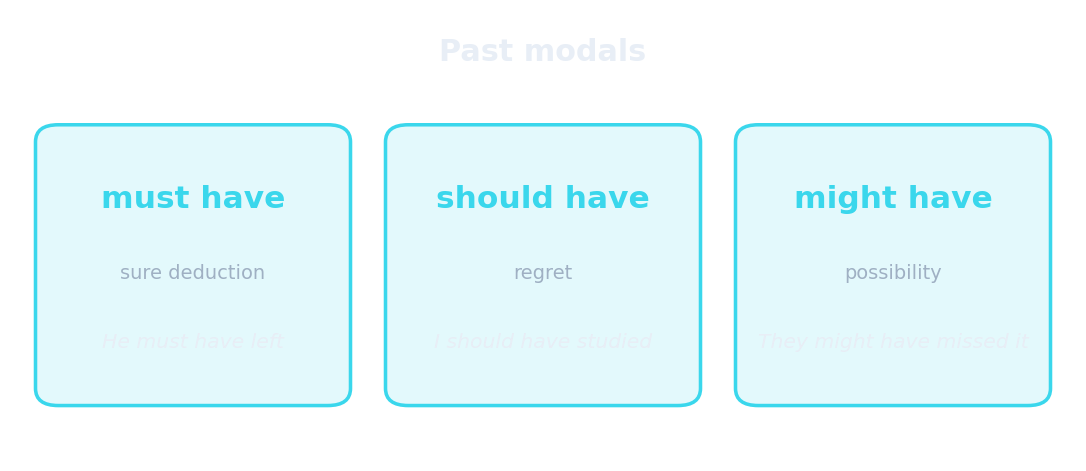
- Past modals = modal verb + have + past participle.
- They let you guess, regret, or imagine about the past.
- He must have left. I should have called.
He must have forgotten the appointment; his calendar looked equally surprised.
must have / can't have (deduction)
- must have + p.p. = you're sure it was true: He must have forgotten.
- can't have + p.p. = you're sure it wasn't: She can't have seen us.
- These are confident guesses about the past.
He's not answering. He ___ his phone. (sure deduction)
Past deduction → must have + past participle: “must have forgotten”.
Does “can't have + past participle” mean something was impossible in the past?
Yes — “She can't have seen us” = it's impossible that she saw us.
Translate into English: 他一定是忘了。
Sure about the past → must have + p.p.: “He must have forgotten.”
should have (regret, criticism)
- should have + p.p. = "the right thing to do, but it didn't happen".
- I should have studied harder. (regret)
- You shouldn't have said that. (criticism)
Regret: I ___ have studied harder. (one modal verb)
Past regret → should have + past participle: “I should have studied”.
could have / might have (possibility)
- could / might have + p.p. = it was possible, but we're not sure.
- They might have missed the train. It could have been worse.
- could have can also mean "was able to, but didn't".
What is the modal doing?
must/can't have = confident deduction; could/might have = open possibility; should have = criticism or regret.
Common mistakes
- ❌ He must forgot. → ✓ He must have forgotten. — past deduction = modal + have + participle.
- ❌ should of gone → ✓ should have gone. — of is a mis-heard have.
- ❌ I could help you yesterday, but I was busy. → ✓ I could have helped you. — unused past chance.
Match each sentence to its meaning.
must have = sure it happened; might have = maybe; should have = it didn't but ought to; can't have = sure it didn't.
Complete (criticism): You ___ have told me earlier!
should have + participle = you didn't, and that was wrong.
- Sure about the past: must have / can't have + p.p.
- Regret / criticism: should(n't) have + p.p.
- Possibility: could / might have + p.p.
Write one sentence about a past regret, using “should have” + a past participle.
Example: “I should have called you earlier.”