Relative clauses — defining and non-defining
IntroducedTwo kinds of relative clause
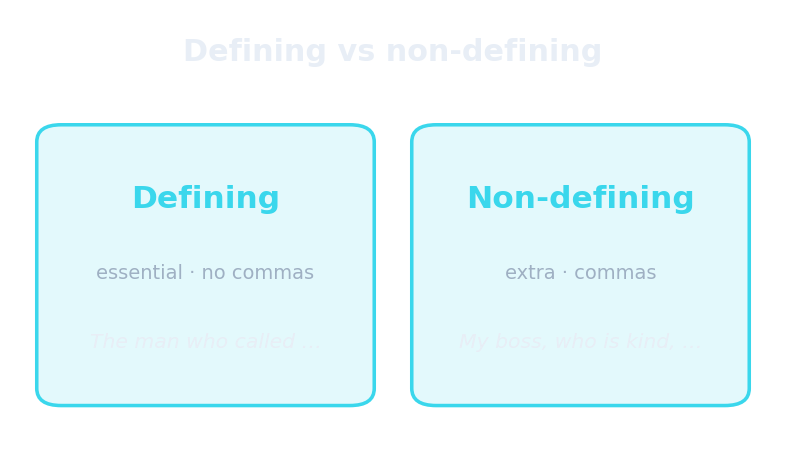
- A relative clause can be defining or non-defining.
- The difference is whether the information is essential.
- Commas are the key signal.
The cat, which ignores instructions, ate the note that explained the rules.
Defining (essential, no commas)
- Gives necessary information — tells you which one.
- No commas.
- The man who called you is my boss. (which man? the one who called)
Non-defining (extra, commas)
- Gives extra information you could remove.
- Use commas around it.
- My boss, who is very kind, called me. (we already know who)
Do the commas matter here?
No commas = the clause picks WHICH one; commas = the clause just adds a fact you could delete.
Extra (non-essential) information needs which punctuation?
Non-defining (extra) clauses are set off with commas.
Translate into English: 我老板人很好,他给我打了电话。
Extra info → non-defining, commas + who: “My boss, who is very kind, called me.”
who / which, never that
- Non-defining clauses use who (people) or which (things).
- Never that, and you can't leave the pronoun out.
- This book, which I read last year, is excellent.
Complete the non-defining clause: My phone, ___ is new, broke. (for a thing)
Non-defining + a thing → which (never “that”): “My phone, which is new, …”.
Is this correct? “My boss, that is kind, called me.”
Non-defining clauses can't use “that”: use “who”: “My boss, who is kind, …”.
Common mistakes
- ❌ My mother who lives in Beijing is kind. → ✓ My mother**, who** lives in Beijing**,** is kind. — unique things take commas.
- ❌ He failed, it surprised us. → ✓ He failed**, which** surprised us. — which can refer to the whole fact.
- Non-defining rules: never that, never drop the pronoun, commas in pairs.
Match each sentence to its clause type.
No commas = tells you which one; commas = extra info; , which can point at the whole clause.
Is this correct? “My boss, that is kind, called me.”
Non-defining clauses never take that → My boss, who is kind, called me.
- Defining = essential, no commas (who / which / that, can be omitted).
- Non-defining = extra, commas (who / which only, never that, never omitted).
- Commas tell you the information is "by the way".
Write one sentence with a non-defining relative clause (extra information inside commas, using who or which).
Example: “Shanghai, which is a huge city, has great food.”