Rotational Equilibrium and Newton's First Law in Rotational Form
Введено| English | Значение |
|---|---|
| rotational equilibrium/rəʊˈteɪʃənl ˌiːkwɪˈlɪbrɪəm/ | Равновесие вращения |
A seesaw balances, but not where you'd guess
- A heavy adult and a light child can balance a seesaw perfectly: the light child sits farther from the pivot. Balance is not about equal forces; it is about equal torques.
- This lesson is Newton's first law for rotation: when does an object's angular velocity stay constant, and how do engineers use that to find unknown forces?
Rotational equilibrium
- A system is in rotational equilibrium 转动平衡 when the net torque is zero: $\sum\tau = 0$. The clockwise torques balance the counterclockwise torques.
- Newton's first law for rotation: a system has a constant angular velocity only if the net torque on it is zero. "Constant" includes zero (at rest) and steady spinning, such as a fan turning at a steady rate.
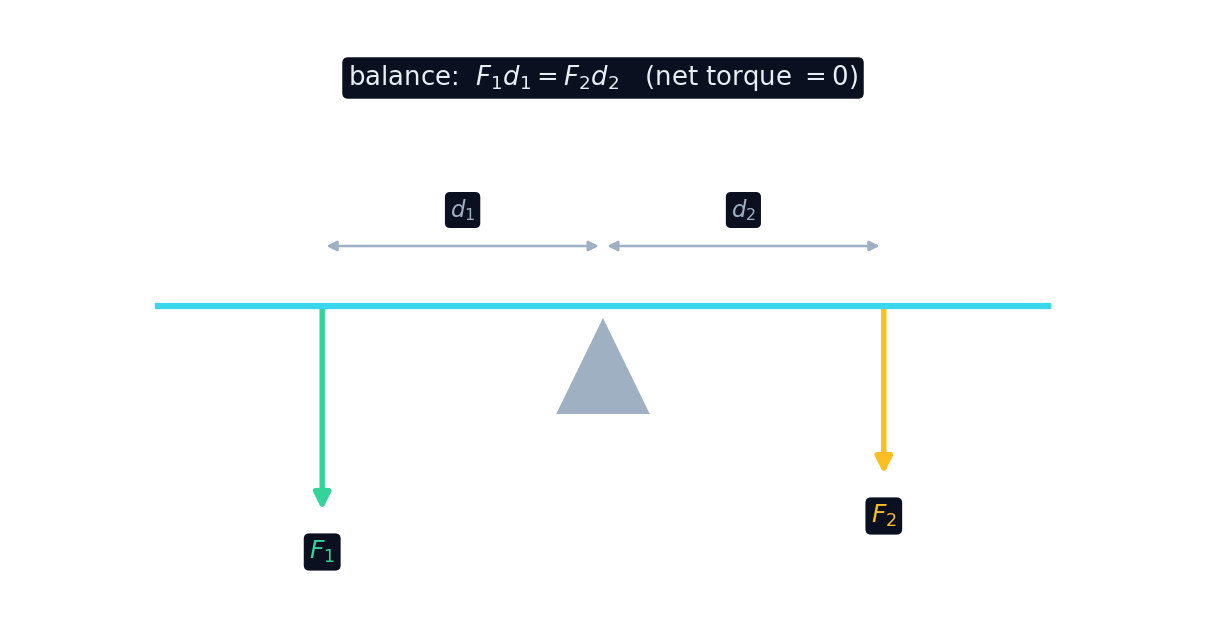
Balance the torques
Adjust the forces and distances until the clockwise and anticlockwise torques cancel.
A $300\ \text{N}$ child sits $2\ \text{m}$ from a seesaw pivot. How far from the pivot must a $400\ \text{N}$ child sit to balance it, in metres?
Сложность 2/5 · 140 монет + небольшой бонус за первое завершение сегодня
$300 \times 2 = 400 \times d_2 \Rightarrow d_2 = 600/400 = 1.5\ \text{m}$.
What is the condition for rotational equilibrium?
Сложность 1/5 · 100 монет + небольшой бонус за первое завершение сегодня
Rotational equilibrium means $\sum \tau = 0$ — the turning effects balance.
In rotational equilibrium, the total clockwise torque equals the total ____ torque.
Сложность 1/5 · 100 монет + небольшой бонус за первое завершение сегодня
The clockwise and anticlockwise torques must be equal for $\sum\tau = 0$.
Rotational equilibrium is the rotational form of which of Newton's laws?
Сложность 1/5 · 100 монет + небольшой бонус за первое завершение сегодня
Zero net torque ⇒ no change in rotation — the first law (inertia) written for rotation.
A ceiling fan spinning at a constant rate is in rotational equilibrium.
Сложность 1/5 · 100 монет + небольшой бонус за первое завершение сегодня
Rotational equilibrium means $\sum\tau=0$, so the angular velocity is constant. Constant includes steady spinning, not only rest.
Two kinds of equilibrium
| Condition | Meaning |
|---|---|
| $\sum F = 0$ | translational equilibrium: velocity constant |
| $\sum \tau = 0$ | rotational equilibrium: angular velocity constant |
- They are independent. A steering wheel turned by two equal, opposite hands has $\sum F=0$ but $\sum\tau\neq0$: it starts to rotate. A wheel spinning steadily while the car speeds up has $\sum\tau=0$ but $\sum F\neq0$. A beam at rest needs both.
Two equal forces acting at different distances from a pivot always keep an object balanced.
Сложность 1/5 · 100 монет + небольшой бонус за первое завершение сегодня
Balance needs equal torques, not equal forces. Different lever arms give different torques.
For an object to be in полной equilibrium, select все that must be true.
Сложность 2/5 · 140 монет + небольшой бонус за первое завершение сегодня
Full equilibrium needs $\sum F = 0$ и $\sum \tau = 0$, so neither linear nor angular acceleration. Shape is irrelevant.
Match each situation to the equilibrium it has.
Сложность 2/5 · 140 монет + небольшой бонус за первое завершение сегодня
The ruler has $\sum F=0$ but the two forces make a torque. The wheel has $\sum\tau=0$ but the bicycle accelerates. A shelf at rest has both.
Choosing the pivot
- For an object in equilibrium, $\sum\tau = 0$ about any point, so you may choose the pivot. Choose it where an unknown force acts: that force has zero lever arm, so it drops out of the equation.
- Method: draw a force diagram with each force at its point of application (a uniform beam's weight acts at its centre), write $\sum\tau=0$ about the chosen point, then use $\sum F=0$ for the remaining force.
A horizontal seesaw has its own weight acting through the pivot. A 250 N child sits 2.4 m from it. How far away must a 500 N adult sit on the other side?
Сложность 1/5 · 100 монет + небольшой бонус за первое завершение сегодня
Assume the horizontal seesaw's own weight has zero torque about its pivot. Balance moments: $F_cd_c=F_ad_a$. Rearrange: $d_a=F_cd_c/F_a=(250\ \text{N})(2.4\ \text{m})/(500\ \text{N})=600/500=1.2\ \text{m}$, on the opposite side.
A uniform 6.0 m beam of weight 300 N rests on supports at both ends. A 900 N crate sits 2.0 m from the left end. What is the force from the right support, in N?
Сложность 2/5 · 140 монет + небольшой бонус за первое завершение сегодня
Torques about the left end: $F_R(6.0) = 900(2.0) + 300(3.0) = 2700$, so $F_R = 450$ N. (Then $F_L = 1200 - 450 = 750$ N.)
To find the right support force on a beam with two unknown support forces, the best point to take torques about is…
Сложность 1/5 · 100 монет + небольшой бонус за первое завершение сегодня
Taking torques where one unknown acts removes it from the equation, leaving only the force you want.
Worked FRQ: the loaded beam
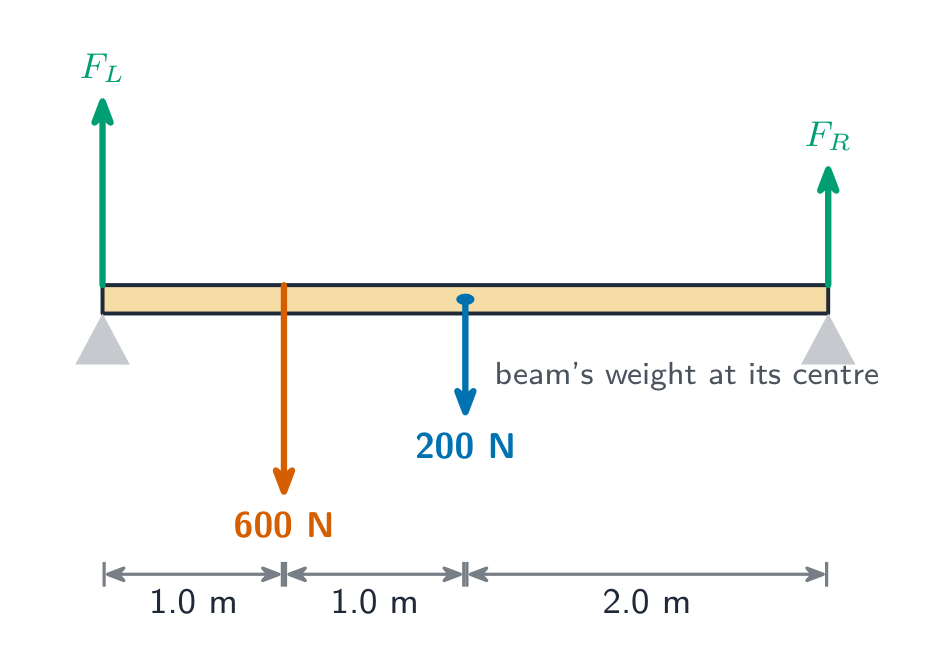
The beam above is at rest.
(A) Calculate $F_R$. Take torques about the left support, so $F_L$ drops out. Counterclockwise = clockwise:
(B) Calculate $F_L$. $\sum F=0$: $F_L + 250 = 600 + 200$, so $F_L = 550$ N.
(C) The person walks slowly to the right. Describe how $F_L$ changes, and justify. $F_L$ decreases. As the person's distance from the left support grows, their clockwise torque about the left end grows, so $F_R$ must increase to balance it. The total upward force stays 800 N, so $F_L = 800 - F_R$ decreases.
- Why it scores: the pivot choice is stated; each torque is force × distance from that pivot; (C) argues from both conditions, $\sum\tau=0$ and $\sum F=0$.
- Rotational equilibrium needs balanced torques, not balanced forces. Two equal forces at different distances can still turn an object.
- Constant angular velocity ≠ at rest. A steadily spinning wheel is in rotational equilibrium.
- Measure every lever arm from the same pivot, and put a uniform object's weight at its centre.
Rotational equilibrium: $\sum\tau = 0$, and then the angular velocity is constant (Newton's first law for rotation). It is independent of translational equilibrium ($\sum F = 0$); an object at rest needs both. To find unknown forces, take torques about the point where an unknown acts, then use $\sum F = 0$.