Real Interest Rates and International Capital Flows
Введено| English | Значение |
|---|---|
| real interest rate/rɪəl ˈɪntrest reɪt/ | An interest rate adjusted for inflation, approximately the nominal rate minus the inflation rate when rates are small. |
| capital inflow/ˈkæpɪtl ˈɪnfləʊ/ | Приток капитала |
| appreciates/əˈpriːʃɪeɪts/ | Gains value relative to another currency, so a unit of the currency buys more of that other currency. |
| capital outflow | capital outflow |
| depreciation/dɪˌpriːʃɪˈeɪʃn/ | A fall in the value of an asset or currency over time. |
| capital flows/ˈkæpɪtl fləʊz/ | Движение капитала |
| supply of loanable funds | supply of loanable funds |
| financial account/faɪˈnænʃl əˈkaʊnt/ | The balance-of-payments account recording cross-border transactions in financial assets and liabilities, such as direct investment, securities and loans. |
| current account/ˈkʌrənt əˈkaʊnt/ | The part of the balance of payments recording trade in goods and services, primary income and secondary income. |
Money chases the best return
- In 2022 the US Federal Reserve raised interest rates fast while the Bank of Japan kept its rates near zero. Investors sold yen to buy dollar bonds, and by October 2022 the yen had fallen to about 150 per dollar, its weakest in 32 years.
- Financial capital moves between countries towards the highest real interest rate 实际利率 (nominal rate minus expected inflation), for the same risk. This lesson links three graphs you already know: loanable funds, foreign exchange and AD.
International capital flows are driven mainly by differences in:
Сложность 1/5 · 100 монет + небольшой бонус за первое завершение сегодня
Money moves toward the highest real return.
Capital inflows raise the currency
- When a country's real interest rate rises relative to other countries', foreign savers buy its bonds and other assets: a capital inflow 资本流入. To buy those assets they first need its currency, so demand for the currency rises and it appreciates 升值.
- A relative fall in the real rate does the opposite: a capital outflow 资本流出, more of the currency supplied on the forex market, and depreciation 贬值. Only real rates matter: 8% nominal with 7% inflation pays less than 4% with 1% inflation.
Foreign savers sending money into a high-rate country create a capital ______.
Сложность 1/5 · 100 монет + небольшой бонус за первое завершение сегодня
A capital inflow is money entering to earn the higher rate.
A capital inflow appreciates the currency because foreigners:
Сложность 1/5 · 100 монет + небольшой бонус за первое завершение сегодня
Buying the currency to invest raises demand, so it appreciates.
A country raises its real interest rate from 2% to 5%. By how many percentage points did it rise?
Сложность 2/5 · 140 монет + небольшой бонус за первое завершение сегодня
5 − 2 = 3 percentage points, far above the world rate — drawing capital in.
Country A pays 9% nominal interest with 7% inflation. Country B pays 5% nominal interest with 1% inflation. Where will financial capital tend to flow?
Сложность 1/5 · 100 монет + небольшой бонус за первое завершение сегодня
Real rate = nominal − inflation. A pays 2% real; B pays 4% real.
Capital flows also move loanable funds
- An inflow adds to the supply of loanable funds 可贷资金供给 in the receiving country, so its real rate falls back a little; the sending country's supply falls, so its rate rises. Capital keeps flowing until the gap in real rates closes.
- Exam shortcut: if a question asks about two countries, draw two loanable funds graphs and shift supply in opposite directions: right in the country receiving capital, left in the country sending it.
Capital flows out of Brazil and into Canada. On the two countries' loanable funds graphs,
Сложность 1/5 · 100 монет + небольшой бонус за первое завершение сегодня
Capital leaving Brazil reduces the funds available there; arriving in Canada, it adds to the funds available there.
The big chain: government borrowing to net exports
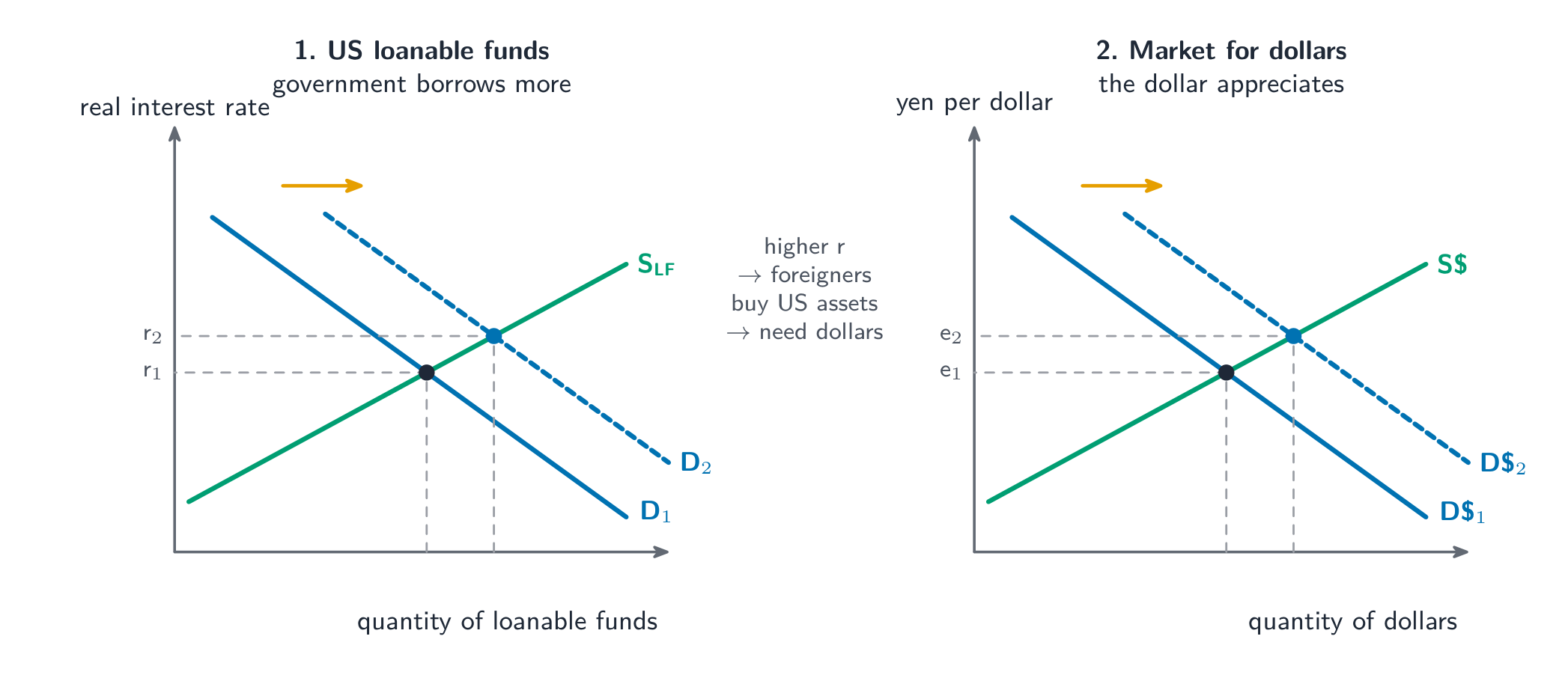
- Deficit spending → the government borrows more, so demand for loanable funds rises → the real interest rate rises → foreign capital flows in → demand for dollars rises → the dollar appreciates → US exports become dearer abroad and imports cheaper → net exports fall.
- This adds a second kind of crowding out: higher rates crowd out private investment and the stronger currency crowds out net exports, so AD rises by less than the extra government spending.
Capital inflow or outflow?
Money chases the best real return. Sort each case by which way capital flows.
Order the chain from a higher real rate to a current-account deficit.
Сложность 3/5 · 200 монет + небольшой бонус за первое завершение сегодня
Higher rate → inflow → appreciation → trade gap widens.
Japan's government increases borrowing to pay for a large spending programme. Which result is most likely?
Сложность 1/5 · 100 монет + небольшой бонус за первое завершение сегодня
More government borrowing raises demand for loanable funds and the real rate; capital flows in, the yen appreciates, and Japanese goods become dearer abroad.
How the two accounts tie together
- The inflow shows up in the financial account 金融账户: foreigners buy US assets, a financial account surplus. The stronger dollar pushes the current account 经常账户 towards deficit, because net exports fall.
- The balance of payments must balance, so a financial account surplus goes with a current account deficit of the same size (ignoring the small capital account).
A financial account surplus (capital inflow) is matched by a current account:
Сложность 1/5 · 100 монет + небольшой бонус за первое завершение сегодня
The appreciation makes exports dearer and imports cheaper, pushing the current account to deficit.
Worked example: a link-FRQ chain
Mexico's central bank sells government bonds while US policy is unchanged. Trace the effects on (a) Mexico's real interest rate, (b) the value of the peso, (c) Mexico's net exports.
- (a) Selling bonds cuts the money supply and raises the nominal rate; with sticky prices in the short run, Mexico's real interest rate rises.
- (b) Foreign savers move funds into Mexican assets (a capital inflow), raising demand for pesos: the peso appreciates. (c) Mexican goods become dearer abroad and imports cheaper, so Mexico's net exports fall.
A country's real interest rate falls relative to the rest of the world. What tends to happen?
Сложность 1/5 · 100 монет + небольшой бонус за первое завершение сегодня
Savers move funds abroad to earn more, selling the currency.
A capital inflow that strengthens the currency tends to push the current account toward deficit.
Сложность 1/5 · 100 монет + небольшой бонус за первое завершение сегодня
A stronger currency cuts exports and raises imports.
Worked FRQ answer
Question: Assume the United States has a large budget deficit and increases it further by borrowing to pay for new spending. (a) Using a correctly labeled graph of the loanable funds market, show the effect on the real interest rate. (b) How will the change in (a) affect the international value of the US dollar? Explain. (c) How will the change in (b) affect US net exports? Explain.
(a) Vertical axis "Real interest rate", horizontal axis "Quantity of loanable funds"; upward S and downward D. Demand shifts right from D₁ to D₂, and the real interest rate rises from r₁ to r₂.
(b) The dollar appreciates. A higher US real interest rate makes US financial assets more attractive, so foreign demand for dollars rises.
(c) Net exports decrease. US goods become more expensive for foreign buyers and foreign goods cheaper for Americans, so exports fall and imports rise.
- Why it scores: (a) shifts demand (government borrowing), not supply, and uses the real rate; (b) gives the reason "US assets more attractive", not just "the dollar rises"; (c) explains both exports and imports.
FRQ practice. The central bank of the euro area raises interest rates to fight inflation, while US rates stay the same. (a) What happens to the flow of financial capital between the US and the euro area? (b) Using a correctly labeled graph of the foreign exchange market for euros, show the effect on the value of the euro. (c) What happens to euro-area net exports? Explain.
In a forex graph, the price on the vertical axis is the other currency per unit of the currency in the market.
Common errors. Using the nominal rate instead of the real rate on the loanable funds graph. Saying a higher interest rate makes the currency depreciate. Mixing up the accounts: a capital inflow is a financial account surplus, and it goes with a current account deficit.
Real interest rates drive capital flows. A relative rise brings a capital inflow: demand for the currency rises and it appreciates, and the inflow adds to the supply of loanable funds. The tested chain: deficit spending → demand for loanable funds ↑ → real rate ↑ → capital inflow → currency appreciates → net exports ↓. A financial account surplus goes with a current account deficit.
Write from the data given
- A country raises its real interest rate from 1 percent to 6 percent.
- Find the rise and say what capital does.
A country raises its real interest rate from 1 percent to 6 percent, while the rest of the world does not. By how many percentage points did the rate rise, and what happens to capital flows and the currency?
6 minus 1 is 5.
By how many percentage points did the real rate rise?
Сложность 1/5 · 100 монет + небольшой бонус за первое завершение сегодня
6 percent minus 1 percent is a rise of 5 percentage points. Other options — 3 (the lesson rise); 6 (the new rate).