Acid-Base Titrations
Введено| English | Значение |
|---|---|
| titration/taɪˈtreɪʃn/ | A method of finding an unknown concentration by measuring the volume needed to react with a solution of known concentration. |
| equivalence point/ɪˈkwɪvələns pɔɪnt/ | эквивалентная точка |
| buffer region | The flat middle part of a weak-acid titration curve, where HA and A− are both present and the pH changes slowly. |
A curve that measures concentration
- In a titration 滴定, a base of known concentration is added slowly from a burette to an acid of unknown concentration, while the pH is recorded. The pH creeps up, then jumps sharply.
- The jump marks the equivalence point 等当点: moles of base added = moles of acid at the start (for a one-proton acid). That one volume reading tells you the unknown concentration.
Concentration from the equivalence volume
- At equivalence, $c_{\text{acid}}V_{\text{acid}}=c_{\text{base}}V_{\text{base}}$ (for 1:1 reactions). Rearrange for the unknown.
- Example: $25.00\ \text{mL}$ of HCl needs $22.40\ \text{mL}$ of $0.1000\ \text{M}$ NaOH. Moles $\text{OH}^-=2.240\times10^{-3}$, so $[\text{HCl}]=\dfrac{2.240\times10^{-3}}{0.02500}=0.08960\ \text{M}$.
$20.00\ \text{mL}$ of $\text{HNO}_3$ needs $16.00\ \text{mL}$ of $0.1250\ \text{M}$ KOH to reach equivalence. Find $[\text{HNO}_3]$, in M.
Сложность 2/5 · 140 монет + небольшой бонус за первое завершение сегодня
Moles KOH $=0.01600\times0.1250=2.000\times10^{-3}$. $[\text{HNO}_3]=\dfrac{2.000\times10^{-3}}{0.02000}=0.1000\ \text{M}$.
$25.00\ \text{mL}$ of $\text{H}_2\text{SO}_4$ needs $30.00\ \text{mL}$ of $0.1000\ \text{M}$ NaOH for complete neutralization. Find $[\text{H}_2\text{SO}_4]$, in M.
Сложность 2/5 · 140 монет + небольшой бонус за первое завершение сегодня
$\text{H}_2\text{SO}_4+2\text{NaOH}$: moles NaOH $=3.000\times10^{-3}$, so moles acid $=1.500\times10^{-3}$ and the concentration is $0.06000\ \text{M}$.
Strong acid vs weak acid curves
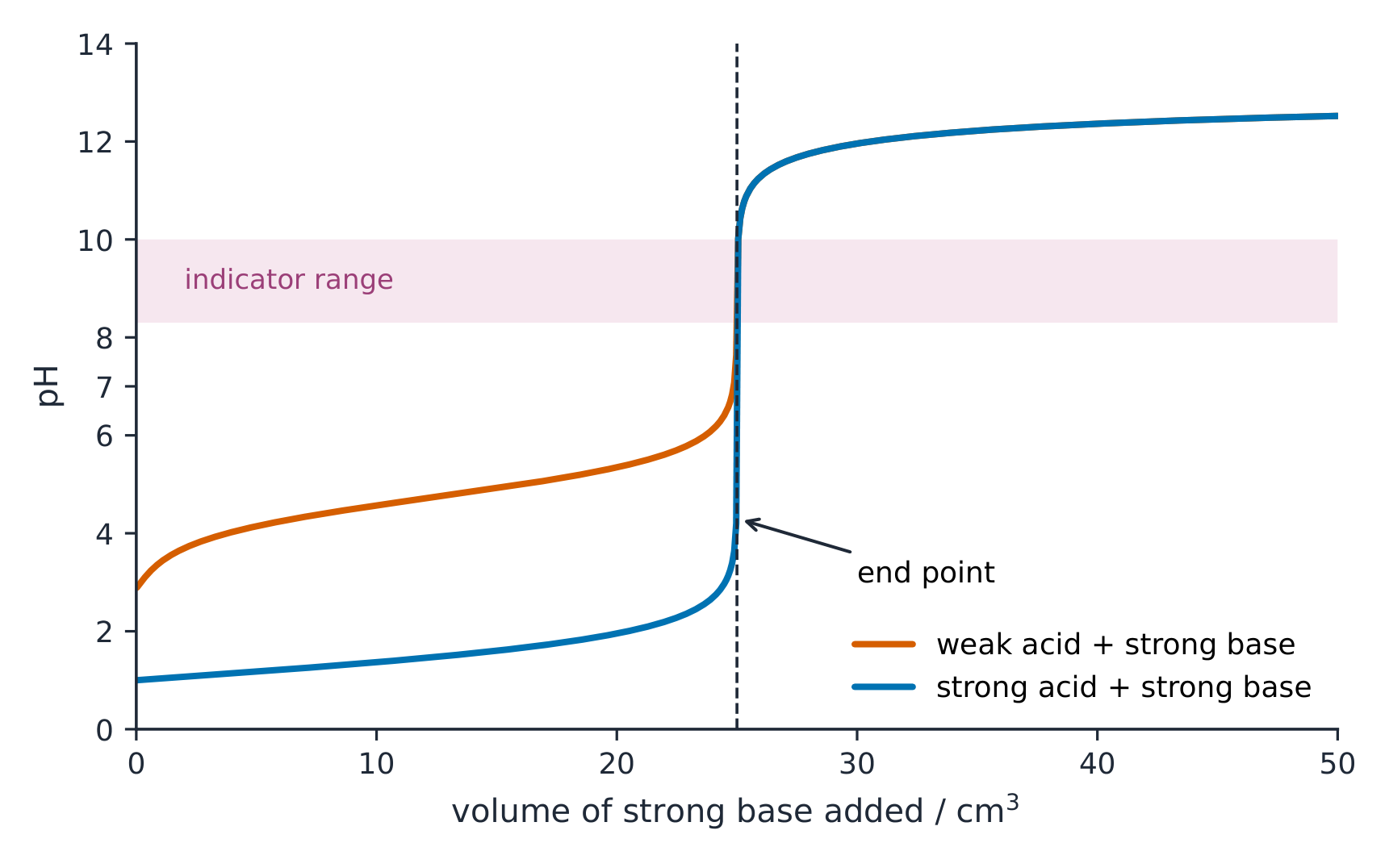
- Strong acid + strong base: starts at low pH (about 1), stays flat, then jumps steeply; pH at equivalence is $7.00$.
- Weak acid + strong base: starts higher, rises quickly at first, then flattens into a buffer region; pH at equivalence is above 7, because the solution then contains only the conjugate base $\text{A}^-$.
What is the pH at the equivalence point when HF is titrated with NaOH?
Сложность 1/5 · 100 монет + небольшой бонус за первое завершение сегодня
Only $\text{F}^-$, a weak base, is left at equivalence, so the solution is basic.
Four points on a weak-acid curve
- Start: weak acid only, use $K_a$. Half-equivalence: $[\text{HA}]=[\text{A}^-]$, so $\text{pH}=\text{p}K_a$.
- Equivalence: conjugate base only, use $K_b$. After equivalence: excess $\text{OH}^-$ sets the pH.
The titration curve
Track pH as titrant is added; the steep vertical jump marks the equivalence point.
$25.0\ \text{mL}$ of $0.100\ \text{M}$ ethanoic acid ($K_a=1.8\times10^{-5}$, $\text{p}K_a=4.74$) is titrated with $0.100\ \text{M}$ NaOH. Equivalence is at $25.0\ \text{mL}$.
- 0 mL: $[\text{H}^+]=\sqrt{1.8\times10^{-5}\times0.100}=1.3\times10^{-3}$, pH $2.87$.
- 12.5 mL (half-equivalence): pH $=\text{p}K_a=4.74$.
- 25.0 mL: $2.50\times10^{-3}\ \text{mol}\ \text{A}^-$ in $50.0\ \text{mL}$ → $0.0500\ \text{M}$. $K_b=5.6\times10^{-10}$, $[\text{OH}^-]=5.3\times10^{-6}$, pOH $5.28$, pH $8.72$.
- 35.0 mL: excess $\text{OH}^-=1.00\times10^{-3}\ \text{mol}$ in $60.0\ \text{mL}$ → $0.0167\ \text{M}$, pOH $1.78$, pH $12.22$.
$20.0\ \text{mL}$ of $0.100\ \text{M}$ HCl is titrated with $0.100\ \text{M}$ NaOH. Find the pH after $30.0\ \text{mL}$ of NaOH has been added.
Сложность 2/5 · 140 монет + небольшой бонус за первое завершение сегодня
Excess $\text{OH}^-=1.00\times10^{-3}\ \text{mol}$ in $50.0\ \text{mL}$ → $0.0200\ \text{M}$, pOH $1.70$, pH $12.30$.
Half-equivalence gives pKa directly
- At half the equivalence volume, half the HA has become $\text{A}^-$, so the two are equal. Then $K_a=[\text{H}^+]$, which means $\text{pH}=\text{p}K_a$.
- So you can read $\text{p}K_a$ straight off a titration curve. This is a favourite AP question.

On a weak-acid titration curve, equivalence is at $30.0\ \text{mL}$ and the pH at $15.0\ \text{mL}$ является $3.85$. What is $K_a$, in units of $10^{-4}$?
Сложность 2/5 · 140 монет + небольшой бонус за первое завершение сегодня
At half-equivalence pH $=\text{p}K_a=3.85$, so $K_a=10^{-3.85}=1.4\times10^{-4}$.
Choosing an indicator
- An indicator changes colour over a small pH range, near its own $\text{p}K_a$. Choose one whose colour change falls inside the steep jump at equivalence.
- Weak acid + strong base (equivalence above 7): phenolphthalein, range about $8.2$–$10$. Strong acid + weak base (equivalence below 7): methyl orange or methyl red.
Ammonia is titrated with HCl; the equivalence pH is about 5.3. Which indicator fits best?
Сложность 1/5 · 100 монет + небольшой бонус за первое завершение сегодня
The colour change must fall inside the steep jump around pH 5.3.
Acids with two protons
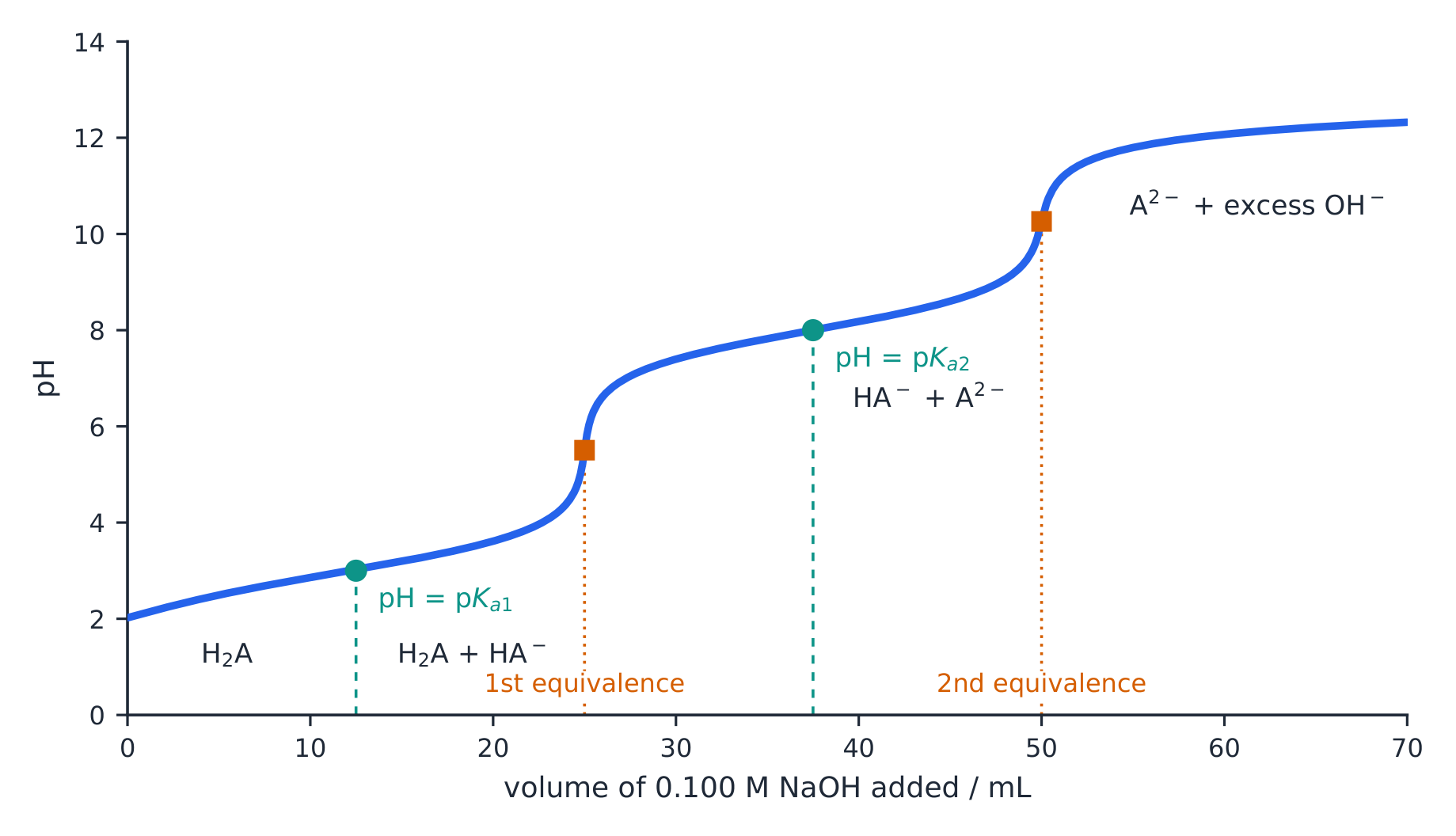
- A diprotic acid such as $\text{H}_2\text{A}$ gives two jumps, one for each proton. The second equivalence volume is twice the first.
- Halfway to each equivalence point, $\text{pH}=\text{p}K_{a1}$ and then $\text{pH}=\text{p}K_{a2}$.
The equivalence point is not always at pH 7: weak acid + strong base is above 7, strong acid + weak base is below 7. The equivalence volume depends only on the moles of acid, not on its strength: equal moles of HCl and ethanoic acid need the same volume of NaOH.
A weak acid needs a larger volume of NaOH to reach equivalence than the same moles of a strong acid.
Сложность 1/5 · 100 монет + небольшой бонус за первое завершение сегодня
The equivalence volume depends only on moles of acid. Strength changes the curve's shape, not the volume.
At equivalence, moles base = moles acid (1:1), giving the unknown concentration. A weak-acid curve starts higher, has a buffer region with $\text{pH}=\text{p}K_a$ at half-equivalence, and reaches equivalence above pH 7. Choose an indicator that changes colour within the steep jump.