Логарифмы, тригонометрия и численные методы (Чистая математика, 3)
Введено| English | Значение |
|---|---|
| logarithm/ˈlɒɡərɪθəm/ | логарифм |
| exponential equation/ˌekspəˈnenʃl ɪˈkweɪʒn/ | показательное уравнение |
| decay/dɪˈkeɪ/ | затухание |
| linearise/ˈlɪnɪəraɪz/ | линеаризация |
| convergence/kənˈvɜːdʒəns/ | схождение |
Building on what you know
- Pure 3 doesn't introduce entirely new ideas — it deepens and extends the skills from Pure 2.
- Logarithms 对数, trigonometry, and numerical methods return with harder problems and richer applications.
Logarithms revisited
- The log laws with $e^x$ and $\ln x$ return in harder contexts: solving exponential equations 指数方程, modelling growth and decay 衰减, and linearising 线性化 data.
- Key skill: when the unknown is in the power, take logs of both sides.
Worked example. Solve $5e^{2x} = 30$. Divide: $e^{2x} = 6$. Take $\ln$: $2x = \ln 6$, so $x = \dfrac{\ln 6}{2} \approx 0.896$.
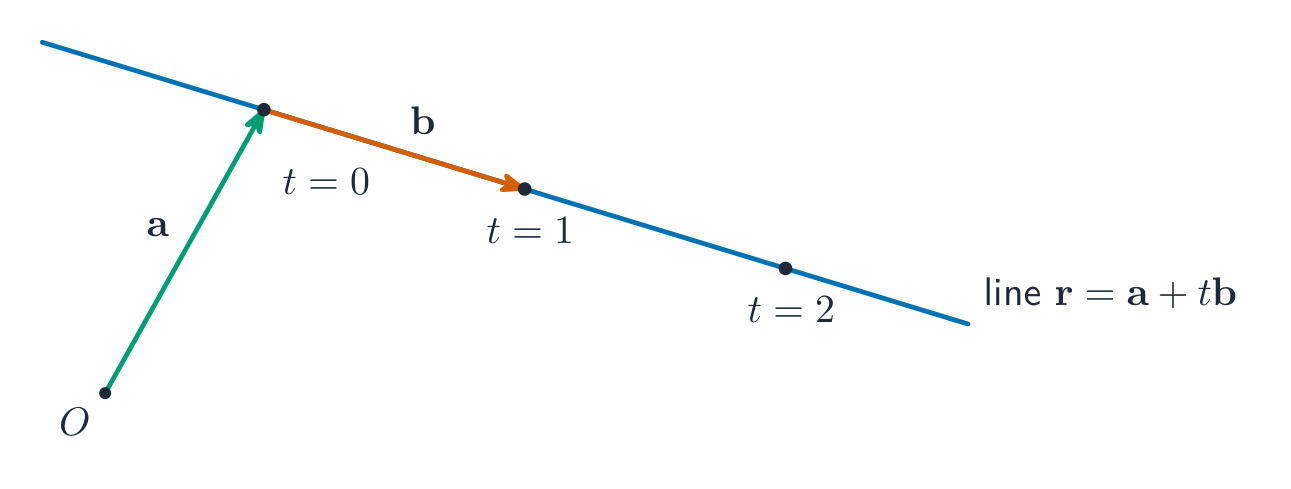
A line r = a + t b: start at a, then slide by t lots of the direction b
Чему равен ln(e³)?
Сложность 2/5 · 140 монет + небольшой бонус за первое завершение сегодня
ln и e являются взаимно обратными функциями, поэтому ln(e³) = 3.
Решите 5e^(2x) = 30 относительно x (округлить до 2 знаков).
Сложность 2/5 · 140 монет + небольшой бонус за первое завершение сегодня
e^(2x) = 6, следовательно 2x = ln 6, x = (ln 6)/2 ≈ 0,896 ≈ 0,90.
Trigonometry revisited
- $\sec^2\theta \equiv 1 + \tan^2\theta$, $\csc^2\theta \equiv 1 + \cot^2\theta$.
- The compound- and double-angle formulae, and the $R$-form of $a\sin\theta + b\cos\theta$.
- These identities are essential for integration and solving trig equations.
Don't mix up the identities. $\sec^2\theta \equiv 1 + \tan^2\theta$ (plus sign), not $1 - \tan^2\theta$. The sign comes from dividing $\sin^2\theta + \cos^2\theta \equiv 1$ by $\cos^2\theta$.
Единичная окружность
(cos θ, sin θ)
R-формула преобразует выражение a sin θ + b cos θ в одну волну — и всё это происходит на этой окружности.
Используя sec²θ ≡ 1 + tan²θ, если tan θ = 3, чему равно sec²θ?
Сложность 2/5 · 140 монет + небольшой бонус за первое завершение сегодня
sec²θ = 1 + 3² = 1 + 9 = 10.
sec²θ ≡ 1 − tan²θ.
Сложность 1/5 · 100 монет + небольшой бонус за первое завершение сегодня
Правильное тождество: sec²θ ≡ 1 + tan²θ (плюс, а не минус).
Numerical methods revisited
- A sign change to trap a root, then an iterative formula $x_{n+1} = F(x_n)$.
- Convergence 收敛 requires $|F'(x)| < 1$ near the root.
Численный корень находится методом изменения знака, затем многократным применением:
Сложность 1/5 · 100 монет + небольшой бонус за первое завершение сегодня
Метод итераций использует формулу x_{n+1} = F(x_n) до тех пор, пока значения не сойдутся к корню.
Worked example — R-formula application
- Express $3\sin\theta + 4\cos\theta$ in the form $R\sin(\theta + \alpha)$.
- $R = \sqrt{3^2 + 4^2} = 5$. $\tan\alpha = \dfrac{4}{3} \Rightarrow \alpha \approx 53.1^{\circ}$.
- So $3\sin\theta + 4\cos\theta = 5\sin(\theta + 53.1^{\circ})$.
- Maximum value is $5$ (when $\sin(\theta + 53.1^{\circ}) = 1$).
- Plotting $\ln y$ against $x$ gives a line whose gradient and intercept find the constants (using indices and inverse functions); know the reciprocal trig functions secant, cosecant, cotangent; and iteration $x_{n+1}=F(x_n)$ shows convergence to a root.
Для выражения 3 sin θ + 4 cos θ = R sin(θ + α), чему равно R?
Сложность 2/5 · 140 монет + небольшой бонус за первое завершение сегодня
R = √(3² + 4²) = √25 = 5.
You've got it
- 3.2 logs, 3.3 trig identities/angle formulae, 3.6 numerical methods = the Pure 2 skills
- use $\sec^2\theta \equiv 1 + \tan^2\theta$ and the R-formula as before
- find roots by a sign change then iteration $x_{n+1} = F(x_n)$
Write from the data given
- Solve e to the 2x = e to the 10.
Решите e в степени 2x = e в степени 10.
2 умножить на 5 равно 10, поэтому показатели согласованы.
Чему равно x?
Сложность 1/5 · 100 монет + небольшой бонус за первое завершение сегодня
2x = 10, следовательно x = 5. Другие варианты — 0.9 (учебная аппроксимация); 10 (показатель, использованный как x).