Differentiation (Pure 2)
Введено| English | Значение |
|---|---|
| standard derivatives/ˈstændəd dɪˈrɪvətɪvz/ | стандартные производные |
| quotient rule/ˈkwəʊʃənt ruːl/ | правило частного |
| product rule/ˈprɒdʌkt ruːl/ | правило произведения |
| parametric/ˌpærəˈmetrɪk/ | параметрический |
| implicit/ɪmˈplɪsɪt/ | неявный |
New functions, new rules
- $e^x$ has a special property: its derivative is itself. This is why it models growth, decay and compound interest.
- Pure 2 adds the derivatives of $e^x$, $\ln x$, $\sin x$, $\cos x$ and $\tan x$, and three tools for harder functions: the product rule, the quotient rule, and parametric and implicit differentiation.
- Exam questions use them to find gradients, tangents, normals and stationary points.
Standard derivatives 标准导数
- Learn the left column. The right column applies the chain rule to an inside function; it comes up in almost every question.
| $y$ | $\dfrac{dy}{dx}$ |
|---|---|
| $e^{x}$ | $e^{x}$ |
| $e^{f(x)}$ | $f'(x)\,e^{f(x)}$ |
| $\ln x$ | $\dfrac1x$ |
| $\ln f(x)$ | $\dfrac{f'(x)}{f(x)}$ |
| $\sin(ax+b)$ | $a\cos(ax+b)$ |
| $\cos(ax+b)$ | $-a\sin(ax+b)$ |
| $\tan(ax+b)$ | $a\sec^2(ax+b)$ |
- Examples: $y=e^{3x}$ gives $3e^{3x}$. $y=\ln(3x^2+1)$ gives $\dfrac{6x}{3x^2+1}$. $y=\sin^2x=(\sin x)^2$ gives $2\sin x\cos x$.
- Trap: angles must be in radians for these results to be true.
Наклон касательной в точке
gradient = dy/dx
Slide the point — the касательную slope is the derivative, even for these new standard functions.
The derivative of ln x is 1/x. What is its value at x = 4?
Сложность 2/5 · 140 монет + небольшой бонус за первое завершение сегодня
d/dx(ln x) = 1/x = 1/4 = 0.25.
The derivative of eˣ is eˣ. What is its value at x = 0?
Сложность 2/5 · 140 монет + небольшой бонус за первое завершение сегодня
d/dx(eˣ) = eˣ, and e⁰ = 1.
If y = e^(3x), then dy/dx = 3e^(3x). What is dy/dx at x = 0?
Сложность 2/5 · 140 монет + небольшой бонус за первое завершение сегодня
At x = 0: dy/dx = 3e⁰ = 3 × 1 = 3.
y = e^(4x). Find dy/dx at x = 0, and explain each step.
4 times 1 is 4. The exponential itself is 1 at x = 0.
Differentiate y = ln(x² + 5).
Сложность 1/5 · 100 монет + небольшой бонус за первое завершение сегодня
d/dx ln f(x) = f′(x)/f(x), and f′(x) = 2x.
The product rule 乘积法则
- If $y=uv$, then $\dfrac{dy}{dx}=u\dfrac{dv}{dx}+v\dfrac{du}{dx}$. The derivative of a product is not the product of the derivatives.
- Method: write down $u$, $v$, $u'$ and $v'$ first, then put them into the formula.
$y=x^2\sin x$. Let $u=x^2$ and $v=\sin x$, so $u'=2x$ and $v'=\cos x$.
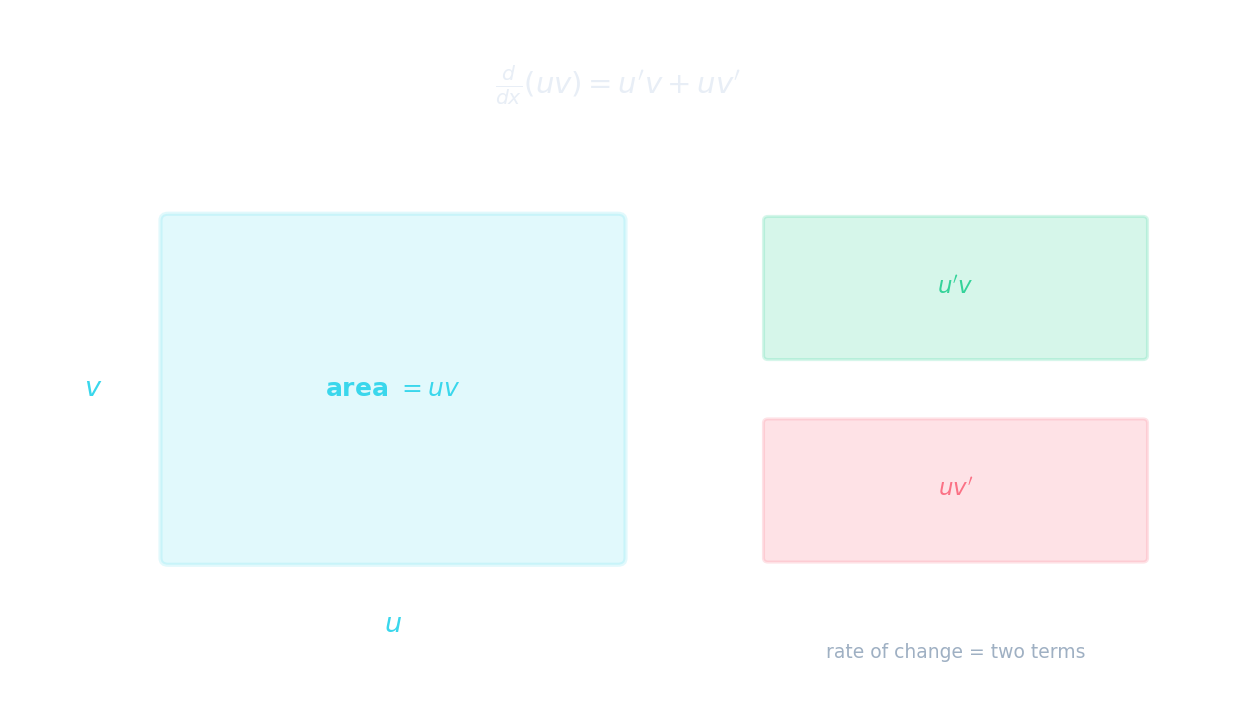
When both $u$ and $v$ change, the area $uv$ grows in two strips, one for each function changing.
The product rule says (uv)′ equals:
Сложность 1/5 · 100 монет + небольшой бонус за первое завершение сегодня
The product rule: (uv)′ = u′v + uv′.
y = x e^x. Find dy/dx at x = 0.
Сложность 2/5 · 140 монет + небольшой бонус за первое завершение сегодня
dy/dx = e^x + x e^x. At x = 0 this is 1 + 0 = 1.
The quotient rule 商法则
- If $y=\dfrac uv$, then $\dfrac{dy}{dx}=\dfrac{v\,u'-u\,v'}{v^2}$. The order on the top matters: $v\,u'$ comes first.
$y=\dfrac{e^{2x}}{x+1}$. Here $u=e^{2x}$, $u'=2e^{2x}$, $v=x+1$, $v'=1$.
Since $e^{2x}>0$, the gradient is zero only when $2x+1=0$, at $x=-\tfrac12$.
The quotient rule for (u/v)′ is (u′v + uv′)/v².
Сложность 1/5 · 100 монет + небольшой бонус за первое завершение сегодня
The quotient rule is (u′v − uv′)/v² (minus, not plus in the numerator).
Parametric differentiation 参数的
- When $x$ and $y$ are both given in terms of a parameter $t$, use $\dfrac{dy}{dx}=\dfrac{dy/dt}{dx/dt}$.
$x=t^2+1$, $y=t^3-3t$. Find the tangent at $t=2$.
- $\dfrac{dx}{dt}=2t$ and $\dfrac{dy}{dt}=3t^2-3$, so $\dfrac{dy}{dx}=\dfrac{3t^2-3}{2t}$.
- At $t=2$: the point is $(5,\,2)$ and the gradient is $\dfrac{9}{4}$.
- Tangent: $y-2=\tfrac94(x-5)$, which is $4y=9x-37$.
If x = t² and y = t³, then dy/dx = (dy/dt)/(dx/dt) = 3t²/2t = 3t/2. At t = 4, dy/dx = ?
Сложность 2/5 · 140 монет + небольшой бонус за первое завершение сегодня
At t = 4: dy/dx = 3(4)/2 = 6.
x = 2t + 1, y = t³. Find the gradient dy/dx when t = 2.
Сложность 2/5 · 140 монет + небольшой бонус за первое завершение сегодня
dx/dt = 2 and dy/dt = 3t² = 12, so dy/dx = 12 ÷ 2 = 6.
Implicit differentiation 隐式的
- When $x$ and $y$ are mixed in one equation, differentiate every term with respect to $x$. A term in $y$ gets an extra factor $\dfrac{dy}{dx}$ (chain rule), and $xy$ needs the product rule.
$x^2+xy+y^2=7$. Find the gradient at $(1,\,2)$.
Collect the $\dfrac{dy}{dx}$ terms: $(x+2y)\dfrac{dy}{dx}=-(2x+y)$, so
At $(1,2)$: $\dfrac{dy}{dx}=-\dfrac{4}{5}$.
x² + y² = 25. Find dy/dx at the point (3, 4), as a decimal.
Сложность 2/5 · 140 монет + небольшой бонус за первое завершение сегодня
2x + 2y dy/dx = 0, so dy/dx = −x/y = −3/4 = −0.75.
Worked exam question: a stationary point
Question (6 marks). The curve $y=xe^{-2x}$ has one stationary point. Find its exact coordinates and determine whether it is a maximum or a minimum.
- Product rule with $u=x$ and $v=e^{-2x}$ (M1, A1):
- Set to zero: $e^{-2x}>0$, so $1-2x=0$ and $x=\tfrac12$. (M1)
- Coordinates: $y=\tfrac12e^{-1}=\dfrac{1}{2e}$, so the point is $\left(\tfrac12,\ \dfrac1{2e}\right)$. (A1, exact form)
- Nature: $\dfrac{d^2y}{dx^2}=e^{-2x}(4x-4)$. At $x=\tfrac12$ this is $-2e^{-1}<0$, so it is a maximum. (M1 A1)
Why answers lose marks: writing $\dfrac{d}{dx}e^{-2x}=e^{-2x}$ (the $-2$ is missing), giving $y\approx0.184$ when the question says exact, or stating "maximum" with no test.
The curve y = x e^(−x) has one stationary point. Find its exact coordinates and its nature.
Same method as the worked question, with −1 in place of −2.
You've got it
- $\dfrac{d}{dx}e^{f(x)}=f'(x)e^{f(x)}$; $\dfrac{d}{dx}\ln f(x)=\dfrac{f'(x)}{f(x)}$; $\sin(ax+b)\to a\cos(ax+b)$; $\cos(ax+b)\to-a\sin(ax+b)$; $\tan(ax+b)\to a\sec^2(ax+b)$; radians only
- product: $(uv)'=uv'+vu'$; quotient: $\left(\dfrac uv\right)'=\dfrac{vu'-uv'}{v^2}$
- parametric: $\dfrac{dy}{dx}=\dfrac{dy/dt}{dx/dt}$; implicit: differentiate every term, multiply $y$-terms by $\dfrac{dy}{dx}$, then rearrange
- stationary point: set $\dfrac{dy}{dx}=0$, give exact coordinates, then test the nature with $\dfrac{d^2y}{dx^2}$
y = e^(4x). What is dy/dx at x = 0?
Сложность 1/5 · 100 монет + небольшой бонус за первое завершение сегодня
dy/dx = 4e^(4x), and e^0 = 1, so the answer is 4. Answer 1 forgets the chain factor 4.