Market failure and externalities
Введено| English | Значение |
|---|---|
| market failure/ˈmɑːkɪt ˈfeɪlɪə/ | провал рынка |
| externality/ekˈstɜːnælɪti/ | внешний эффект |
| social optimum/ˈsəʊʃl ˈɒptɪməm/ | социальный оптимум |
| third party/θɜːd ˈpɑːti/ | третья сторона |
| negative externality/ˈneɡətɪv ekˈstɜːnælɪti/ | негативный внешний эффект |
| positive externality/ˈpɒzɪtɪv ekˈstɜːnælɪti/ | позитивный внешний эффект |
| marginal social cost/ˈmɑːdʒɪnl ˈsəʊʃl kɒst/ | предельные социальные издержки |
| overproduction/ˌəʊvəprəˈdʌkʃn/ | перепроизводство |
| underproduction/ˌʌndəprəˈdʌkʃn/ | недопроизводство |
The smog nobody paid for
- In January 2013, air pollution in Beijing reached readings near 900 µg/m³ of fine particles, more than 30 times the WHO daily guideline of the time. Coal-burning power stations, factories and heating boilers sold their electricity and goods at prices that did not include the cost of the hospital visits and lost working days that the smog caused.
- When prices leave out costs or benefits like these, the market produces the wrong quantity. This is market failure 市场失灵, and its most important cause is the externality 外部性.
What market failure means
- Market failure is when a free market allocates resources inefficiently: too much or too little of a good is produced compared with the quantity that is best for society, the social optimum 社会最优.
- Causes include externalities, public goods, merit and demerit goods, and information failure (the next lesson covers the others).
What is market failure?
Сложность 1/5 · 100 монет + небольшой бонус за первое завершение сегодня
Too much or too little is produced compared with the social optimum.
Externalities and third parties
- An externality is a cost or benefit of a transaction that falls on a third party 第三方, someone who is neither the buyer nor the seller.
- Social cost = private cost + external cost. Social benefit = private benefit + external benefit. The market only counts the private side.
| Negative externality 负外部性 | Positive externality 正外部性 | |
|---|---|---|
| Example | pollution from a coal plant; noise from an airport | vaccination; education; planting trees |
| Comparison | marginal social cost 边际社会成本 (MSC) > marginal private cost | marginal social benefit (MSB) > marginal private benefit |
| Market result | overproduction 生产过多 | underproduction 生产不足 |
The market and where it fails
Supply and demand set the market price and quantity at their intersection. Market failure is when this free-market outcome is not the best one for society.
A factory's private cost of a unit is 40, and its pollution imposes an external cost of 15 per unit. What is the social cost per unit?
Сложность 2/5 · 140 монет + небольшой бонус за первое завершение сегодня
Social cost = private cost + external cost = 40 + 15 = 55.
Match each example to its type of externality.
Сложность 2/5 · 140 монет + небольшой бонус за первое завершение сегодня
Harm or benefit to a third party.
The negative externality diagram
- The market produces where private benefit equals private cost. Because MSC lies above the private cost curve, the market quantity is greater than the social optimum, where MSB = MSC.
- Each unit beyond the optimum costs society more than it is worth, so there is a welfare loss (the triangle between MSC and MSB from the optimum to the market quantity).
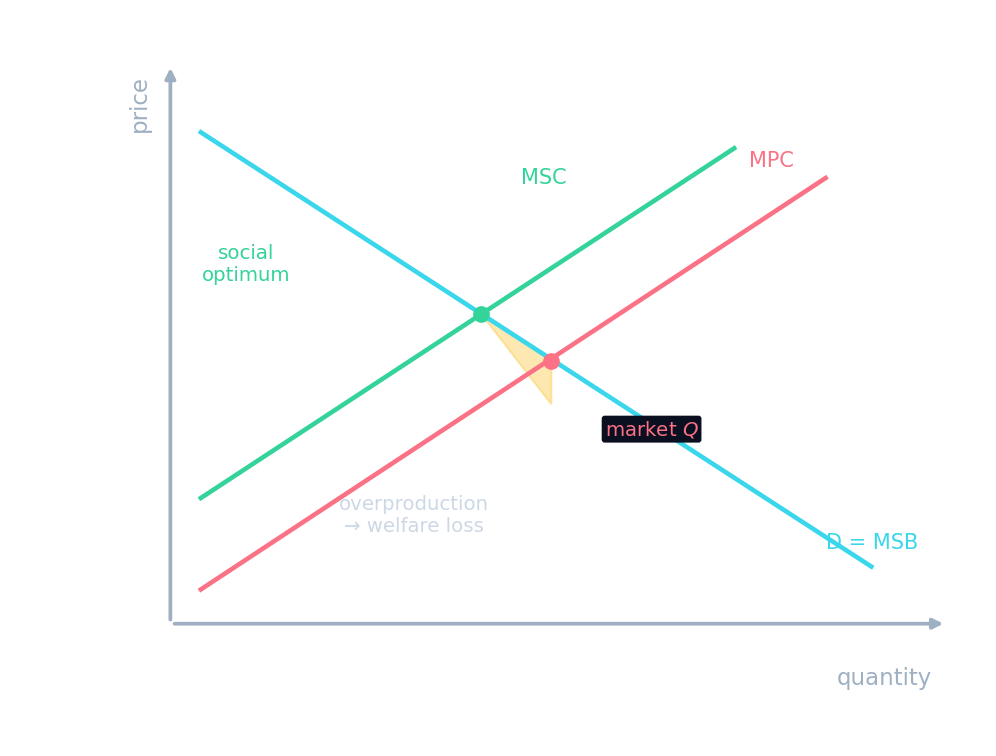
In a market with a negative externality, how does the market quantity compare with the social optimum?
Сложность 1/5 · 100 монет + небольшой бонус за первое завершение сегодня
MSC lies above private cost, so the market over-produces.
The positive externality diagram
- With a positive externality, MSB lies above the private benefit curve. The market produces where private benefit equals cost, which is less than the social optimum.
- Example: people deciding whether to be vaccinated count their own protection, but not the protection they give others, so too few are vaccinated.
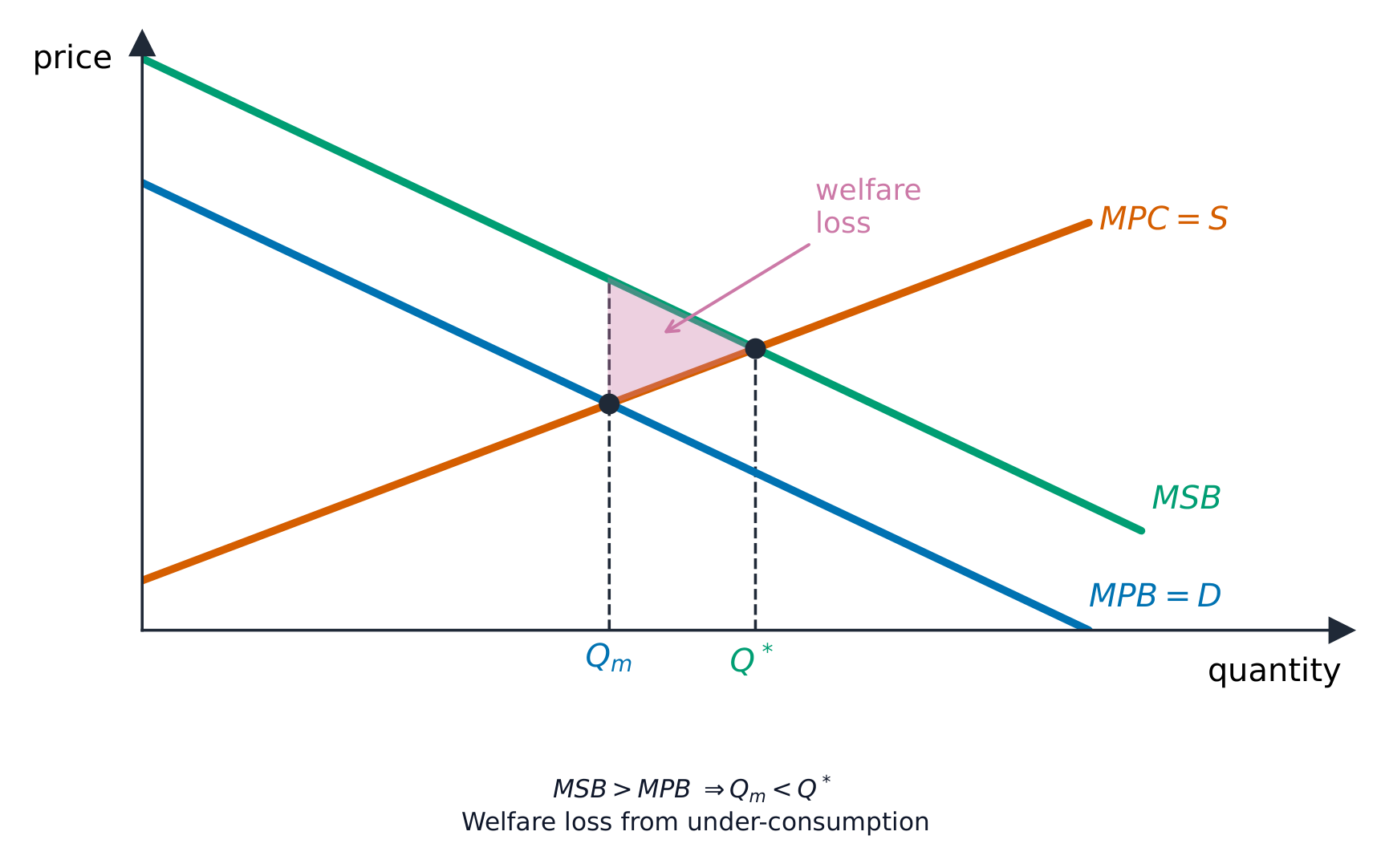
Without intervention, a free market tends to produce too few vaccinations.
Сложность 1/5 · 100 монет + небольшой бонус за первое завершение сегодня
People ignore the protection they give others, so MSB is above private benefit.
Worked exam answer
A chemical plant's private cost of producing one more tonne rises with output. Its emissions cause an external cost of £10 per tonne. The market produces 500 tonnes; the social optimum is 400 tonnes. Explain why this is a market failure. [6]
Social cost is private cost plus the £10 external cost, so the MSC curve lies £10 above the private cost curve. The firm ignores the £10 borne by third parties and produces where private benefit equals private cost, at 500 tonnes. The social optimum is where MSB = MSC, at 400 tonnes. The extra 100 tonnes cost society more than they are worth, so resources are over-allocated and there is a welfare loss. A tax of £10 per tonne would make the firm count the external cost.
- Why it scores: defines social cost, explains why the firm ignores it, compares the two quantities, and names the welfare loss (AO1 and AO2).
Negative externality means over-production, not under-production. Pollution → MSC above private cost → too much is produced. Positive externality → MSB above private benefit → too little.
Market failure is an inefficient allocation of resources. An externality is a cost or benefit to a third party. Social = private + external. A negative externality (MSC > private cost) leads to overproduction; a positive externality (MSB > private benefit) leads to underproduction. Both create a welfare loss compared with the social optimum where MSB = MSC.
Exam practice. Explain, with a diagram, why a free market may under-provide education. [6]
Positive externality means underproduction.