Lares
Introduzido| English | Significado |
|---|---|
| income/ˈɪŋkʌm/ | renda |
| consumption/kənˈsʌmpʃn/ | consumo |
| saving/ˈseɪvɪŋ/ | poupança |
| borrowing/ˈbɒrəʊɪŋ/ | Taking money as a loan now and paying it back later with interest. |
| interest rates/ˈɪntrest reɪts/ | taxas de juros |
| mortgage/ˈmɔːɡɪdʒ/ | hipoteca |
| confidence/ˈkɒnfɪdəns/ | confiança |
A third of income saved, April 2020
- In April 2020, as COVID-19 closed shops, restaurants and travel in the United States, households suddenly saved about a third of their after-tax income — the highest share since records began in 1959. In normal years the figure was around 7%. People had fewer chances to spend and were worried about their jobs.
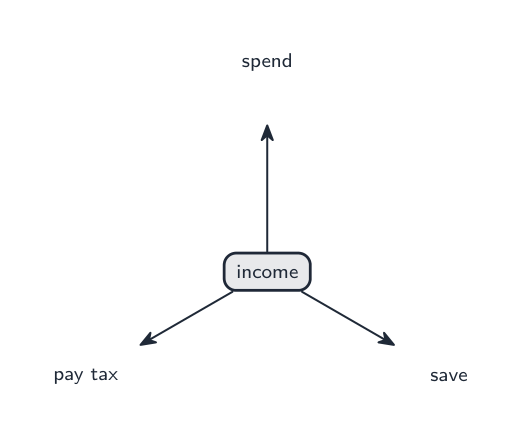
- A household's income 收入 goes on consumption 消费 (spending), saving 储蓄 and taxes; it may also borrow to spend more than it earns.
Laboratório de casos de economia
Classify real examples by the economic idea they show.
US households saved an unusually high share of income in April 2020.
Dificuldade 1/5 · Moedas 100 + pequeno bônus na primeira conclusão hoje
About a third.
Three uses of income
- Spending on goods and services; saving in a bank or pension; paying direct taxes.
- Borrowing 借款 — loans and credit cards — lets a household spend more than its income now, but it must repay with interest later.

Which are uses of household income?
Dificuldade 2/5 · Moedas 140 + pequeno bônus na primeira conclusão hoje
Borrowing adds to spending power.
Income changes the pattern
- Low-income households spend most of their income, much of it on necessities, and save little.
- High-income households spend more in total but save a larger share of their income.
Which households usually save the largest share of their income?
Dificuldade 1/5 · Moedas 100 + pequeno bônus na primeira conclusão hoje
They have income left after necessities.
Interest rates
- Higher interest rates 利率 reward saving and make borrowing more expensive, so households save more and spend less.
- Lower interest rates do the opposite. A mortgage 抵押贷款 — a long-term loan to buy a home — becomes cheaper or dearer each month as rates change.
What happens when interest rates rise?
Dificuldade 1/5 · Moedas 100 + pequeno bônus na primeira conclusão hoje
Saving pays more; loans cost more.
Worked example: a mortgage and a rate rise
A family pays only interest on a $200,000 mortgage (to keep the arithmetic simple).
- At 3% a year: $200{,}000 \times 0.03 = \$6{,}000$ a year, or $500 a month.
- At 5% a year: $200{,}000 \times 0.05 = \$10{,}000$ a year, or about $833 a month.
- Effect: about $333 less to spend each month on other goods, so consumption falls.
Interest at 4% a year on a $150,000 mortgage. How much is that per year, in dollars?
Dificuldade 2/5 · Moedas 140 + pequeno bônus na primeira conclusão hoje
150,000 × 0.04.
Confidence and other factors
- Confidence 信心: when households expect secure jobs and rising incomes they spend more; when worried, as in 2020, they save more.
- Other factors: wealth (house prices, shares), age (young people borrow, middle-aged save for pensions), and the availability of credit.
Falling consumer confidence usually increases saving.
Dificuldade 1/5 · Moedas 100 + pequeno bônus na primeira conclusão hoje
Households prepare for bad times.
Match each stage of life to its typical behaviour.
Dificuldade 2/5 · Moedas 140 + pequeno bônus na primeira conclusão hoje
Life-cycle pattern.
Saving is not the opposite of having money. A household with high income can save a lot and spend a lot; what matters is the share of income used each way.
Households use income for consumption, saving and tax, and may borrow. Higher income raises the share saved; higher interest rates encourage saving and discourage borrowing and spending; confidence, wealth and age also affect decisions.
Explain two reasons why a household might save more next year.
Factors in saving.