Half-equations and charge
Introduzido| English | Significado |
|---|---|
| electrolysis/ɪlekˈtrɒləsɪs/ | The decomposition of an electrolyte by an electric current passing through its molten form or a solution. |
| half-equations/hɑːf ɪˈkweɪʒnz/ | meias-equações |
| oxidation/ˌɒksɪˈdeɪʃn/ | oxidação |
| reduction/rɪˈdʌkʃn/ | redução |
A battery that made a new metal, 1807
- In October 1807 Humphry Davy passed electricity from a large battery through molten potash at the Royal Institution in London. Small, shining globules of a metal formed and burst into flame. He had discovered potassium; days later he made sodium the same way.
- Electrolysis 电解 breaks an ionic compound down with electricity. We describe what happens at each electrode with half-equations 半反应式.
Which metal did Davy first isolate by electrolysis in 1807?
Dificuldade 1/5 · Moedas 100 + pequeno bônus na primeira conclusão hoje
From molten potash.
Oxidation and reduction by electrons
- Reduction 还原 is gain of electrons; oxidation 氧化 is loss of electrons.
- Memory aid: OIL RIG — Oxidation Is Loss, Reduction Is Gain.
Match each process to its electron change.
Dificuldade 2/5 · Moedas 140 + pequeno bônus na primeira conclusão hoje
OIL RIG.
At the cathode (negative electrode)
- Positive ions are attracted to the cathode and gain electrons: Na⁺ + e⁻ → Na. This is reduction.
- An ion with charge 2+ needs two electrons: Cu²⁺ + 2e⁻ → Cu.
Which is the correct cathode half-equation for copper?
Dificuldade 1/5 · Moedas 100 + pequeno bônus na primeira conclusão hoje
Two electrons for a 2+ ion.
At the anode (positive electrode)
- Negative ions are attracted to the anode and lose electrons: 2Cl⁻ → Cl₂ + 2e⁻. This is oxidation.
- Two chloride ions are needed because chlorine gas is diatomic, Cl₂.
Reduction and oxidation at the electrodes
Cations reach the cathode and GAIN electrons (reduction); anions reach the anode and LOSE electrons (oxidation). Step to the discharge stage to see the half-equations.
At the anode, chloride ions are oxidised to chlorine gas.
Dificuldade 1/5 · Moedas 100 + pequeno bônus na primeira conclusão hoje
2Cl⁻ → Cl₂ + 2e⁻.
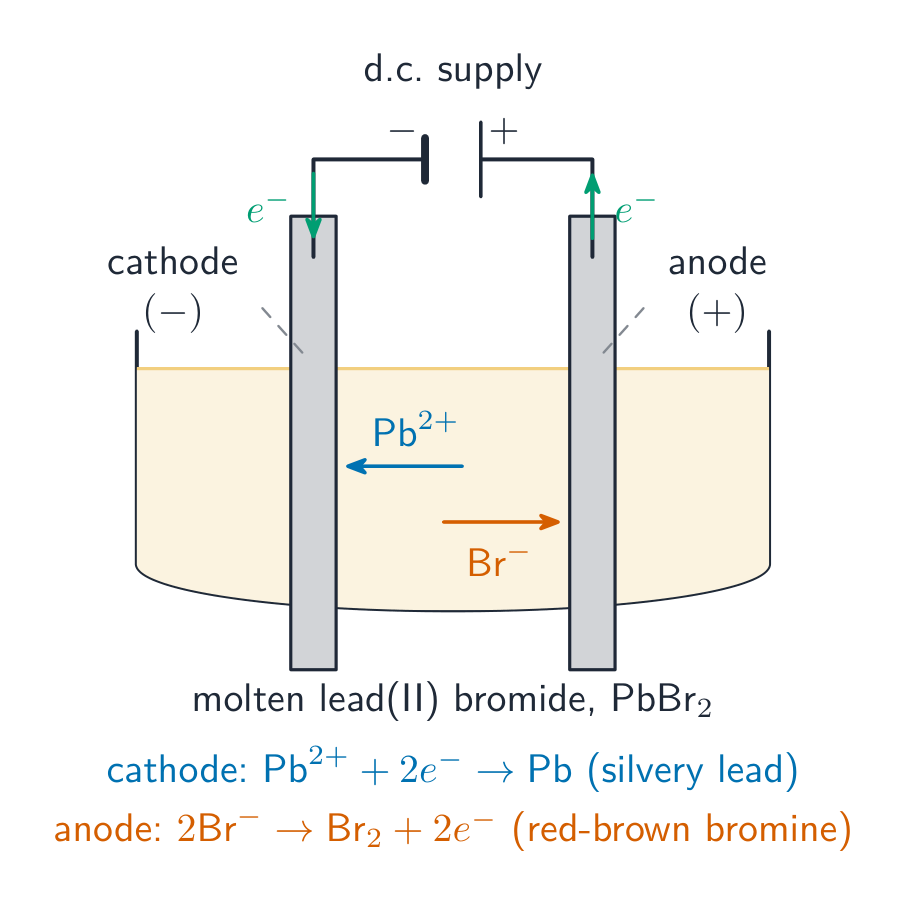
Worked example: molten lead(II) bromide
Molten PbBr₂ contains Pb²⁺ and Br⁻ ions.
- Cathode: Pb²⁺ + 2e⁻ → Pb (grey lead forms; reduction).
- Anode: 2Br⁻ → Br₂ + 2e⁻ (red-brown bromine vapour; oxidation).
- Check: each half-equation balances atoms and charge — on the left of the cathode equation, 2+ and two electrons give 0; on the right, 0.
What forms at the anode when molten lead(II) bromide is electrolysed?
Dificuldade 1/5 · Moedas 100 + pequeno bônus na primeira conclusão hoje
Br⁻ ions lose electrons.
Balancing charge
- Count the total charge on each side; electrons are added to the side with the higher positive charge, so both sides match.
- Aluminium: Al³⁺ + 3e⁻ → Al. Oxide ions: 2O²⁻ → O₂ + 4e⁻.
How many electrons are needed to reduce one Al³⁺ ion to an aluminium atom?
Dificuldade 2/5 · Moedas 140 + pequeno bônus na primeira conclusão hoje
Al³⁺ + 3e⁻ → Al.
In 2O²⁻ → O₂ + ne⁻, what is n?
Dificuldade 2/5 · Moedas 140 + pequeno bônus na primeira conclusão hoje
Charge −4 on the left.
Electrons are added on the left at the cathode and appear on the right at the anode. Writing Na⁺ → Na + e⁻ gives a charge of +1 on the left but −1 on the right — unbalanced and wrong.
At the cathode, positive ions gain electrons (reduction); at the anode, negative ions lose electrons (oxidation). Balance atoms and charge in every half-equation.
Write both half-equations for the electrolysis of molten zinc chloride, ZnCl₂, and say which is oxidation.
Ions and charges.