Types of business organisation
Introduzido| English | Significado |
|---|---|
| liable/ˈlaɪəbl/ | Responsável |
| sole trader/səʊl ˈtreɪdə/ | Empresário individual |
| partnership/ˈpɑːtnəʃɪp/ | Sociedade em conta de participação |
| unlimited liability/ʌnˈlɪmɪtɪd ˌlaɪəˈbɪlɪti/ | Responsabilidade ilimitada |
| private limited company/ˈpraɪvət ˈlɪmɪtɪd ˈkʌmpəni/ | Sociedade limitada por ações |
| public limited company/ˈpʌblɪk ˈlɪmɪtɪd ˈkʌmpəni/ | Sociedade anônima |
| shareholders/ˈʃeəhəʊldəz/ | acionistas |
| limited liability/ˈlɪmɪtɪd ˌlaɪəˈbɪlɪti/ | Responsabilidade limitada |
| creditors/ˈkredɪtəz/ | Credores |
Who owns the business?
- A one-person market stall and a global company are owned in completely different ways.
- The type of business organisation decides who owns it and who is liable 负有责任 for its debts.
Choose the ownership form
Compare ownership, control and liability in real business types.
A sole trader has:
Dificuldade 1/5 · Moedas 100 + pequeno bônus na primeira conclusão hoje
A sole trader is personally liable for all debts.
A partnership has two or more owners who share the capital and risk.
Dificuldade 1/5 · Moedas 100 + pequeno bônus na primeira conclusão hoje
Partners share ownership, profit and (usually) unlimited liability.
When owners risk their personal possessions for business debts, they have ______ liability.
Dificuldade 1/5 · Moedas 100 + pequeno bônus na primeira conclusão hoje
Sole traders and partnerships usually have unlimited liability.
Sole trader 独资企业 and partnership 合伙企业
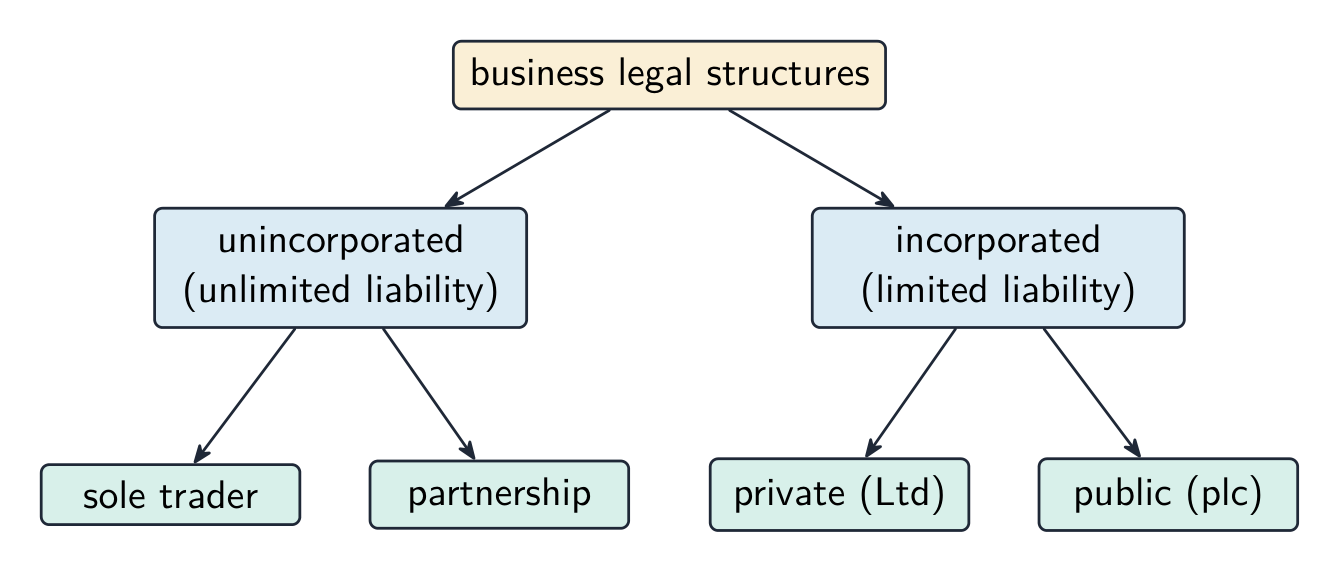
- Sole trader: one owner. Easy to set up, keeps all profit — but unlimited liability 无限责任.
- Partnership: 2+ owners share capital, work and risk; usually still unlimited liability.
Limited liability means shareholders can lose:
Dificuldade 1/5 · Moedas 100 + pequeno bônus na primeira conclusão hoje
Their loss is capped at their investment.
An advantage of becoming a limited company is:
Dificuldade 1/5 · Moedas 100 + pequeno bônus na primeira conclusão hoje
Limited liability protects owners' personal assets.
Limited companies
- Private limited company 私人有限公司 (Ltd) and public limited company 公众有限公司 (plc) are owned by shareholders 股东.
- They have limited liability 有限责任: owners can lose only what they invested.
Comparing them
- Sole trader/partnership: simple and private, but risky (unlimited liability), hard to raise finance.
- Companies: can raise more finance and protect owners, but face more rules and shared control.
Unlimited liability puts personal assets at risk. If a sole trader's business fails, creditors 债权人 can take the owner's personal possessions. A shareholder in a limited company cannot lose more than they invested.
Worked example: a plumber's business fails
Ana is a sole trader. Her business owes £30,000 but has only £10,000 of assets. Ben owns £5,000 of shares in a private limited company that fails. What can each lose?
- Ana has unlimited liability: the business and the owner are the same in law, so creditors can claim the remaining £20,000 from her personal possessions, such as her car or savings.
- Ben has limited liability: the company is a separate legal person, so he loses at most the £5,000 he invested. His house and savings are safe.
Why might a sole trader take on a partner?
Dificuldade 1/5 · Moedas 100 + pequeno bônus na primeira conclusão hoje
A partner adds money and skills, but profits are shared and liability is usually still unlimited.
A public limited company can sell its shares to anyone on the stock exchange; a private limited company cannot.
Dificuldade 1/5 · Moedas 100 + pequeno bônus na primeira conclusão hoje
Ltd shares are sold privately, often to family and friends.
You've got it
- sole trader (one owner) and partnership (a few) — usually unlimited liability
- Ltd and plc are owned by shareholders with limited liability
- companies raise more finance and limit risk, but face more rules
Write from the data: find the personal claim
- A sole trader put 4000 into a business that now owes 9000.
- A shareholder who paid 4000 for shares can lose at most that 4000.
A sole trader invested 4000, and the failed business owes 9000. How much of the owner's personal wealth is still at risk, and how does that differ for a shareholder who paid 4000?
Unlimited liability reaches the owner's personal assets. Limited liability stops the loss at the amount invested in the shares.
How much beyond the 4000 already invested can creditors claim from the sole trader?
Dificuldade 1/5 · Moedas 100 + pequeno bônus na primeira conclusão hoje
9000 minus 4000 is 5000, and unlimited liability leaves that amount at risk. Other options — Nothing (because every owner has limited liability); Only 4000 (the same cap as a shareholder).