Labour markets
Introduzido| English | Significado |
|---|---|
| labour market/ˈleɪbə ˈmɑːkɪt/ | The interaction of workers offering labour and employers seeking it, determining employment and wages. |
| derived demand/dɪˈraɪvd dɪˈmænd/ | Demanda derivada |
| marginal revenue product/ˈmɑːdʒɪnl ˈrevənjuː ˈprɒdʌkt/ | The additional revenue generated by employing one more unit of a factor of production. |
| monopsony/məˈnɒpsəni/ | Monopsonio |
A 30% pay rise
- In 2010 Foxconn, which assembles iPhones in Shenzhen, raised its basic wage by more than 30% after it struggled to hire and keep workers.
- Fewer young people were moving to coastal factories, and inland jobs were growing.
- Wages are prices in the labour market 劳动力市场, set by the demand for and supply of workers.
Demand for labour is derived
- Firms want workers for the output they make, not for their own sake: derived demand 派生需求. When phone sales rise, demand for assembly workers rises.
- The value of one more worker is the marginal revenue product 边际收益产品: $\text{MRP} = \text{MP} \times \text{MR}$.
Why is the demand for labour called a derived demand?
Dificuldade 1/5 · Moedas 100 + pequeno bônus na primeira conclusão hoje
It comes from the demand for the product.
Worked example: should the firm hire?
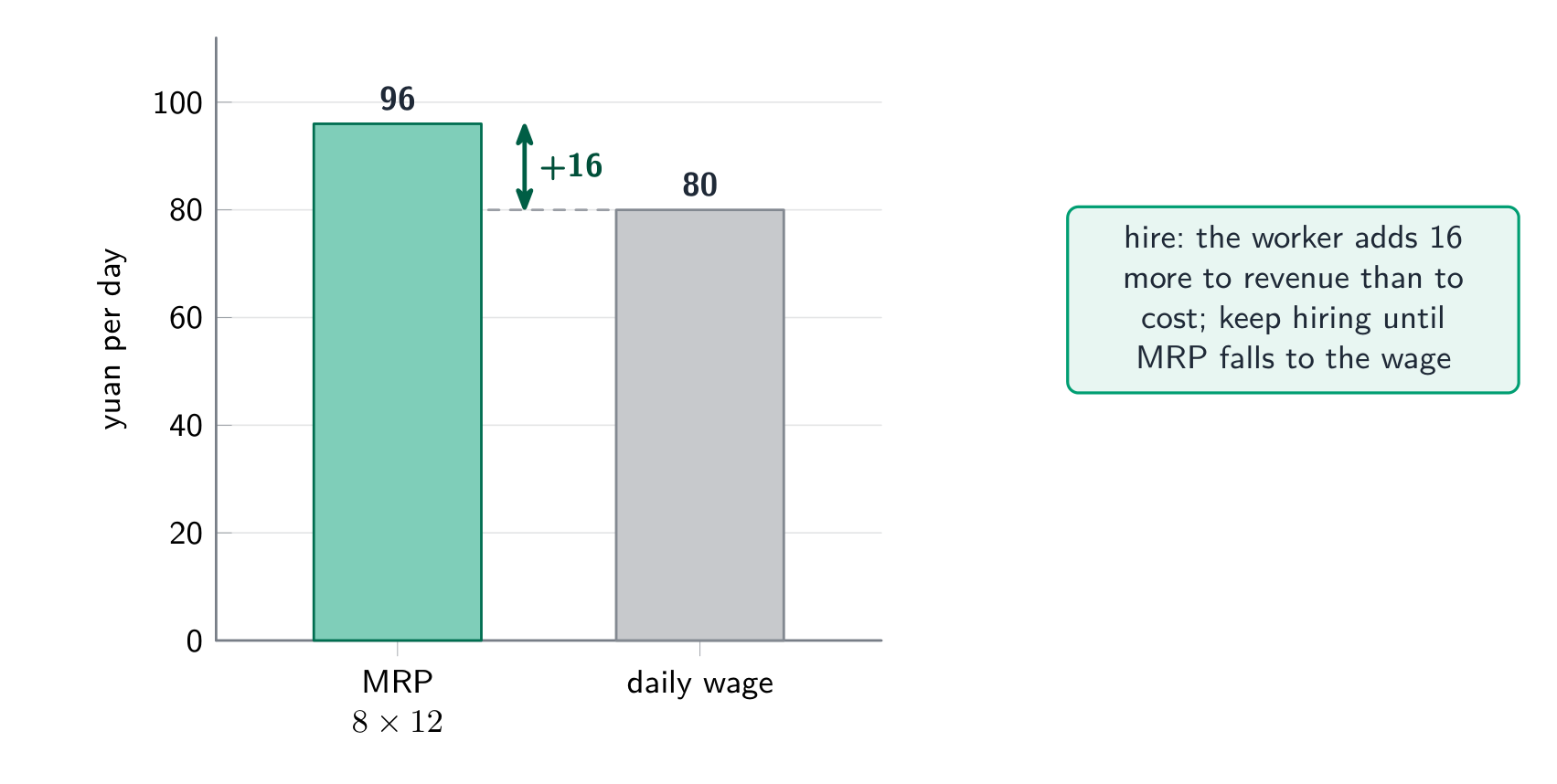
One more worker adds 8 units a day, sold at a constant price of ¥12.
- $\text{MRP} = 8 \times 12 = ¥96$ a day.
- The daily wage is ¥80, so the worker adds ¥16 more to revenue than to cost. The firm should hire.
- It keeps hiring until MRP falls to the wage: $\text{MRP} = W$.
A worker adds 15 units a day; each sells for ¥9. What is the worker's MRP?
Dificuldade 2/5 · Moedas 140 + pequeno bônus na primeira conclusão hoje
$15 \times 9 = ¥135$.
If MRP is ¥135 and the wage is ¥150, the firm should hire the worker.
Dificuldade 1/5 · Moedas 100 + pequeno bônus na primeira conclusão hoje
The worker costs more than the revenue they add.
Supply of labour
- More people offer to work at a higher wage. Supply also depends on population, migration, training, working conditions and benefits.
- Jobs that need long training — doctors, pilots — have a small supply, so wages are high.
Which would increase the supply of nurses?
Dificuldade 2/5 · Moedas 140 + pequeno bônus na primeira conclusão hoje
Worse conditions reduce supply; a wage rise is a movement along supply.
Why wages differ
- Productivity and skill: workers whose output is worth more earn more. Scarcity: a top footballer has rare skills that millions want to watch.
- Bargaining power: trade unions can raise wages; a monopsony 买方垄断 employer can hold them down. Discrimination can lower pay for some groups.
Match each case to its reason for the wage difference.
Dificuldade 2/5 · Moedas 140 + pequeno bônus na primeira conclusão hoje
Several forces explain differentials.
High wages do not mean a job is more useful. Nurses are vital but earn less than many bankers. Wages reflect demand and supply — how many people can do the job and how much revenue their work brings — not how much society values it.
Wages show how much society values a job.
Dificuldade 1/5 · Moedas 100 + pequeno bônus na primeira conclusão hoje
They reflect demand and supply in the labour market.
Labour demand is derived from demand for the product; a firm hires until MRP equals the wage. Supply depends on the wage and on training, conditions and migration. Wages differ because of productivity, scarcity, bargaining power and discrimination.
Explain why Foxconn raised wages in 2010.
Use demand and supply in the labour market.