Equilibrium output and simultaneous shifts
Introduzido| English | Significado |
|---|---|
| equilibrium real output/ˌiːkwɪˈlɪbrɪəm rɪəl ˈaʊtpʊt/ | produto real de equilíbrio |
| aggregate supply shift/ˈæɡrɪɡeɪt səˈplaɪ ʃɪft/ | deslocamento da oferta agregada |
| cost-push inflation/kɒst pʊʃ ɪnˈfleɪʃn/ | Inflation caused by rising costs of production, which firms pass on as higher prices. |
Two shocks at once
- In 2021 households in the US spent the savings built up in lockdown, and the government sent stimulus cheques: AD rose fast.
- At the same time, chip shortages and blocked ports cut supply. Prices rose sharply, while output grew less than demand.
- To predict such outcomes, economists find where AD meets SRAS — and see how each curve moves.
Macroeconomic equilibrium
- The economy is in equilibrium where AD = SRAS: planned spending equals planned output at that price level.
- At the crossing we read the equilibrium real output 均衡实际产出 and the price level.
Worked example: solving AD = SRAS
$\text{AD}: P = 140 - 2Y$; $\text{SRAS}: P = 20 + Y$.
- Set equal: $140 - 2Y = 20 + Y$, so $3Y = 120$ and $Y = 40$; then $P = 20 + 40 = 60$.
- AD rises to $P = 170 - 2Y$: $170 - 2Y = 20 + Y$ gives $Y = 50$, $P = 70$. Output and prices both rise.
- SRAS rises instead to $P = 5 + Y$: $140 - 2Y = 5 + Y$ gives $Y = 45$, $P = 50$. Output rises, prices fall.
- Both together: $170 - 2Y = 5 + Y$ gives $Y = 55$, $P = 60$. Output rises; here the price effects cancel.
Shift AD and SRAS together
AD P = 140 − 2Y and SRAS P = 20 + Y meet at Y 40, P 60. Raising AD to 170 gives Y 50, P 70. Lowering SRAS to 5 instead gives Y 45, P 50. Doing both gives Y 55, P 60: output rises, and in this example the price effects cancel.
AD: $P = 200 - 3Y$ and SRAS: $P = 40 + Y$. What is equilibrium output $Y$?
Dificuldade 2/5 · Moedas 140 + pequeno bônus na primeira conclusão hoje
$200 - 3Y = 40 + Y$, so $4Y = 160$ e $Y = 40$.
In that example, what is the equilibrium price level $P$?
Dificuldade 2/5 · Moedas 140 + pequeno bônus na primeira conclusão hoje
$P = 40 + 40 = 80$.
Demand shifts
- A rise in AD with SRAS unchanged raises both real output and the price level: demand-pull pressure.
- A fall in AD lowers both — as in 2009, when output and inflation fell together.
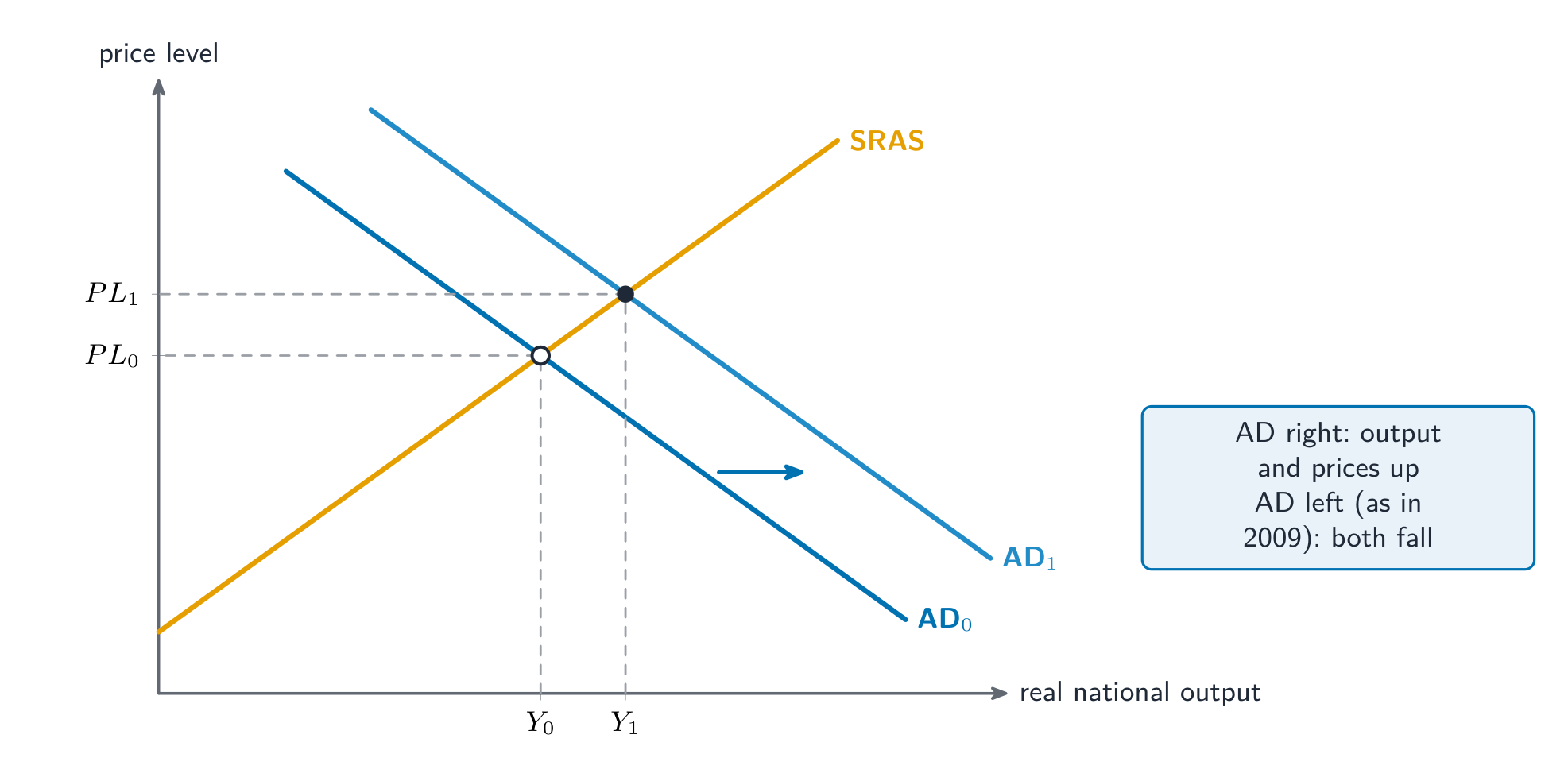
Consumer confidence rises sharply. What happens in the AD/AS model?
Dificuldade 1/5 · Moedas 100 + pequeno bônus na primeira conclusão hoje
AD shifts right along an upward-sloping SRAS.
Supply shifts
- An aggregate supply shift 总供给移动 to the left, from higher costs, raises the price level and lowers output: cost-push inflation with falling output.
- A rightward shift, such as cheaper energy or better technology, lowers prices and raises output.
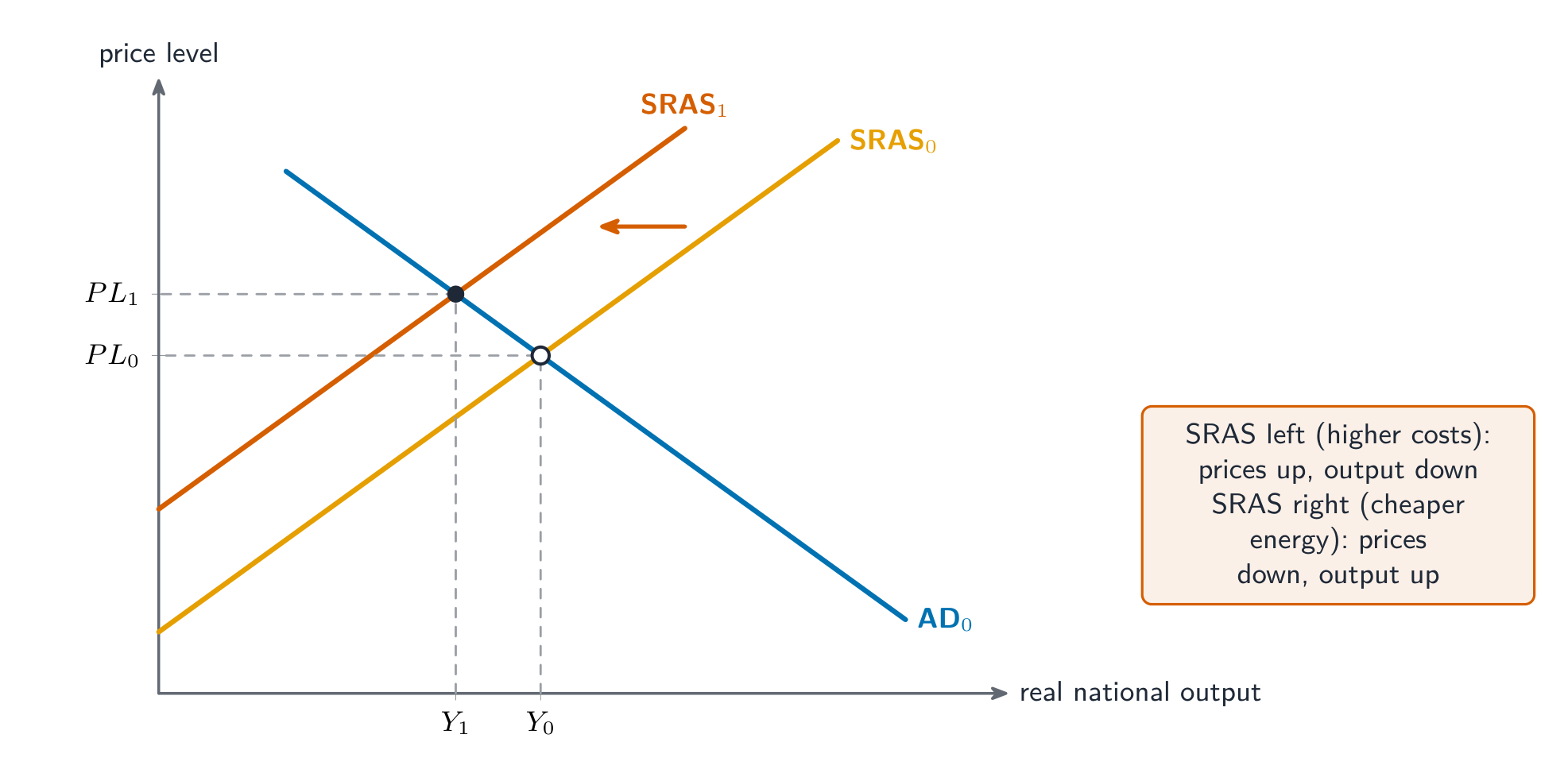
Oil prices fall sharply. What happens?
Dificuldade 1/5 · Moedas 100 + pequeno bônus na primeira conclusão hoje
Lower costs shift SRAS right.
When both curves move, one result is uncertain. AD right and SRAS right both raise output, but they push prices in opposite directions. The price change depends on which shift is bigger — so in an exam say "output rises; the price level could rise, fall or stay the same".
Match each pair of shifts to the variable whose direction is CERTAIN.
Dificuldade 2/5 · Moedas 140 + pequeno bônus na primeira conclusão hoje
The other variable depends on the sizes of the shifts.
If AD and SRAS both shift right, the price level must rise.
Dificuldade 1/5 · Moedas 100 + pequeno bônus na primeira conclusão hoje
It could rise, fall or stay the same.
Equilibrium is where AD meets SRAS. An AD shift moves output and prices in the same direction; an SRAS shift moves them in opposite directions. When both shift, one variable has a clear direction and the other depends on the sizes.
Using AD/AS, explain the effects of the 2021 combination of stimulus spending and supply-chain disruption on output and prices.
Two shifts — one certain result, one uncertain.