The multiplier
Introduzido| English | Significado |
|---|---|
| multiplier/ˌmʌltɪˈplaɪə/ | A number by which another quantity is multiplied. |
| autonomous injection/ɔːˈtɒnəməs ɪnˈdʒekʃn/ | injeção autônoma |
| marginal propensity to withdraw/ˈmɑːdʒɪnl prəˈpensɪti tə wɪθˈdrɔː/ | propensão marginal a retirar |
One yuan, spent many times
- When a city builds a new metro line, the construction workers spend their wages in shops and restaurants. Those owners then spend their extra income, and so on.
- One injection of spending creates several rounds of income. The final rise in national income is a multiple of the first spending: the multiplier 乘数.
The multiplier formula
- An autonomous injection 自主注入 is a change in I, G or X that does not depend on income.
- At each round, part of the extra income is withdrawn (saved, taxed or spent on imports). The marginal propensity to withdraw 边际漏出倾向 is $\text{MPW} = \text{MPS} + \text{MPT} + \text{MPM}$.
The MPC is 0.8. What is the multiplier?
Dificuldade 2/5 · Moedas 140 + pequeno bônus na primeira conclusão hoje
$\dfrac{1}{1 - 0.8} = 5$.
Worked example: rounds of income
The government spends an extra ¥20 bn. The MPC (on domestic output) is 0.75.
- Rounds: $20$, then $0.75 \times 20 = 15$, then $11.25$, then $8.4375$ … The first four sum to $54.6875$.
- Multiplier $k = \dfrac{1}{1 - 0.75} = 4$.
- Final rise in income $= 4 \times 20 = ¥80$ bn. Later rounds get smaller and add the remaining $25.3$.
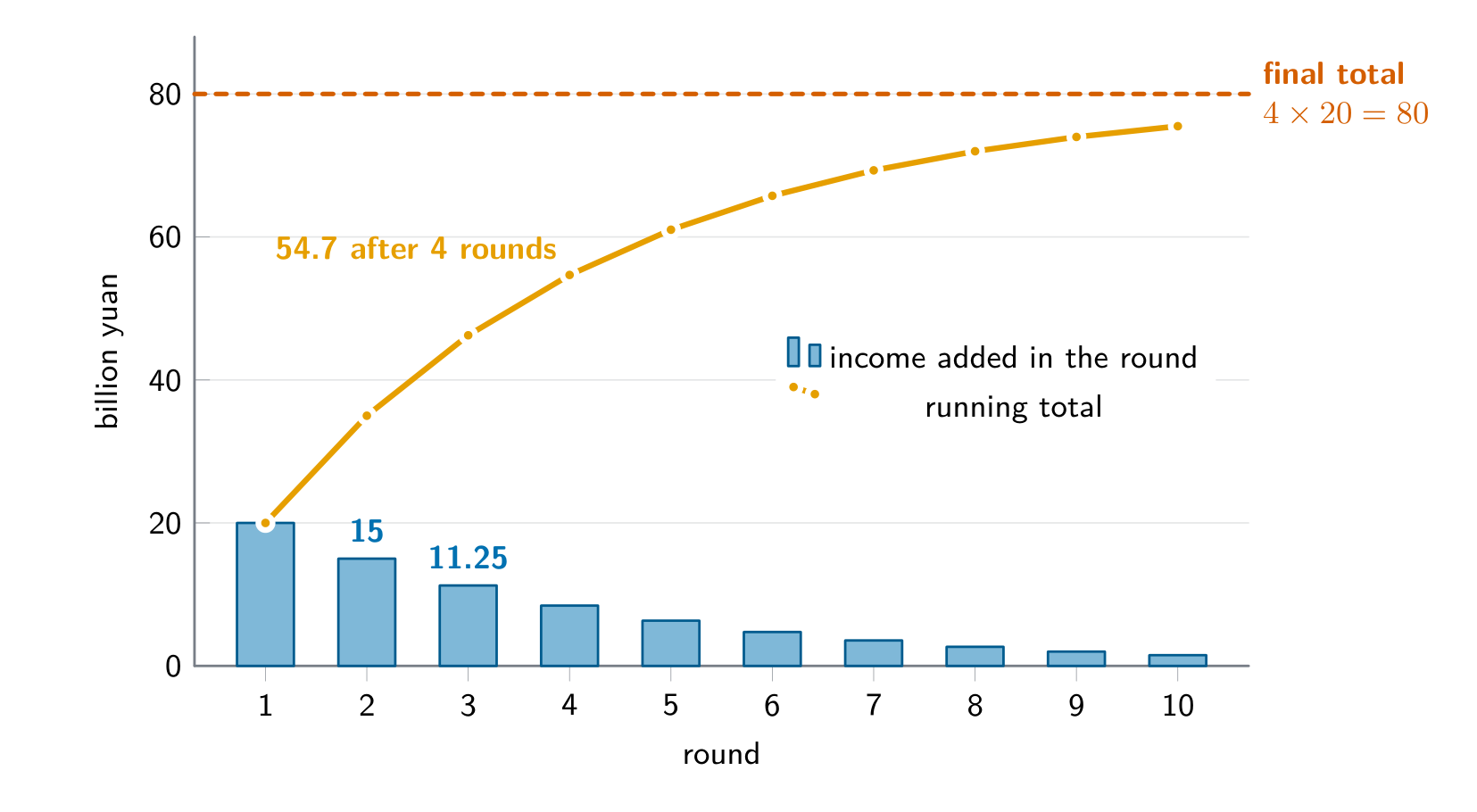
Income rounds and the multiplier’s assumptions
$\Delta Y=k\Delta J$
Compare the first few income rounds with the infinite model total. Domestic re-spending and total consumption must be distinguished when tax and imports are present.
Investment rises by ¥30 bn and the multiplier is 2.5. What is the final rise in national income?
Dificuldade 2/5 · Moedas 140 + pequeno bônus na primeira conclusão hoje
$2.5 \times 30 = ¥75$ bn.
An injection of 100 is made and the MPC is 0.6. How much income is created in the SECOND round?
Dificuldade 2/5 · Moedas 140 + pequeno bônus na primeira conclusão hoje
$0.6 \times 100 = 60$.
Why real multipliers are small
- In an open economy with taxes, withdrawals are large. If MPS 0.1, MPT 0.2 and MPM 0.3, then $\text{MPW} = 0.6$ and $k = \dfrac{1}{0.6} \approx 1.67$.
- Small, open economies such as Singapore import a lot, so their multipliers are small.
MPS = 0.15, MPT = 0.25, MPM = 0.1. What is the multiplier?
Dificuldade 2/5 · Moedas 140 + pequeno bônus na primeira conclusão hoje
$\text{MPW} = 0.5$, so $k = \dfrac{1}{0.5} = 2$.
Why does Singapore have a smaller multiplier than the United States?
Dificuldade 1/5 · Moedas 100 + pequeno bônus na primeira conclusão hoje
A high MPM means a high MPW.
Limits of the multiplier
- Time lags: the rounds take months or years.
- Capacity: near full employment, extra spending raises prices more than output.
- Confidence: if households expect future tax rises, they may save the extra income.
- The multiplier also works downward: a fall in exports reduces income by a multiple.
Which reduce the effect of the multiplier on real output?
Dificuldade 2/5 · Moedas 140 + pequeno bônus na primeira conclusão hoje
Spare capacity lets output respond fully.
Use the MPC on domestic output, or the full MPW. If a question gives MPS 0.2 and MPM 0.3, the multiplier is $\dfrac{1}{0.5} = 2$, not $\dfrac{1}{0.2} = 5$. Every withdrawal reduces the next round.
An injection creates rounds of extra income that shrink as part of each round is withdrawn. The multiplier is $\dfrac{1}{\text{MPW}}$, so it is smaller when saving, taxes and imports are high. It works both ways, takes time and raises prices near full capacity.
Explain how a fall in exports of ¥10 bn could reduce national income by more than ¥10 bn.
The multiplier also works downward.