Production externalities
Introduzido| English | Significado |
|---|---|
| negative production externality | A cost imposed on third parties when a good is produced. |
| marginal external cost/ˈmɑːdʒɪnl ekˈstɜːnl kɒst/ | custo externo marginal |
| marginal social cost/ˈmɑːdʒɪnl ˈsəʊʃl kɒst/ | custo social marginal |
| welfare loss/ˈwelfeə lɒs/ | A reduction in total economic surplus compared with an efficient allocation of resources. |
| positive production externality | A benefit to third parties from production. |
A river that turned toxic
- In November 2005 an explosion at a chemical plant in Jilin spilled about 100 tonnes of benzene into the Songhua River.
- Downstream, the city of Harbin cut off its water supply for four days.
- The plant's costs had not included the risk it placed on millions of people. That is a negative production externality.
Negative production externalities
- A negative production externality 负生产外部性 is a cost imposed on third parties when a good is produced.
- Marginal external cost 边际外部成本 (MEC) is the extra cost to third parties from one more unit.
- Marginal social cost 边际社会成本 $\text{MSC} = \text{MPC} + \text{MEC}$, so MSC lies above MPC.
The marginal private cost of a unit is ¥50 and its marginal external cost is ¥15. What is the marginal social cost?
Dificuldade 2/5 · Moedas 140 + pequeno bônus na primeira conclusão hoje
$\text{MSC} = \text{MPC} + \text{MEC} = 50 + 15 = ¥65$.
Worked example: the welfare loss
$\text{MPB} = 100 - Q$, $\text{MPC} = 20 + Q$, and $\text{MEC} = 20$ per unit, so $\text{MSC} = 40 + Q$.
- Market: $Q = 40$. Optimum: $Q = 30$.
- Welfare loss 福利损失 $= \tfrac{1}{2} \times (40 - 30) \times 20 = 100$: the triangle between MSC and MSB over the extra 10 units.
- Total external damage at $Q = 40$ is $20 \times 40 = 800$ — a different and larger number.
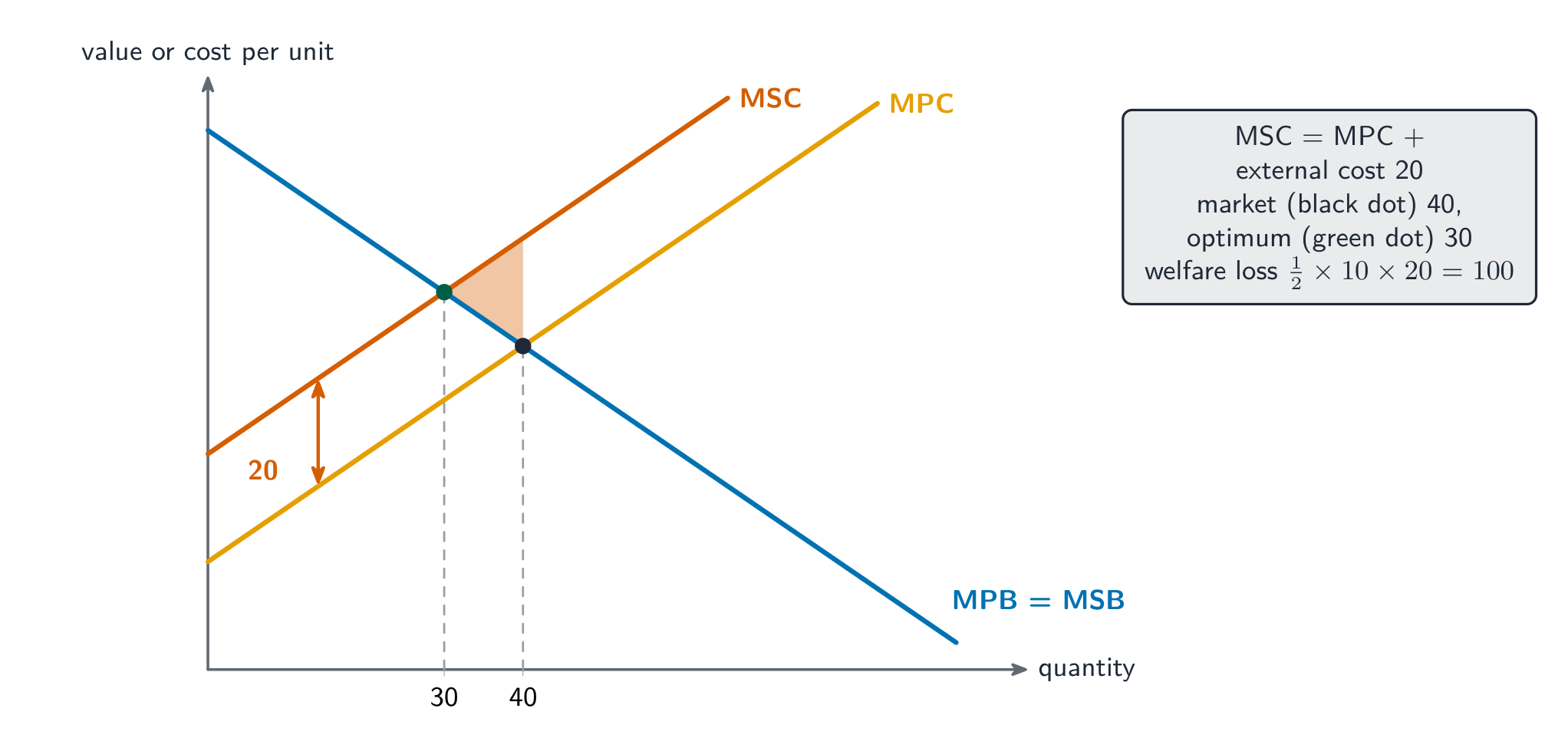
An external cost of production
MPB = 100 − Q and MPC = 20 + Q give market output 40. Adding an external cost of 20 gives MSC = 40 + Q and a social optimum of 30. The welfare loss is ½ × 10 × 20 = 100; the total external damage of 800 is a different quantity.
A market produces 60 units; the optimum is 45. The MEC is a constant ¥12. What is the welfare loss?
Dificuldade 2/5 · Moedas 140 + pequeno bônus na primeira conclusão hoje
$\tfrac{1}{2} \times (60 - 45) \times 12 = 90$.
The welfare loss is not the total pollution damage. The damage from the first 30 units is worth bearing because those units' benefits exceed their full cost. Only the 10 extra units cause a net loss, so the welfare-loss triangle (100) is much smaller than total damage (800).
In the same market, what is the total external damage at the market output of 60 units?
Dificuldade 2/5 · Moedas 140 + pequeno bônus na primeira conclusão hoje
$12 \times 60 = 720$, much more than the welfare loss of 90.
Positive production externalities
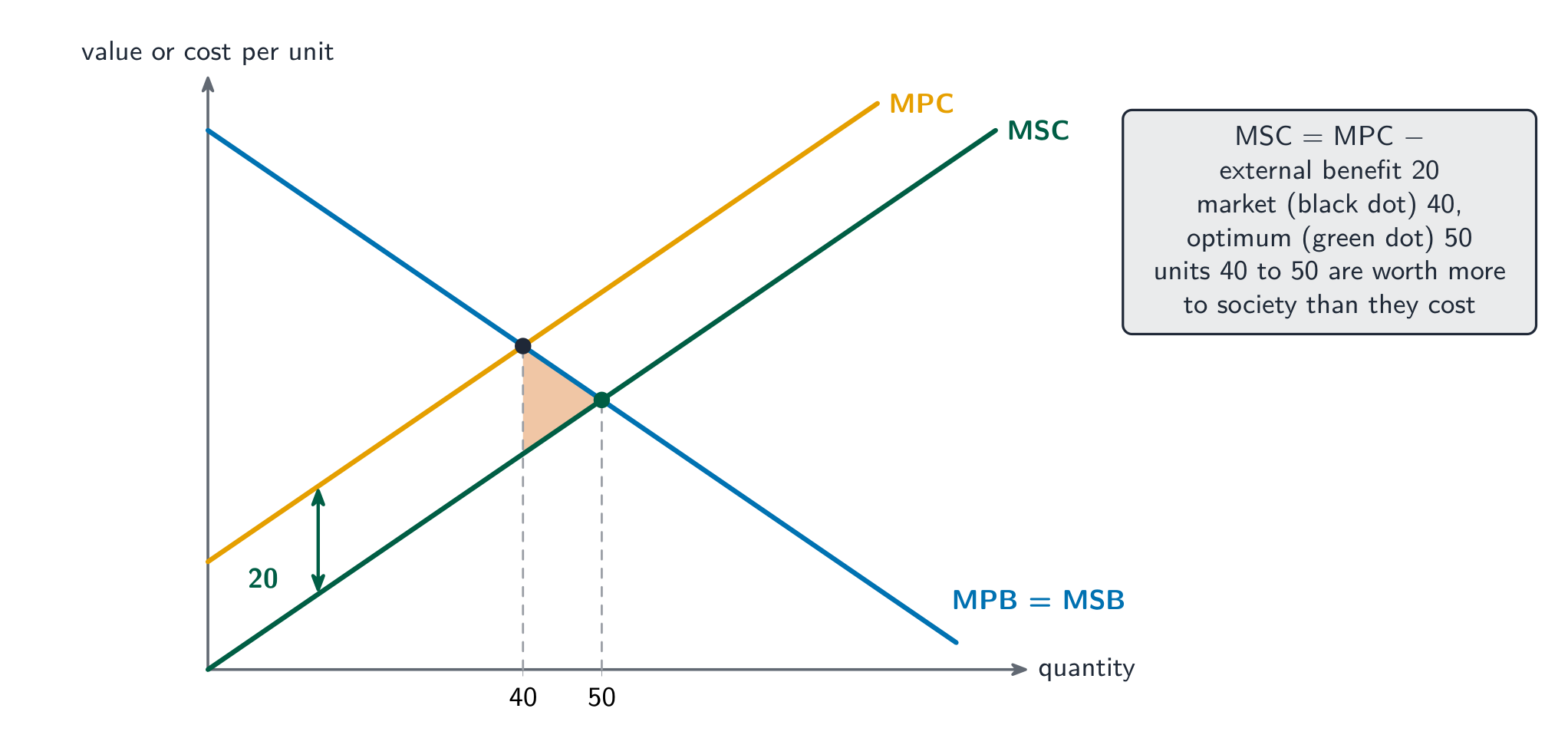
- A positive production externality 正生产外部性 is a benefit to third parties from production.
- A beekeeper's bees pollinate nearby orchards for free; a firm that trains workers raises skills for other firms they later join.
- MSC lies below MPC, so the market under-produces: here 40 units against an optimum of 50.
Which are positive production externalities?
Dificuldade 2/5 · Moedas 140 + pequeno bônus na primeira conclusão hoje
Noise is a negative externality; the others bring benefits to third parties.
With a positive production externality, the free market —
Dificuldade 1/5 · Moedas 100 + pequeno bônus na primeira conclusão hoje
Producers do not count the benefits others receive, so they make too little.
Drawing it in an exam
- Draw MPB = MSB and MPC; add MSC above (negative) or below (positive) MPC.
- Label the market quantity where MPB = MPC and the optimum where MSB = MSC.
- Shade the welfare loss triangle, pointing towards the market quantity.
Put the steps for drawing a negative production externality diagram in order.
Dificuldade 3/5 · Moedas 200 + pequeno bônus na primeira conclusão hoje
Curves first, then the two quantities, then the triangle between them.
A negative production externality puts MSC above MPC, so the market over-produces and a welfare-loss triangle appears between Q market and Q optimum. A positive production externality puts MSC below MPC, so the market under-produces. The welfare loss covers only the misallocated units, not all the damage.
Using the Songhua River case, explain why the chemical plant's output was above the social optimum.
Apply the theory to the case — name the third parties.