Consumption externalities
Introduzido| English | Significado |
|---|---|
| positive consumption externality | A benefit to other people when someone consumes a good, such as a vaccine. |
| marginal external benefit/ˈmɑːdʒɪnl ekˈstɜːnl ˈbenɪfɪt/ | benefício externo marginal |
| marginal social benefit/ˈmɑːdʒɪnl ˈsəʊʃl ˈbenɪfɪt/ | benefício social marginal |
| merit goods/ˈmerɪt ɡʊdz/ | Goods that are good for people and under-consumed in a free market, such as education. |
| demerit good/ˈdemərɪt ɡʊd/ | A good whose harmful effects consumers may underestimate, leading to consumption above a socially desirable level. |
Why measles needs 95%
- Measles spreads so easily that about 95% of people must be vaccinated to stop outbreaks.
- When you are vaccinated, you are protected — and so are the babies and sick people near you who cannot be.
- That extra benefit to others is a positive consumption externality 正消费外部性.
Positive consumption externalities
- Marginal external benefit 边际外部收益 (MEB) is the benefit to third parties of one more unit consumed.
- Marginal social benefit 边际社会收益 $\text{MSB} = \text{MPB} + \text{MEB}$, so MSB lies above MPB.
- Consumers consider only their own benefit, so the good is under-consumed: education, vaccines, exercise.
A flu jab gives the patient a benefit worth ¥60 and protects others by ¥25. What is the marginal social benefit?
Dificuldade 2/5 · Moedas 140 + pequeno bônus na primeira conclusão hoje
$\text{MSB} = \text{MPB} + \text{MEB} = 60 + 25 = ¥85$.
Worked example: the missed gain
$\text{MPB} = 80 - Q$, $\text{MPC} = 20 + Q$, and $\text{MEB} = 20$ per unit, so $\text{MSB} = 100 - Q$.
- Market: $80 - Q = 20 + Q$, so $Q = 30$.
- Optimum: $100 - Q = 20 + Q$, so $Q = 40$. The market under-consumes by 10.
- Missed gain (welfare loss) $= \tfrac{1}{2} \times 10 \times 20 = 100$. A subsidy of ¥20 per unit would move MPB up to MSB and close the gap.
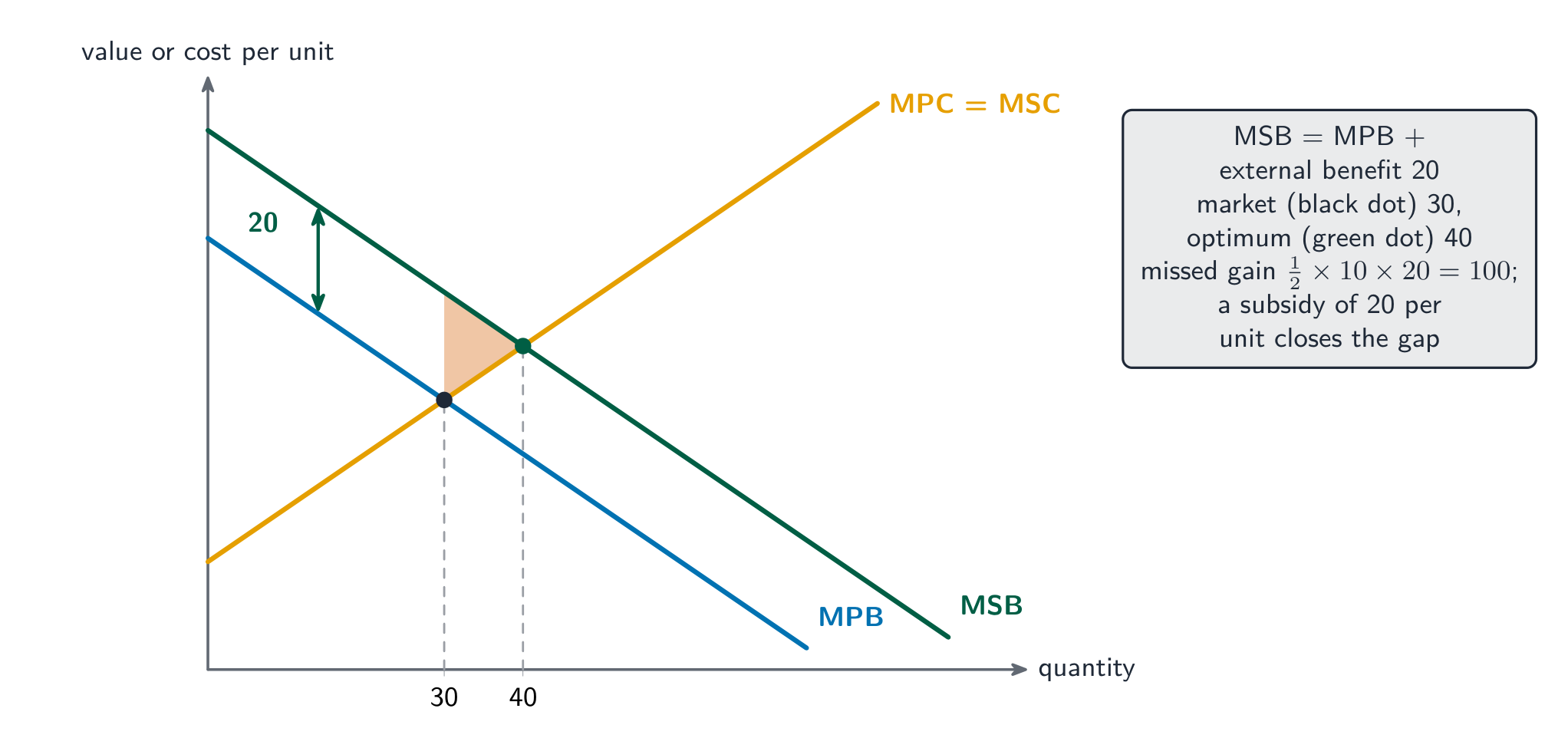
An external benefit of consumption
MPB = 80 − Q and MPC = 20 + Q give market output 30. An external benefit of 20 makes MSB = 100 − Q, so the optimum is 40. The missed net gain is ½ × 10 × 20 = 100; a subsidy of 20 per unit would close the gap.
$\text{MPB} = 90 - Q$, $\text{MPC} = 30 + Q$ e $\text{MEB} = 10$. What is the social optimum quantity?
Dificuldade 2/5 · Moedas 140 + pequeno bônus na primeira conclusão hoje
$\text{MSB} = 100 - Q$. Setting $100 - Q = 30 + Q$ gives $Q = 35$ (the market makes 30).
With a constant MEB of ¥20, what subsidy per unit would move the market to the optimum?
Dificuldade 1/5 · Moedas 100 + pequeno bônus na primeira conclusão hoje
A subsidy equal to the MEB makes private benefit (after the subsidy) equal to social benefit.
Negative consumption externalities
- Some goods harm others when consumed: second-hand smoke, drink-driving, loud music at night.
- Here MSB lies below MPB, so the good is over-consumed: in the figure, 30 units against an optimum of 20.
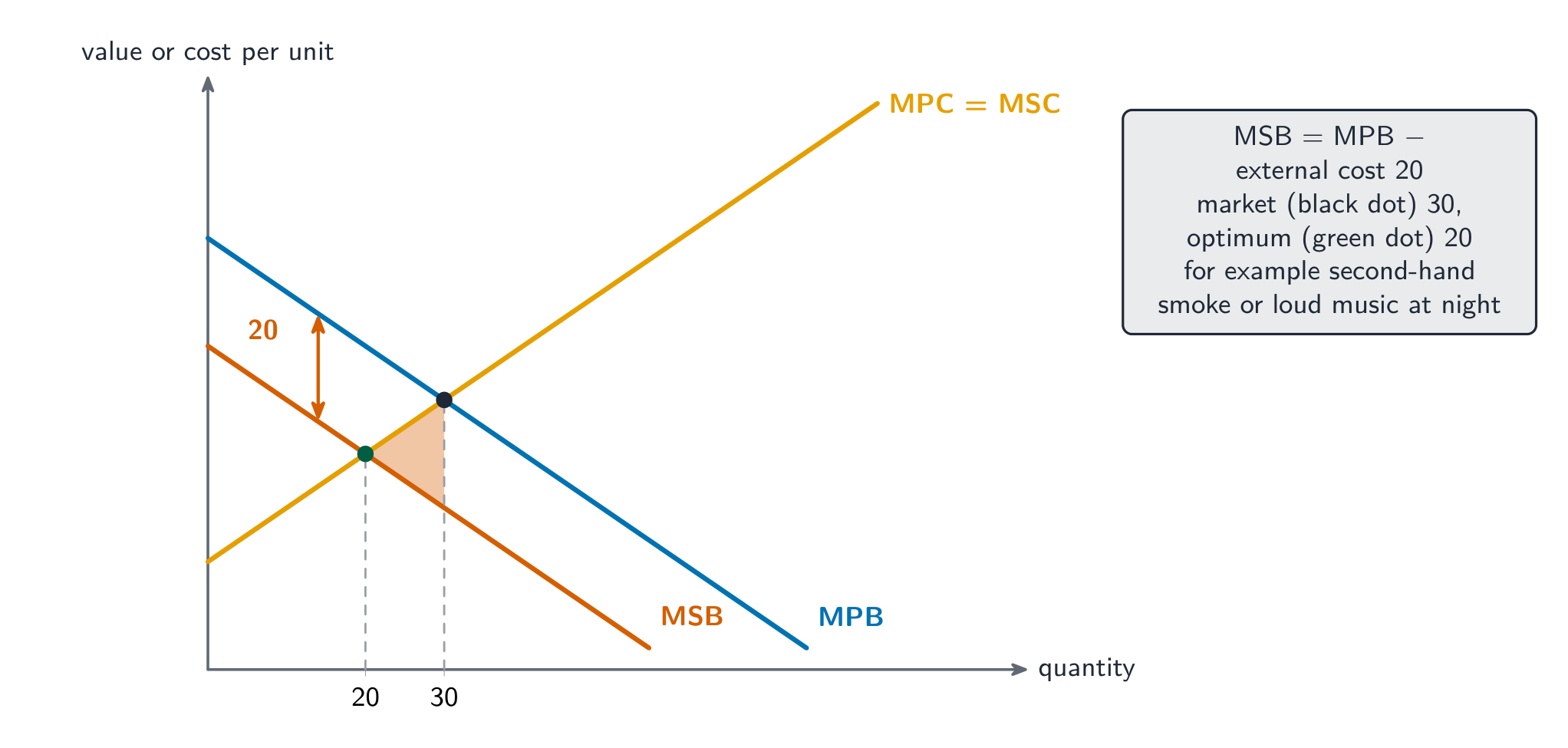
Match each good to its externality.
Dificuldade 2/5 · Moedas 140 + pequeno bônus na primeira conclusão hoje
Ask who causes the effect — a consumer or a producer — and whether it helps or harms.
Consumption externalities move the benefit curve, not the cost curve. For vaccines or smoking, draw MSB above or below MPB and keep MPC = MSC. Shifting the cost curve instead is a common exam error and loses the diagram marks.
For a negative consumption externality, the MSC curve is drawn above the MPC curve.
Dificuldade 1/5 · Moedas 100 + pequeno bônus na primeira conclusão hoje
For consumption externalities MSB differs from MPB; MPC = MSC.
Merit and demerit goods
- Goods like education and healthcare are often called merit goods 优效品: under-consumed in a free market, partly because of positive externalities.
- Goods like cigarettes are demerit goods 劣值品: over-consumed, partly because of negative externalities and poor information about harm.
Why is education often called a merit good?
Dificuldade 1/5 · Moedas 100 + pequeno bônus na primeira conclusão hoje
Educated people also benefit others, and individuals may undervalue their own benefit.
A positive consumption externality puts MSB above MPB, so the market under-consumes and a subsidy can close the gap. A negative consumption externality puts MSB below MPB, so the market over-consumes. For consumption externalities, it is the benefit curve that differs.
Explain why a free market leads to too few people being vaccinated.
Name the curves and say which quantity is larger.