Subsidies and who gains from them
Introduzido| English | Significado |
|---|---|
| subsidy/ˈsʌbsɪdi/ | Financial assistance, usually from government, that reduces costs or supports a particular activity. |
| public expenditure/ˈpʌblɪk ekˈspendɪtʃə/ | despesa pública |
| subsidy incidence/ˈsʌbsɪdi ˈɪnsɪdəns/ | incidência de subsídio |
| deadweight loss/ˈdedweɪt lɒs/ | The loss of total economic surplus when a market produces an inefficient quantity. |
| opportunity cost/ɒpəˈtjuːnɪti kɒst/ | The value of the best alternative forgone when a choice is made. |
Cheaper electric cars
- For more than a decade China's government paid subsidies on each new electric car sold.
- Sales grew from a few thousand cars a year to millions.
- A subsidy 补贴 lowers producers' costs. Who gains from it, and what does it cost taxpayers?
A subsidy shifts supply down
- A subsidy is a payment from the government to producers for each unit made or sold.
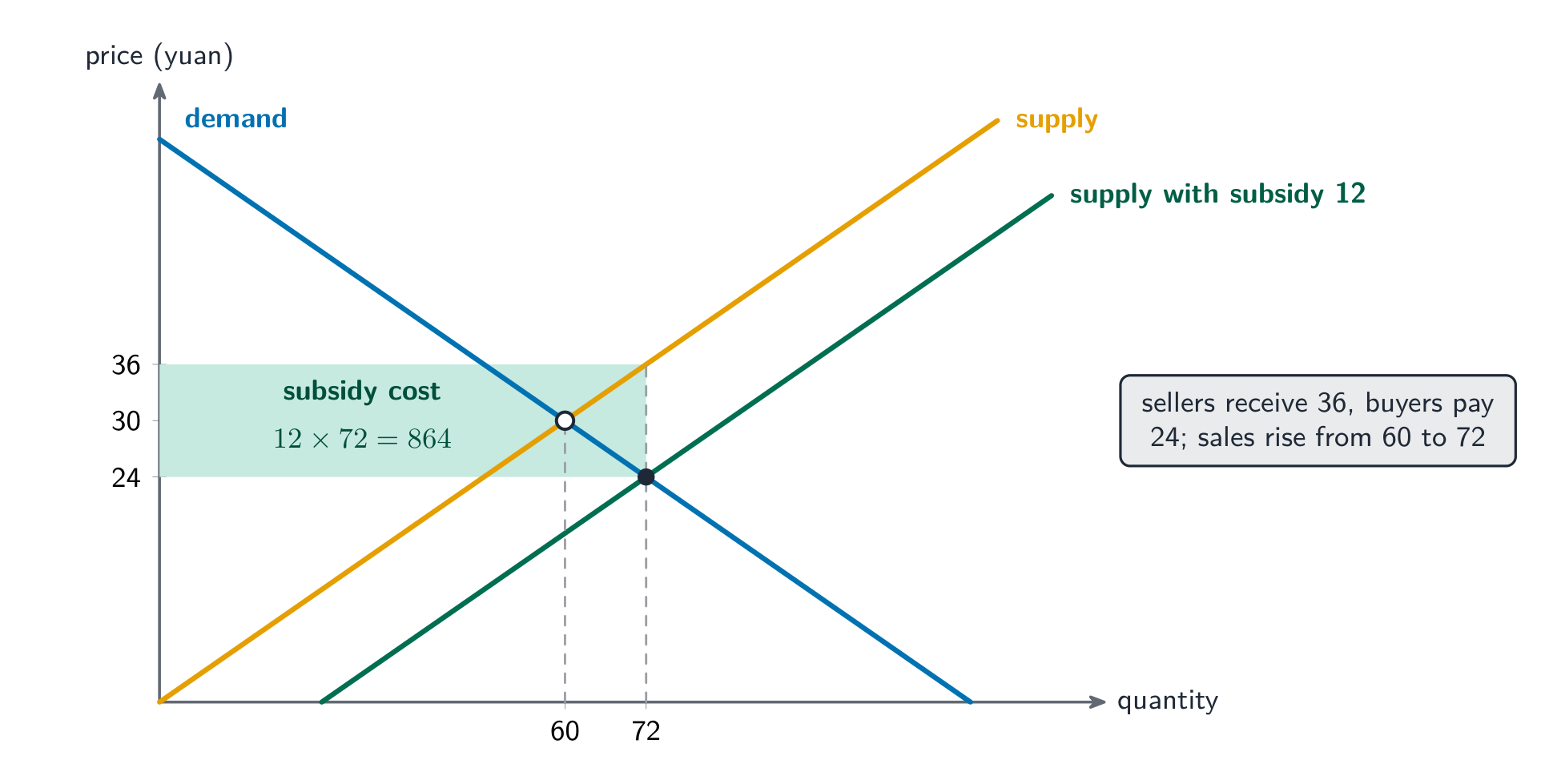
- A subsidy of ¥12 per unit shifts the supply curve down by ¥12 at every quantity.
- Price falls and the quantity bought rises.
A subsidy of ¥3 per unit is given to milk producers. How does the supply curve move?
Dificuldade 1/5 · Moedas 100 + pequeno bônus na primeira conclusão hoje
The subsidy lowers costs by ¥3 per unit, so supply shifts down by ¥3.
Worked example: the subsidy wedge
Demand is $P = 60 - 0.5Q$ and supply is $P = 0.5Q$, so before the subsidy $P = 30$, $Q = 60$. A subsidy of ¥12 per unit is paid.
- New supply: $P = 0.5Q - 12$. Set equal to demand: $60 - 0.5Q = 0.5Q - 12$, so $Q = 72$.
- Buyers pay $P_b = 60 - 0.5(72) = ¥24$. Sellers receive $P_s = 24 + 12 = ¥36$.
- Cost to the government, a form of public expenditure 公共支出: $12 \times 72 = ¥864$.
A subsidy of ¥8 per unit is paid and 500 units are sold. What does it cost the government?
Dificuldade 2/5 · Moedas 140 + pequeno bônus na primeira conclusão hoje
$8 \times 500 = ¥4000$.
Who gains?
- Consumers pay ¥6 less per unit ($30 \to 24$): their share is $6 \times 72 = ¥432$.
- Producers receive ¥6 more per unit ($30 \to 36$): their share is $6 \times 72 = ¥432$.
- This split is the subsidy incidence 补贴收益归宿. As with a tax, the less elastic side gets the larger share.
A subsidy of ¥10 lowers the price buyers pay from ¥50 to ¥43. 200 units are sold. What is the consumers' total gain?
Dificuldade 2/5 · Moedas 140 + pequeno bônus na primeira conclusão hoje
Buyers save ¥7 on 200 units: $7 \times 200 = ¥1400$. Producers gain the other $3 \times 200 = ¥600$.
The welfare cost
- Consumer surplus and producer surplus each rise from ¥900 to ¥1296, a total gain of ¥792.
- But taxpayers pay ¥864. The ¥72 difference is a deadweight loss 无谓损失: units are produced that cost more than buyers value them.
- So a subsidy is justified only if the good brings extra benefits to society, such as cleaner air.
A subsidy raises trade but not net welfare
A subsidy of 12 gives Pb 24, Ps 36 and Q 72. CS and PS are 1,296 each, but the subsidy costs 12 × 72 = 864, so the net total is 1,728, below the original 1,800. The 72 difference is the deadweight loss.
In the worked example, the gain in consumer and producer surplus is smaller than the cost of the subsidy.
Dificuldade 1/5 · Moedas 100 + pequeno bônus na primeira conclusão hoje
Surplus rises by ¥792 but the subsidy costs ¥864, leaving a deadweight loss of ¥72.
The subsidy is not "free money" for consumers. Buyers gain only part of it; producers gain the rest, and taxpayers fund all of it. There is also an opportunity cost 机会成本: the ¥864 could have paid for schools or hospitals instead.
What is the opportunity cost of a subsidy to electric cars?
Dificuldade 1/5 · Moedas 100 + pequeno bônus na primeira conclusão hoje
Government money spent on one thing cannot be spent on another.
Why governments subsidise
- To lower prices of essentials, such as public transport or basic food.
- To encourage goods with benefits to others, such as electric cars, solar panels or vaccines.
- To protect jobs in an industry. Each aim must be weighed against the cost to taxpayers.
Which are reasons governments give subsidies?
Dificuldade 2/5 · Moedas 140 + pequeno bônus na primeira conclusão hoje
A subsidy costs revenue; it never raises it.
A subsidy shifts supply down by the subsidy per unit. Buyers pay less, sellers receive more, quantity rises, and the government pays subsidy × quantity. The less elastic side gains most, and unless the good benefits society, the subsidy causes a deadweight loss.
Evaluate whether subsidising electric cars is a good use of government money.
A justified judgement with a condition earns the evaluation marks.