Market failure and government intervention
Introduzido| English | Significado |
|---|---|
| market failure/ˈmɑːkɪt ˈfeɪlɪə/ | A situation in which markets alone allocate resources inefficiently or fail to provide a socially desirable outcome. |
| misallocation of resources | When resources are not used to make what society values most. |
| externalities/ekˈstɜːnælɪtiz/ | Costs or benefits of an activity that affect third parties and are not reflected fully in its market price. |
| government failure/ˈɡʌvənmənt ˈfeɪlɪə/ | falha governamental |
| public good/ˈpʌblɪk ɡʊd/ | bem público |
A lottery for the right to drive
- Since 2011 Beijing has given out new car licence plates by lottery, because too many cars caused jams and smog.
- Each driver chose freely, yet together they made roads slower and air dirtier for everyone.
- When free markets produce a result that is bad for society as a whole, economists call it market failure 市场失灵.
What market failure means
- Market failure is a misallocation of resources 资源错配: too much or too little of a good is produced, compared with what is best for society.
- The price mechanism fails to signal the full costs or benefits of a choice.
Market failure occurs when —
Dificuldade 1/5 · Moedas 100 + pequeno bônus na primeira conclusão hoje
Market failure is about the allocation of resources for society, not about one firm's profit.
The sources of market failure in this topic
- Externalities 外部性: costs or benefits for people outside the deal, such as pollution or vaccination.
- Public goods 公共物品: goods like street lighting that markets do not provide at all.
- Information gaps: one side knows more than the other, as in insurance or used cars.
- Also moral hazard and speculation, which can cause bubbles in financial and housing markets.
Match each case to the source of market failure.
Dificuldade 2/5 · Moedas 140 + pequeno bônus na primeira conclusão hoje
Each case shows a different reason the price mechanism fails.
How governments intervene
- Change prices: indirect taxes, subsidies, maximum and minimum prices.
- Change quantities or rules: tradable pollution permits, regulation, state provision.
- Change information: labelling and campaigns so that consumers choose better.
Which policies work by changing the PRICE people face?
Dificuldade 2/5 · Moedas 140 + pequeno bônus na primeira conclusão hoje
Taxes, subsidies and price controls change prices; a ban is a regulation.
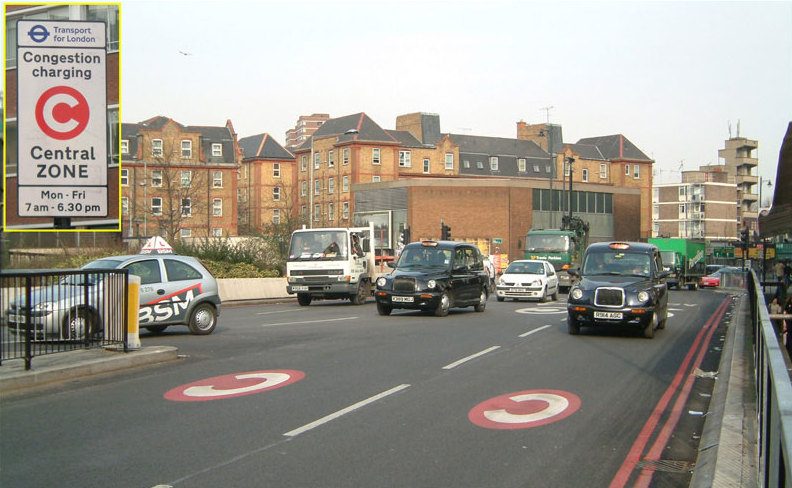
Congestion, two answers. Beijing rations plates by lottery (a quantity rule). London charges drivers about £15 a day to enter the centre (a price). The lottery caps the number of cars but gives plates to lucky drivers, not those who value driving most; the charge lets those who value the trip most still drive, and raises revenue.
Compared with a plate lottery, what is an advantage of a congestion charge?
Dificuldade 1/5 · Moedas 100 + pequeno bônus na primeira conclusão hoje
A price rations by willingness to pay and earns revenue; a lottery rations by chance.
Government failure
- Intervention can make things worse. Government failure 政府失灵 is when intervention causes a net welfare loss.
- Causes include poor information, high administrative costs, unintended consequences and distorted incentives.
Government failure means a policy causes a net welfare loss.
Dificuldade 1/5 · Moedas 100 + pequeno bônus na primeira conclusão hoje
The policy's costs and side effects outweigh its benefits.
Market failure does not prove that the government should act. Intervention is justified only if it does better than the market after its own costs and risks. An evaluation answer always weighs the market failure against the risk of government failure.
Which can cause government failure?
Dificuldade 2/5 · Moedas 140 + pequeno bônus na primeira conclusão hoje
Perfect competition is a market structure, not a cause of government failure.
Market failure is a misallocation of resources by the free market, caused by externalities, public goods, information gaps, moral hazard and speculation. Governments can change prices, quantities, rules or information, but every intervention risks government failure.
Explain why the existence of market failure does not always justify government intervention.
The comparison is the key evaluation point.