Why People Moved
Introduzido| English | Significado |
|---|---|
| indentured labourer | A worker who agreed to labour for an employer for a fixed number of years, often abroad, in return for travel, food and low wages. |
Leaving a starving island, 1845–55
- In 1845, a disease struck Ireland's potato crop, the main food of the poor. The crop failed again and again. About 1 million people died of hunger and disease, and about 2 million emigrated by 1855, most to the United States, Britain and Canada. Crowded ships to North America were called "coffin ships" because so many passengers died on the way.
- In the 19th century, about 50 million Europeans and millions of Asians migrated, pushed by hunger and poverty and pulled by work.
About 1 million died and about 2 million emigrated in the Irish famine. How many million were lost to Ireland in total?
Dificuldade 2/5 · Moedas 140 + pequeno bônus na primeira conclusão hoje
1 + 2.
Pressure at both ends
- Push factors: population growth, famine, land shortage and poverty in Europe, China and India.
- Pull factors: jobs in factories, mines, railways and plantations in the Americas, Australia and Southeast Asia.
Match each to push or pull.
Dificuldade 2/5 · Moedas 140 + pequeno bônus na primeira conclusão hoje
Push and pull factors.
Transport changed the destination
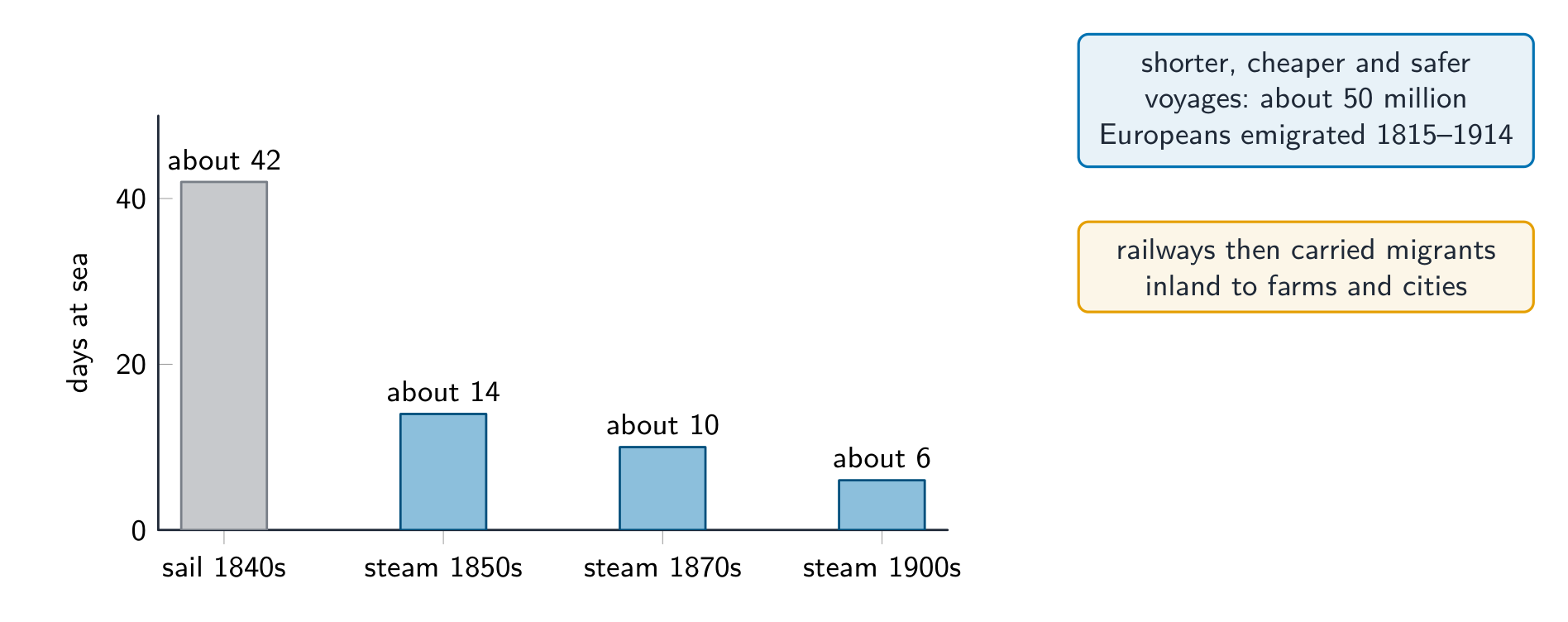
- Steamships cut the Atlantic crossing from about six weeks by sail to about ten days by the 1870s.
- Railways carried migrants inland to farms and cities.
Separate why people moved from what moved them
Demographic change gives the reason; steamships and railways give the possibility.
The crossing fell from about 42 days by sail to about 10 by steamship. How many days were saved?
Dificuldade 2/5 · Moedas 140 + pequeno bônus na primeira conclusão hoje
42 − 10.
Worked example: free choice and its opposite
- Free migrants: Irish and Italians paid their own way to the US and Argentina.
- Indentured labour: about 1.3 million Indians went as indentured labourers 契约劳工 to the Caribbean, Fiji, Mauritius and Natal, bound by five-year contracts.
- Coerced: some Chinese "coolie" labourers to Cuba and Peru were tricked or kidnapped; conditions there were close to slavery.
Match each migrant to the kind of migration.
Dificuldade 2/5 · Moedas 140 + pequeno bônus na primeira conclusão hoje
Free choice and its opposite.
Return was possible
- Faster, cheaper ships let many migrants return home; perhaps a third of Italians who went to the US returned.
- Migrants sent money home, called remittances.
Many migrants returned home thanks to faster ships.
Dificuldade 1/5 · Moedas 100 + pequeno bônus na primeira conclusão hoje
Perhaps a third of Italians.
Environmental and economic factors
- Famines, such as Ireland's, and droughts in China and India pushed people out.
- Industrial jobs and cheap land pulled them in.
Not all migration was free. Indentured and coerced labour moved millions on contracts they could not easily leave.
All 19th-century migration was free.
Dificuldade 1/5 · Moedas 100 + pequeno bônus na primeira conclusão hoje
Indenture and coercion.
In the 19th century, famine, poverty and population growth pushed people out of Europe and Asia, and jobs pulled them to the Americas and plantations. Steamships made migration and return easier, but many moved as indentured or coerced labourers rather than by free choice.
Explain why people migrated in the 19th century.
Causation.