Expected Counts in Two-Way Tables
IntroduzidoExpected counts in a table
- For a two-way table, each cell has its own expected count under the null of "no relationship."
- The formula:
-
$$\text{expected} = \frac{(\text{row total})(\text{column total})}{\text{grand total}}$$
- Compute it separately for every cell.
Why that formula?
- Under the null, the two variables are unrelated — the column split is the same in every row.
- So a cell's expected count = (that row's total) $\times$ (that column's overall fraction).
- That column fraction is $\dfrac{\text{column total}}{\text{grand total}}$.
- Multiply out and you get the row$\times$column$\div$grand-total formula.
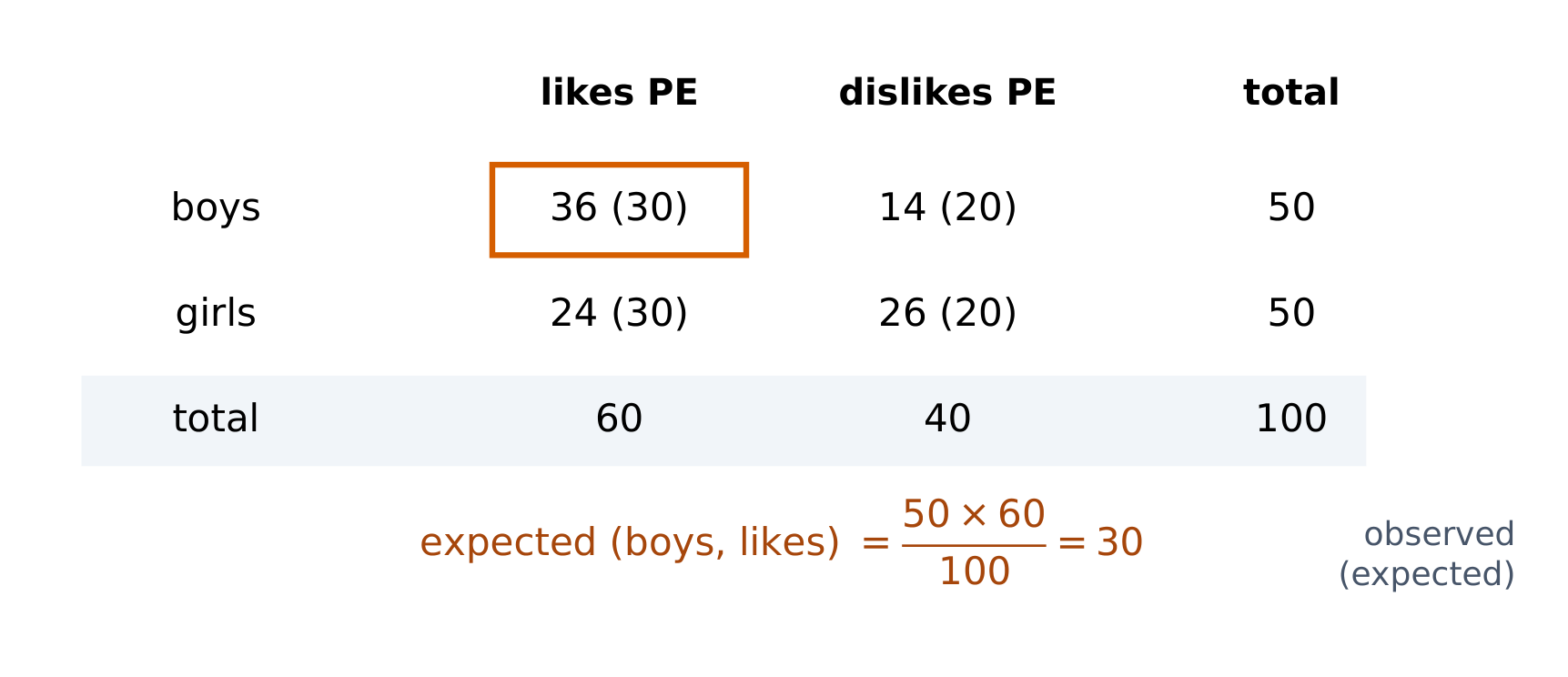
Expected count = row total × column total ÷ grand total
Check every cell
- The large counts condition applies to every cell's expected count $\ge 5$.
- Not the observed counts, and not just some cells — all of them.
- One expected count below 5 fails this approximation guideline; another method may be needed.
- Compute the full table of expected counts and scan it.
Degrees of freedom
- For a two-way table, $df = (\text{rows} - 1)(\text{columns} - 1)$.
- A $2 \times 3$ table → $df = (2-1)(3-1) = 2$.
- It counts the "free" cells once the margins are fixed.
- It depends on the table's shape, not the sample size.
Expected counts in a two-way table
Compute the count you would expect in a cell if the two variables were independent.
Two-way $df$ is $(\text{rows}-1)(\text{columns}-1)$, a product — not (cells $-1$). A $2\times2$ table has $df=1$, not $3$. And the expected-count formula uses row total $\times$ column total $\div$ grand total for each cell; mixing up which totals go on top is the usual error. Check every expected count $\ge 5$.
A $2\times2$ table: row totals $60, 40$; column totals $50, 50$; grand total $100$.
- Expected for the top-left cell: $\dfrac{60 \times 50}{100} = 30$.
- Repeat for all four cells: $30, 30, 20, 20$ — all $\ge 5$ ✓.
- $df$: $(2-1)(2-1) = 1$.
In a two-way table, each cell's expected count $= \frac{(\text{row total})(\text{column total})}{\text{grand total}}$ (from the null of no relationship). Check that every expected count is $\ge 5$. The degrees of freedom are $(\text{rows} - 1)(\text{columns} - 1)$.
Write from the data: find the expected count
- A row total is 40, a column total is 30, and the table total is 100.
- Find this cell’s expected count under the null model.
Under the null of independence, a cell has row total 40, column total 30 and grand total 100. What is its expected count?
Expected count is row total times column total divided by the table total.
Under the null of independence, a cell has row total 40, column total 30 and grand total 100. What is its expected count?
Dificuldade 1/5 · Moedas 100 + pequeno bônus na primeira conclusão hoje
1200 divided by 100 is 12.
Row total 60, column total 50, grand total 100. Find the expected count (row·col/grand).
Dificuldade 2/5 · Moedas 140 + pequeno bônus na primeira conclusão hoje
60 × 50 / 100 = 30.
For a 2×3 two-way table, what are the degrees of freedom (r−1)(c−1)?
Dificuldade 2/5 · Moedas 140 + pequeno bônus na primeira conclusão hoje
(2−1)(3−1) = 1×2 = 2.
For a 2×2 two-way table, what are the degrees of freedom?
Dificuldade 2/5 · Moedas 140 + pequeno bônus na primeira conclusão hoje
(2−1)(2−1) = 1.
The large counts condition for a two-way table requires...
Dificuldade 1/5 · Moedas 100 + pequeno bônus na primeira conclusão hoje
All expected cells must be at least 5.
The degrees of freedom for a two-way table are the number of cells minus 1.
Dificuldade 1/5 · Moedas 100 + pequeno bônus na primeira conclusão hoje
It's (rows−1)(columns−1), a product.