Homogeneity or Independence?
Introduzido| English | Significado |
|---|---|
| homogeneity/ˈhɒməʊdʒneɪti/ | homogeneidade |
| independence/ˌɪndɪˈpendəns/ | independência |
Homogeneity vs. independence
- Both use a two-way table and the same chi-square math — the design tells them apart.
- Homogeneity 齐性: several groups are sampled separately; do they have the same distribution of one variable?
- Independence 独立性: one sample, two variables recorded; are the two variables related?
- Same computation, different question and hypotheses.
Test of homogeneity
- Used when you take separate samples from different populations or groups.
- $H_0$: the distribution of the categorical variable is the same across all groups.
- $H_a$: the distributions differ for at least one group.
- Example: is the favorite-sport breakdown the same across three schools?
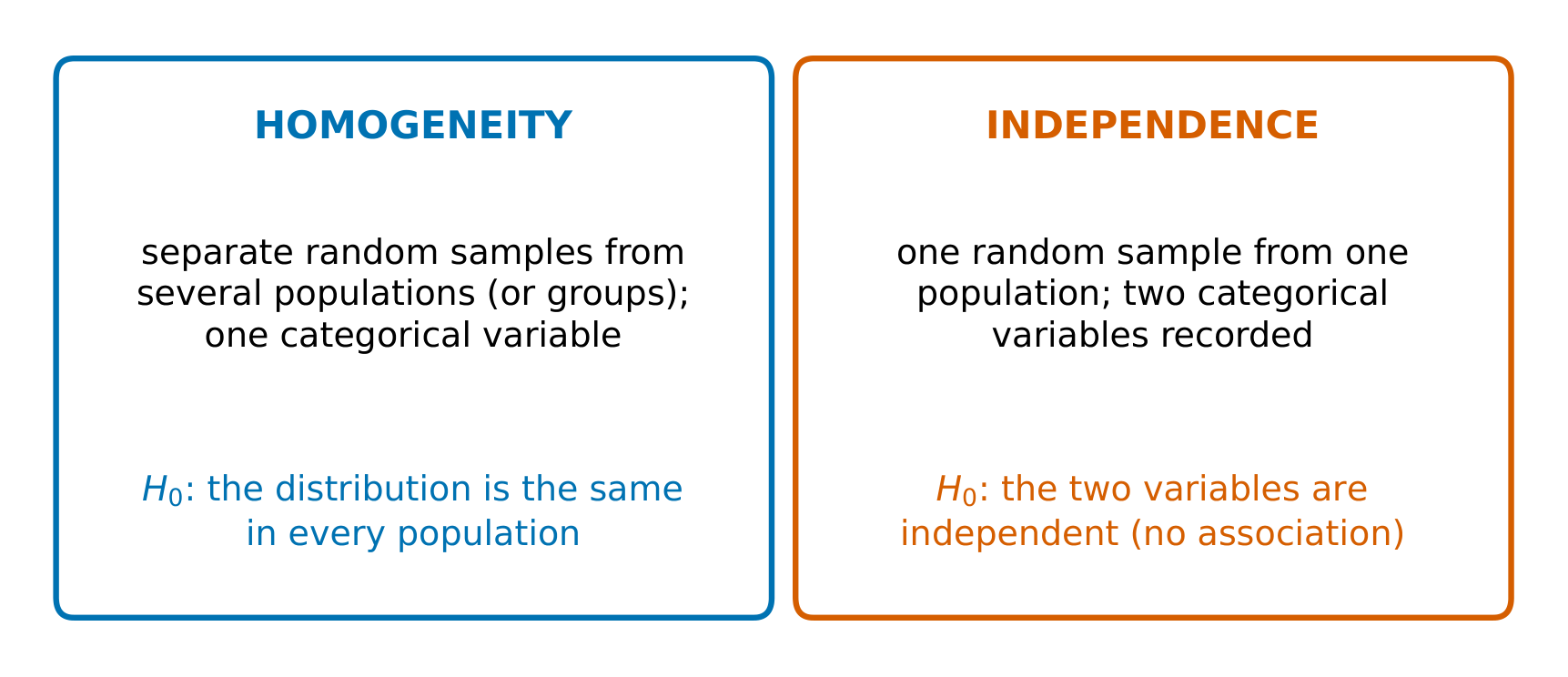
Homogeneity compares populations on one variable; independence asks about two variables in one sample
Test of independence
- Used when you take one sample and record two categorical variables.
- $H_0$: the two variables are independent (no association).
- $H_a$: the two variables are associated.
- Example: in one survey, are gender and handedness related?
Conditions and expected counts
- Same conditions for both: random, 10%, and every expected count $\ge 5$.
- Expected counts use the same $\frac{(\text{row})(\text{col})}{\text{grand total}}$ formula.
- Degrees of freedom: $(\text{rows}-1)(\text{columns}-1)$, as in 8.4.
- Only the wording of $H_0/H_a$ changes between the two tests.
Homogeneity vs. independence is decided by the DESIGN, not the math. Several separately-sampled groups compared on one variable → homogeneity. One sample classified by two variables → independence. The chi-square statistic, expected counts, and $df$ are identical — only the hypotheses and conclusion wording differ.
Two studies, same-looking $2\times3$ table:
- Sampled $100$ boys and $100$ girls separately, recorded favorite subject → homogeneity (same distribution across the two groups?).
- Surveyed $200$ people once, recording gender and subject → independence (are the two related?).
Chi-square tests of homogeneity and independence share the same math but differ by design: homogeneity compares one variable's distribution across several separate samples; independence checks whether two variables are related in one sample. Both check random, 10%, and every expected count $\ge 5$.
Write from this case
- One random sample of people is asked about two categorical variables.
- The question is whether the variables are associated.
One random sample of people records two categorical variables. To assess association between them, which chi-square test fits?
One sample measuring two categorical variables gives an independence question; two categories of a single variable do not.
Which chi-square test assesses association between two categorical variables recorded in one random sample?
Dificuldade 1/5 · Moedas 100 + pequeno bônus na primeira conclusão hoje
The design is one sample measuring two variables.
One group's category distribution
Homogeneity asks if this distribution is the same across groups.
You sample 100 boys and 100 girls SEPARATELY and compare favorite subject. This is a test of...
Dificuldade 1/5 · Moedas 100 + pequeno bônus na primeira conclusão hoje
Several separate samples compared on one variable → homogeneity.
You survey ONE sample of 200 people, recording gender AND handedness. This is a test of...
Dificuldade 1/5 · Moedas 100 + pequeno bônus na primeira conclusão hoje
One sample, two variables → independence.
Homogeneity and independence tests use the same chi-square statistic and expected-count formula.
Dificuldade 1/5 · Moedas 100 + pequeno bônus na primeira conclusão hoje
Only the hypotheses/design differ; the math is identical.
What decides whether a two-way chi-square test is homogeneity or independence?
Dificuldade 1/5 · Moedas 100 + pequeno bônus na primeira conclusão hoje
Design decides it — several samples vs. one sample.
A test of ___ checks whether two variables in one sample are related (one word).
Dificuldade 1/5 · Moedas 100 + pequeno bônus na primeira conclusão hoje
Independence: one sample, two variables.