Explaining and Classifying Disorders
Introduzido| English | Significado |
|---|---|
| deviation from the social norm/ˌdiːvɪˈeɪʃn frʌmðə ˈsəʊʃl nɔːm/ | behaviour that differs from what a society expects; not enough alone to define a disorder |
| distress/dɪˈstres/ | suffering or emotional pain experienced by a person |
| dysfunction/dɪsˈfʌŋkʃn/ | A breakdown that interferes with ordinary daily life. |
| biopsychosocial model/baɪˈɒsaɪkəʊsəʊʃl ˈmɒdl/ | Modelo biopsicossocial |
| diathesis-stress model/ˈdaɪəθəsɪs stres ˈmɒdl/ | Modelo diátese-estresse |
| eclectic approach/ɪˈklektɪk əˈprəʊtʃ/ | choosing treatments from several psychological perspectives to fit the person |
A "disease" invented to defend slavery, 1851
- In 1851 the Louisiana doctor Samuel Cartwright published a paper describing "drapetomania", a supposed mental illness that made enslaved people run away. Escaping slavery broke the social norms of the American South, so Cartwright labelled it a disorder. Today it is a standard example of how a diagnosis can serve power instead of describing illness.
- A useful definition of a psychological disorder needs more than deviation from the social norm 偏离社会规范.
Drapetomania shows how deviation from social norms alone can be misused as a definition of disorder.
Dificuldade 1/5 · Moedas 100 + pequeno bônus na primeira conclusão hoje
It labelled escape from slavery as illness.
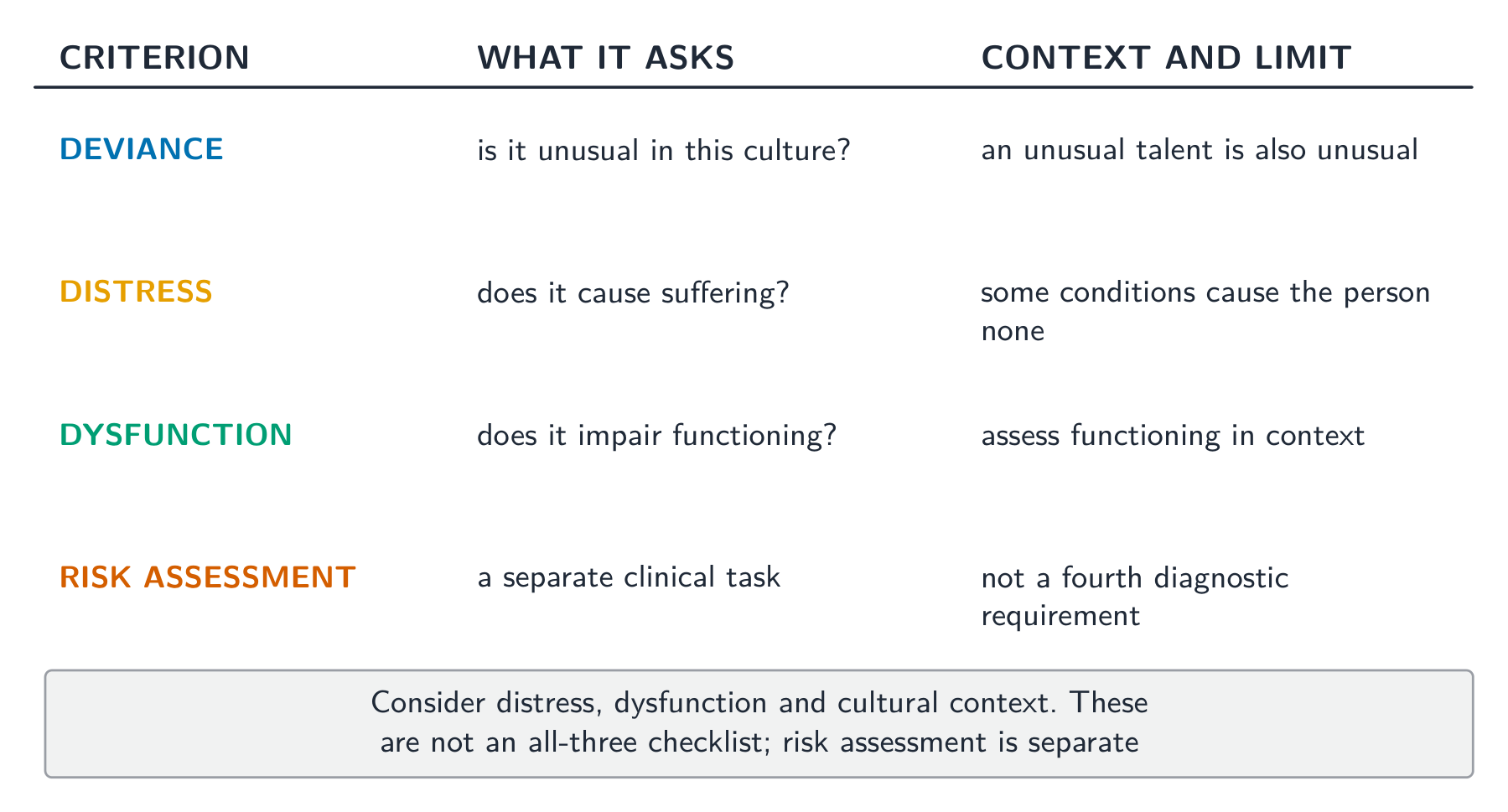
Three criteria together
- Distress 痛苦: the person suffers, for example with constant anxiety or sadness.
- Dysfunction 功能失调: the thoughts or behaviours interfere with daily life — work, school, relationships. Deviation from norms matters only alongside these, and norms differ across cultures.
Which perspective explains it this way?
Match each proposed cause to the perspective that offers it.
Match each criterion to its meaning.
Dificuldade 2/5 · Moedas 140 + pequeno bônus na primeira conclusão hoje
Judged together.
Classification systems
- The DSM-5-TR (American Psychiatric Association, 2022) lists disorders with criteria, such as how many symptoms and for how long. The World Health Organization's ICD-11 is used internationally.
- Shared criteria improve reliability — two clinicians are more likely to agree — but labels can bring stigma.
What does the DSM-5-TR provide?
Dificuldade 1/5 · Moedas 100 + pequeno bônus na primeira conclusão hoje
A classification manual.
Shared diagnostic criteria help different clinicians agree.
Dificuldade 1/5 · Moedas 100 + pequeno bônus na primeira conclusão hoje
Reliability.
Explaining disorders
- The biopsychosocial model 生物心理社会模型 combines biological factors (genes, brain chemistry), psychological factors (thinking styles, stress) and social factors (poverty, relationships).
- The diathesis-stress model 素质-压力模型: a vulnerability (diathesis) plus a stressor together trigger a disorder; either alone may not.
Match each model to its idea.
Dificuldade 2/5 · Moedas 140 + pequeno bônus na primeira conclusão hoje
Two explanatory models.
Worked example: apply the criteria
- A student is very anxious before every exam but sleeps, eats and performs normally: distress is mild and short, no dysfunction → not a disorder.
- A man washes his hands for four hours a day, cannot keep a job and feels tormented: distress and dysfunction → likely meets criteria (for example obsessive-compulsive disorder), confirmed by a clinician.
- A person dresses in an unusual style and is happy and successful: deviation only → not a disorder.
Which case most clearly meets the criteria for a disorder?
Dificuldade 1/5 · Moedas 100 + pequeno bônus na primeira conclusão hoje
Distress and dysfunction.
The eclectic approach
- Clinicians often use an eclectic approach 折中取向, choosing treatments from several perspectives — for example medication (biological) with cognitive-behavioural therapy (psychological) and family support (social).
- This fits the biopsychosocial view that disorders have several causes.
Which is an eclectic approach?
Dificuldade 1/5 · Moedas 100 + pequeno bônus na primeira conclusão hoje
Several perspectives.
Being unusual is not the same as having a disorder. Diagnosis needs significant distress or dysfunction, judged in cultural context — as drapetomania shows, norms alone can be misused.
A disorder is judged by distress and dysfunction, with deviation from norms considered only in cultural context. DSM-5-TR and ICD-11 classify disorders; the biopsychosocial and diathesis-stress models explain them; an eclectic approach treats them.
Use the diathesis-stress model to explain why two siblings who lose their jobs respond differently.
Applying the model.