Changes in Policies and Economic Conditions
Introduzido| English | Significado |
|---|---|
| interest rates/ˈɪntrest reɪts/ | taxas de juros |
| inflation/ɪnˈfleɪʃn/ | inflação |
| income/ˈɪŋkʌm/ | renda |
| monetary policy/ˈmʌnɪtəri ˈpɒlɪsi/ | política monetária |
| Fiscal policy/ˈfɪskl ˈpɒlɪsi/ | política fiscal |
What moves the exchange rate
- Several forces shift currency demand and supply, moving the exchange rate.
- The big three: interest rates, inflation, and income.
- Government policy works through these same channels.
- Learn the three and you can predict almost any exchange-rate move.
If a country raises its interest rates (others steady), its currency tends to:
Dificuldade 1/5 · Moedas 100 + pequeno bônus na primeira conclusão hoje
Higher bond returns attract foreign money, raising currency demand.
Higher domestic inflation than the rest of the world tends to make a currency:
Dificuldade 1/5 · Moedas 100 + pequeno bônus na primeira conclusão hoje
Dearer goods lose foreign buyers, so demand for the currency falls.
Interest rates and inflation
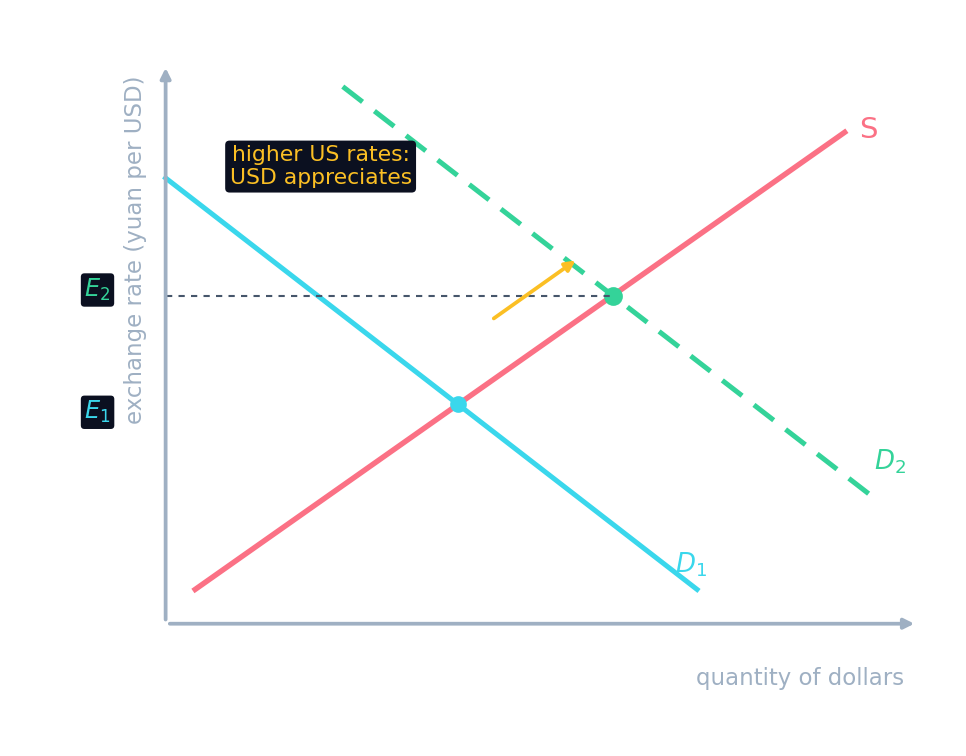
- A change in interest rates 利率: raise them, and foreign investors want your bonds — they demand your currency, so it appreciates.
- A difference in inflation 通货膨胀: higher inflation at home makes your goods dearer, so foreigners buy fewer — demand falls and the currency depreciates.
- So high rates strengthen a currency; high inflation weakens it.
Does it appreciate or depreciate the dollar?
Higher domestic interest rates appreciate a currency; higher inflation or higher income (more imports) depreciate it.
When a country's income booms and imports surge, its currency tends to depreciate because residents:
Dificuldade 1/5 · Moedas 100 + pequeno bônus na primeira conclusão hoje
Buying imports means offering your currency — supply rises, the rate falls.
Income
- A change in income 收入: when a country's income grows, its residents buy more imports.
- To buy imports they supply more of their own currency, which tends to depreciate it.
- A booming economy can therefore weaken its own currency through extra imports.
- Notice this one works through the supply side, not demand.
Contractionary monetary policy, by raising interest rates, tends to weaken a currency.
Dificuldade 1/5 · Moedas 100 + pequeno bônus na primeira conclusão hoje
False. Higher interest rates attract foreign financial capital, which must buy the currency, so it tends to appreciate.
Which changes would appreciate a currency? (Select all that apply)
Dificuldade 2/5 · Moedas 140 + pequeno bônus na primeira conclusão hoje
Higher rates and bond demand raise currency demand; inflation and imports weaken it.
The US raises rates while others hold steady. The demand for dollars shifts:
Dificuldade 1/5 · Moedas 100 + pequeno bônus na primeira conclusão hoje
Investors buy dollars to hold higher-paying US bonds — demand right, dollar up.
Policy works the same way
- Contractionary monetary policy 货币政策 raises interest rates and tends to strengthen the currency.
- Fiscal policy 财政政策 that raises interest rates (through government borrowing) can do the same.
- Worked idea. The US central bank raises rates while others hold steady. Global investors move money into higher-paying US bonds, buying dollars first. Demand for dollars shifts right and the dollar appreciates.
- Higher interest rates draw in foreign money and lift the currency.
Worked example: two policies, one currency
The UK has high inflation. The Bank of England raises its interest rate while other countries keep theirs unchanged. Predict the effect on the pound through each channel.
- Interest rates: higher UK rates attract foreign savers to UK bonds. They must buy pounds, so the demand for pounds rises and the pound appreciates.
- Inflation: if the rate rise brings UK inflation down relative to other countries, UK goods become relatively cheaper over time, which also supports demand for pounds. Both channels push the pound up.
US incomes rise quickly while Europe's stay flat. What tends to happen to the dollar against the euro?
Dificuldade 1/5 · Moedas 100 + pequeno bônus na primeira conclusão hoje
Higher income raises imports, increasing the supply of dollars.
Higher inflation in a country, relative to its trading partners, tends to make its currency depreciate.
Dificuldade 1/5 · Moedas 100 + pequeno bônus na primeira conclusão hoje
Its goods become dearer, so foreigners demand less of its currency.
The exchange rate shifts with interest rates (higher → appreciate), inflation (higher → depreciate), and income (higher → more imports → depreciate). Policy works through these: contractionary monetary policy raises rates and strengthens the currency, as foreign investors buy it to hold higher-paying bonds.
Write from domestic inflation of 9 percent
- Domestic inflation is 9 percent. Inflation in the rest of the world is 2 percent.
- Say what happens to the currency.
Domestic inflation is 9 percent while inflation in the rest of the world is 2 percent. What tends to happen to the domestic currency, and why?
Buyers switch away from the country with the faster price rise.
What does inflation of 9 percent tend to do to the currency?
Dificuldade 1/5 · Moedas 100 + pequeno bônus na primeira conclusão hoje
Dearer exports lose foreign buyers, so demand for the currency falls. Other options — Appreciate it (because higher prices mean a stronger economy); Fix it (because world inflation is 2 percent).