Fiscal and Monetary Policy Actions in the Short Run
Introduzido| English | Significado |
|---|---|
| Monetary policy/ˈmʌnɪtəri ˈpɒlɪsi/ | Política Monetária |
| business cycle/ˈbɪznəs ˈsaɪkl/ | ciclo econômico |
| money market/ˈmʌni ˈmɑːkɪt/ | mercado monetário |
| investment/ɪnˈvestmənt/ | investimento |
| Stabilization policy/ˌsteɪbɪlaɪˈzeɪʃn ˈpɒlɪsi/ | Política Estabilizadora |
| Full employment/fʊl emˈplɔɪmənt/ | Emprego Pleno |
| potential GDP/pəˈtenʃl ˌdʒiː diː ˈpiː/ | PIB potencial |
| Price stability/praɪs stəˈbɪlɪti/ | Estabilidade de Preços |
Two hands on the same wheel
- The government steers aggregate demand with fiscal policy — spending and taxes.
- The central bank steers it with monetary policy — the money supply and interest rates.
- Both can push AD the same way, at the same time.
- Together they aim to smooth the business cycle.
The monetary chain
- Monetary policy 货币政策 works through the money market 货币市场: buying bonds raises the money supply and lowers the interest rate.
- A lower interest rate makes borrowing cheaper, so investment 投资 rises, lifting $C + I$.
- So AD shifts right — the same direction as expansionary fiscal policy.
- The chain: money supply ↑ → interest rate ↓ → investment ↑ → AD →.
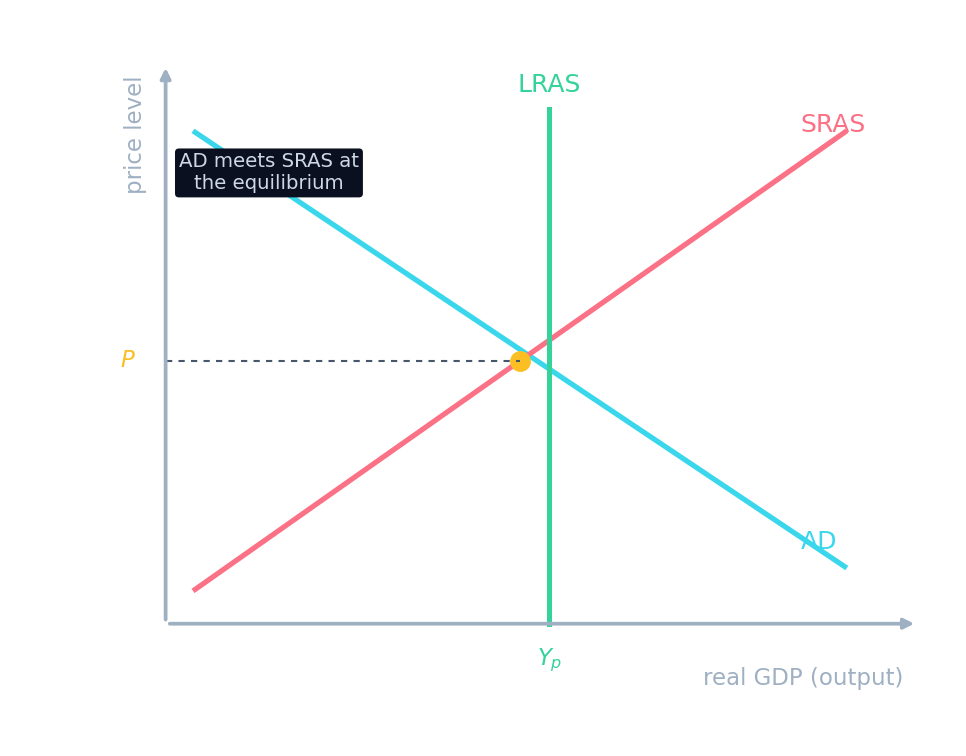
The AD-AS model
Both fiscal and monetary policy shift AD. Combine expansionary versions and the rightward shifts add up, closing a recessionary gap faster.
Put the expansionary monetary chain in order.
Dificuldade 3/5 · Moedas 200 + pequeno bônus na primeira conclusão hoje
More money lowers the rate, which lifts investment and shifts AD right.
Expansionary monetary policy shifts AD in the same direction as:
Dificuldade 1/5 · Moedas 100 + pequeno bônus na primeira conclusão hoje
Both cut interest rates or taxes to raise spending, shifting AD right.
When the central bank buys bonds, the interest rate:
Dificuldade 1/5 · Moedas 100 + pequeno bônus na primeira conclusão hoje
Buying bonds raises the money supply, lowering the equilibrium interest rate.
Two goals of stabilization
- Stabilization policy 稳定政策 smooths the business cycle 经济周期, aiming for two things.
- Full employment 充分就业: pull real output back to potential GDP 潜在GDP, so unemployment returns to its natural rate.
- Price stability 价格稳定: keep inflation low and steady.
Select ambos goals of stabilization policy.
Dificuldade 2/5 · Moedas 140 + pequeno bônus na primeira conclusão hoje
Stabilization aims for full employment and price stability.
Stabilization policy tries to pull real output back to ______ GDP.
Dificuldade 1/5 · Moedas 100 + pequeno bônus na primeira conclusão hoje
At potential GDP, unemployment is at its natural rate.
Combining the tools
- Fiscal and monetary policy can be combined for a stronger effect.
- Worked idea. An economy is in a recessionary gap: output is 1,000b, potential is 1,080b.
- The central bank buys bonds (rate 5% → 3%, lifting investment) and the government cuts taxes (lifting consumption).
- Both shifts push AD right, so the joint policy closes the gap faster than either tool alone.
To fight a deep recession, a tax cut and lower interest rates together shift AD further right than either alone.
Dificuldade 1/5 · Moedas 100 + pequeno bônus na primeira conclusão hoje
Both are expansionary, so their rightward shifts add up.
Worked example: a policy mix for inflation
An economy has an inflationary gap: output 1,150b, potential 1,100b. Name one fiscal and one monetary policy to close it, and trace each to AD.
- Fiscal: raise taxes or cut government spending. Lower $C$ or $G$ shifts AD left.
- Monetary: the central bank sells bonds; the money supply falls, the interest rate rises, investment falls, and AD shifts left. Both move output down toward 1,100b and ease the price level, meeting the price stability goal.
Which pair of policies both fight a recession?
Dificuldade 1/5 · Moedas 100 + pequeno bônus na primeira conclusão hoje
Both shift AD right.
Expansionary policy in an inflationary gap would move the economy further from price stability.
Dificuldade 1/5 · Moedas 100 + pequeno bônus na primeira conclusão hoje
It pushes AD right when output is already above potential, adding to inflation.
Fiscal and monetary policy both shift AD, and can be combined. The monetary chain is money supply ↑ → interest rate ↓ → investment ↑ → AD →. Stabilization policy targets full employment and price stability by pulling output back to potential.
Write from a combined shift further right
- A tax cut and a cut in the interest rate are used together in a deep recession.
- Compare the AD shift with either policy alone.
In a deep recession the government cuts taxes and the central bank cuts the interest rate. How does the shift in aggregate demand compare with using only one of those policies?
Two rightward shifts add to a larger rise in spending.
What does using both policies do to AD?
Dificuldade 1/5 · Moedas 100 + pequeno bônus na primeira conclusão hoje
Both tools raise spending, so their shifts add.